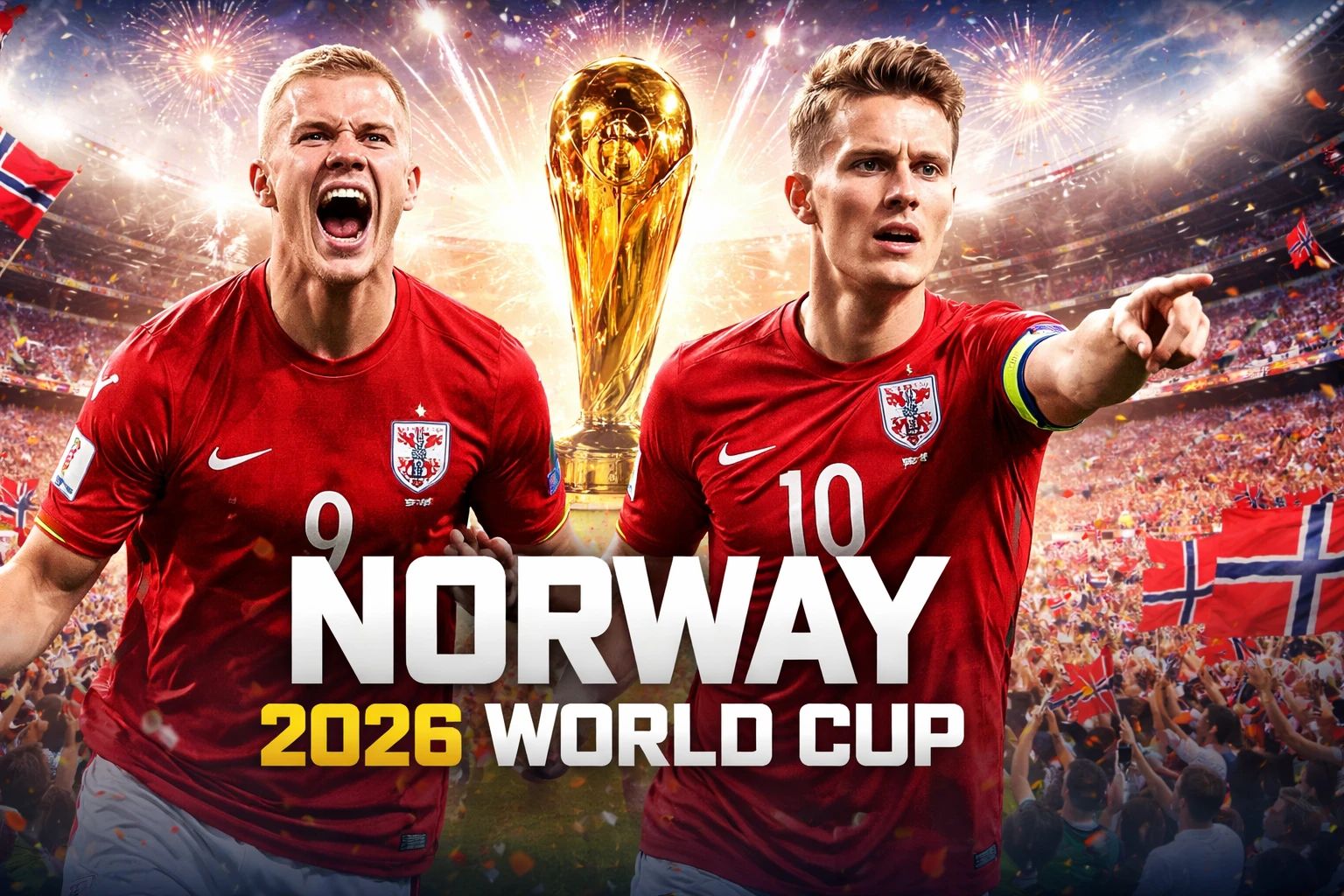

Norway 2026 World Cup qualification ends a 28-year absence from international football’s biggest stage — and the Scandinavians did not just scrape through. They won every single qualifying game. They scored 37 goals. They beat Italy 4-1 at San Siro on the final matchday. And they did all of it behind a striker who scored 16 goals in eight qualifying games.
This is not a nostalgic return. This is a genuine dark horse.
TL;DR
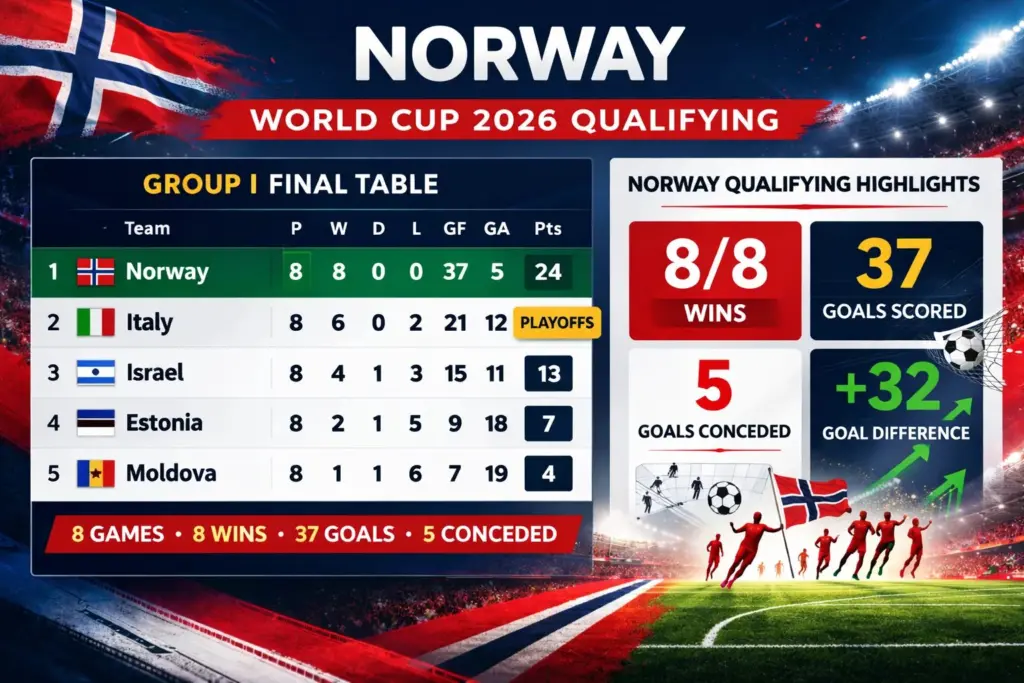
- Norway qualified for their first World Cup since 1998 with a perfect record — 8 wins from 8, 37 goals scored, 5 conceded.
- Erling Haaland scored 16 goals in 8 qualifying games, matching the European record set by Lewandowski in 2018.
- Martin Ødegaard captains the team and provided 7 assists in qualifying — more than any other European player.
- Norway are in Group I alongside France, Senegal, and the Intercontinental Playoff Path 2 winner (Iraq, Bolivia or Suriname).
- Their group games are played at Gillette Stadium (Foxborough, Massachusetts) and MetLife Stadium (East Rutherford, New Jersey) — June 16, 22 and 26.
- Norway were placed in Pot 3 for the draw despite their perfect qualifying record, due to their FIFA ranking of 29th as of November 2025.
- Best realistic finish: Round of 16 or quarterfinal. Best historical finish: Round of 16 (1998).
SNIPPET BLOCK
Norway qualified for the 2026 World Cup with a perfect 8-win qualifying record, their first appearance since France 1998. Led by Erling Haaland — who scored 16 goals in 8 qualifying games — and captain Martin Ødegaard, they are drawn in Group I alongside France and Senegal. Their group games are on June 16, 22 and 26 at Gillette Stadium in Foxborough, Massachusetts and MetLife Stadium in East Rutherford, New Jersey.
Norway 2026 World Cup A 28-Year Wait — What It Means
Norway’s last World Cup was France 1998. They beat Brazil 2-1 in the group stage — one of the tournament’s great upsets — and reached the Round of 16 before losing to Italy. They went home as heroes.
Then 28 years of nothing. Failed to qualify in 2002, 2006, 2010, 2014, 2018 and 2022 — six consecutive editions. A generation of Norwegian footballers who never experienced the tournament. A fanbase that watched every World Cup from the outside.
Norway hadn’t played a World Cup since France 1998 — a tournament that took place before Haaland was even born. That team shocked the world by eliminating Brazil in the group stage and reaching the Round of 16.
Now the wait is over. And this Norwegian generation is arguably better equipped than any since 1998.
How Norway Qualified: Eight From Eight
The numbers from qualifying are extraordinary.
Norway made qualifying look easy, scoring 37 goals and conceding just five times across their eight games, with two sensational wins over Italy the standout — especially their 4-1 victory away at San Siro on the final matchday. Norway finished UEFA World Cup qualifying with a perfect record of 8 wins, 0 draws, 0 losses. They outscored the group by such a margin that automatic qualification was never seriously in doubt after the opening fixtures.
The group contained Italy, Israel, Estonia and Moldova. Italy were the test. Norway passed it twice.
Key qualifying results:
- Norway 5–0 Moldova (Haaland scored five)
- Norway 3–0 Israel (Haaland hat-trick)
- Italy 0–3 Norway (away, October 2025)
- Italy 1–4 Norway (San Siro, November 16, 2025 — clinching match)
Norway won all eight of their games. In the final group game, they fought back from 1-0 down in Milan to win 4-1, as Haaland scored two late goals to secure a perfect qualifying campaign.
Erling Haaland: The Record-Breaking Qualifier
Haaland at a World Cup is one of the most anticipated storylines of 2026. And he arrives with something to prove.
Haaland scored 16 goals in Norway’s eight qualifying games, finishing eight clear of his nearest challengers in the European top-scorer charts. His tally included five goals in an 11-1 win against Moldova, a hat-trick versus Israel, and a remarkable record of at least one goal in each of Norway’s eight matches.
His tally matched the record for goals scored by a European player in a single World Cup qualifying campaign — set by Poland’s Robert Lewandowski over ten games for the 2018 edition. Haaland equalled it in two fewer games.
The numbers at international level are just as striking as his club record. Haaland is Norway’s all-time top goalscorer at just 25, finding the net 55 times in 48 caps and averaging 1.15 goals per game for his nation.
This will be his first major international tournament. He has won the Champions League, the Premier League — but he has never played at a World Cup or European Championship. Norway’s qualification drought denied him that experience. Now, in the summer of 2026, that changes.
At the heart of Norway’s ambitions, Haaland will arrive at the 2026 World Cup not only as Norway’s most clinical finisher but on a mission to complete his family’s unfinished business. His father, Alf-Inge, played in the 1994 World Cup in the United States — a feat the younger Haaland has long sought as the final frontier of his career.
The United States hosted the 1994 World Cup. The United States co-hosts the 2026 World Cup. Haaland will play where his father played, three decades later.
Landon Donovan, watching the World Cup draw for Fox Sports, summed up the defensive problem facing any team with Haaland in it: “If you have to play against a player like that, it is a nightmare. You get isolated in a 1-v-1, it’s a disaster.”
Martin Ødegaard: The Brain Behind the Goals
Haaland takes the headlines. Ødegaard makes the system work.
The Arsenal captain provided seven assists in qualifying — more than any other player across all of European qualifying. Four of those went directly to Haaland.
Ødegaard acts as the team’s tactical “quarterback” — the primary trigger for Norway’s high-pressing approach from the front and the player whose ability to thread passes through compact defensive blocks unlocks the space Haaland needs.
Injuries have at times limited Ødegaard from reaching his full potential, but he remains one of the world’s best creators. Against the world’s best, Haaland will definitely rely on Ødegaard’s ability to control the midfield and steadily supply him with chances.
The Haaland–Ødegaard partnership is the beating heart of this team. When both are at full fitness, Norway are capable of dismantling almost any opponent.
The Supporting Cast: Norway’s Golden Generation
Cobi Jones described Norway’s wider squad: “Antonio Nusa and Oscar Bobb, the wingers that Norway has, they’re electric 1-v-1 in dribbling and taking you on. Martin Ødegaard and his fantastic left foot. They’re good all the way around.”
Alexander Sørloth is the squad depth story that goes largely untold. Sørloth is a dual threat who can either partner Haaland in a devastating twin-tower formation or act as a lone focal point. The 1.95m Atletico Madrid striker will be arguably the most devastating backup striker in the tournament. Sørloth has scored 26 goals for Norway across 68 appearances and has been a focal point for Atletico Madrid’s attack. In most international squads, he would be a starter. In Norway, he is the backup.
Sander Berge provides the defensive midfield engine — physical, intelligent, and capable of breaking up opposition attacks before they reach Norway’s defensive line. Julian Ryerson provides energy at right back and contributed four assists in qualifying. Antonio Nusa and Oscar Bobb offer explosive wide options capable of beating defenders one-on-one.
The collective identity of the squad is a deliberate construction by manager Ståle Solbakken. “The fact that players like Ødegaard, Haaland, Berge, and Sørloth have all carried major responsibility and leadership roles at their clubs has certainly benefited us,” Solbakken says. “Haaland is a goal machine,” Solbakken added after the Italy win. “I’m happy that Italian fans applauded him too. This is an audience who saw great players playing here over the years and I’m happy that they appreciated Haaland’s performance too.”
Former Spurs and Norway goalkeeper Erik Thorstvedt offered this insight: “Solbakken has built a tremendous culture within the team. All the media wants to speak to Haaland, and the team’s security setup is basically built around keeping people away from him. But it helps that he’s so down-to-earth and so well-liked in the group for who he is.”
How Norway Play: Solbakken’s System
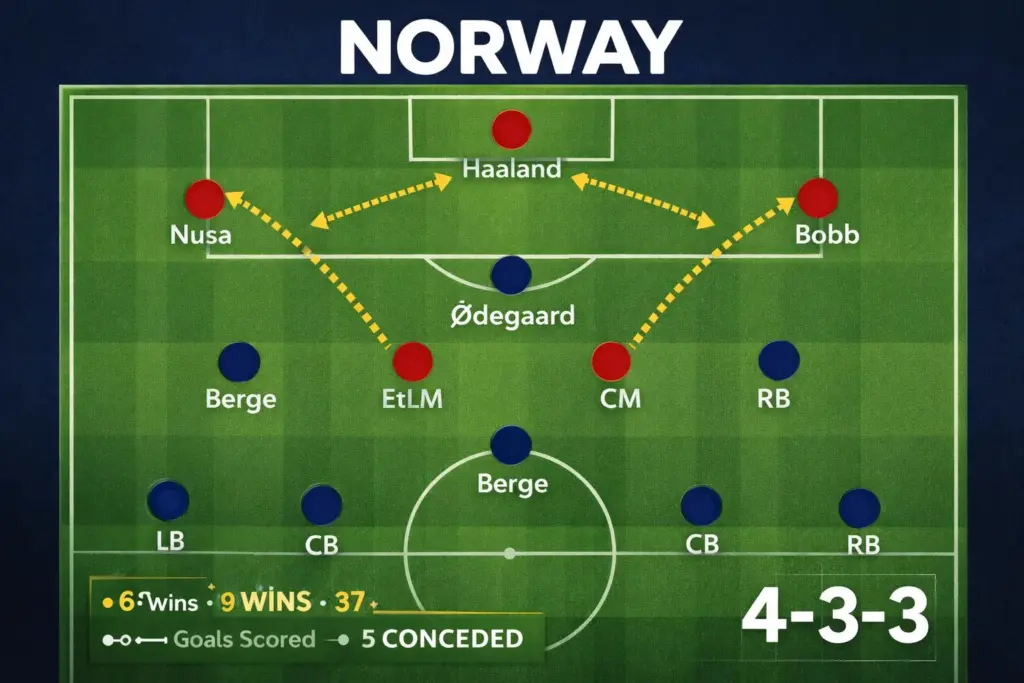
Solbakken’s Norway are not just attacking more — they’re attacking smarter. The evolution from being reactive to dominating possession has defined this side. His fingerprints are visible everywhere: a compact 4-3-3 or 4-2-3-1 formation that often turns into a pressing diamond, through ball circulation aimed at inviting the opposition press before exploding into a counter attack, and a collective insistence on bravery when on the ball.
Solbakken’s primary formation is a compact 4-3-3 that can fluidly shift to a 4-2-3-1 or a pressing diamond depending on the opponent’s shape.
The tactical identity in plain terms:
When Norway have the ball: They circulate patiently through midfield, using Ødegaard as the pivot. The wide players — Nusa and Bobb — stretch the defence. The moment space opens centrally, the ball goes to Haaland. His combination of aerial dominance, back-to-goal hold-up play, and devastating runs in behind means defenders face impossible choices: step tight and get turned, stay deep and allow him to receive and turn.
When Norway do not have the ball: The press is immediate and coordinated. Solbakken’s zonal defensive organisation gives Norway an edge at a time when many teams prefer man-to-man systems. The press is triggered high up the pitch, led by Haaland and Ødegaard from the front — a combination few teams have at the international level.
Group I: Norway’s Path at the Tournament
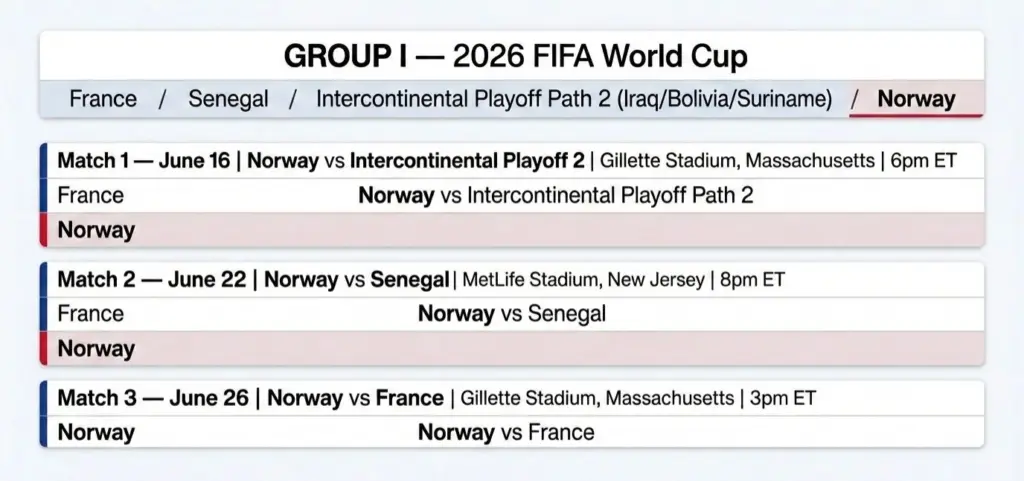
Group I of the 2026 FIFA World Cup will take place from June 16 to 26, 2026, and consists of France, Senegal, the Intercontinental Playoff Path 2 winner, and Norway.
Norway were placed in Pot 3 for the draw — a situation that caused widespread surprise given their perfect qualifying record. According to the final draw pots confirmed by FIFA in November 2025, Pot 3 included Norway alongside Panama, Egypt, Algeria, Scotland, Paraguay, Tunisia, Ivory Coast, Uzbekistan, Qatar, Saudi Arabia, and South Africa. The pots were determined using the FIFA/Coca-Cola Men’s World Ranking of November 19, 2025, where Norway sat at 29th.
“They’re way better than a Pot 3 team,” said Landon Donovan. “They’re not a Pot 1 team, but they’re a top Pot 2. It’s just recent that this form has come, so it hasn’t caught up yet, but they are good.”
The consequence of being underseeded: Norway landed in a group widely regarded as the tournament’s toughest. France — the 2018 champions and 2022 runners-up — are the group favourites. Senegal are a formidable African side. It is a Group of Death, and Norway are in it.
Norway’s Group I Schedule:
- June 16: Norway vs. Intercontinental Playoff Path 2 winner (Iraq/Bolivia/Suriname) — Gillette Stadium, Foxborough, Massachusetts, 6 p.m. ET
- June 22: Norway vs. Senegal — MetLife Stadium, East Rutherford, New Jersey, 8 p.m. ET
- June 26: Norway vs. France — Gillette Stadium, Foxborough, Massachusetts, 3 p.m. ET
Note: Gillette Stadium will be referred to as “Boston Stadium” during the World Cup due to FIFA sponsorship regulations, though the venue is located in Foxborough, approximately 30 miles south of Boston.
Game 1 — vs Intercontinental Playoff Path 2 Winner: Norway’s most winnable game and the one they must take three points from. Whichever team emerges from the Iraq-Bolivia-Suriname playoff will face an immediate Haaland problem. Norway should be expected to win this comfortably.
Game 2 — vs Senegal: The pivotal group fixture. Senegal have quality across the pitch — Sadio Mané in his 2026 context, a strong defensive unit, physical intensity and tactical discipline. This game will determine whether Norway advance as group winners or fight for second place. Senegal famously beat France 1-0 at the 2002 World Cup, showing what African sides can do in the tournament. Norway cannot take them lightly.
Game 3 — vs France: The group finale. By the time this kicks off, both teams will know what they need. Norway coach Solbakken told reporters after the draw: “France is the strong favourite, but I hope Erling stays in this form. Mbappé is at his best, so we hope he will slow down a little.” The Haaland–Mbappé showdown on June 26 is already one of the most anticipated individual matchups of the entire tournament.
Norway’s Strengths and Weaknesses
✅ Strengths
- A generational striker at peak age. Haaland turns 26 during the tournament. This is the prime of a striker who scores at 1.15 goals per game internationally. Opposing teams will double and triple-mark him — which means Ødegaard and the wide players get space.
- Depth at striker. Sørloth at Atletico Madrid is a world-class striker who cannot get in the team. That is not a problem — it is extraordinary squad depth at the position that matters most.
- Tactical cohesion built over years. Solbakken’s long insistence on structure and style has finally paid off after years of skepticism. Norway now look both meticulously coached and emotionally connected.
- Set-piece threat. With Haaland and Sørloth in the box, Norway are a serious aerial threat at every dead-ball situation. They won corners and free-kicks regularly in qualifying and converted them at a high rate.
❌ Weaknesses
- Defensive depth. The one area of weakness that could stop Norway reaching the latter stages is the lack of squad depth in defence. If centre-back Kristoffer Ajer or one of the full-backs picks up an injury, the options behind them are limited. Against a team like France — with Mbappé’s pace and Dembélé’s directness — defensive fragility could be exposed quickly.
- No major tournament experience. For many of their stars this will be their first taste of a major tournament, having not qualified for any since the Euros in 2000. Managing knockout-round pressure is a different environment from qualifying. No one in this squad has ever experienced a World Cup elimination game.
- Ødegaard fitness. Injuries have periodically held Ødegaard back from reaching his full potential. The system is built around him. An Ødegaard injury at any point in the tournament would significantly reduce Norway’s creative output.
Norway’s World Cup History
This is only Norway’s fourth World Cup appearance in their entire history — which makes each one significant.
- 1938 — France: First ever World Cup. Eliminated in the Round of 16 by Italy, 2-1 after extra time.
- 1994 — USA: Group stage exit. Drew with Mexico (1-1), lost to Italy (1-0), and drew with Ireland (0-0). Alf-Inge Haaland played in this tournament.
- 1998 — France: The great campaign. Drew with Morocco (2-2), drew with Scotland (1-1), beat Brazil 2-1 in the group stage. Reached the Round of 16 before losing 1-0 to Italy. The high-water mark of Norwegian football — until now, potentially.
- 2026 — USA/Canada/Mexico: The return, 28 years later, with Erling Haaland.
Norway have never won the World Cup. Their best finish is the Round of 16, which they achieved at the 1998 edition.
How Far Can Norway Go?
This is the question that matters. Here is an honest, scenario-based assessment.
- Scenario 1 — Group stage exit (10% probability): Norway fail to get results against Senegal and France. They may qualify as one of the eight best third-placed teams, but an outright group-stage exit would require a complete collapse. Possible only with injuries to Haaland and Ødegaard simultaneously.
- Scenario 2 — Round of 32 exit (25% probability): Norway advance from the group but face a strong Pot 1 or Pot 2 team in the Round of 32. Without tournament experience in high-pressure knockout games, an early exit is a realistic outcome.
- Scenario 3 — Quarterfinal run (45% probability): The most likely outcome for a team of this quality. Norway beat their opener comfortably, take points off Senegal, and manage the France game enough to advance — then make a competitive run into the quarterfinals before facing a traditional powerhouse.
- Scenario 4 — Semifinal or beyond (20% probability): If Haaland has the tournament of his career — as he is capable of doing — and Ødegaard stays fit, Norway have the individual and collective quality to reach the semifinals. One game can change everything at a tournament. Norway have the player — Haaland — who can produce that moment.
Many people assume dark horses always fall short. Sometimes they do not. In 1998, the dark horse beat Brazil.
FAQs: Norway at the 2026 World Cup
When did Norway last play at a World Cup?
France 1998 — 28 years ago. They beat Brazil 2-1 in the group stage and reached the Round of 16.
How did Norway qualify for 2026?
With a flawless qualifying campaign: 8 wins from 8 matches, 37 goals scored, and Haaland finishing with 16 goals.
How many goals did Haaland score in qualifying?
16 goals in 8 games — one goal in every match. He equalled the European record set by Robert Lewandowski (Poland) in 2018 qualifying, but in two fewer matches.
Who is Norway’s manager?
Ståle Solbakken, who has been in charge since 2020. He played for Norway in the 1998 World Cup as a midfielder and is now the architect of this generation’s success.
What group are Norway in?
Group I, alongside France, Senegal, and the Intercontinental Playoff Path 2 winner (one of Iraq, Bolivia or Suriname).
When do Norway play their group games?
June 16 vs Intercontinental Playoff Path 2 winner (Gillette Stadium, Foxborough, MA), June 22 vs Senegal (MetLife Stadium, East Rutherford, NJ), June 26 vs France (Gillette Stadium, Foxborough, MA).
Is Haaland Norway’s all-time top scorer?
Yes. Haaland is Norway’s all-time top goalscorer at just 25, with 55 goals in 48 caps — averaging 1.15 goals per game.
Why were Norway in Pot 3 despite winning all their games?
FIFA rankings are based on long-term performance across multiple years, not a single qualifying campaign. The draw pots were determined using the FIFA/Coca-Cola Men’s World Ranking of November 19, 2025, where Norway was ranked 29th. This placed them in Pot 3 alongside teams like Panama, Egypt, and Scotland.
Has Haaland played at a major tournament before?
No. For Haaland and many of Norway’s stars, this will be their first major tournament — Norway have not qualified for any since Euro 2000.
What is Norway’s best realistic finish?
Based on squad quality, tactical development and the draw, a quarterfinal run is the most likely strong outcome — with a semi-final or beyond possible if Haaland produces the tournament of his career.
Key Takeaway
Norway are not here to make up the numbers. They arrive with the most prolific striker on the planet, a world-class creative midfielder, a tactically coherent system and depth at every position. Their group is brutal — France and Senegal are serious obstacles. But this team beat Italy twice in qualifying. They conceded five goals in eight games. They have never experienced the World Cup before as a unit, which is both a risk and a source of raw energy.
The 1998 Norway side arrived with similar underdog energy and beat Brazil. This 2026 Norway side has significantly more individual quality than that team. Where the ceiling is — nobody knows yet.
→ Related reading: Italy’s World Cup 2026 Qualification Crisis Explained | All 48 Teams at GOALCUP 2026 | GOALCUP 2026 Groups A–L | Top Players to Watch at GOALCUP 2026 | GOALCUP 2026 Format & Rules Explained