


Scotland are going to the World Cup. After 28 years away from international football’s biggest stage, Steve Clarke’s side are back — and they earned it in the most dramatic fashion possible, with two stoppage-time goals against Denmark on the final night of qualifying. Now they face Brazil, Morocco and Haiti in Group C. Here is everything the Tartan Army needs to know.
TL;DR
- Scotland qualified directly for the 2026 World Cup, winning UEFA Group C ahead of Denmark, Greece and Belarus.
- They sealed qualification with a 4-2 win over Denmark on the final matchday, scoring twice in stoppage time.
- It is Scotland’s first World Cup since France 1998 — a 28-year absence.
- They are in World Cup Group C alongside Brazil, Morocco and Haiti.
- Their group games: June 13 vs Haiti (Boston), June 19 vs Morocco (Boston), June 24 vs Brazil (Miami).
- Scotland were placed in Pot 3 and face a genuinely tough group — Brazil are five-time world champions, Morocco reached the 2022 semis.
- Manager: Steve Clarke, who has overseen Scotland’s most successful international era in a generation.
SNIPPET BLOCK
Scotland qualified for the 2026 World Cup by winning UEFA Group C, their first tournament since France 1998. They beat Denmark 4-2 in the final qualifier with two stoppage-time goals to seal automatic qualification. Scotland are drawn in World Cup Group C with Brazil, Morocco and Haiti, playing all three games in the United States — in Boston on June 13 and 19, and in Miami on June 24.
Scotland 2026 World Cup: The Moment Scotland Got There
On 18 November 2025, Hampden Park was on the edge. Scotland hosted Denmark needing to win Group C outright — a draw or defeat would mean the playoffs.
A manic 4-2 triumph against ten-man Denmark saw Scotland qualify for the World Cup in some style.

Scotland celebrate Kenny McLean’s late goal — one of those stoppage-time strikes that will be replayed for years. Scotland sealed their first World Cup since 1998 in dramatic fashion when they scored two stoppage-time stunners to pip Denmark to top spot in their final qualifier, thereby earning automatic qualification for next summer’s tournament finals.
The roar that went around Hampden that night was 28 years in the making.
Thousands of Scottish fans who were children the last time this happened — who had watched six failed qualification campaigns since 1998 — finally witnessed the moment they had been waiting for. A generation that had only heard stories of Archie Gemmill’s goal against the Netherlands in 1978, or the famous Brazil draw in 1974, or the heartbreak of 1-0 defeats in final group games, finally had their own World Cup to look forward to.
Scotland 2026 World Cup: How Qualifying Unfolded
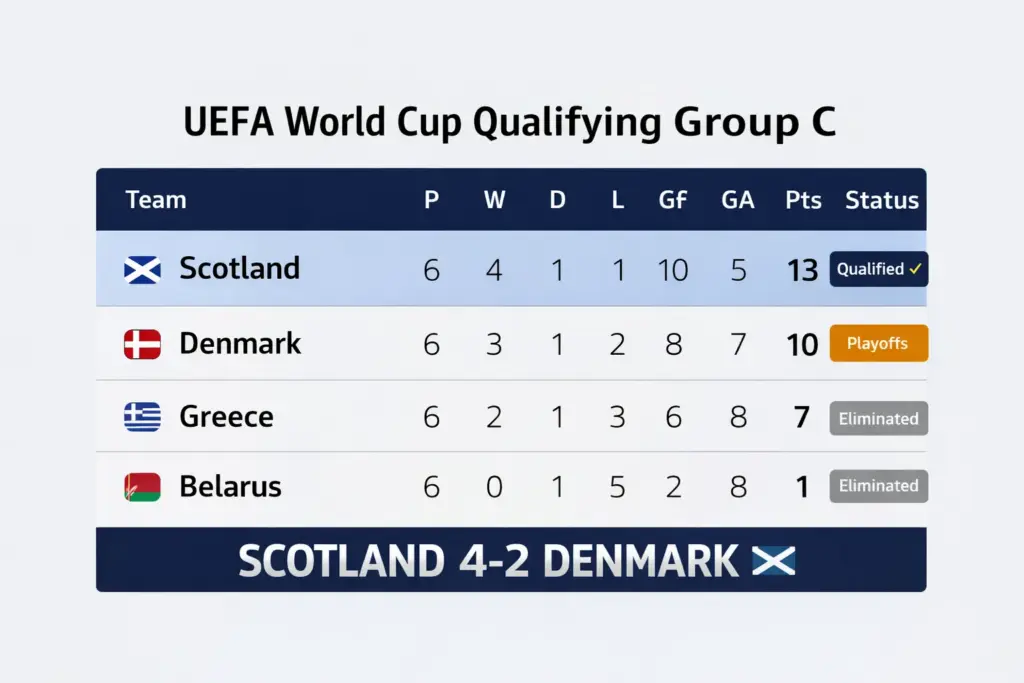
Scotland were drawn in Group C for the qualifiers of the 2026 World Cup. They took on Greece, Belarus and Denmark twice in the group stage, starting from September 2025.
The campaign was not without nerves. Scotland opened with a goalless draw against Denmark — not the ideal start for a side that needed to win the group. But they built from there.
In their second game, they picked up their first win of the campaign and defeated Belarus 2-0. Goals from Ryan Christie, Lewis Ferguson and Lyndon Dykes helped Scotland to an emphatic 3-1 win over Greece in their third game. A win against Belarus followed soon after that.
Then came a wobble. A disappointing defeat to Greece in their penultimate match followed — a result that made the final game against Denmark a genuine must-win. Lose or draw and Scotland would fall into the playoffs, with all the uncertainty that brings. Win and the World Cup was theirs.
They won. Emphatically. 4-2, with Denmark reduced to ten men, and two goals in stoppage time to make sure.
The group winners, Scotland, qualified directly for the World Cup finals, while the runners-up, Denmark, advanced to the second round of play-offs.
Scotland 2026 World Cup Record: A History of Near-Misses
This is only Scotland’s ninth World Cup appearance — but their history at the tournament is one of the most bittersweet stories in football.
Scotland have never been eliminated in the knockout rounds. Not because they always go out in the groups — but because in six of their eight previous appearances, they were eliminated on goal difference or by one goal in the group stage, agonisingly close to advancing. They have the unwanted distinction of being the nation most associated with dramatic group-stage exits.
Key moments from Scotland’s World Cup history:
- 1974 — West Germany: Scotland were the only unbeaten team eliminated at the group stage. They drew with Brazil (0-0) and Yugoslavia (1-1), and secured a win against Zaire (2-0), but were eliminated on goal difference.
- 1978 — Argentina: The Archie Gemmill tournament. After a humiliating 3-1 loss to Peru and a draw with Iran, Scotland needed to beat the Netherlands by three goals. They won 3-2 — Gemmill’s famous individual goal — but fell one goal short of advancing.
- 1982 — Spain: Opened with a 5-2 win over New Zealand, lost 4-1 to Brazil, and then drew 2-2 with the USSR. For the second time in their history, they were eliminated on goal difference.
- 1990 — Italy: Defeated by Costa Rica in their opener, drew with Sweden, then lost to Brazil and went home.
- 1998 — France: Scotland’s last World Cup. Scotland’s only previous game against a CONCACAF nation at the World Cup came in 1990, losing 1-0 to Costa Rica in their opening group game. The 1998 campaign opened against Brazil — a 2-1 defeat despite leading at half time through John Collins’ penalty. They then faced Morocco, with a 3-0 win for the North Africans ending Scotland’s 1998 campaign in Saint Etienne.
Now, 28 years later, Scotland meet Morocco again. And Brazil again.
Scotland 2026 World Cup Group C: The Draw Scotland Got
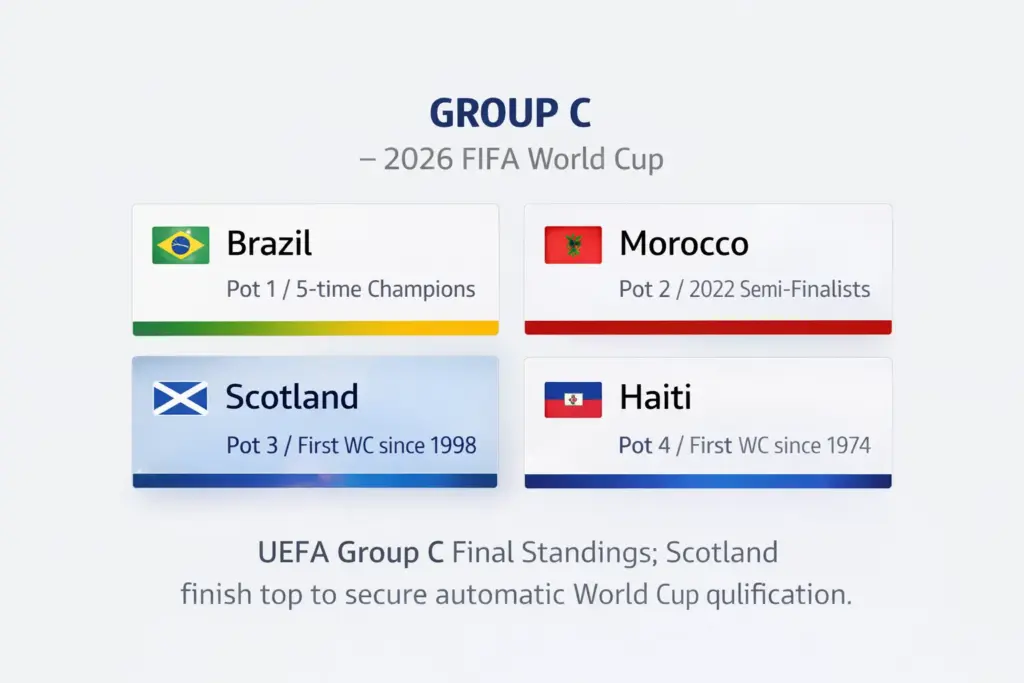
Scotland, in Pot 3 after qualifying for their first World Cup in 28 years, were drawn in Group C at the draw in Washington D.C. alongside two of the toughest teams they could have drawn.
The four teams in Group C:
- Brazil (Pot 1) — Five-time world champions. Scotland have faced Brazil four times at World Cups already: 1974, 1982, 1990 and 1998. Brazil are the only nation that Scotland have faced more than three times in their entire history without ever winning, losing eight of their 10 meetings in all competitions.
- Morocco (Pot 2) — 2022 World Cup semi-finalists. The first African team to reach the last four of a World Cup. They beat Scotland 3-0 in Saint Etienne in 1998 — the result that ended Scotland’s campaign. Steve Clarke will be very aware of that history.
- Haiti (Pot 4) — Haiti are returning to a World Cup for the first time since 1974. Fifty years away from the tournament. An emotional return for a footballing nation that has faced extraordinary challenges. Scotland will be clear favourites here.
Speaking after the draw, Clarke said: “It’s a good draw. I didn’t want any European teams, I wanted teams from different continents, and we got that. Brazil is always a good game, and it’s nice to get them. But Morocco is also a tough opponent, and it’s two teams who, the last time we were at a World Cup, were teams that beat us. So hopefully this time we can do a little bit better against them.”
Scotland’s Group Game Fixtures and Dates
Scotland’s fixtures will have their fans who haven’t made the trip to the US staying up through the night, with the first game against Haiti in the early hours and their subsequent group games with Morocco and Brazil at 11pm UK time.
Game 1 — Scotland vs Haiti
Date: June 13, 2026 (June 14 for UK viewers)
Kick-off: 9pm ET / 2am BST
Venue: Gillette Stadium, Foxborough, Massachusetts (Boston area)
This is the game Scotland must win. Haiti have not been at a World Cup since 1974. Scotland, as a Pot 3 team, will be heavy favourites. Three points here is the foundation everything else is built on.
Game 2 — Scotland vs Morocco
Date: June 19, 2026
Kick-off: 6pm ET / 11pm BST
Venue: Gillette Stadium, Foxborough, Massachusetts
The pivotal fixture. Morocco eliminated Portugal and Spain in 2022 before falling to France in the semis. They are a powerful, physically intense, tactically sophisticated side. Scotland’s only previous meeting with Morocco — 1998 — ended 3-0 to Morocco. This is the match that defines whether Scotland advance or go home early.
Game 3 — Scotland vs Brazil
Date: June 24, 2026
Kick-off: 6pm ET / 11pm BST
Venue: Hard Rock Stadium, Miami Gardens, Florida (Miami area)
The marquee occasion. Scotland vs Brazil at the World Cup — a fixture that has occurred four times in history, with Scotland never winning. By the time this match kicks off, Scotland will know exactly what they need. Three points vs Haiti, something from Morocco, and the Brazil game becomes an opportunity rather than a final throw of the dice.

Steve Clarke’s Scotland: How They Play
Steve Clarke has been Scotland manager since May 2019, and the transformation he has overseen is remarkable. Before Clarke, Scotland had not qualified for a major tournament since the 1998 World Cup. Under him, they reached Euro 2020, Euro 2024, and now the 2026 World Cup.
The tactical approach Clarke has built is pragmatic, disciplined and effective. Scotland do not try to outplay opponents — they structure themselves to be hard to beat, stay compact, and exploit set pieces and transitions.
- Formation: Clarke has alternated between a back-three system with wing-backs and four-at-the-back shapes, depending on the opponent and availability. The midfield three prioritises industry and winning second balls over flair. The wide forwards tuck in when out of possession, leaving two banks of four that are difficult to break down.
- Out of possession: Scotland press selectively rather than continuously. The triggers are opponent back passes, poor touches and wide defenders in possession. They are not a high-press team but a structured mid-block side that makes it very difficult to play through.
- In possession: Scotland build patiently through their centre-backs and use the wide forwards to stretch opposition shapes. The key creative outlet is Scott McTominay, who has developed into an end-product midfielder — comfortable arriving late into the box from deep positions and capable of goals from range.
- Set pieces: Scotland are a significant aerial threat at set pieces. Their physicality — taller than average for a European team — causes problems at corners and free-kicks. In qualifying, set-piece situations contributed directly to several important goals.
Scotland’s Key Players
- Scott McTominay is Scotland’s most important player. The Manchester United midfielder arrived at this stage of his career in the best form of his international life — capable of driving forward from midfield, arriving into the penalty area and scoring at crucial moments. He is the player opposing teams most need to stop.
- Andy Robertson remains Scotland’s most experienced and recognised player internationally. The Liverpool left-back is both captain and emotional leader — the embodiment of the qualifying journey. His crosses, energy and leadership in transition are central to how Scotland play. At 32, this is likely his last World Cup opportunity.
- Ryan Christie provides technical quality in the final third that Scotland’s system sometimes lacks — his movement, combination play and ability to shoot from range make him the most dangerous of Scotland’s wider attacking players.
- Kieran Tierney, when fit, provides defensive solidity and attacking threat at left-back or left of a back three. His injury history has made him an inconsistent presence, but his quality is unquestioned.
- Angus Gunn has consolidated the goalkeeping position and shown composure in high-pressure situations — a requirement for a team that will face moments of sustained pressure against Brazil and Morocco.
- Billy Gilmour is the metronome in midfield. His ability to receive the ball under pressure, retain possession, and dictate the tempo could be crucial, especially in a game where Scotland need to keep the ball against a superior opponent.
Scotland’s Strengths and Vulnerabilities
✅ What Scotland do well
- Defensive organisation. Clarke’s Scotland are difficult to break down. Their compactness and defensive discipline have frustrated opponents across multiple campaigns. Against a Brazil or Morocco side that expects space, Scotland’s refusal to offer it could be their most valuable asset.
- Set pieces. Scotland’s aerial threat at corners and free-kicks is genuine — they score and concede significant numbers of set-piece goals. In a tournament where margins are tight, one set-piece goal can change everything.
- Team spirit and mental resilience. A group that came from behind against Denmark in the final qualifier, scoring twice in stoppage time, is not a group short on belief or character. Resilience is a Scotland hallmark under Clarke.
- Tactical flexibility. Clarke has shown willingness to change shape mid-game and adapt to opponents. Against Haiti, Scotland will likely press and dominate. Against Brazil, they will almost certainly sit deep and look to counter. The ability to shift tactical approach within the group is valuable.
❌ Where Scotland can be exposed
- Individual quality gap against top opposition. Brazil are five-time world champions while Morocco were the most dangerous side from Pot 2, having made the semifinals four years ago. Scotland do not have players at the individual level of Brazil or Morocco’s best. In open play, sustained quality from opponents can wear them down.
- Attacking output. Scotland’s goals-per-game in qualifying was not high. They are a team built to be hard to beat, not to outgun opponents. Against Haiti they must be more clinical — leaving Haiti goals in the group stages has ended Scottish campaigns before.
- Thin squad depth. Clarke has a dependable first eleven but limited cover in key positions. An injury to Robertson, McTominay or Christie mid-tournament creates a quality drop that is significant.
- Experience gap. Most of this squad have never played at a World Cup. Managing the emotional intensity — particularly of the Haiti opener, which carries 28 years of expectation — will be a mental challenge for the group.
What to Realistically Expect
- The realistic best case: Round of 32. Scotland win the Haiti game, take at least a point from Morocco, and advance as one of the eight best third-placed teams even without beating Brazil. A Round of 32 appearance would be Scotland’s best World Cup result in the modern era — they have never advanced from the group stage.
- The most likely scenario: Beat Haiti, lose to Morocco and Brazil. Scotland advance if results elsewhere allow a third-placed qualification, or exit at the group stage. Advancing depends heavily on the Morocco game — it is the match that defines the campaign.
- The dream scenario: Beat Haiti comfortably, upset Morocco — as Morocco themselves upset Belgium and Portugal in 2022 — and make the Brazil game a genuine contest with something still at stake. Stranger things have happened at World Cups.
Scotland are winless in eight previous meetings with South American opposition at the World Cup, and winless in each of their last six meetings with CONCACAF nations. History is a long list of obstacles — but Scotland teams have occasionally written new history when it mattered most.
Scotland 2026 World Cup: The 28-Year Absence and What It Means
Scotland’s 28-year gap between World Cups is one of the longest for a nation with their pedigree, having previously qualified eight times between 1974 and 1998. Between 1998 and 2026, they missed:
- 2002 Japan/South Korea — failed to qualify
- 2006 Germany — failed to qualify (lost a close group to France/Switzerland)
- 2010 South Africa — failed to qualify
- 2014 Brazil — failed to qualify
- 2018 Russia — failed to qualify
- 2022 Qatar — failed to qualify (lost the playoff semifinal to Ukraine)
Six campaigns. Twenty-four years of near-misses, heartbreaks, and close-run failures. Managers came and went. Players who deserved a World Cup never got one.
Clarke arrived in 2019 and began changing the culture — not through glamour or revolution, but through structure, belief and the willingness to grind. Euro 2020 was the first payoff. Euro 2024 followed. Now a World Cup.
For every Scottish football fan watching from Foxborough on June 13, the game against Haiti will be emotionally enormous — regardless of the opponent.
Scotland vs Brazil: A Fixture With History
Scotland vs Brazil is one of the World Cup’s most played fixtures involving a smaller nation. Scotland have faced Brazil four times previously at World Cups — in 1974, 1982, 1990 and 1998.
Each meeting has been a loss for Scotland — but several have been competitive and memorable.
In 1974, Scotland held Brazil to a 0-0 draw in their famous unbeaten group exit. In 1998, Scotland led Brazil at half time through a John Collins penalty before losing 2-1. This is not a fixture where Scotland have historically capitulated — they have competed.
The June 24 game in Miami will be the fifth meeting. Whether Scotland have something to play for by then, or are already eliminated, will determine the tone. If qualification is already secure, it becomes a chance to make history. If Scotland need a point, it becomes the most pressure-filled match in a generation.
FAQs: Scotland at the 2026 World Cup
When did Scotland last play at a World Cup?
France 1998, where they were eliminated in the group stage with losses to Brazil (2-1) and Morocco (3-0), bookended by a draw.
How did Scotland qualify for the 2026 World Cup?
They won UEFA qualifying Group C — beating Belarus twice, Greece and Denmark — and secured top spot with a dramatic 4-2 win over Denmark on the final matchday, scoring twice in stoppage time.
Who did Scotland beat to qualify?
Their qualifying group contained Denmark, Greece and Belarus. They won the group ahead of Denmark.
What group are Scotland in at the World Cup?
Group C, alongside Brazil (five-time world champions), Morocco (2022 semi-finalists) and Haiti (returning to their first World Cup since 1974).
When are Scotland’s World Cup matches?
June 13 vs Haiti in Boston (2am BST), June 19 vs Morocco in Boston (11pm BST), June 24 vs Brazil in Miami (11pm BST).
Who is Scotland’s manager?
Steve Clarke, in charge since May 2019. He has led Scotland to three consecutive major tournament qualifications — Euro 2020, Euro 2024 and the 2026 World Cup.
Have Scotland ever beaten Brazil at a World Cup?
No — Scotland have never beaten Brazil in their entire history of meetings, losing eight of their ten encounters across all competitions and drawing two.
What is Scotland’s best-ever World Cup finish?
Scotland have never advanced past the group stage. They have been eliminated on goal difference multiple times — in 1974 and 1982 — without ever losing a game.
Who are Scotland’s key players for 2026?
Scott McTominay (midfield/goals from deep), Andy Robertson (captain, left back), Ryan Christie (creativity from wide) and Kieran Tierney when fit.
Can Scotland qualify from Group C?
Yes — if they beat Haiti and take points from Morocco, advancing as a third-placed team is realistic. Finishing second would require beating or drawing with Morocco and benefiting from the Brazil result.
Key Takeaway
Scotland at a World Cup is not a novelty — it is a return to where they belong. This team earned qualification in the most dramatic fashion possible, and they arrive with a manager who has rebuilt the culture, a captain who embodies it, and a group of players who understand what this moment means.
Group C is tough. Nobody pretends otherwise. But Scotland’s history at World Cups is full of competitive displays — they do not simply roll over for famous opponents. Beat Haiti, make the Morocco game a contest, and the rest will take care of itself.
After 28 years, the Tartan Army are back. June 13 in Foxborough is not just a football match — it is the end of a very long wait.