

VAR at the 2026 World Cup could change significantly after IFAB — football’s law-making body — holds its annual general meeting on 28 February 2026 (09:30 GMT) in Hensol, Wales. On the agenda are major expansions to VAR: reviewing corner kicks, overturning incorrect second yellow cards (factual errors only), cracking down on time-wasting, and enforcing a 10-second substitution rule. Any changes approved on Saturday formally take effect from 1 July 2026 — after the World Cup begins on 11 June 2026 — unless FIFA receives permission to apply them earlier for the tournament. Some proposals are likely to pass. Others face resistance. Here is what you need to know before the decision drops.
TL;DR
- IFAB votes on major rule changes on 28 February 2026 (09:30 GMT, Hensol, Wales).
- VAR for corner kicks and VAR for second yellow cards (factual errors only) are the headline proposals.
- Anti-time-wasting rules (throw‑ins, goal kicks, substitutions) are also on the table.
- Changes approved on Saturday formally take effect 1 July 2026 — but could be fast‑tracked for the World Cup.
- The penalty rebound rule (banning goals from saved spot‑kicks) is unlikely to pass this time.
- This article will be updated the moment the decision is announced.
SNIPPET BLOCK
VAR at the 2026 World Cup could cover more situations than ever before. IFAB votes on 28 February 2026 on whether to allow VAR to review corner‑kick decisions and incorrect second yellow cards. If approved, these changes take effect 1 July 2026 — after the World Cup starts on 11 June — but FIFA may seek a tournament‑specific exemption to implement them early, following a precedent set at the 2017 Confederations Cup.
What Is IFAB and Why Does It Control VAR?
Before we get into the changes, a quick primer.
The International Football Association Board (IFAB) is the independent body that writes and amends the Laws of the Game. It was founded in 1886 and is made up of FIFA (which holds four votes) and the four British football associations — England, Scotland, Wales, and Northern Ireland (one vote each). Any change to the laws needs at least six of those eight votes to pass.
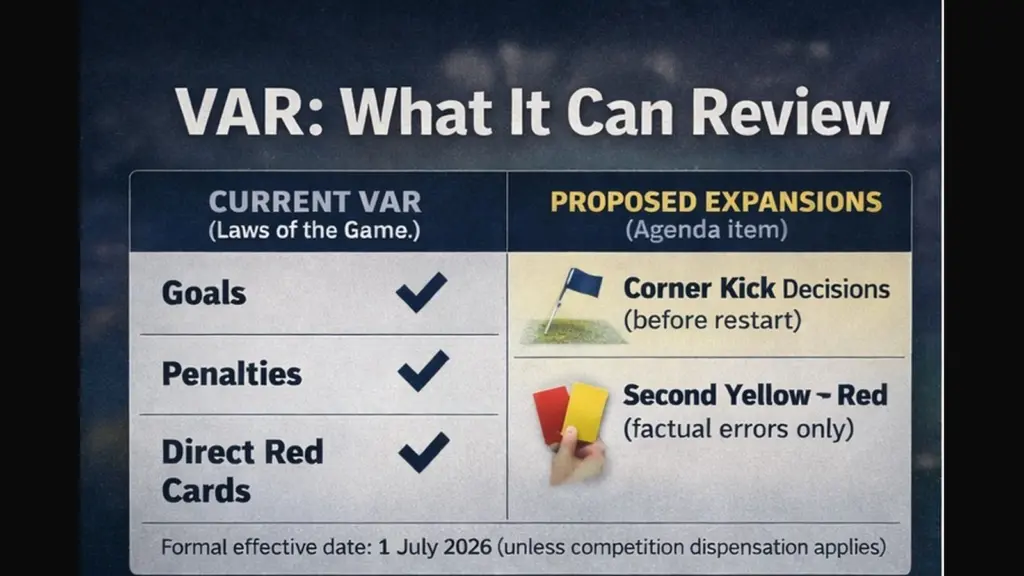
VAR — Video Assistant Referee — was introduced into the Laws of the Game in 2018, after trials at the 2017 FIFA Confederations Cup. It currently has authority over exactly four types of decisions: goals, penalties, red cards, and cases of mistaken identity. Everything else — including corner kicks — is off limits.
That is now under review.
What Is Being Voted On at the Feb 28 IFAB Meeting?
IFAB’s annual general meeting is scheduled for February 28 at 09:30 GMT in Hensol, Wales. Several rule changes could be approved without the need for on-field testing. Any rules adopted at the AGM are set to formally take effect on 1 July 2026 — though FIFA may request early implementation for the World Cup, as it did when trialling VAR at the 2017 Confederations Cup. [World Soccer Talk]
There are five distinct proposals on the table. They are not all equal in likelihood. Here is each one, explained clearly.
1. VAR Reviews for Incorrectly Awarded Corner Kicks
This is the headline proposal. Right now, once a referee signals a corner, play continues. VAR cannot intervene. The ball was last touched by a defender? Doesn’t matter — if the referee ruled corner, it stands.
Pierluigi Collina, FIFA’s referees chief, has been one of the biggest champions of expanding VAR’s reach and has suggested that any clear, quick-fixable error should be fair game for intervention. At the 2026 World Cup, corners would effectively become a fifth category of VAR review, right alongside goals, penalties, red cards, and mistaken identity. [Inside World Football]
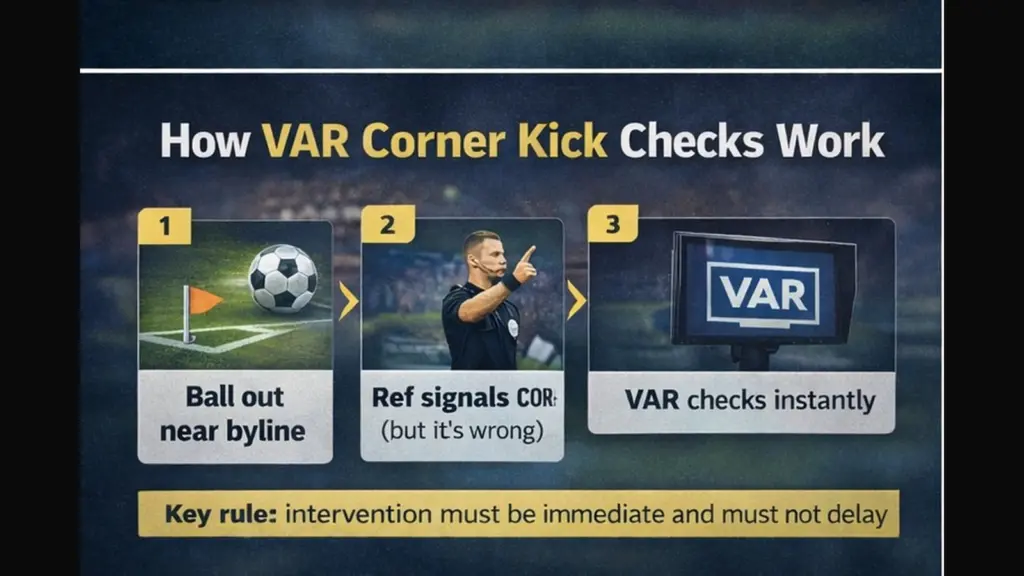
IFAB analysts have attached a key condition to Collina’s proposal: VAR intervention on incorrectly awarded corners would need to be immediate and must not delay the restart of play. [World Soccer Talk]
An important aspect of the Laws of the Game is that a referee cannot change a restart decision even if they realise it is incorrect after play is back underway. So once the corner is taken and play is live, the game must continue. [FOX Sports] The proposal is specifically designed to fix this window — the brief gap between the corner being signalled and the kick being taken.
What technology would be used? Two approaches are being considered. In stadiums with a chip in the ball, the system can instantly identify which player last touched it. Where that technology isn’t available, the VAR operator reviews camera angles manually — but only for clear, obvious errors.
What would actually be reviewed? Primarily: which team last touched the ball before it crossed the byline. Did it go off a defender (corner) or an attacker (goal kick)? The proposal does not open the door to reviewing whether the corner was crossed correctly, or anything that happens after the corner is taken.
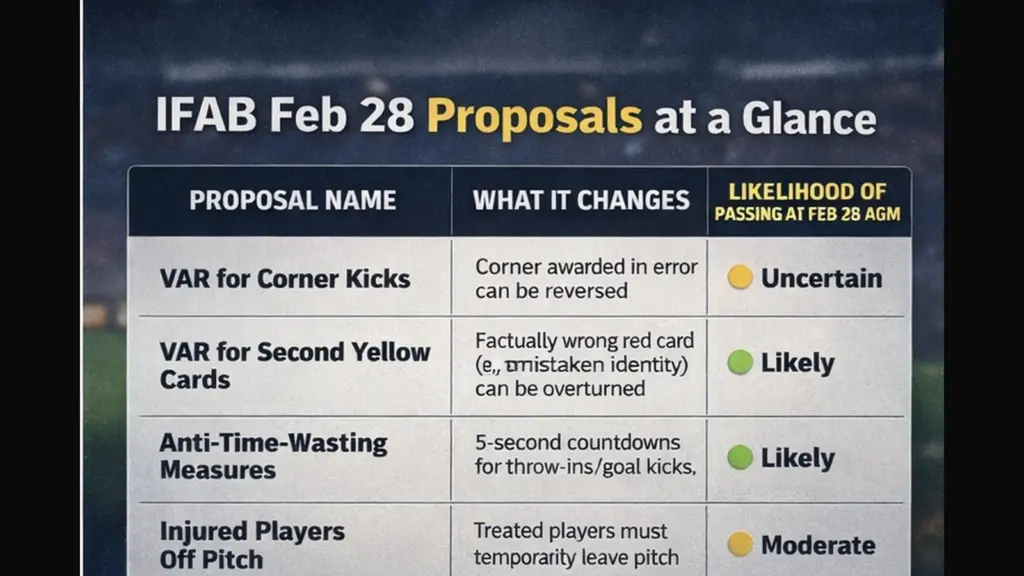
Likelihood of passing: Uncertain. The FA’s chief executive Mark Bullingham, also on IFAB’s board, told BBC Sport that his organisation’s position is that “we don’t think there’s any need to extend the use of VAR.” [FOX Sports] There is genuine resistance from domestic leagues who fear more stoppages. FIFA, however, is pushing hard and has the votes (four) to make a significant difference.
2. VAR Reviews for Factual Errors in Second Yellow Cards
This one has broader support and is widely expected to pass. IFAB’s January 2026 Business Meeting explicitly defined the scope as reviewing “factual errors in the awarding of second yellow cards.”
Currently, VAR cannot intervene on yellow card decisions. A player can receive a second booking — leading to a red card and ejection from the game — based on a mistake by the referee, and technology cannot overturn it.
FIFA is poised to receive special authorization to expand VAR powers to cover second yellow card reviews. FIFA officials argue that given the tournament’s high stakes, maximum accuracy is essential for potentially decisive moments. [Tribuna.com]
Former Premier League referee David Elleray said: “If the decision of a second yellow card is clearly factually incorrect, it could be reviewed. We’re expecting that will be brought immediately.” [GiveMeSport]
The key word is “factually incorrect.” This is not about whether the foul warranted a yellow — that is a matter of judgment and VAR does not override judgment calls. This is specifically about situations where a player was clearly not the one who committed the foul, or where the ball clearly struck another player first. Factual errors, not opinion errors.
Likelihood of passing: High. Most IFAB members support this. The expansion is narrow and clearly defined, which makes it easier to approve without risking match flow.
3. Anti-Time-Wasting: Throw-Ins, Goal Kicks, and Substitutions
IFAB is launching a multi-pronged attack on time-wasting, building on rules that have already proven effective.
The 8-Second Goalkeeper Rule (Already in Effect): First trialled at the Club World Cup in June 2025, this rule officially became law on 1 July 2025. A goalkeeper who controls the ball with their hands for more than eight seconds now concedes a corner kick to the opposing team. The referee counts down the last five seconds visibly. [IFAB] This rule has already changed behaviour noticeably at the top level. [Coaching American Soccer]
5-Second Countdown for Throw-Ins and Goal Kicks (Proposed): The same logic is now being extended. Referees would be given licence to begin a visible five-second countdown using their fingers when they judge that a player is deliberately dawdling at a throw-in or a goal kick. If the player fails to restart in time, possession would be switched to the opposition. [World Soccer Talk] [Three Men On a Boat]
10-Second Substitution Rule (Proposed): In a significant new measure agreed upon at IFAB’s January 2026 Business Meeting, a player being substituted must leave the field within 10 seconds. Failure to do so will mean the new player cannot come on immediately, forcing the team to play with ten men temporarily. [World Soccer Talk]
Injured Players Must Leave the Pitch (Proposed): Another change would penalise players who leave the field for medical assessment, requiring them to remain off the pitch for a set period (reportedly around one minute), with goalkeepers as the lone exception. This closes a well-known loophole where a player goes down, receives treatment, wastes 60 seconds, and is back playing a moment after the restart. [World Soccer Talk] The exact duration of the mandatory absence is still being debated.
Likelihood of passing (for the proposed measures): High. This is a natural extension of a rule (the 8-second goalkeeper rule) already proven to work. The 10-second substitution rule, in particular, is highly specific and enforceable.
4. The Penalty Rebound Rule — NOT Expected at This Meeting
You may have seen headlines about IFAB planning to ban goals from penalty rebounds — making the ball “dead” if the goalkeeper saves a spot-kick, just as in ice hockey. The proposals would see the ball declared dead if the goalkeeper saves a spot-kick, meaning the attacking team cannot then score on the follow-up. [SPORTbible]
This proposal exists, but it is highly unlikely to be voted through on February 28. The governing body is likely to want to see lengthy trials before such a significant change, and this may not be possible before the next AGM. [SPORTbible]
This is one to watch for the 2027/28 season, not the 2026 World Cup.
Why Is All This Happening Now?
Two forces are driving these changes at the same time.
Force 1: World Cup accuracy pressure
The stakes at a World Cup are enormous. A wrongly awarded corner that leads to a goal in the final would be catastrophic. Collina has cited an incident from the Euro 2016 final, when Portugal were wrongly awarded a free-kick in extra time for handball on the edge of the area. [FOX Sports] The push is to eliminate errors that technology can clearly fix, in a tournament where the margin between winning and losing is everything.
Force 2: The 2022 Qatar problem
The 2022 World Cup exposed a time-wasting crisis on a global stage. Matches regularly ran to 100-plus minutes of actual playing time because players fell over, received treatment, argued with referees, and dawdled over every restart. Any changes approved this weekend come into force on 1 July 2026 — three weeks after the FIFA World Cup begins on 11 June. IFAB and FIFA have form for fast-tracking rule changes ahead of major tournaments; last year’s goalkeeper retention rule was trialled at the Club World Cup in June 2025 before the general July deadline. [Three Men On a Boat]
In other words: the 2026 World Cup is the most watched sporting event on Earth. IFAB and FIFA want it to feel faster, fairer, and more accurate than 2022. These rule changes are the answer.
How Would VAR Corner Kick Checks Actually Work in Practice?
Walk through a typical scenario:
- A ball bounces off a defender’s shin and trickles behind for what looks like a goal kick.
- The referee signals corner kick to the attacking team — a mistake.
- The VAR operator flags the error immediately.
- Play has NOT restarted yet. The VAR tells the referee the decision is clearly wrong.
- The referee changes the call to goal kick. The corner is not taken.
- Total delay: under 10 seconds.
The key constraint IFAB has placed on this is that intervention must be immediate and must not delay the restart. If the corner has already been taken, the game continues. There is no “going back” once play restarts.
The Arguments For and Against
✅ The case for expanding VAR
- Accuracy matters most at the World Cup. A tournament decided by a wrongly awarded corner would be a scandal.
- Corners lead to goals. Roughly 20–25% of goals in elite football come from set pieces. [2] Getting the corner/goal-kick call right is not trivial.
- The delay is minimal. Unlike penalty reviews that can take three minutes, a corner check with chip technology or obvious camera angles takes seconds.
- The precedent is there. VAR itself was trialed at a FIFA tournament (2017 Confederations Cup) before formal IFAB approval. FIFA has done this before.
❌ The case against
- More stoppages. Every corner would need to be monitored. Even if most checks are instant, the mental burden on officials increases.
- Scope creep. If VAR keeps expanding, football may drift toward an NFL-style system where almost every restart becomes reviewable. [Inside World Football] The concern is not just corners — it is what comes after corners.
- Domestic league resistance. The Premier League, Bundesliga, and La Liga are wary of implementing changes they have not tested. A World Cup-only rule creates inconsistency for players who play differently at club level.
- Inconsistency is already a problem. VAR implementation varies widely across leagues. Adding complexity risks making the inconsistency worse.
What Happened at Previous IFAB Votes?
IFAB does not always vote as expected. Here is quick context:
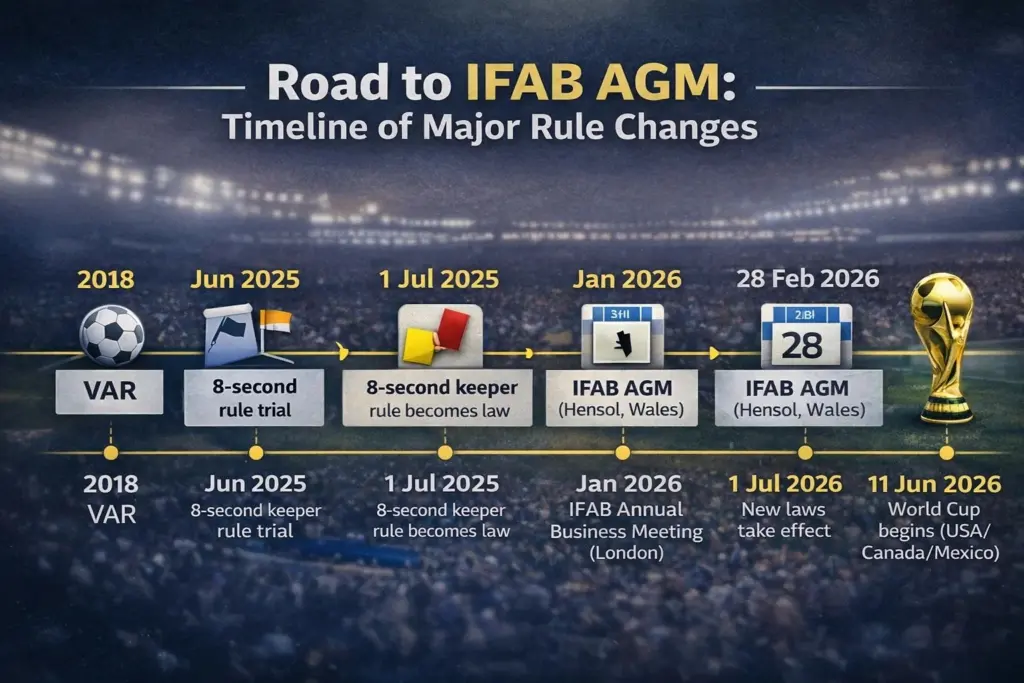
- October 2025: IFAB meeting discussed VAR for corners — the idea was rejected at that stage. FIFA then pushed ahead anyway and is now reportedly prepared to “implement the trial independently” at the World Cup if necessary, seeking a special tournament exemption.
- January 2026: Annual Business Meeting in London set the agenda for the February 28 AGM. Second yellow card VAR was widely supported, with its scope formally defined. The 10-second substitution rule was also agreed upon in principle.
- June 2025: 8-second goalkeeper rule trialled at the Club World Cup.
- 1 July 2025: 8-second goalkeeper rule officially becomes law.
- 2017 Confederations Cup: VAR trialed before formal IFAB approval. FIFA used this tournament exemption route to get VAR into mainstream football.
The February 28 vote could follow the same pattern: even if IFAB does not formally approve VAR for corners, FIFA may seek a tournament-specific exemption to use it at the World Cup anyway.
What Does This Mean for Fans Watching the World Cup?
Whether or not these rules pass, here is the practical effect if they do:
Corner kicks will take slightly longer to start — perhaps 5–10 seconds — as the VAR room clears each decision. In most cases, the check will confirm the corner was correct and you will barely notice. When it intervenes, you may see the referee change their signal: corner becomes goal kick, or vice versa.
Second yellow card red cards could be overturned. This is the bigger emotional moment for fans. A player gets two yellows and is sent off. The VAR checks. It was a clear case of mistaken identity — the wrong player was booked. The card is rescinded. The player stays on. That has never been possible before.
Restarts and substitutions will happen faster. If a player dawdles over a throw-in or goal kick, the referee raises their hand and counts down. If a substituted player lingers, their team will be temporarily down to ten men. Matches should have less dead time between plays.
Many people think VAR is only used for goals and penalties. Reality: it has always covered red cards and mistaken identity too. These proposals add corner kicks and second yellows to that list — it is an expansion, not a reinvention.
Common Misconceptions
“VAR will now review every foul.”
No. The proposals do not expand VAR to cover fouls, yellow cards for dissent, or subjective calls. The corner kick proposal is specifically about ball-out-of-play decisions — factual, not judgmental. The second yellow proposal only covers cases where it is “clearly factually incorrect,” not cases where the referee made a judgment call about whether a challenge deserved a booking.
“The penalty rebound ban is happening at the World Cup.”
Almost certainly not. This change requires extensive trials and is unlikely to be approved at the February 28 meeting. It is a separate conversation for future seasons.
“IFAB controls everything.”
FIFA can apply for a special tournament exemption even if IFAB does not formally approve a change. It did this with VAR at the 2017 Confederations Cup. So a rejection from IFAB on the corner kick proposal does not necessarily mean corners are not reviewed at the World Cup — FIFA may still implement it independently.
FAQs: VAR Changes at the 2026 World Cup
What is IFAB and when does it meet?
IFAB — the International Football Association Board — is the body that writes the Laws of the Game. It holds its Annual General Meeting on 28 February 2026 at 09:30 GMT in Hensol, Wales, near Cardiff. This is where rule changes are formally approved.
When do any new rules take effect?
Formally, rules approved at the February 28 AGM take effect from 1 July 2026. The World Cup begins 11 June 2026. FIFA can apply for a tournament-specific exemption to implement approved rules early, as it has done before.
Will VAR check every corner at the World Cup?
If the proposal passes, yes — every corner decision would be quickly verified. But in the vast majority of cases the check will be instantaneous and invisible to fans. Only clear errors would trigger a change of decision.
Can VAR overturn a red card for a second yellow now?
No — not yet. Under current rules, VAR cannot intervene on any yellow card decision. The proposal being voted on February 28 would change this specifically for “factual errors in the awarding of second yellow cards.”
What is the eight-second goalkeeper rule?
First trialled at the Club World Cup in June 2025, this rule became law on 1 July 2025. A goalkeeper who controls the ball with their hands for more than eight seconds now concedes a corner kick to the opposing team. [IFAB] The referee counts down the last five seconds visibly. This rule is already in force.
What is the proposed 10-second substitution rule?
Agreed upon in principle at IFAB’s January 2026 meeting, this rule would require a substituted player to leave the field within 10 seconds. Failure to do so would result in the new player being temporarily unable to enter, forcing the team to play with ten men.
Is the penalty rebound rule being introduced at the World Cup?
Almost certainly not. The proposal — which would make the ball dead if a penalty is saved — is expected to require further trials before it can be formally adopted. It is unlikely to pass at the February 28 meeting.
What was the Wenger offside rule and why was it rejected?
The offside proposal introduced by former Arsenal manager Arsène Wenger, which would have changed how attacking players are judged in offside positions, was ultimately dismissed by IFAB members. [World Soccer Talk] It is now being trialed in minor leagues rather than adopted for the World Cup.
Why is FIFA pushing for changes that IFAB rejected?
FIFA can apply for special dispensation to trial rules at its own tournaments even before they are formally adopted. It used this same route to introduce VAR at the 2017 Confederations Cup, before VAR was formally part of the Laws in 2018. The corner kick proposal could follow the same path.
Will these rules apply to all 104 matches at the World Cup?
If implemented, yes — all matches from the group stage through to the final would be subject to the same laws.
Where can I find the official rule changes once they are announced?
The official source is the IFAB website at theifab.com. Updates will be published there after the February 28 vote.
What to Watch For on February 28
The meeting takes place at 09:30 GMT in Hensol, Wales. Decisions are typically announced the same day or the following morning. Here is what the decision could look like:
- Best-case scenario (for change): VAR for corners approved, VAR for second yellows approved, anti-time-wasting measures passed. The 2026 World Cup becomes the most technologically accurate tournament in history.
- Moderate scenario: VAR for second yellows approved. VAR for corners rejected but FIFA pursues a tournament exemption. Anti-time-wasting rules pass. Net effect: significant change to how matches flow.
- Resistance scenario: Corner kick VAR rejected, no exemption pursued. Second yellows approved. Matches feel similar to 2022 but with faster restarts.
This article will be updated the moment the IFAB announcement is made. Bookmark it and check back on or after February 28.
Key Takeaway
Football is undergoing the biggest review of its rules since VAR was introduced in 2018. The February 28 vote is not just about corners and yellow cards — it is about what kind of game fans want to watch at the world’s biggest tournament. More accuracy means more stoppages. Fewer errors mean fewer controversies. The balance IFAB strikes on Saturday will define how 104 World Cup matches feel in 2026.
→ Related reading: VAR at GOALCUP 2026 Explained | GOALCUP 2026 Format & Rules Explained | The Offside Rule Explained | GOALCUP 2026 Full Schedule


