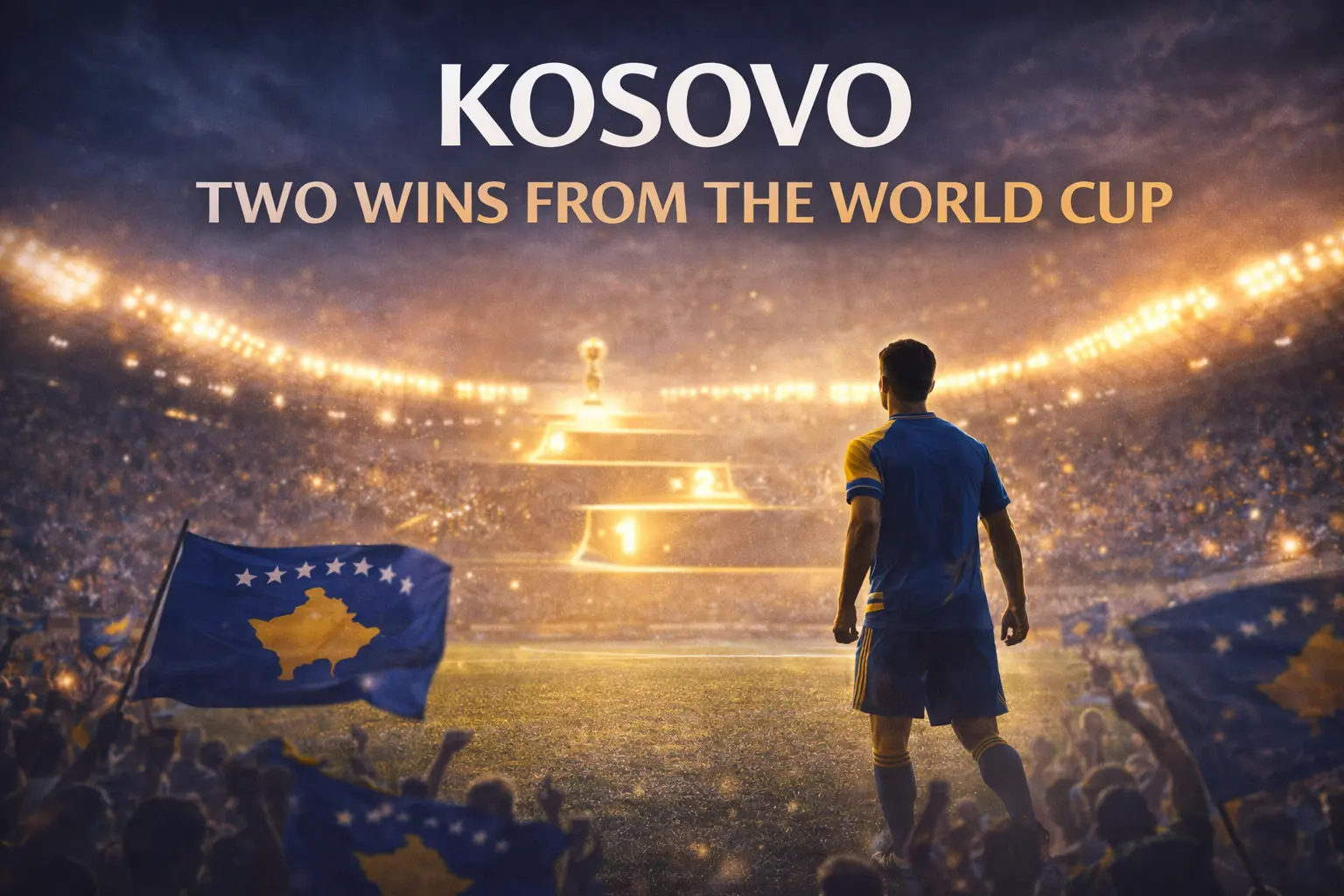

Kosovo at the 2026 World Cup is no longer just a dream—the nation is two wins from the tournament. It would be one of the most extraordinary debut stories in the World Cup’s 96-year history, and it’s a story that began less than ten years ago, when the country gained the right to compete on football’s biggest stage.
Kosovo joined FIFA nine years ago. They played their first World Cup qualifier in September 2016. Now they are two wins away from the World Cup itself. If they get there — and they have a genuine chance — it will be one of the most remarkable debut stories in the tournament’s entire history.
This is not just a football story. It is a story about a country, an identity, and what it means to compete on the world’s biggest stage after decades of international invisibility.
Kosovo at the 2026 World Cup: The Road So Far
- Kosovo joined FIFA and UEFA in May 2016 — making their national team just 9 years old in official international football terms.
- They finished second in UEFA Group B behind Switzerland to earn their playoff place.
- Their playoff semifinal: Kosovo vs Slovakia — 26 March 2026 — away in Slovakia (Pot 2 hosts Pot 3).
- If they win: the Path C final — 31 March 2026 — against Turkey or Romania.
- If Kosovo qualify, they enter Group D alongside the USA, Paraguay and Australia.
- Key players: Vedat Muriqi (all-time top scorer, 32 goals in 66 caps), Amir Rrahmani (Napoli), Edon Zhegrova (Lille).
- Kosovo have never appeared at a World Cup — this would be their first.
- For political reasons, Kosovo cannot be drawn against Serbia or Bosnia and Herzegovina in UEFA qualifying groups — a restriction that shapes every draw they enter.
The Country Behind the Team
To understand Kosovo’s football story, you first need to understand Kosovo’s story.
Kosovo declared independence from Serbia on 17 February 2008. It is one of the world’s newest countries — recognised by over 100 nations but not yet a member of the United Nations, partly due to opposition from Serbia and Russia. Its status remains disputed internationally, which has created unique challenges across every area of public life — including sport.
For years, Kosovo was locked out of international competition entirely. Kosovar-born players who wanted to play professionally had to represent other nations. Many chose Albania, the country sharing the closest cultural and linguistic ties. Others represented Switzerland, Germany or Sweden — countries with large Kosovar diaspora communities. Some represented Serbia. The Kosovar football talent existed; the Kosovar team did not.
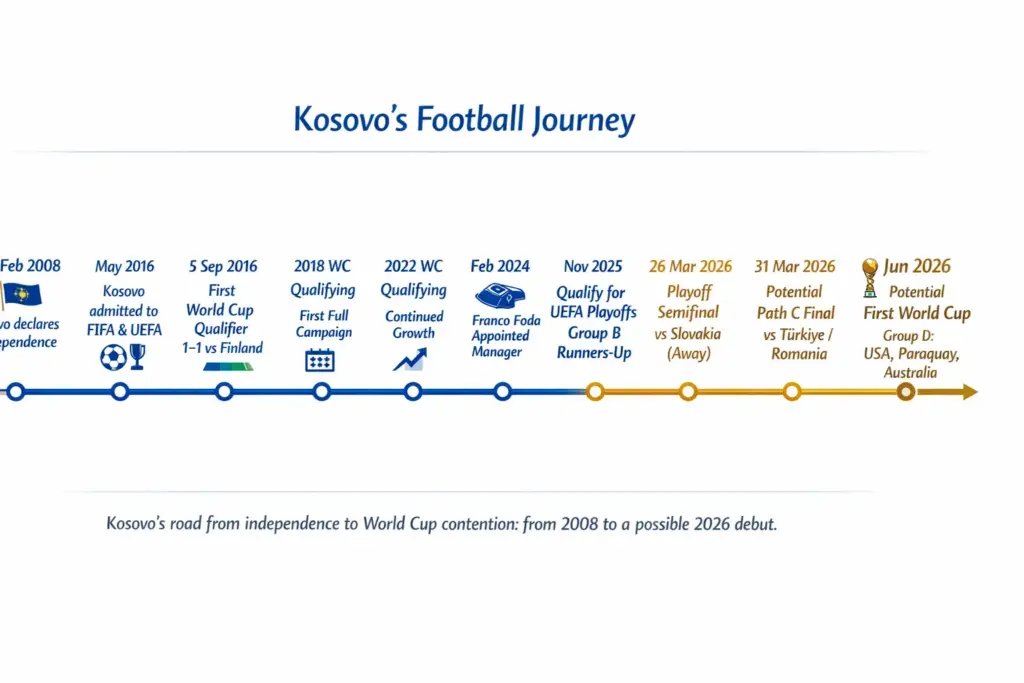
Kosovo was admitted as a member of UEFA and FIFA in May 2016, allowing the team to participate in official international competitions. Prior to official recognition, Kosovan players were eligible to play for other national teams, most notably Albania.
That May 2016 moment — admission to UEFA and FIFA — was not just administrative. It was the beginning of a national team in the truest sense. Kosovar-born players who had represented other nations began the process of switching allegiance. A squad assembled from players who grew up in Pristina, Prizren, and across the Kosovar diaspora in Switzerland, Germany, Sweden and beyond.
On 5 September 2016, Kosovo made its debut in FIFA World Cup qualification with a 1-1 away draw against Finland, with Kosovo’s equalizing goal being scored by Valon Berisha from a penalty kick in the 60th minute.
That draw, in Helsinki, was Kosovo’s first competitive international match. Now, less than a decade later, they are two games from the World Cup.
How Kosovo Qualified for the Playoffs
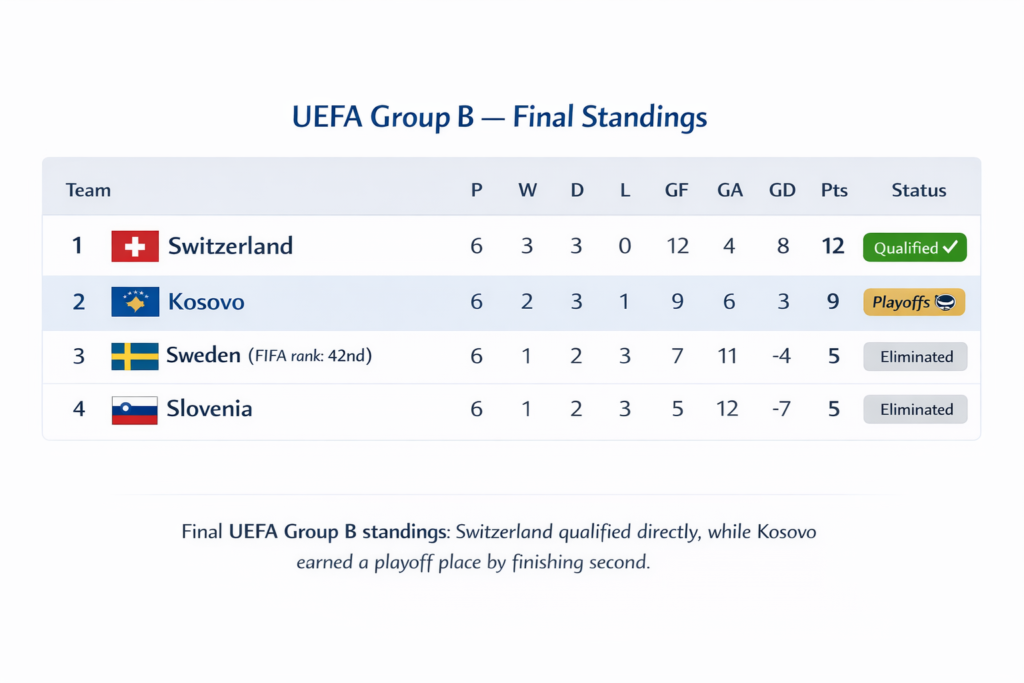
Kosovo finished as runners-up in UEFA Group B, behind Switzerland, to advance to the second round play-offs.
Group B contained Switzerland, Kosovo, Sweden and Slovenia. Switzerland — one of Europe’s most consistent qualifiers — were the group’s dominant force. Kosovo pushed them throughout, running Switzerland close across the campaign before ultimately finishing second.
Their qualifying record shows a team that has grown significantly. Results from the UEFA fixtures data show Kosovo beating Sweden twice — Kosovo 2-0 Sweden and Sweden 0-1 Kosovo — which illustrates the level of performance this side is now capable of. Beating Sweden, a side ranked comfortably above Kosovo, home and away, is not an accident. It is evidence of genuine quality.
Switzerland officially booked their place with a 1-1 draw with Kosovo, sending the Kosovars to the UEFA playoffs. The final group game — Kosovo vs Switzerland, a draw that sealed both outcomes simultaneously — was a moment of conflicting emotions. Elimination from automatic qualification, but confirmation of a playoff place that keeps the World Cup dream alive.
Kosovo at the 2026 World Cup: The Playoff Path
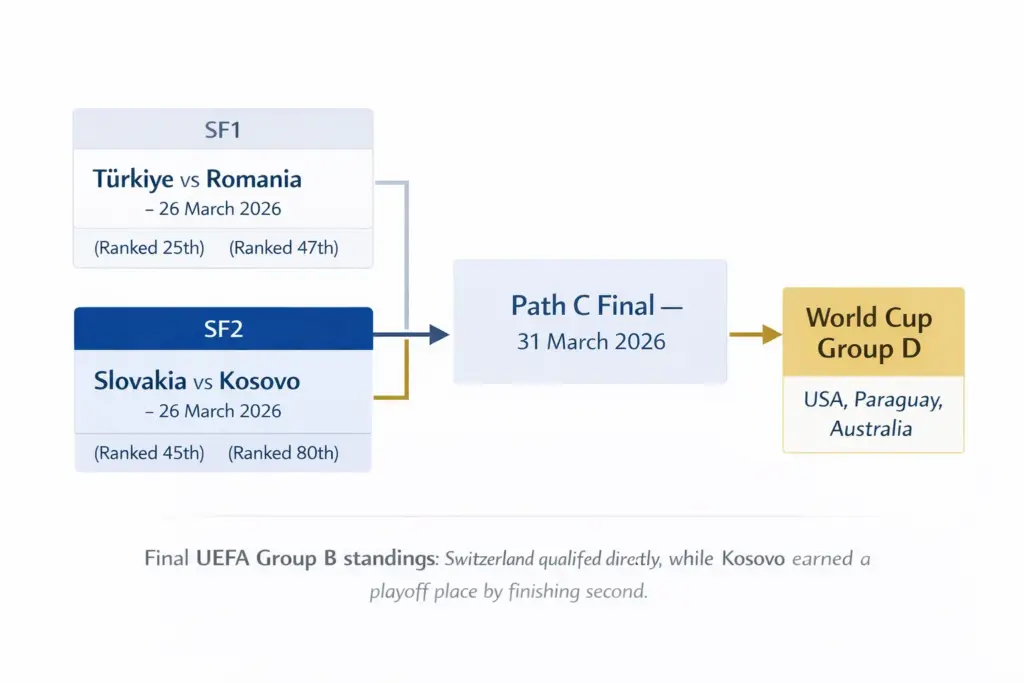
Kosovo at the 2026 World Cup depends entirely on winning two matches in March. Their route runs through Path C — and it requires them to win away from home in the semifinal, then in a neutral or opponent-hosted final.
Path C: Turkey vs Romania (semifinal 5) and Slovakia vs Kosovo (semifinal 6). The Path C final winner joins the United States, Paraguay and Australia in Group D.
Match 1 — Semifinal
Slovakia vs Kosovo
Date: 26 March 2026, 15:45 CET
Venue: Slovakia (home — Pot 2 teams host in the semifinals)
Format: Single leg. Extra time and penalties if level after 90 minutes.
Kosovo travel to Slovakia as the away team. Slovakia were the seeded side in the semifinal draw. On paper, it’s a mismatch. But Kosovo have spent their entire existence defying paper—they beat Sweden twice in qualifying. Rankings are not the whole story.
Match 2 — Path C Final (if Kosovo win)
Kosovo vs Turkey or Romania
Date: 31 March 2026
Venue: To be determined by pre-draw
One match. One World Cup place.
Turkey would be the harder potential final opponent — a well-resourced football nation with a long World Cup history. Romania would be more achievable. Either way, Kosovo would be underdogs — and underdogs have a remarkable record at this stage of World Cup qualifying.
Kosovo at the 2026 World Cup: The Political Dimension
Kosovo at the 2026 World Cup would be a political milestone as much as a sporting one. The team’s football story cannot be told without addressing the political restrictions that make every draw a logistical challenge.
In UEFA competition draws, certain matchups are designated as prohibited clashes for security reasons. These include Belarus-Ukraine, Gibraltar-Spain, Kosovo-Bosnia and Herzegovina, and Kosovo-Serbia. Among those teams, only Ukraine and Kosovo advanced to the play-offs.
In practical terms, this means: Kosovo cannot be drawn against Serbia in any UEFA group stage. They also cannot face Bosnia and Herzegovina. These are not just scheduling preferences — they are formal UEFA draw restrictions that reflect the unresolved political tensions surrounding Kosovo’s status.
For the players themselves, this is a lived reality. Many Kosovo players were born in Serbia, grew up in Serbia, or have family connections across the border. Representing Kosovo — choosing to wear the blue and yellow — is, for many of them, a statement that goes beyond sport.
The diaspora dimension adds another layer. Kosovo’s squad draws heavily on players raised and developed in Switzerland, Germany and Sweden — countries where significant Kosovar communities settled during and after the 1990s conflicts. The squad includes both home-grown players and others shaped by the wider Kosovar diaspora across Europe. Edon Zhegrova was born in North Macedonia. The team is a living map of the Kosovar diaspora — assembled from across Europe, unified around a flag that is itself barely two decades old.
Kosovo at the 2026 World Cup: Key Players
Kosovo at the 2026 World Cup would be built around three standout performers who represent different threads of the national story.
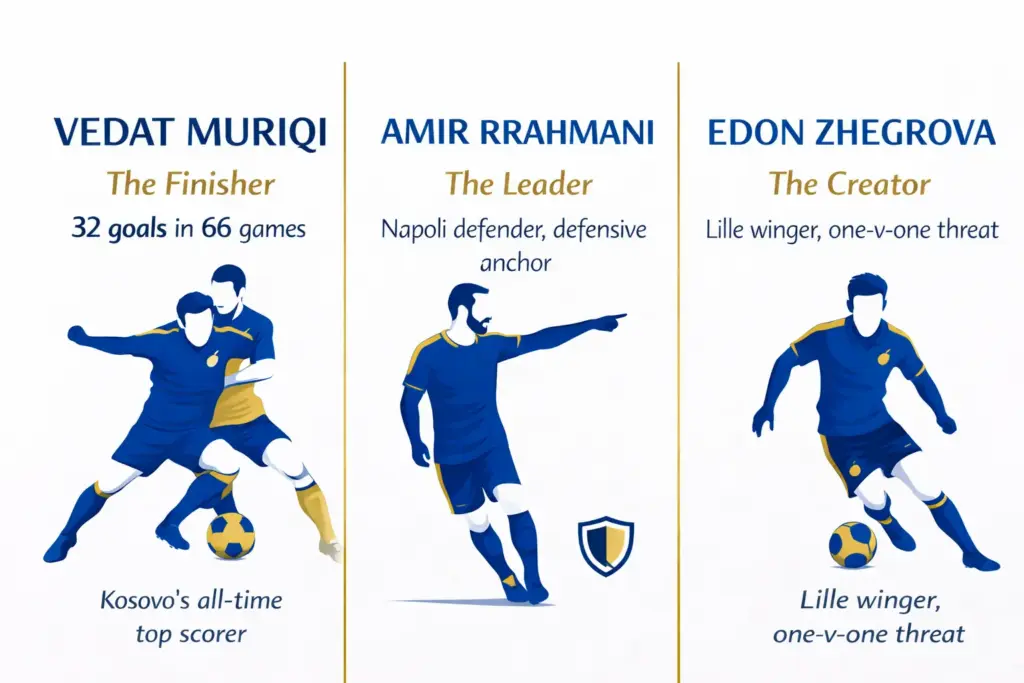
Vedat Muriqi is Kosovo’s all-time leading scorer and the centrepiece of their attacking play.
Muriqi has established himself as the all-time leading goalscorer for Kosovo, with 32 goals in 66 appearances as of 18 November 2025. Among his standout performances are a two-goal display against Cyprus in a 5-1 victory in September 2022, and a hat-trick against Iceland on 23 March 2025 in the UEFA Nations League play-offs.
Muriqi is a physically imposing centre-forward — aerial, powerful, and capable of holding the ball up under pressure. He plays club football in Spain and brings La Liga-level experience to Kosovo’s attack. His ability to score against Switzerland and Sweden in qualifying shows he performs at the top level, not just against weaker opponents.
Amir Rrahmani is Kosovo’s most technically accomplished player by reputation. Among all Kosovar footballers, Rrahmani has the highest rating, followed by Edon Zhegrova and Vedat Muriqi. The Napoli centre-back, born in Pristina and developed in Kosovo’s youth system, brings Serie A experience and defensive solidity that Kosovo badly need in high-stakes playoff matches. His reading of the game and composure on the ball from the back make him the foundation of Kosovo’s defensive structure.
Edon Zhegrova provides the creativity and directness from wide positions that Kosovo need to create chances. The Lille winger — born in North Macedonia but raised within the Kosovar football identity — is quick, technically confident and capable of beating defenders one-on-one. In tight playoff matches where space is limited, a player who can create something from nothing is invaluable.
Other players contributing to Kosovo’s squad include Besar Halimi, Arber Zeneli and a midfield group that blends physical intensity with technical ability across Swiss, German and Spanish club football.
How Kosovo Play
Kosovo’s tactical approach under manager Franco Foda — the former Austria national team coach who took charge in February 2024 — is built around defensive solidity first, with quick vertical transitions when the ball is won.
They do not attempt to outpossess stronger opponents. Against Switzerland and Sweden, they were happy to concede territory and defend in a compact mid-block before exploiting transitions. Muriqi’s physicality means they can play a direct ball in behind or into feet, giving them an outlet even when possession is limited.
Their set-piece threat is significant. Muriqi’s aerial ability and the quality of delivery from Zhegrova and others mean Kosovo are dangerous at every corner and free-kick. In single-leg playoff matches — where one goal can be the difference — set pieces are often the equalising factor between mismatched opponents.
What makes Kosovo dangerous is precisely their disregard for expectation. They have spent their entire brief existence as underdogs. Against Sweden, they produced their best football as the away side. Pressure, for this team, is not a novelty — it has been the baseline of everything they have done since September 2016.
If Kosovo Qualify: Group D at the World Cup
The winner of UEFA Playoff C will join the United States, Paraguay and Australia in Group D.
Kosovo’s potential group is the most extraordinary possible draw for a team of their standing. Consider what it would mean:
United States — The co-host nation, playing in front of one of the world’s largest football audiences, in front of a home crowd of tens of thousands. A team less than ten years old in official international football terms, playing against the host nation, in America — which has the largest Kosovar diaspora community outside Europe.
Paraguay — A South American football nation with World Cup history and experience. A competitive, physical opponent.
Australia — Like Kosovo, a team still building their World Cup identity; the Socceroos carry genuine quality but are not among the traditional powerhouses.
For Kosovo, Group D is manageable on paper — no Brazil, no France, no Spain. It is a group in which they could realistically compete for every point. And playing the USA in America — in front of an estimated 250,000-strong Kosovar-American community — would be a moment with almost no parallel in World Cup history.
Kosovo’s Football History: Nine Years, One Story
The history of Kosovo’s national team is, by definition, brief. They have played fewer than 100 competitive international matches. Their entire World Cup qualifying record spans just three campaigns — 2018, 2022 and 2026.
But within that brief history, the trajectory is remarkable.
2018 World Cup qualifying: Kosovo’s very first campaign. They finished last in Group I, but the campaign still marked the beginning of their competitive international history.
2022 World Cup qualifying: Kosovo in a group containing Spain, Sweden, Greece and Georgia. They finished fifth, and continued building the team’s identity.
2026 World Cup qualifying: Runners-up in a group with Switzerland and Sweden. Beat Sweden twice. Drew with Switzerland. Close enough to automatic qualification to make the conversation serious. Now in the playoffs.
The direction of travel is unmistakable. Every campaign has produced a better result than the one before.
Kosovo have also participated in the UEFA Nations League across multiple editions, using those matches to build experience and competitive edge. Muriqi has scored in every major competition Kosovo has participated in — a consistency that runs through the team’s entire competitive history.
The Diaspora Factor: A Team That Belongs to a People, Not Just a Place
One of the most distinctive aspects of Kosovo’s squad is where it comes from.
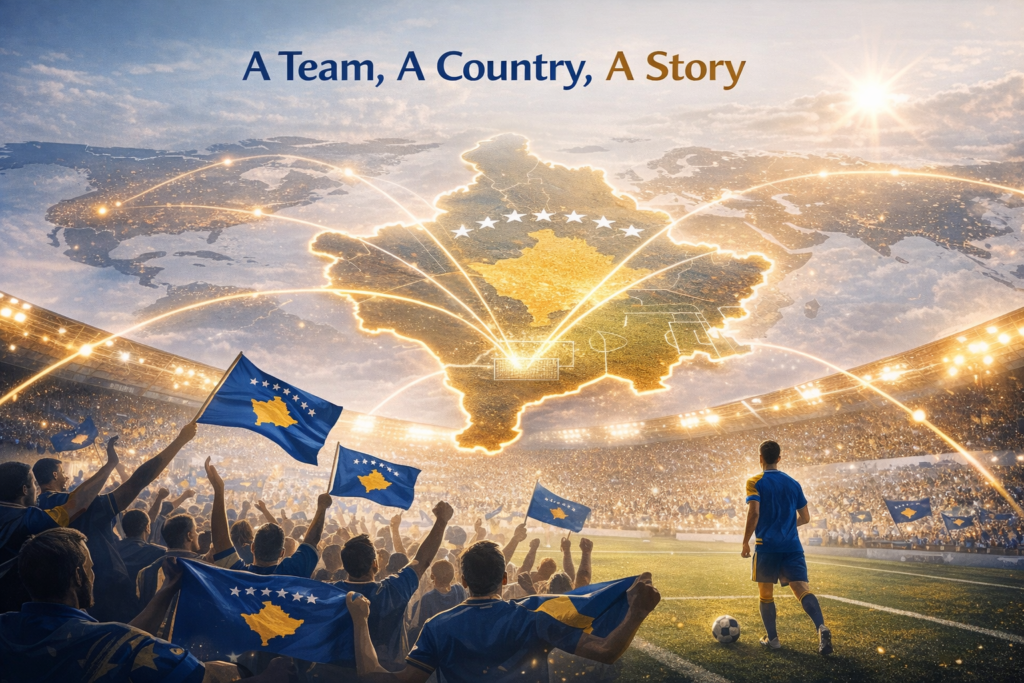
Kosovo’s population within its borders is about 1.6 million, making the scale of its football rise even more striking. But the Kosovar diaspora — communities established during the conflicts of the 1990s — spans Switzerland, Germany, Sweden, Austria, the USA and beyond. Estimates suggest that around 800,000 Kosovars live in Switzerland alone. Germany’s Kosovar community numbers in the hundreds of thousands. The USA’s Kosovar-American population is concentrated in major cities.
When Kosovo plays football, they are not just playing for the 1.6 million at home. They are playing for a people distributed across the world — people who built new lives in new countries while maintaining a fierce connection to where they came from.
Many of Kosovo’s players embody this directly. They grew up in Zurich, in Stuttgart, in Gothenburg — places where their parents or grandparents settled decades ago. Representing Kosovo, for them, is a connection to an identity that was internationally invisible for most of their lives.
This emotional dimension gives the Kosovo squad something that rankings and FIFA coefficients cannot capture. Representing Kosovo is not a career obligation. It is, for many of these players, a deeply personal act.
Kosovo at the 2026 World Cup: Can They Beat Slovakia?
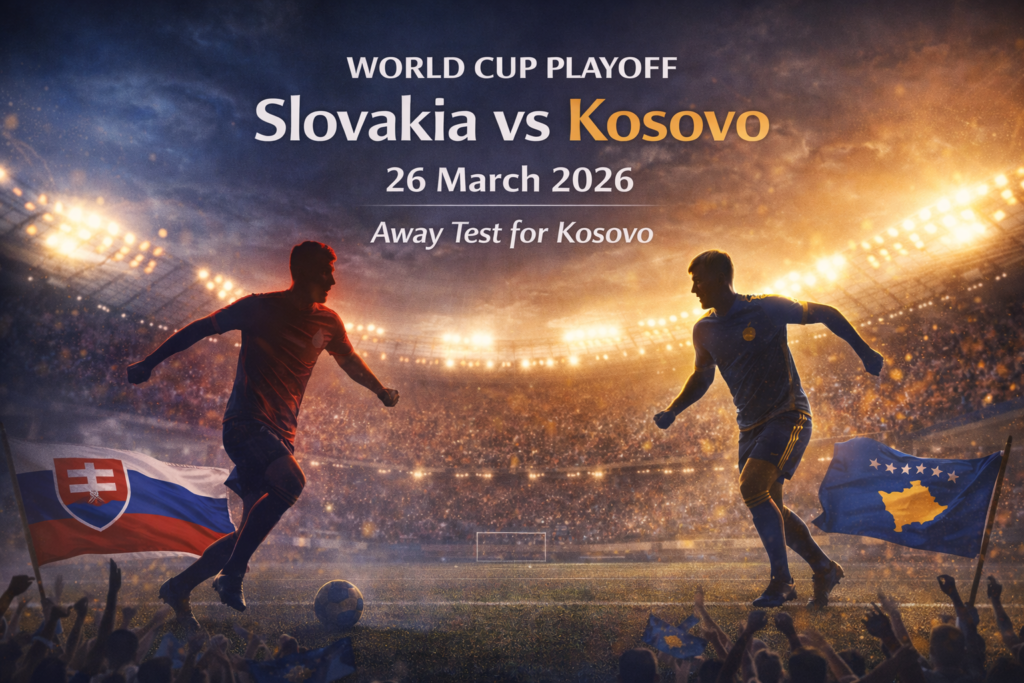
Kosovo at the 2026 World Cup hinges on this single match. They travel to Slovakia as the away side — Pot 2 teams host the semifinal. Slovakia were the seeded side in the draw. On paper, they are the stronger team.
But context matters. Slovakia qualified for Euro 2024 and reached the Round of 16, beating Belgium along the way. They are a competitive European nation with genuine quality. However, this is a single-leg match. One goal, one inspired performance, one moment of individual quality — from Muriqi, from Zhegrova — can change everything.
Kosovo beat Sweden away in qualifying. Sweden were significantly higher-ranked than Kosovo at the time. The argument that Kosovo cannot win in Bratislava does not survive scrutiny of what they have already done.
The match will be tight. Slovakia will have home advantage and crowd support. Kosovo will defend resolutely and look to exploit transition and set pieces. If Muriqi scores — as he does with remarkable consistency — Kosovo have every chance.
FAQs: Kosovo at the 2026 World Cup
Has Kosovo ever been to a World Cup?
No. This would be their first ever appearance. Kosovo only joined FIFA and UEFA in May 2016, making this only their third World Cup qualifying campaign.
When did Kosovo join FIFA?
Kosovo was admitted as a member of UEFA and FIFA in May 2016.
When was Kosovo’s first World Cup qualifier?
5 September 2016 — a 1-1 draw away against Finland, with Valon Berisha scoring Kosovo’s equaliser from a penalty.
Who does Kosovo play in the playoff?
First: away at Slovakia on 26 March 2026 (Path C semifinal). If they win: the Path C final on 31 March against Turkey or Romania.
What group would Kosovo be in at the World Cup?
Group D alongside the United States, Paraguay and Australia.
Why can’t Kosovo play Serbia or Bosnia?
For security and political reasons, Kosovo-Serbia and Kosovo-Bosnia and Herzegovina are designated as prohibited clashes in UEFA draw procedures. Kosovo’s disputed political status makes these matchups impossible to schedule safely under current conditions.
Who is Kosovo’s all-time top scorer?
Vedat Muriqi, with 32 goals in 66 appearances as of November 2025.
Who are Kosovo’s best players?
Amir Rrahmani (Napoli) holds the highest rating among Kosovo players, followed by Edon Zhegrova (Lille) and Vedat Muriqi.
What is Kosovo’s FIFA ranking?
Kosovo are ranked approximately 80th in the FIFA world rankings, placing them in Pot 3 of the UEFA playoffs.
Who is Kosovo’s manager?
Franco Foda, the Austrian-born coach who previously managed the Austrian national team. He took charge in February 2024 and has built Kosovo’s tactical structure around defensive organisation and direct counter-attacking football.
What language do Kosovo players speak?
Albanian is the primary language spoken within Kosovo. The squad includes players raised across multiple European countries — many speak German, Swedish and French in addition to Albanian.
Key Takeaway
Kosovo are nine years into their official existence as a footballing nation. In that time they have gone from playing their first qualifying game against Finland to standing two wins away from the biggest tournament on earth. The road goes through Bratislava, on 26 March, against Slovakia.
If they get through — if Muriqi scores, if Zhegrova creates, if Rrahmani holds the defensive line — Kosovo will be at the World Cup. Playing in America, in front of the largest Kosovar community outside Europe, in a Group D that is genuinely competitive.
The story of Kosovo at the 2026 World Cup would be one of the most emotionally significant debut stories in the tournament’s history. Not because of their ranking, their history, or their budget — but because of what it means for a country that only nine years ago was told, officially, that it existed enough to compete.