

FIFA World Cup 2026 is soon to return — and this edition breaks records before a ball is kicked. For the first time in history, 48 national teams compete across three countries on a single continent. If you want one clear, no-fuss guide to what is happening, how it works, and what to watch for, you are in the right place.
TL;DR
- Dates: June 11 – July 19, 2026
- Host nations: USA, Canada, Mexico (16 cities, 16 venues)
- Teams: 48 (expanded from 32)
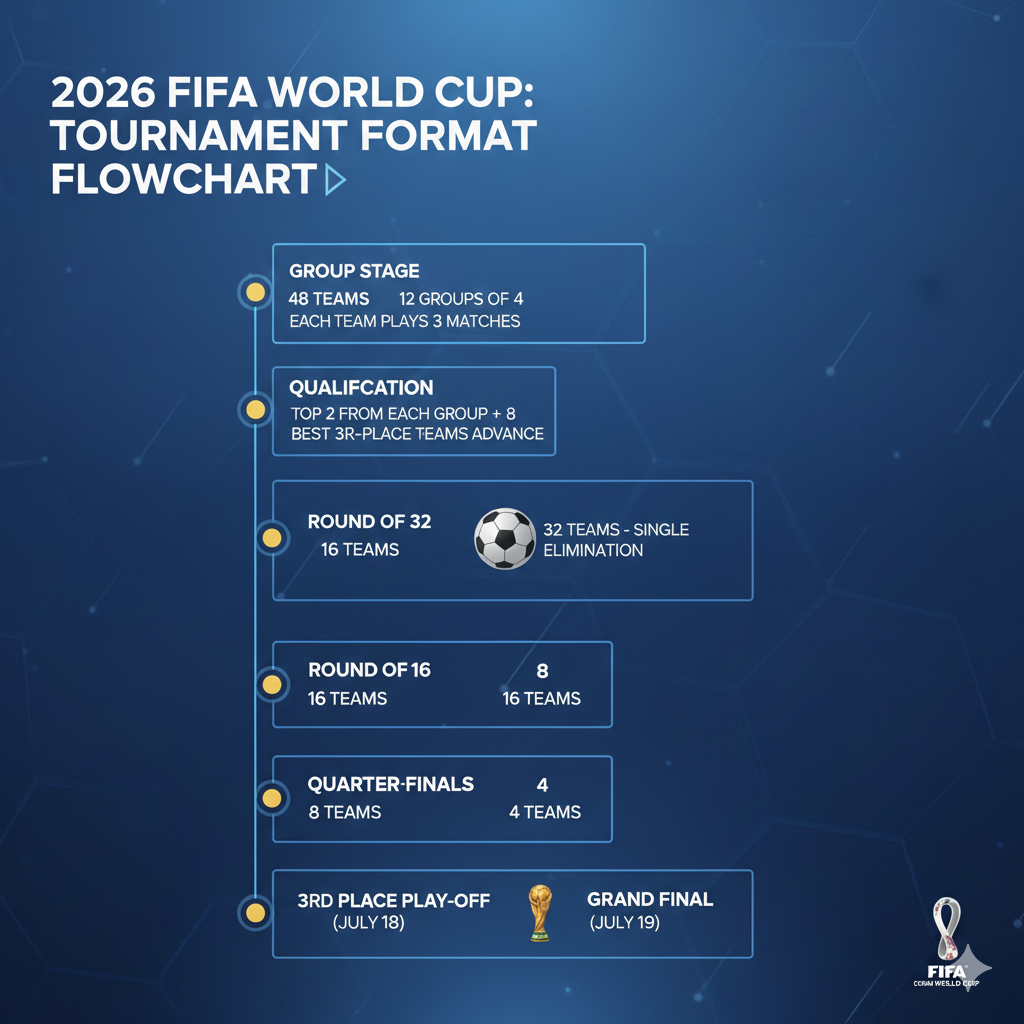
- Format: 12 groups of 4 → Round of 32 → Round of 16 → Quarterfinals → Semifinals → Final
- Opening match: Mexico vs. South Africa, Estadio Azteca, June 11
- Final venue: MetLife Stadium, East Rutherford, New Jersey, July 19
- 6 spots still to be confirmed (playoff results expected March 2026)
Snippet Block
The 2026 FIFA World Cup is the 23rd edition of the men’s football world championship, held June 11 to July 19, 2026, across 16 cities in the United States, Canada, and Mexico. For the first time, 48 teams compete in 12 groups of four, with 32 teams advancing to the knockout rounds. The final takes place at MetLife Stadium in New Jersey on July 19.
What Makes the FIFA World Cup 2026 Different?
Three things make this edition stand out from any previous World Cup.
First, the size. This is the first 48-team World Cup in history. Every previous edition since 1998 featured 32 teams. Adding 16 more nations means more global representation, more matches, and more chances for upsets.
Second, the hosts. For the first time, three countries share the tournament: the United States, Canada, and Mexico. This is the first multi-host men’s World Cup since Japan and South Korea co-hosted in 2002. Mexico becomes the only country in history to host or co-host the men’s World Cup three times.
Third, the knockout format. Because 48 teams is not a “clean” number for the old round of 16 format, FIFA introduced a new round of 32 — an entirely new knockout stage that has never existed before at a World Cup.
Tournament Dates: When Does It Start and End?
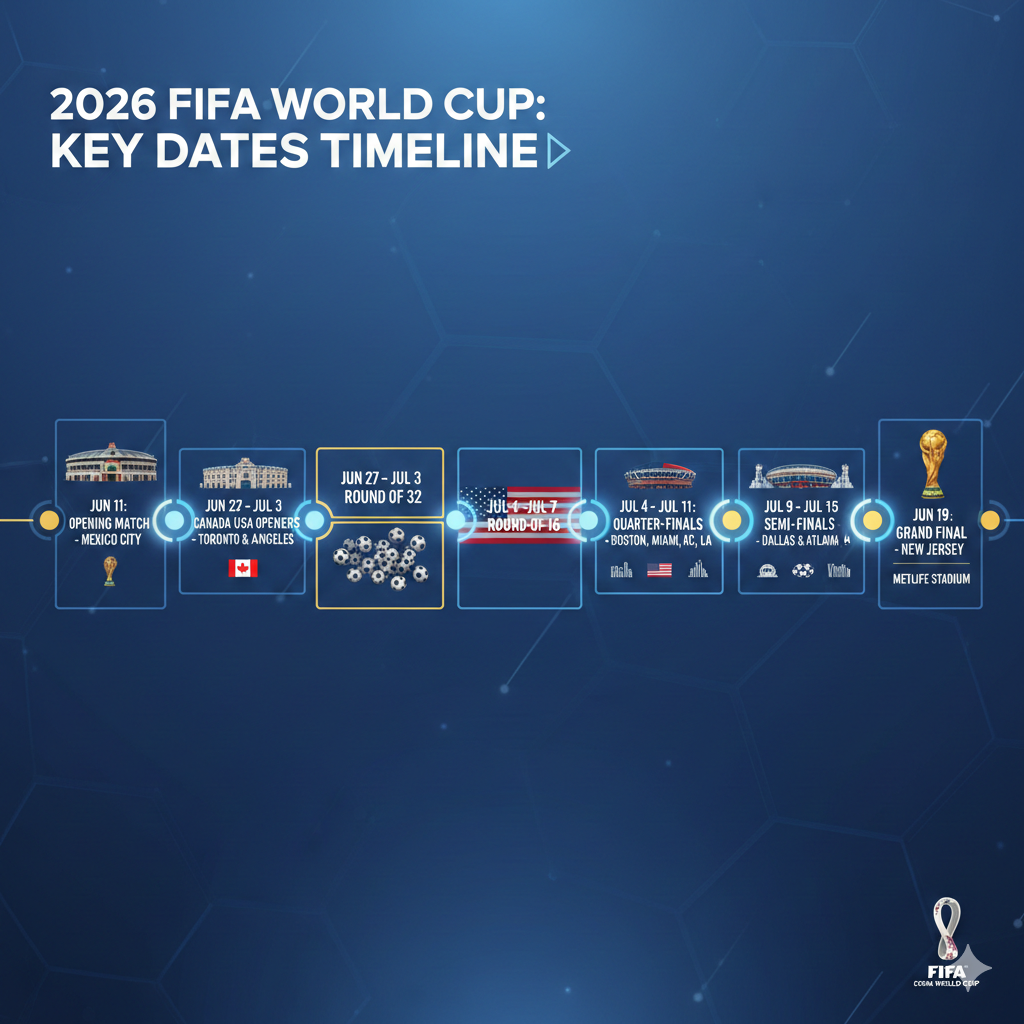
The 2026 World Cup runs for 39 days, from June 11 to July 19, 2026.
Here are the key milestone dates to mark in your calendar:
| Stage | Approximate Dates |
|---|---|
| Group Stage | June 11 – June 27, 2026 |
| Round of 32 | June 28 – July 3, 2026 |
| Round of 16 | July 4 – July 7, 2026 |
| Quarterfinals | July 9–11, 2026 |
| Semifinals | July 14–15, 2026 |
| Third-Place Match | July 18, 2026 (Hard Rock Stadium, Miami Gardens) |
| Final | July 19, 2026 (MetLife Stadium, New Jersey) |
The opening match — Mexico vs. South Africa — kicks off on June 11, 2026, at 1 p.m. local time (Mexico City) / 3 p.m. ET at Estadio Azteca in Mexico City. This is the symbolic moment the tournament begins. (Source: FIFA tournament site: https://www.fifa.com/en/tournaments/mens/worldcup/canadamexicousa2026)
As of February 2026 — dates are confirmed; exact kick-off times for all matches are subject to final broadcast confirmation.
How Does the 2026 Format Work?
The Group Stage
The 48 teams are divided into 12 groups, labeled A through L, each containing four teams. Every team plays three matches — one against each opponent in their group.
At the end of the group stage, teams in each group are ranked by:
- Points (3 for a win, 1 for a draw, 0 for a loss)
- Goal difference
- Goals scored
- Points in matches between the tied teams
- Goal difference in matches between the tied teams
- Goals scored in matches between the tied teams
- Fair play score (yellow and red card record)
- Drawing of lots (Source: ESPN format/tiebreakers explainer: https://www.espn.in/football/story/_/id/47108758/2026-fifa-world-cup-format-tiebreakers-fixtures-schedule)
Who Advances?
Thirty-two teams advance from the group stage to the Round of 32. Here is exactly how:
- 24 automatic qualifiers: The top two teams from each of the 12 groups
- 8 additional qualifiers: The eight third-placed teams with the best records across all 12 groups
This is a key point that confuses many fans. Not all third-place teams advance — only the eight best ones, ranked by their group-stage records (points first, then goal difference, then goals scored, then fair play, then drawing of lots). (Source: FIFA tournament overview and format coverage: https://www.fifa.com/en/tournaments/mens/worldcup/canadamexicousa2026)
The Knockout Rounds
Once the Round of 32 is set, the tournament becomes pure single-elimination. Lose and go home.
If a match is level after 90 minutes in the knockout phase:
- 30 minutes of extra time (two 15-minute halves)
- If still level: penalty shootout (five rounds, then sudden death) (Source: FIFA tournament regulations overview: https://www.fifa.com/en/tournaments/mens/worldcup/canadamexicousa2026)
The knockout phase runs: Round of 32 → Round of 16 → Quarterfinals → Semifinals → Final.
A Common Myth — Corrected
Myth: “With 48 teams, the tournament should have 16 groups of three.”
Reality: FIFA initially planned 16 groups of three (announced 2017), but changed course in 2023 after concerns about fairness. Three-team groups create a real risk of the final match being played when both teams already know that a draw benefits them — a situation sometimes called “collusion.” Four-team groups of 12 reduce this risk significantly. (Source: FIFA format update coverage: https://www.fifa.com/en/tournaments/mens/worldcup/canadamexicousa2026)
The 16 Host Cities
The 2026 World Cup is spread across three countries and three geographic regions. The USA hosts 11 cities, Mexico three, and Canada two.
Here is the full breakdown by region and country:
Western Region
| City | Country | Stadium |
|---|---|---|
| Vancouver | Canada | BC Place |
| Seattle | USA | Lumen Field |
| San Francisco Bay Area | USA | Levi’s Stadium, Santa Clara |
| Los Angeles | USA | SoFi Stadium, Inglewood |
Central Region
| City | Country | Stadium |
|---|---|---|
| Guadalajara | Mexico | Estadio Akron |
| Mexico City | Mexico | Estadio Azteca |
| Monterrey | Mexico | Estadio BBVA |
| Houston | USA | NRG Stadium |
| Dallas | USA | AT&T Stadium, Arlington |
| Kansas City | USA | Arrowhead Stadium |
Eastern Region
| City | Country | Stadium |
|---|---|---|
| Toronto | Canada | BMO Field |
| Boston | USA | Gillette Stadium, Foxborough |
| Philadelphia | USA | Lincoln Financial Field |
| New York/New Jersey | USA | MetLife Stadium |
| Atlanta | USA | Mercedes-Benz Stadium |
| Miami | USA | Hard Rock Stadium |
The Final will be played at MetLife Stadium in East Rutherford, New Jersey — just outside New York City. Note: MetLife Stadium is not in New York City itself; it sits across the Hudson River in New Jersey. (Source: Wikipedia final page: https://en.wikipedia.org/wiki/2026_FIFA_World_Cup_final)
The Third-Place match takes place at Hard Rock Stadium in Miami Gardens on July 18, 2026. (Source: FIFA tournament site: https://www.fifa.com/en/tournaments/mens/worldcup/canadamexicousa2026)
The USA hosts the most matches of any single country — 78 in total. Canada and Mexico each host 13. (Source: Wikipedia overview: https://en.wikipedia.org/wiki/2026_FIFA_World_Cup)
All 12 Groups: Who Is Playing Who?
The draw took place on December 5, 2025, at the Kennedy Center in Washington, D.C. The 48 teams (and six playoff placeholders) were placed into 12 groups. (Source: FIFA draw page: https://www.fifa.com/en/tournaments/mens/worldcup/canadamexicousa2026/live-draw)
Important note: Six spots were still to be confirmed at the time of the draw. Four come from the UEFA European playoffs and two from the inter-confederation playoffs — both decided in March 2026. The groups below reflect the confirmed 42 teams plus the six yet-to-qualify placeholders (marked with an asterisk).
| Group | Teams |
|---|---|
| A | Mexico (host), South Africa, Korea Republic, UEFA Playoff D winner* |
| B | Canada (host), Switzerland, Qatar, UEFA Playoff A winner* |
| C | Brazil, Morocco, Scotland, Haiti |
| D | USA (host), Paraguay, Australia, UEFA Playoff C winner* |
| E | Germany, Ecuador, Côte d’Ivoire, Curaçao |
| F | Netherlands, Japan, Tunisia, UEFA Playoff B winner* |
| G | Belgium, Egypt, Iran, New Zealand |
| H | Spain, Uruguay, Saudi Arabia, Cabo Verde |
| I | France, Senegal, Norway, Inter-Conf. Playoff 2 winner* |
| J | Argentina, Algeria, Austria, Jordan |
| K | Portugal, Colombia, Uzbekistan, Inter-Conf. Playoff 1 winner* |
| L | England, Croatia, Ghana, Panama |
*To be confirmed after March 2026 playoffs. This article will be updated when those results are known.
A Few Group Storylines to Watch
Group C — Brazil vs. Morocco: Two of the biggest draws in world football open their campaigns against each other. Brazil has not won a World Cup since 2002.
Group H — Spain vs. Uruguay: European champions Spain, ranked number one in the world, face a tough South American test in Uruguay. Spain are widely regarded as pre-tournament favorites.
Group I — France, Senegal, Norway: This group has already been flagged by analysts as among the most competitive. France are defending runners-up; Norway brings Erling Haaland in his first World Cup; Senegal are 2022 round-of-16 finishers.
Group J — Argentina vs. Algeria: Defending champions Argentina open against Algeria. This is one of the most anticipated group openers given Argentina’s status as the team to beat.
Group L — England vs. Croatia: England face the nation that knocked them out in the 2018 World Cup semifinals — a rematch with clear history behind it.
Who Are the Favorites?
This section separates analysis (our interpretation) from verified facts (rankings and outcomes). No predictions are treated as guaranteed.
Verified fact: Spain are ranked number one in the FIFA Men’s World Rankings as of November 2025. Argentina are ranked second, France third, England fourth. (Source: FIFA rankings: https://www.fifa.com/fifa-world-ranking/men)
Analysis: The teams most frequently cited by analysts as contenders to win the tournament are Spain, Argentina, France, England, Brazil, and Portugal. All six have strong squads, recent major tournament experience, and routes that — if their groups are navigated — keep them apart until deep into the knockout phase.
The bracket protection system: FIFA introduced a new rule for 2026 that places the top four ranked teams (Spain, Argentina, France, England) into separate quadrants of the knockout bracket. This means, if all four win their groups, they cannot meet each other before the semifinals. (Source: ESPN draw procedure coverage: https://www.espn.in/football/story/_/id/47096853/fifa-sets-procedure-world-cup-draw-48-teams-4-pots)
Decision Framework: Which team should I follow if I’m new to the World Cup?
- If you want to follow a historic giant with the most World Cup wins: Brazil (5 titles) or Germany (4 titles)
- If you want to follow the defending champions: Argentina
- If you want to follow the current world number one: Spain
- If you want to follow a host nation: USA, Canada, or Mexico
- If you want to follow a tournament debutant (never qualified before): Curaçao, Jordan, Uzbekistan, or Cabo Verde
- If you want to follow a dark horse (underrated with genuine potential): Morocco, Netherlands, Portugal, Colombia
First-Time Qualifiers and Milestone Stories
The 2026 World Cup is notable for several firsts.
Curaçao becomes the smallest nation by population ever to qualify for the FIFA World Cup, part of the small Caribbean island’s remarkable football journey. They will face Germany in their opening match. (Source: ESPN: https://www.espn.in/football/story/_/id/46997321/curacao-become-smallest-ever-nation-qualify-world-cup)
Jordan, Uzbekistan, and Cabo Verde each make their World Cup debut in 2026 — first appearances at the biggest stage in football. (Source: Wikipedia overview: https://en.wikipedia.org/wiki/2026_FIFA_World_Cup)
Qatar returns to the World Cup just four years after hosting it in 2022, now qualifying through the normal Asian process rather than as automatic hosts.
New Zealand secures the first-ever guaranteed World Cup berth for the OFC (Oceania Football Confederation) — in previous tournaments, OFC nations had to fight through inter-confederation playoffs for a chance to qualify. (Source: OFC qualification overview: https://en.wikipedia.org/wiki/2026_FIFA_World_Cup_qualification_(OFC))
Common Mistakes and Misconceptions — Cleared Up
“The MetLife Stadium final is in New York.”
Not quite. MetLife Stadium is in East Rutherford, New Jersey — across the Hudson River from Manhattan. The tournament refers to it as the “New York/New Jersey” venue. Plan your travel accordingly if you’re attending.
“All third-place teams advance.”
No. Only the eight best third-place teams advance. Four of the 12 third-place teams will be eliminated at the group stage despite finishing third. The ranking of third-place teams is based on points, then goal difference, then goals scored, then fair play, then drawing of lots.
“With 48 teams, there will be weaker matches.”
Weaker on paper, sometimes. But more nations means more upsets. At the 2022 World Cup (32 teams), Saudi Arabia beat Argentina and Morocco reached the semifinals. With 16 more nations at 2026, the probability of major surprises is at least as high — if not higher.
“The USA, Canada, and Mexico are automatically in the final.”
No — they qualified automatically as hosts, but they still must earn their way through the group stage and knockout rounds. Automatic qualification only means they are guaranteed a place in the tournament, not the final.
How to Follow the 2026 World Cup
If you want match-by-match previews: Check the Matches section of GOALCUP2026 for pre-match breakdowns of every game, including tactical context, key players, and what to watch for.
If you want team guides: The Teams section covers all 48 qualified nations — squad details, coach approach, strengths and weaknesses, and qualifying journey.
If you want to understand the tactics: The Tactics & Stats section explains formations, pressing systems, set piece routines, and more in plain language.
If you want to track tournament news: The News section covers verified updates only — no rumors, no speculation, no clickbait.
FAQs: Everything You’re Probably Wondering
When does the 2026 FIFA World Cup start?
The tournament begins on June 11, 2026, with the opening match: Mexico vs. South Africa at Estadio Azteca in Mexico City.
When is the 2026 World Cup Final?
The Final takes place on July 19, 2026, at MetLife Stadium in East Rutherford, New Jersey.
How many teams are in the 2026 FIFA World Cup?
48 teams — the largest field in World Cup history, expanded from the previous standard of 32.
How does the 2026 World Cup format work?
48 teams play in 12 groups of four. Each team plays three group matches. The top two from each group (24 teams) plus the eight best third-placed teams (8 teams) advance to a new Round of 32 — making 32 knockout-stage participants in total. The tournament then proceeds as single-elimination: Round of 32, Round of 16, Quarterfinals, Semifinals, and Final.
Which countries are hosting the 2026 World Cup?
Three nations: the United States (11 host cities), Mexico (3 host cities), and Canada (2 host cities). It is the first men’s World Cup to be hosted by three countries simultaneously.
Who are the co-hosts of the 2026 World Cup?
The United States, Canada, and Mexico are co-hosts. All three automatically qualified for the tournament without needing to go through standard qualifying.
Who is the defending World Cup champion?
Argentina, who won the 2022 FIFA World Cup in Qatar. They are drawn in Group J against Algeria, Austria, and Jordan.
Are there any countries making their World Cup debut in 2026?
Yes — four nations will appear at the World Cup for the first time: Curaçao, Jordan, Uzbekistan, and Cabo Verde.
Where is the 2026 World Cup Final?
MetLife Stadium in East Rutherford, New Jersey — often referred to as the New York/New Jersey stadium. The match is July 19, 2026.
How many matches will be played at the 2026 World Cup?
A total of 104 matches — up from 64 at the 2022 World Cup in Qatar.


