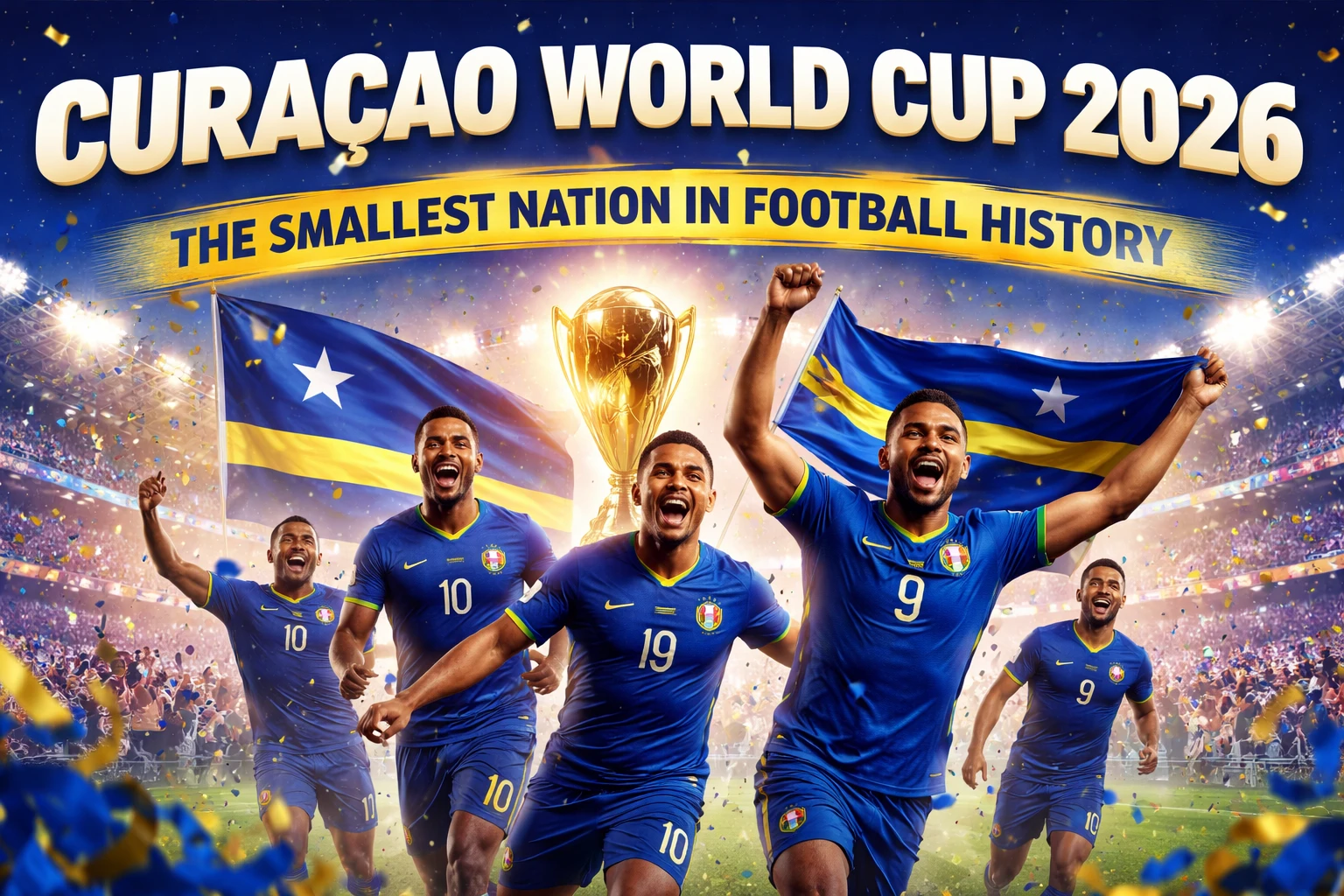

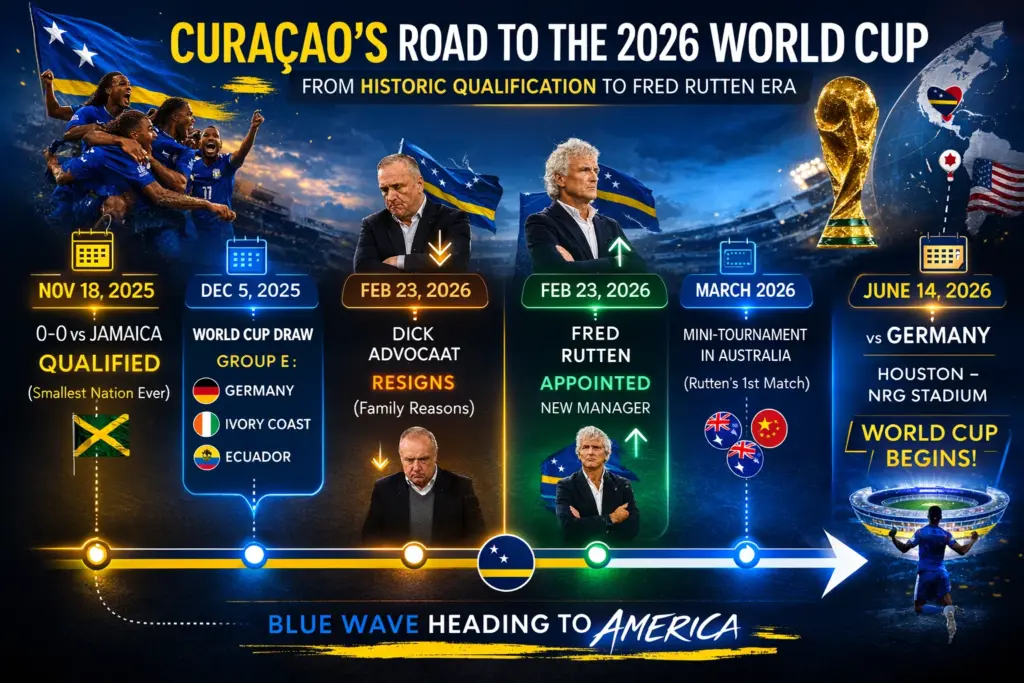
Curaçao World Cup 2026 begins with an island of 444 square kilometres — smaller than the Isle of Man — floating 60 kilometres off the coast of Venezuela. A population of 156,115 people. And on November 18, 2025, in the National Stadium in Kingston, Jamaica, they held on for a 0-0 draw. The final whistle blew. Curaçao had qualified for the World Cup.
In November 2025, during 2026 FIFA World Cup qualification, Curaçao drew 0-0 against Jamaica, making Curaçao the smallest nation by population ever to qualify for the FIFA World Cup. Reuters and FIFA both treated it as the island’s first-ever World Cup berth.
The record had belonged to Iceland, who qualified for Russia 2018 with a population of approximately 335,000. Curaçao, at 156,115, did not just break that record — they shattered it. And they did it by going the entire CONCACAF qualifying campaign unbeaten.
Now the Blue Wave face Germany, Ecuador and Ivory Coast in Group E. Their first-ever World Cup match is on June 14 in Houston. And their manager — the legendary Dick Advocaat — resigned for family reasons in February 2026, handing the job to fellow Dutchman Fred Rutten.
This is one of the most extraordinary stories of the 2026 World Cup. And it is just getting started.
TL;DR
- Curaçao qualified on November 18, 2025 — a 0-0 draw away at Jamaica sealed first place in CONCACAF Group B.
- They are the smallest nation by population (156,115) ever to qualify for the World Cup — surpassing Iceland’s 2018 record.
- Curaçao became the first team from the island to reach the FIFA World Cup finals.
- Group E: Germany (4x world champions), Ivory Coast, Ecuador, Curaçao.
- First match: June 14 vs Germany at NRG Stadium, Houston, Texas.
- Manager: Fred Rutten (63) — Dutch coach, formerly PSV, Feyenoord, and Schalke — replaced Dick Advocaat on February 23, 2026.
- Key players: Tahith Chong (Sheffield United, born in Curaçao), Juninho Bacuna, Sontje Hansen, Ar’jany Martha, Joshua Brenet.
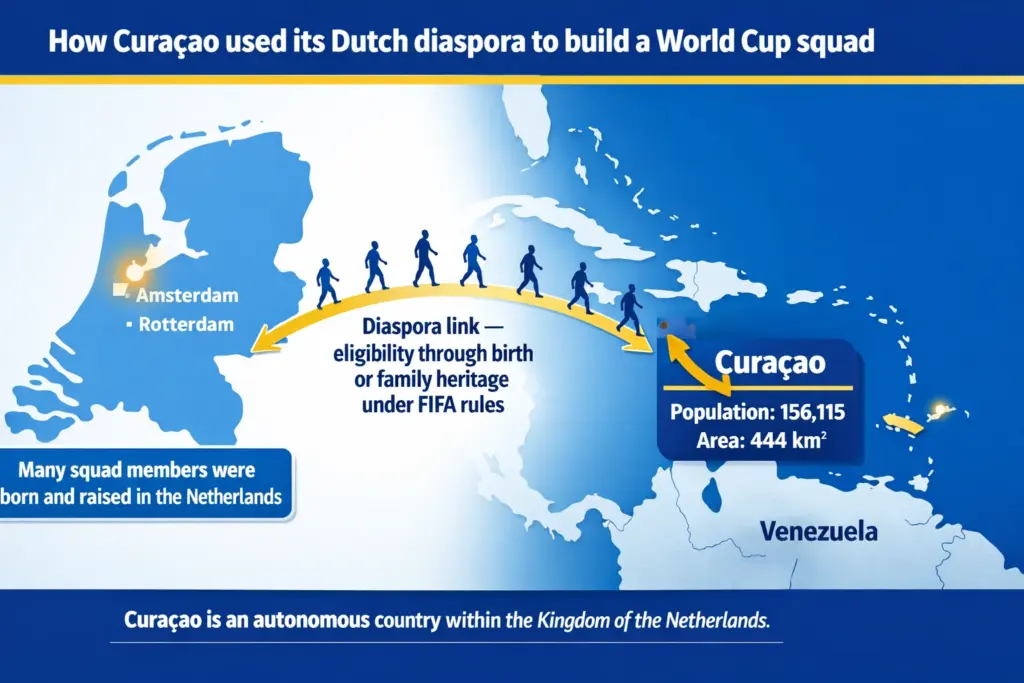
- The squad is built almost entirely from the Dutch diaspora — players born and raised in the Netherlands who chose to represent their island heritage.
- Nickname: Blue Wave (also “The Blue Family”).
Snippet Block
Curaçao qualified for the 2026 World Cup on November 18, 2025, becoming the smallest nation by population in the tournament’s history. The Caribbean island topped CONCACAF Group B unbeaten with 12 points. They are in Group E alongside Germany, Ivory Coast and Ecuador. Their first match is June 14 against Germany at NRG Stadium in Houston. Manager Fred Rutten replaced Dick Advocaat on February 23, 2026, after Advocaat resigned for family reasons.
Curaçao World Cup 2026: Dick Advocaat Has Resigned — Fred Rutten Takes Charge
Before any other part of this story is told, one thing must be acknowledged — because it happened this year.
Dick Advocaat has resigned as Curaçao’s head coach after overseeing their historic qualification for the 2026 World Cup, citing personal reasons. Reuters reported on February 23, 2026 that Advocaat had stepped down because of his daughter’s ill health and that Fred Rutten would replace him ahead of the tournament.
The 78-year-old elected to resign from his position to focus on caring for his daughter, who is dealing with ill health. Had he remained in charge, Advocaat would have become the oldest coach to lead a team at the finals in World Cup history.
In a statement issued on February 23, 2026, Advocaat said: “I’ve always said family is above football. This is therefore a natural decision. That said, I will greatly miss Curacao, its people, and my colleagues. I consider qualifying the smallest nation in the world for the World Cup one of the highlights of my career.”
The new head coach of Curaçao is 63-year-old Dutchman Fred Rutten, known for his work at PSV, Feyenoord, and Germany’s Schalke. He has promised to continue the course set by his predecessor.
Rutten said: “Dick is an icon in world football. It is truly an honour to continue his work. I have spoken extensively with him and his staff and will continue along the same path.”
Rutten will take charge of the Curaçao squad for the first time in March, when they travel to Australia for a mini-tournament with the host country and China.
Curaçao will also play a warm-up friendly against Scotland on May 30 before the World Cup begins. The management change is significant — but the mission remains the same.
Curaçao World Cup 2026: The Night Curaçao Made History
Curaçao’s CONCACAF qualifying group — Group B — contained Jamaica, Trinidad and Tobago and Bermuda. On paper, a manageable group. In practice, CONCACAF qualifying is never straightforward — the region has produced upsets, pressure-match collapses and late-drama disqualifications throughout its history.
Curaçao finished as the only undefeated nation in the final round and finished atop Group B with 12 points. They surpassed Iceland’s record when they qualified in 2018 with a population of just over 350,000.
Twelve points from six matches — all wins and draws, no defeats. Including a mammoth 7-0 win over Bermuda that announced them as the dominant force in their group from the opening stages.
The final match in Kingston was the one that mattered. Curaçao’s adventure is set to put players from unheralded clubs on the biggest stage. The squad that clinched qualification included players from England’s third tier, Turkey’s second tier and Saudi Arabian football.
The squad composition tells you everything about Curaçao’s football reality — and their ambition. These are not players from the Champions League or even Europe’s top five leagues. They are players from the third tier of English football, the second tier of Turkey, the Saudi Pro League. And they qualified unbeaten from CONCACAF qualifying.
Jamaica struck the woodwork three times in the second half in Kingston. A potentially decisive penalty kick awarded to the home team in stoppage time was overturned after a video review.
The woodwork struck three times. A penalty given then taken away. Curaçao’s goalkeeper — and the entire defensive structure Advocaat had drilled across two years — held firm. The 0-0 was enough. The group was won. History was made.
Dick Advocaat: A Lifetime in Football, One Final Chapter
To understand what Curaçao’s qualification meant, you need to understand who Dick Advocaat is.
Advocaat’s extensive career makes him one of the sport’s most experienced coaches. At 78, he would have become the oldest manager to lead a team at a World Cup, surpassing Otto Rehhagel’s previous record. Rehhagel was 71 years and 317 days old when he led Greece at the 2010 World Cup in South Africa.
Advocaat’s managerial career spans nearly four decades. He has managed the Netherlands, South Korea and Russia at World Cups as a head coach. He has won league titles in the Netherlands and Scotland. He managed Rangers, Sunderland, PSV, Zenit St Petersburg, Galatasaray, Fenerbahçe — clubs across Europe and beyond. He is, by any reasonable measure, one of Dutch football’s most decorated and widely-travelled coaches.
Dick Advocaat took charge of the Caribbean island nation in 2024 and, for the first time in its history, led the team to the World Cup finals. Reuters later quoted him calling it the “craziest thing” of his managerial career.
A man who has managed the Netherlands and South Korea at World Cups. Who has won titles across four countries. And the “craziest thing” of his career is qualifying an island of 156,115 people.
That speaks more to the scale of Curaçao’s achievement than any statistic.
His resignation — for his daughter’s health — is the right decision. His legacy is the qualification itself. And Fred Rutten arrives to honour it.
Fred Rutten: Continuing the Dutch Blueprint
Advocaat will be replaced by Fred Rutten, who will be making his first foray into international management. Rutten has spent the bulk of his career coaching in the Eredivisie, the 63-year-old enjoying spells in charge of Twente, PSV Eindhoven, Feyenoord and Vitesse. He has also coached in Germany with Schalke and in Belgium with Anderlecht.
The appointment maintains the Dutch connection that has defined Curaçao’s football identity — a Dutch coach, working with a squad predominantly built from the Dutch diaspora, representing an island that is part of the Kingdom of the Netherlands.
Rutten’s Eredivisie experience — particularly his time at PSV and Feyenoord, two of Dutch football’s most tactically sophisticated clubs — gives him the technical and organisational understanding to continue Advocaat’s defensive framework. His experience at Schalke in the Bundesliga adds familiarity with German football specifically — useful context for a team about to face Germany in their first-ever World Cup match.
Rutten has a tall task on his hands to get any points from a daunting group, with Curaçao likely to be heavy underdogs in all three games. But Rutten arrives with a clear brief: maintain the identity, maintain the shape, and give the players the best possible chance to compete.
Curaçao World Cup 2026: The Dutch Diaspora That Built the Squad
This is central to understanding Curaçao’s football — and it requires context.
Curaçao has actively recruited from its diaspora, getting permission within FIFA eligibility rules for players who once represented the Netherlands at youth or Under-21 level to switch international allegiance. Defender Joshua Brenet is the most striking case: he played a World Cup qualifier for the Netherlands in 2016 and is now part of Curaçao’s World Cup story.
FIFA’s eligibility rules allow players who have represented a national team only at youth or Under-21 level to switch international allegiance — provided they meet the eligibility criteria for the new nation through birth, parentage or residency. Curaçao has used this rule systematically and intelligently. Players who were good enough to represent the Netherlands at youth level — but could not break into the senior Dutch national team — were offered the opportunity to represent their island heritage at full international level.
The result: a squad that punches far above its weight by drawing on players developed in the Netherlands’ elite youth system — one of the best in the world — and redirecting that talent to Curaçao’s colours.
Joshua Brenet’s case is the most dramatic. He played a World Cup qualifying match for the Netherlands in 2016 — for one of European football’s historic powers — and is now preparing to play at the World Cup for Curaçao. The same tournament, different shirt, different continent of the table.
Curaçao’s Key Players
Tahith Chong is the squad’s most recognisable name internationally — a forward who came through Manchester United’s academy and now plays for Sheffield United in the Championship. Tahith Chong was born in Curaçao, making him one of the rare members of the squad with a direct birthplace connection to the island rather than a diaspora heritage link. His high-level English football experience gives Curaçao a forward capable of competing at a high level of intensity.
Juninho Bacuna provides the midfield engine — a player with experience in Dutch, English, Scottish, Saudi and Turkish football who brings the physical presence and technical reliability that CONCACAF qualifying demands.
Sontje Hansen is an attacking player with Championship-level quality — direct, quick and capable of creating danger against organised defences. His movement in behind the opposition line gives Curaçao’s counter-attacking system a threat that better-ranked opponents cannot ignore.
Ar’jany Martha represents the reality of Curaçao’s squad — a League One player who has qualified for the World Cup through a combination of talent, hard work and the unlikely opportunity that Curaçao’s eligibility recruitment provided. His story is, in microcosm, Curaçao’s story.
Joshua Brenet brings the most remarkable individual background — a defender who played qualifying football for the Netherlands in 2016 and is now preparing for a World Cup with Curaçao. His experience at the highest qualifying level, combined with his club career across Dutch and Scottish football, makes him one of the squad’s most experienced defensive options.
What Curaçao Is — and Why This Is Historic
The island of Curaçao sits 60 kilometres off the Venezuelan coast. Curaçao is a small Caribbean island situated just 37 miles off the Venezuelan coast, covering approximately 444 sq km — smaller than the Isle of Man.
The country gained autonomous country status within the Kingdom of the Netherlands in 2010 after the dissolution of the Netherlands Antilles. Before that, the island was part of the Netherlands Antilles — and the football association competed as the Netherlands Antilles until 2010.
Both FIFA and CONCACAF recognize the Curaçao national team as the direct successor of the Netherlands Antilles. Curaçao is not a sovereign independent state — it is an autonomous country within the Kingdom of the Netherlands, similar to how England, Scotland, Wales and Northern Ireland compete as separate football nations within the United Kingdom.
That is an extraordinary piece of football history. An island that became an autonomous country only 16 years ago has reached the biggest tournament in the sport.
Curaçao World Cup 2026: Group E, Germany, Ivory Coast, Ecuador — and Curaçao
Their first-ever match at the tournament will be against Germany, in Houston, on June 14. Ecuador and Ivory Coast will be their other opponents in Group E. FIFA’s official draw and match schedule confirm that Group E contains Germany, Ecuador, Ivory Coast and Curaçao, with Germany v Curaçao in Houston on June 14.
The draw placed Curaçao in arguably the most high-profile opening fixture possible for a debutant nation. Germany are four-time World Cup champions and one of European football’s most powerful nations. Playing Germany first — in Houston, in front of a massive crowd — is both an enormous challenge and an enormous opportunity for global exposure.
Germany will enter the tournament among Europe’s top contenders. Their squad — built around the Bundesliga’s elite — will be heavily favoured to win Group E. For Curaçao, the task is clear: defend resolutely, do not concede an avalanche of goals, and use the match to establish themselves on the world stage.
Ivory Coast are Africa’s most dangerous opponent in the group — a nation with a World Cup tradition and a squad capable of causing problems for any team. Curaçao’s most winnable fixture on paper may be the Ecuador game — but Ivory Coast and Ecuador are both significantly above Curaçao’s ranking, so no match will be straightforward.
Ecuador are a CONMEBOL qualifier with a physical, direct style and a strong tradition from South American qualifying. They represent Curaçao’s most realistic opportunity for a competitive result — but even here, Ecuador’s size advantage in terms of population, resources and football infrastructure is vast.
For Curaçao, the group equation is simple and honest: compete with integrity, defend with everything Rutten has inherited from Advocaat’s system, and make June 14 in Houston a day Curaçao football never forgets.
Curaçao’s Group E Fixtures
Game 1 — Curaçao vs Germany
Date: June 14, 2026
Venue: NRG Stadium, Houston, Texas
Germany. Houston. The biggest stage in world football. An island of 156,115 people against a nation of more than 80 million.
The occasion is almost surreal in its scale — but it is real. Curaçao will walk out onto the pitch at NRG Stadium on June 14, hear the anthem, see the blue and white of their flag, and play a World Cup match. Whatever the scoreline, the moment belongs to every person on the island and in the diaspora who has ever believed this was possible.
Game 2 — Curaçao vs Ivory Coast
The African power presents Curaçao with their second group challenge. Ivory Coast’s physical intensity and technical quality will test Rutten’s defensive system thoroughly. A compact shape and quick transitions will be the template — identical to the approach that kept Curaçao unbeaten through CONCACAF qualifying.
Game 3 — Curaçao vs Ecuador
The group finale. If Curaçao have points from one of the first two games — however unlikely — the Ecuador match becomes a genuine occasion. If they have not, it becomes a farewell for a nation’s first World Cup — and still historic in every sense.
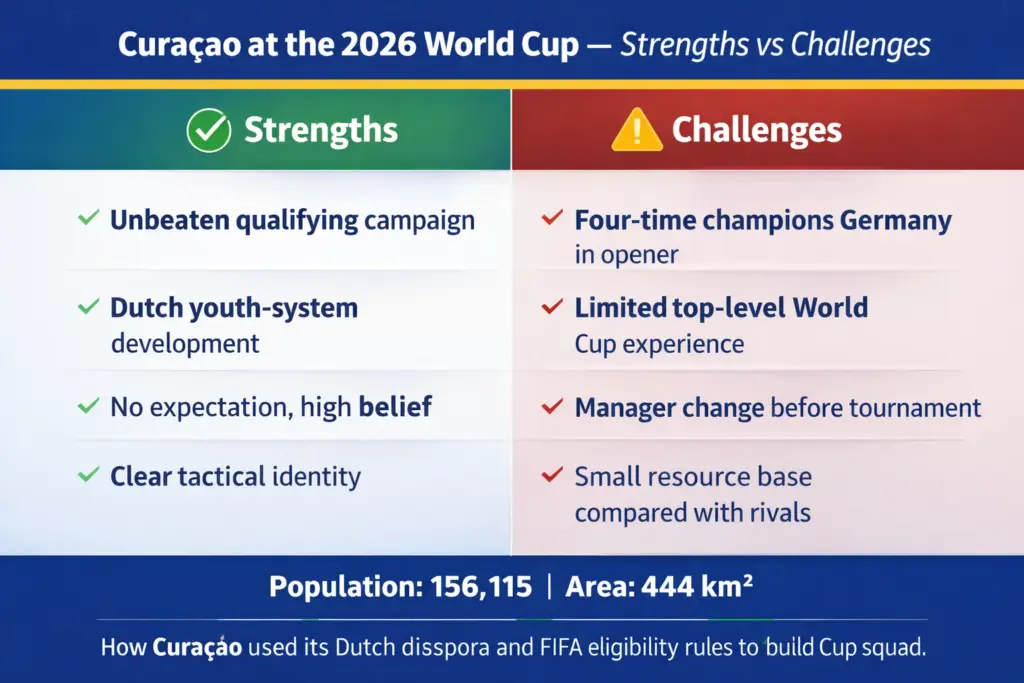
Curaçao’s Strengths and Vulnerabilities
✅ What Curaçao bring
An unbeaten qualifying record. Curaçao completed qualifying without defeat. That is not luck. That is defensive discipline, tactical organisation and the mental resilience to hold a result in pressure matches. Advocaat built it. Rutten inherits it.
Players developed in one of Europe’s best youth systems. The Netherlands’ youth football infrastructure — Ajax’s academy model, the KNVB coaching system — is among the best in the world. Players who came through that system and switched to Curaçao bring a technical foundation that their island’s domestic infrastructure alone could not produce.
Pure freedom. An island of 156,115 people facing Germany in their first World Cup match has no expectation to carry. No history of tournament disappointment. No angry fan base demanding results. Just the joy of being there — and the instinct of a well-drilled team to compete.
Dutch football intelligence. Two Dutch coaches (Advocaat built it, Rutten maintains it), a squad predominantly from Dutch football culture, and an understanding of tactical structure that reflects Netherlands football’s DNA. This is not a randomly assembled group of diaspora players — it is a coherent tactical unit.
❌ Where Curaçao can be exposed
The quality gap against Germany is enormous. Germany have Champions League regulars, Bundesliga stars and a professional infrastructure that dwarfs Curaçao’s in every metric. In open play against Germany’s pressing system, Curaçao’s squad of Championship and lower-league players will face sustained, intense pressure.
Very limited international experience at the highest level. CONCACAF qualifying — even unbeaten — does not fully prepare a squad for a World Cup group stage against Germany. The intensity, the media attention, the tactical preparation from a coaching staff with elite resources — all of it is a step up from anything Curaçao has previously experienced.
The coaching transition. Rutten arrived only a few months before the tournament. His first match in charge is a March mini-tournament in Australia. He has limited time to build familiarity with the squad before June 14. While he has promised to maintain Advocaat’s approach, any change in manager so close to a tournament introduces uncertainty.
How Curaçao Plays
Advocaat’s system — now in Rutten’s hands — is built on defensive compactness and rapid transition. The template is recognisable across every match Curaçao played in CONCACAF qualifying.
A four-man defensive unit protects the backline with Joshua Brenet and the centre-backs disciplined in their shape. The midfield sits compact in a double pivot, denying opponents the central channels that would allow them to play through. The wide players tuck in when defending, creating a mid-block that forces opponents wide.
When the ball is won, the transition is immediate and vertical. Chong, Hansen and Martha have the pace and directness to exploit space behind a high defensive line — making opponents who push forward to chase a game vulnerable.
Set pieces are a consistent source of danger. Curaçao’s physically imposing defenders become attacking threats at corners — a weapon that has produced results in qualifying and will be built into Rutten’s attacking set-piece routine.
The 7-0 win over Bermuda shows the other side of the coin — when Curaçao face a significantly weaker opponent, they can dominate possession and create through combination play. In Group E, they will not enjoy those conditions. The system will need to function primarily in its defensive and transitional mode.
Frequently Asked Questions
Has Curaçao ever been to a World Cup before?
No — 2026 is their first-ever World Cup appearance. The island competed previously as the Netherlands Antilles (1958–2010) but never qualified for the tournament under either identity.
How did Curaçao qualify for the 2026 World Cup?
Curaçao topped CONCACAF Group B with 12 points — winning three matches and drawing three — remaining unbeaten throughout qualifying. They clinched qualification with a 0-0 draw away at Jamaica on November 18, 2025.
Why is Curaçao the smallest nation ever to qualify?
With a population of 156,115, Curaçao surpassed Iceland’s record from 2018 as the smallest nation by population to reach the World Cup. They are also smaller in land area than previous qualifiers often cited in this discussion.
What group is Curaçao in?
Group E alongside Germany, Ivory Coast and Ecuador.
When is Curaçao’s first World Cup match?
June 14, 2026 vs Germany at NRG Stadium, Houston, Texas.
Who is Curaçao’s manager?
Fred Rutten (63), appointed February 23, 2026, after Dick Advocaat resigned for family reasons. Rutten previously managed PSV, Feyenoord, Twente, Schalke and Anderlecht.
Why did Dick Advocaat leave?
Advocaat resigned on February 23, 2026 to focus on caring for his daughter, who is dealing with ill health. Had he remained, he would have become the oldest manager in World Cup finals history at 78.
Is Curaçao an independent country?
No — Curaçao is an autonomous country within the Kingdom of the Netherlands, gaining that status in 2010 when the Netherlands Antilles was dissolved. It is not a sovereign independent state.
How is Curaçao’s squad built?
The majority of players were born and raised in the Netherlands, eligible for Curaçao through parentage or heritage. Several players switched eligibility from the Netherlands youth or Under-21 level under FIFA rules. Tahith Chong, a former Manchester United academy player, was born on the island.
What is Curaçao’s nickname?
The Blue Wave — also referred to by their community as “The Blue Family.”
Curaçao World Cup 2026: Key Takeaway
Curaçao’s World Cup story is about scale — the vast gap between what this island is and what it has achieved. 156,115 people. 444 square kilometres. An autonomous territory within the Kingdom of the Netherlands. And a place at the 2026 World Cup, facing Germany in Houston on June 14.
Dick Advocaat — who has managed at three World Cups for the Netherlands, South Korea and Russia — called qualifying Curaçao for the tournament the “craziest thing” of his 40-year coaching career. Then he stepped aside, because family comes before football, leaving Fred Rutten to take the Blue Wave to North America.
Whatever happens on June 14 — and the gap between Curaçao and Germany is enormous — the moment of walking out onto the pitch at NRG Stadium, hearing the anthem, and representing an island of 156,000 people on the world’s biggest stage is one that rewrites Curaçao’s football history entirely.
The Blue Wave is coming.