
2026 World Cup dark horses story is not the story of the champions — but the story of the team nobody quite believed in, right up until the moment they could not be ignored.
In 2010 it was Ghana, reaching the quarterfinals and coming within seconds of the semifinals. In 2022 it was Morocco — becoming the first African nation to reach the last four. In 2002 it was South Korea, who reached the semifinals on home soil.
The 2026 World Cup dark horses is built for exactly this kind of story. A 48-team field means more paths to the knockout rounds. The 12-group format produces eight third-place qualifiers — giving well-organized, defensively solid teams an extra lifeline. And three host nations across a continent unfamiliar with major tournament football mean that home advantage, travel fatigue for opponents, and crowd intensity will all play roles that are genuinely difficult to model in advance.
The question is not whether there will be dark horse stories in 2026. There will. The question is: which ones?
TL;DR
- Colombia: Copa America 2024 finalists, 28-match unbeaten run, Luis Díaz at Bayern, James Rodríguez still producing — CONMEBOL’s most dangerous outsider
- USA: Most European-based squad in history, home crowds, Pulisic leading a genuinely cohesive unit — home World Cups do strange things
- Japan: Qualified first from Asia, dominated qualifying, Premier League and Bundesliga core — Asia’s most complete team
- Morocco: 2022 semifinalists, same coach (Regragui), same defensive structure, same collective identity — not a dark horse by record, but still treated like one
- Ecuador: CONMEBOL qualifying proof of quality, Moisés Caicedo in midfield, Piero Hincapié at the back — built for tournament football
- Canada: Co-hosts, Alphonso Davies + Jonathan David, home crowds in Vancouver and Toronto — home advantage is real
- Senegal and Uruguay complete the eight — with AFCON tournament experience fresh and a physical style that consistently disrupts favorites
SNIPPET BLOCK
A dark horse at the 2026 World Cup is a team not expected to win the tournament but capable of reaching the quarterfinals or beyond. The eight strongest candidates are Colombia (Copa America 2024 finalists, 28-match unbeaten run), USA (most talented generation + home advantage), Japan (Asia’s most complete team), Morocco (2022 semifinalists, same coaching identity), Ecuador (CONMEBOL-hardened, Caicedo in midfield), Canada (co-hosts with Davies and Jonathan David), Senegal (AFCON experience, physical structure), and Uruguay (Copa America quality, defensive resilience). The 48-team format and three-host structure make 2026 the most unpredictable World Cup in history.
What Makes a Dark Horse? The Three Conditions
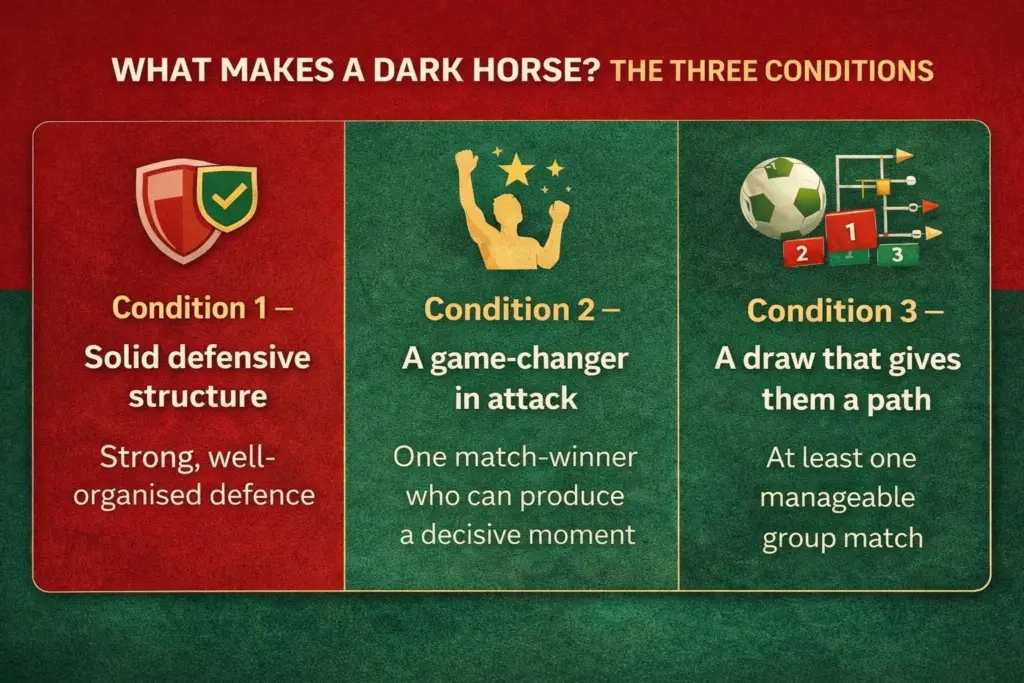
Before naming the eight teams, it helps to define what we mean. A dark horse at a World Cup is not simply a team people have heard of less. It is a team that meets three specific conditions:
Condition 1 — Solid defensive structure. Every dark horse run in recent history has been built on an organized defensive identity. Morocco in 2022 conceded the fewest goals of any team that reached the semifinals. Croatia in 2018 were compact and hard to break down. You cannot go deep at a World Cup without the ability to keep the ball out.
Condition 2 — A gamechanger in attack. Individual quality that can produce a decisive moment. This does not mean a 30-goal striker — it means one player who, on a given day, can create something from nothing against a better-organized opponent.
Condition 3 — A draw that gives them a path. The best dark horse in history cannot survive a genuine Group of Death. Tournament runs require at least one manageable group stage game and a bracket that does not guarantee a top four nation in the Round of 32.
With those three conditions in mind, here are the eight teams.
1. Colombia — The Most Dangerous Dark Horse in the Tournament
Best case scenario: Semifinal
Why they are underrated: Copa America 2024 finalists who only lost to Argentina in extra time
Colombia arrive at the 2026 World Cup as arguably the most credible dark horse in the entire field — and possibly the most underrated team in the tournament altogether.
Under manager Néstor Lorenzo, Colombia went 28 matches unbeaten — a run that included wins over Germany, Brazil, Spain, and Uruguay. It ended only when they lost the Copa America 2024 Final to Argentina in extra time.
The players: Luis Díaz, now at Bayern Munich after leaving Liverpool, is one of the best attackers in European football — ranked among the top five left wingers in the world according to FourFourTwo. He scored 19 goals in 66 international appearances and brings directness, pace, and unpredictability that elite defenses genuinely struggle with.
James Rodríguez turned the Copa America 2024 into a personal showcase — winning the tournament’s Golden Ball as its best player and orchestrating the run to the final. He will be 35 at the 2026 World Cup, and his club form has been inconsistent, but at international level he consistently elevates — and Colombia’s system is built around his creative intelligence. As of February 2026, he has signed for MLS club Minnesota United.
The squad depth beyond those two is genuine: Richard Ríos (Benfica), Daniel Muñoz, Jhon Lucumí, Jefferson Lerma, and Jhon Arias form one of CONMEBOL’s most well-organized supporting casts.
The concern: After the Copa America high, Colombia’s qualifying form dipped — losing four matches including to Bolivia, Uruguay, Ecuador, and Brazil. The lack of a reliable central striker (the “Jhon Duran problem” — high ceiling but inconsistent output) means they can be nullified if their wide outlets are closed.
The verdict: If Díaz is fit and firing, and James Rodríguez has his best tournament, Colombia can beat anyone on a given day. They have done it before — against Germany, Spain, Brazil. They reached a major tournament final in 2024. Anyone writing them off as a “nice story” is making a mistake.
2. USA — Home World Cups Do Strange Things
Best case scenario: Quarterfinal
Why they are underrated: The most European-based American squad in history, on familiar soil
Home World Cups have a habit of producing results that make no rational sense. South Korea went to the semifinals in 2002. France won in 1998. Argentina were champions in 1978. The host nation advantage — altitude, familiarity, crowd, reduced travel, emotional momentum — is one of the most consistently powerful forces in major tournament football.
The USA enters 2026 with its most talented generation ever. This is not a squad built on MLS experience and hope — it is a squad of European professionals. Christian Pulisic (AC Milan), Tyler Adams, Weston McKennie (Juventus), Gio Reyna, Yunus Musah, and Folarin Balogun all bring consistent experience in elite European competition.
The tactical identity: The USMNT has developed a clearer identity under recent management — structured pressing, controlled build-up, improved defensive rotations, and genuine set-piece threat. This is not the chaotic American team of ten years ago.
Home advantage specifics: Group stage matches in Kansas City, Los Angeles, and the New York/New Jersey area mean the USMNT will play in front of sold-out hostile-to-opponents atmospheres at venues they know. Reduced travel compared to European teams making transatlantic journeys is a genuine physical advantage by the knockout rounds.
The concern: The USA has never progressed past the Round of 16 at a major tournament outside of 2002. Tournament management — absorbing pressure when a plan does not work — remains unproven at this level. And their group assignment matters enormously: a favorable draw could see them into the Round of 32 with confidence; a tough draw could end their run early.
The verdict: Do not underestimate what home advantage means psychologically for a team that will have 70,000 people roaring them forward. If the USMNT get through their group with momentum, a quarterfinal is genuinely achievable.
3. Morocco — The Dark Horse That Proved It Already
Best case scenario: Semifinal (repeating 2022)
Why they are underrated: Still treated as an upset candidate despite being proven semifinalists
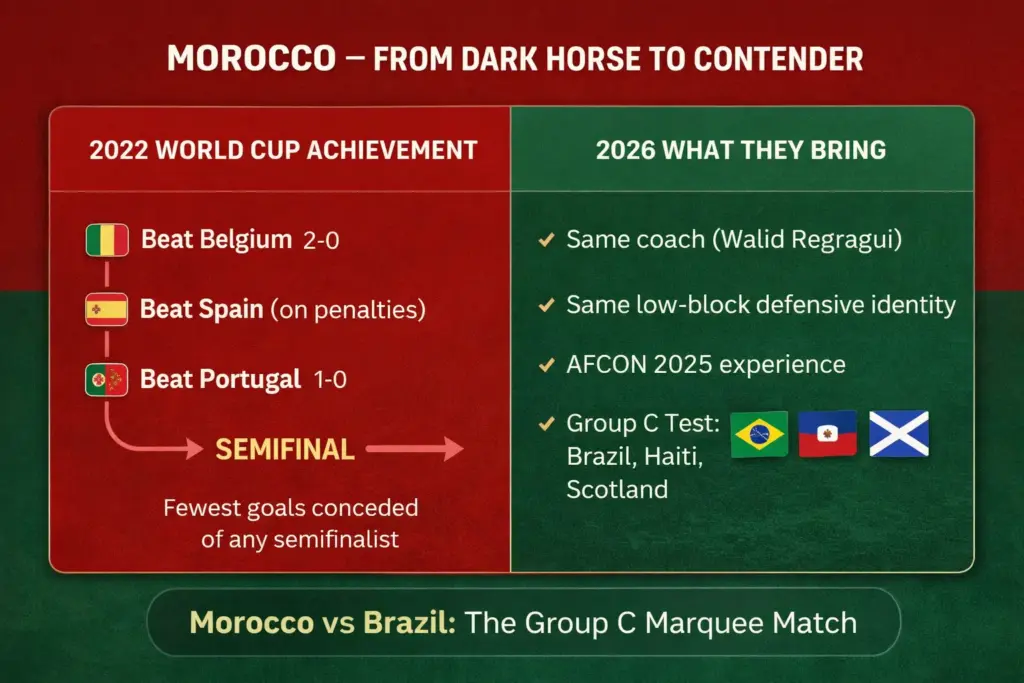
Calling Morocco a dark horse in 2026 feels almost inaccurate — because they have already shown what they can do. In Qatar 2022, Morocco became the first African nation to reach a World Cup semifinal. They beat Belgium, Spain (on penalties), and Portugal on their way there, conceding the fewest goals of any team that reached that stage.
What makes 2026 different is that Morocco arrives with the same coach (Walid Regragui), the same defensive collective identity, and the same refusal to play anything other than their own game. The 2022 run was not a fluke — it was the product of a specific tactical system executed with remarkable discipline.
The players: Achraf Hakimi (PSG) remains one of the best attacking right backs in world football. Hakim Ziyech provides creativity and set-piece quality. Youssef En-Nesyri leads the line. The midfield collective — Sofyan Amrabat has been widely linked to big clubs — operates as a compact, disciplined pressing unit.
Group C reality: Morocco face Brazil, Haiti, and Scotland. Brazil is the genuine test — a marquee Group C fixture that Post #15 identifies as one of the group stage’s marquee matches. Beat Brazil (or even draw while winning the other two), and Morocco are through as group winners or strong second.
The concern: The margin between their 2022 run and a very different story was small. They were eliminated by France in the semifinal — and two of the favorites (France, Spain) could again be in their knockout path. The system works when everyone is fit and the collective is intact. Any key injury disrupts the balance.
The verdict: Morocco are the one “dark horse” that has already proven they belong. Treat them as a guaranteed top-16 side and a genuine quarterfinal threat.
4. Japan — Asia’s Most Complete Team
Best case scenario: Round of 16 minimum; quarterfinal if bracket is kind
Why they are underrated: Qualifying dominance treated as regional achievement rather than genuine signal
Japan became the first nation to qualify for the 2026 World Cup — clinching their place with a 2-0 win over Bahrain in March 2025. That early confirmation is not just a calendar fact — it reflects how clearly superior Japan were in Asian qualifying.
The squad: Japan’s transformation from an MLS-and-J-League reliant side to a Premier League and Bundesliga core is one of football’s underreported stories of the last five years. Takefusa Kubo (Real Sociedad), Wataru Endo (Liverpool captain in Premier League), Kaoru Mitoma (Brighton) — the starting lineup reads like a mid-table European top-flight team playing together for their country.
The tactical identity: Japan play structured pressing with a clear out-of-possession identity, comfortable in both possession-based and transition moments. They are “well-balanced and dominated qualifying in Asia” according to NBC Sports’ World Cup analyst.
2022 precedent: Japan beat Spain and Germany in the 2022 group stage — not on penalties, not via a lucky break, but through tactical adjustments and collective execution. They were eliminated in the Round of 16 on penalties by Croatia, having led 1-0 at halftime.
The concern: Asian qualifying, however complete, is still Asian qualifying. The step up to knockout tournament football against South American or European opponents remains Japan’s consistent ceiling challenge. The squad also dealt with internal squad management issues in 2024 — the removal of Junya Ito from the Asian Cup squad for team focuses reasons — suggesting off-pitch management remains a variable.
The verdict: Japan are the most underrated team in the tournament. If their bracket gives them a manageable Round of 32 opponent, a quarterfinal is not impossible — they beat Spain and Germany in 2022. Do not be surprised.
5. Ecuador — CONMEBOL’s Proven Survivors
Best case scenario: Round of 16; quarterfinal if form peaks
Why they are underrated: Qualifying consistency dismissed as “boring” rather than recognised as quality
Ecuador qualified for the 2026 World Cup by securing 25 points with two matches remaining — with a 0-0 draw against Peru being enough to confirm their place in June 2025. CONMEBOL qualifying is the most unforgiving qualifying process on earth — every match against a South American nation is a full international against a competitive opponent. Finishing with 25 points is not an accident.
The players: Moisés Caicedo (Chelsea) is one of the best defensive midfielders in the Premier League — a relentless box-to-box presence who controls tempo and disrupts opponents’ rhythm. Piero Hincapié (Bayer Leverkusen) provides the defensive backbone. Together, they anchor what is one of international football’s most organized midfield and defensive units.
The style: Ecuador are not flashy. They are built on defensive solidity, disciplined pressing, wide-channel speed, and midfield aggression. They “do not apologies for physicality — they hunt in packs, then hit you in transition.” This is precisely the profile that consistently troubles favorites who expect space and possession against opponents who should theoretically be inferior.
The concern: Ecuador lack a world-class striker. Their attack functions through collective movement and wide creativity rather than individual finishing quality — which becomes a problem if they need to break down a defensively organized opponent in a knockout match.
The verdict: Ecuador are the classic dark horse that nobody watches carefully until they are 1-0 up against a big nation. Caicedo alone justifies monitoring them closely.
6. Canada — The Co-Host With Alphonso Davies
Best case scenario: Round of 16; quarterfinal if home crowds propel them
Why they are underrated: First World Cup since 1986 creates low expectations from outside observers
Canada co-hosts the 2026 World Cup. Their group stage games in Vancouver and Toronto will be played in front of sold-out crowds of passionate Canadian fans — a home tournament dynamic that has historically elevated host nations beyond their seeding.
The players: Alphonso Davies (Bayern Munich) is arguably the most dynamic left back in world football when fit — a player who “can flip a match with one run.” Jonathan David (one of Europe’s most consistent scorers across his career) provides the finishing quality. Their combination — Davies providing pace and width, David providing goals — is a genuine threat.
The result that matters: Canada beat the USA 2-1 in the CONCACAF Nations League third-place match in March 2025, with Jonathan David scoring the winner — evidence that big moments do not frighten them, and that their rivalry with the USA (who are also co-hosting) is genuinely competitive.
The concern: Canada’s first World Cup since 1986 means they have no recent major tournament experience to draw on. Managing the emotional weight of a home tournament — the expectation, the scrutiny, the weight of a nation watching — is an entirely different challenge from qualifying matches. And their group assignment will largely determine how far they can go.
The verdict: Home crowds are the most powerful performance-enhancing force in tournament football. Canada should advance from their group, and if they do with momentum, a home crowd pushing them through the Round of 32 is not fantasy.
7. Senegal — Africa’s Physical Force
Best case scenario: Round of 16; quarterfinal possible
Why they are underrated: Grouped with France and Norway — if they survive, the bracket opens
Senegal arrive at the 2026 World Cup as AFCON 2021 champions (claimed in early 2022) — and with a style that consistently disrupts opponents who expect comfort. They “win the physical battle without making it a circus — defend with strength, then attack with speed.”
The AFCON advantage: Africa Cup of Nations in late 2025 means Senegal’s squad enters the 2026 World Cup with recent tournament experience — the rhythm of knockout football, the squad cohesion of competing together, and the confidence of having performed on the continental stage within the six months before the World Cup. NBC Sports specifically cited this as a genuine advantage for African teams.
The structural quality: Their Copa America 2024 group stage showed a floor that sits above most expectations — finishing group play with three wins from three in the early 2024 AFCON run demonstrates collective organization that does not depend on a single individual.
Group I challenge: Senegal are in Group I with France, Norway, and a playoff winner. If France and Norway take the top two spots, Senegal must compete as a third-place qualifier — which is possible under the new 2026 format but adds pressure.
The verdict: Senegal are the dark horse that physically bullies whoever stands in their way. In a tournament where favourites arrive tired and jet-lagged, Senegal’s relentless style punishes teams that switch off for a moment.
8. Uruguay — The Team That Never Goes Quietly
Best case scenario: Round of 16; quarterfinal if Núñez fires
Why they are underrated: Veteran spine dismissed as “past it” — but still dangerous
Uruguay won the Copa America’s opener in 2024 with a 3-1 win over Panama — and they “showed how sharp they look even when the opponent creates moments.” They secured their World Cup qualification with a 2-0 win over Venezuela in June 2025.
Uruguay do not play pretty football. They “bring a knife to every midfield duel — they hunt in packs, then hit you in transition.” Darwin Núñez (Liverpool) provides the physical attacking threat. Rodrigo Bentancur and Federico Valverde provide world-class midfield quality. José Giménez and Ronald Araújo anchor one of international football’s most physically imposing defensive units.
The concern: The veteran spine — the Suárez/Cavani generation has gone — and the replacement generation has not yet been tested at a full World Cup. The transition from “proven experienced squad” to “younger squad with talent” is where Uruguay’s consistency historically wavers.
The verdict: Uruguay are football’s most reliable overachievers. They reach quarterfinals with squads that have no business being there — and they will do it again.
The 2026 Format: Why Dark Horses Have Never Had It Better
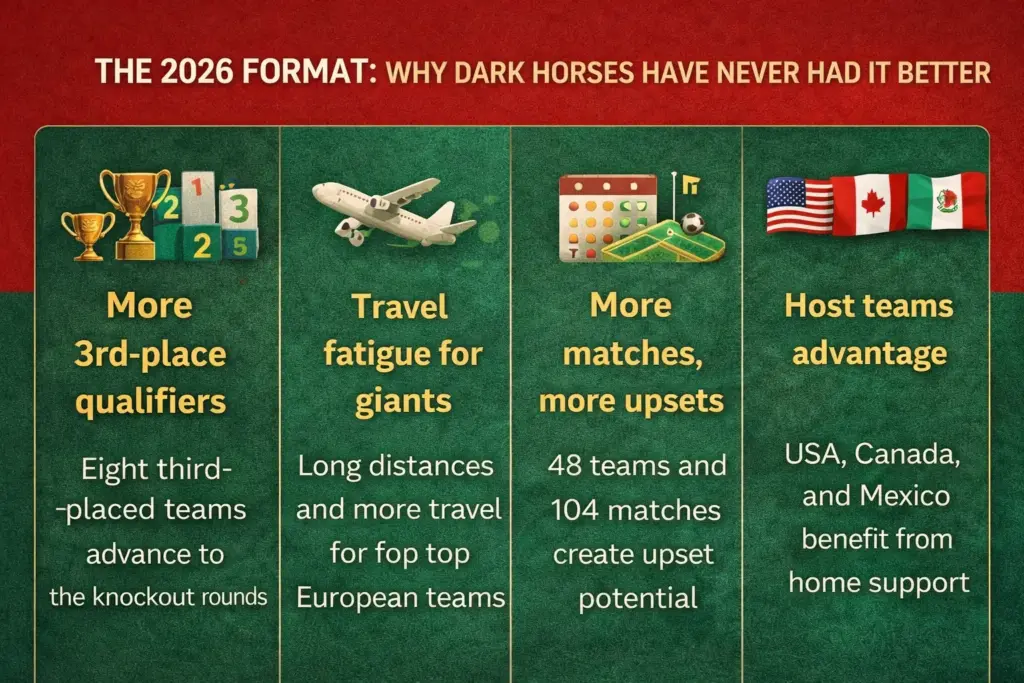
The 48-team format is not just a bigger tournament. It is structurally different in ways that specifically help well-organized outsiders:
Eight third-place qualifiers. A team that finishes third in their group — even without winning or drawing many matches — can still advance if they are among the eight best third-place finishers. A dark horse only needs to avoid last place. In a group of four, that is a lower bar than under the previous 32-team format.
Travel fatigue works against giants. European teams travel transatlantic to reach North America. They then travel between venues in the USA, Canada, and Mexico across a tournament that spans 39 days. A South American or CONCACAF team travels regionally — a meaningful physical advantage in the late rounds.
More matches equals more upset opportunities. 104 matches means more moments where a tired favourite meets a fresh, motivated outsider on a given day. The more matches played, the more the law of averages works in favour of surprise.
Home advantage is real. USA, Canada, and Mexico all benefit from home crowds. Teams from the Americas who face them have a shorter psychological distance to navigate than European giants playing in completely unfamiliar cultural environments.
Common Mistakes: Who Is NOT Actually a Dark Horse
Portugal. Portugal have Ronaldo, Bruno Fernandes, Rúben Dias, and Rafael Leão. They regularly reach World Cup quarterfinals. Calling them a dark horse is confusing “underdog” with “not the absolute favorite.” They are a genuine contender.
Germany. Rebuilding, yes — but with Florian Wirtz, Jamal Musiala, and a Nagelsmann system that performed impressively at Euro 2024. Germany at a World Cup with Wirtz and Musiala in form is not a dark horse. They are a contender with a caveat.
Belgium. A team with De Bruyne and a golden generation in its final chapter is not an underdog — it is a fading contender. Different category.
Mexico. As a co-host with CONCACAF home advantage, Mexico carry real tournament electricity — but being a co-host with significant historical pedigree makes them a home contender, not a classic dark horse.
FAQs: 2026 World Cup Dark Horses
What is a dark horse at the World Cup?
A dark horse is a team not expected to win the tournament but capable of surprising, better-ranked opponents and advancing further than pre-tournament predictions suggest. The term comes from horse racing — a horse with unknown or underestimated form.
Has a dark horse ever won the World Cup?
Technically, no — every World Cup winner since 1978 was either a favorite or a strong contender before the tournament. However, some winners — like France in 1998 or Germany in 1954 — were not the absolute pre-tournament favorites. The last four winners (Argentina, France, Germany, Spain) were all predicted as serious contenders before kick-off.
Why is Morocco considered a dark horse if they reached the 2022 semifinal?
Morocco are still seeded and treated by many analysts as an outside bet because they have never won or come close to winning a World Cup. Despite the 2022 run, global odds markets and mainstream predictions still position them outside the “first tier” of contenders. In that sense, they are a dark horse by expectation — even if not by evidence.
Can the USA actually win the 2026 World Cup?
To win would require beating multiple top five nations in consecutive knockout matches. That is possible but unlikely based on squad quality comparisons. The realistic ceiling for the USA is quarterfinal — which would be their best World Cup result outside the unusual 2002 tournament. Home advantage helps, but it does not close the quality gap entirely.
Why is Ecuador a dark horse — aren’t they in CONMEBOL with the big nations?
That is exactly why. Surviving CONMEBOL qualifying — which includes matches against Brazil, Argentina, Uruguay, and Colombia — with 25 points proves Ecuador can compete against elite opposition. They are a dark horse not because they are weak, but because global audiences underestimate South American qualifying as a quality benchmark.
Which dark horse has the best chance of reaching the semifinal?
Among the eight, Colombia and Morocco have the strongest cases. Colombia reached the Copa America 2024 Final (losing only to Argentina in extra time). Morocco reached the 2022 World Cup semifinal. Both have clear tactical identities, world-class individual quality, and proven experience of beating elite nations.
Does the 48-team format help or hurt dark horses?
It helps. Eight third-place qualifiers advance, creating more survival paths. More matches mean more upset opportunities. Travel fatigue accumulates more severely for European giants. The format was explicitly designed to include more nations — and that inclusion structurally benefits well-organized outsiders.
Which dark horse should I watch in the group stage?
Colombia in their group (watch for Luis Díaz and whether James Rodríguez hits form), Japan against whoever their toughest group opponent is (they beat Spain and Germany in 2022), and Morocco vs Brazil in Group C — one of the tournament’s most anticipated group stage matches.