
France arrives at the 2026 World Cup as the only team in the tournament who have appeared in the last two World Cup finals. They won one. They lost the other on penalties — a 3–3 draw against Argentina in Qatar that produced one of the greatest finals in football history.
The 2026 World Cup in North America is Didier Deschamps’ last tournament — he confirmed his contract ends after the competition and will not be renewed. It is also the tournament where France can become only the third nation in history to appear in three consecutive World Cup finals. And it is the stage on which Kylian Mbappé — 12 goals in 14 World Cup matches, one short of France’s all-time World Cup scoring record — arrives with an attacking unit that most analysts consider the most dangerous in the tournament.
This preview covers everything you need to understand France at the 2026 World Cup — how they play, who their key players are, what Group I holds, the weight of Deschamps’ swansong, and a realistic assessment of whether France can finally complete their back-to-back bid.
TL;DR
- Manager: Didier Deschamps — in charge since 2012; 2026 confirmed as his final tournament
- FIFA ranking: #3 in the world (behind Spain and Argentina)
- Group I: Senegal, Norway, and inter-confederation playoff 2 winner (Bolivia/Iraq/Suriname)
- Formation: 4-2-3-1 — Mbappé as striker; Dembélé and Olise wide; double pivot Tchouaméni + Camavinga
- The headline: Mbappé vs Haaland — June 26, Gillette Stadium, Boston — the tournament’s most anticipated group stage match
- The record chase: Mbappé needs 1 goal to equal France’s World Cup scoring record (Fontaine, 13)
- The Dembélé subplot: 2025 Ballon d’Or winner returning from early-season injury to prove it was no fluke
- The historical goal: Three consecutive World Cup finals — only West Germany and Brazil have done it
SNIPPET BLOCK
France enter the 2026 FIFA World Cup ranked #3 in the world under manager Didier Deschamps — his confirmed final tournament after 13 years in charge. As 2018 World Cup winners and 2022 runners-up, France are attempting to become only the third nation to reach three consecutive World Cup finals. They are in Group I alongside Senegal, Norway, and the inter-confederation playoff winner. Their squad is built around captain Kylian Mbappé (12 World Cup goals, one short of France’s all-time record), 2025 Ballon d’Or winner Ousmane Dembélé, and an emerging generation including Michael Olise and Rayan Cherki. France plays a 4-2-3-1 with a Real Madrid double pivot of Tchouaméni and Camavinga.
Part 1: The Manager — Didier Deschamps’ Swansong
Didier Deschamps has been managing France since 2012. In that time, he has won the World Cup (2018), reached the World Cup Final (2022), and consistently maintained France as a top-three international team across a 13-year period that most international managers would consider a complete and successful career.
He is now 57 years old, and he has confirmed publicly that his contract ends after the 2026 World Cup — he will not be extending it. The 2026 tournament is his deliberate farewell. His swansong.
That context matters for how you watch France in 2026. Deschamps is not building for the future or managing a transition. He has a specific window — eight matches, at most — and a squad that he has assembled and refined across years of careful work. He is managing for one outcome: a World Cup title to end his tenure at the highest possible note.
His achievement in simply reaching consecutive World Cup Finals is underappreciated because the results — 2022 especially — overshadow the process. No team loses a World Cup Final 4–2 on penalties after scoring three goals in regulation and extra time without extraordinary quality being present. France did not lose that Final because they were inferior; they lost it because Argentina was exceptional.
“Deschamps is loaded with options at virtually every position,” Yahoo Sports noted after the December 2025 draw — a summary that reflects both the depth of French football and the quality of talent assembled under his stewardship.
His selection philosophy is consistent, well-established, and pragmatic. He builds around a defensive foundation, uses a double pivot to protect the backline, and liberates his attacking players — particularly Mbappé — to express themselves without defensive burden. He managed the criticism of that approach throughout the Griezmann era and through the Benzema-Mbappé tensions that briefly complicated the squad dynamic. He will manage whatever selection pressures arise in 2026 with the same calm authority.
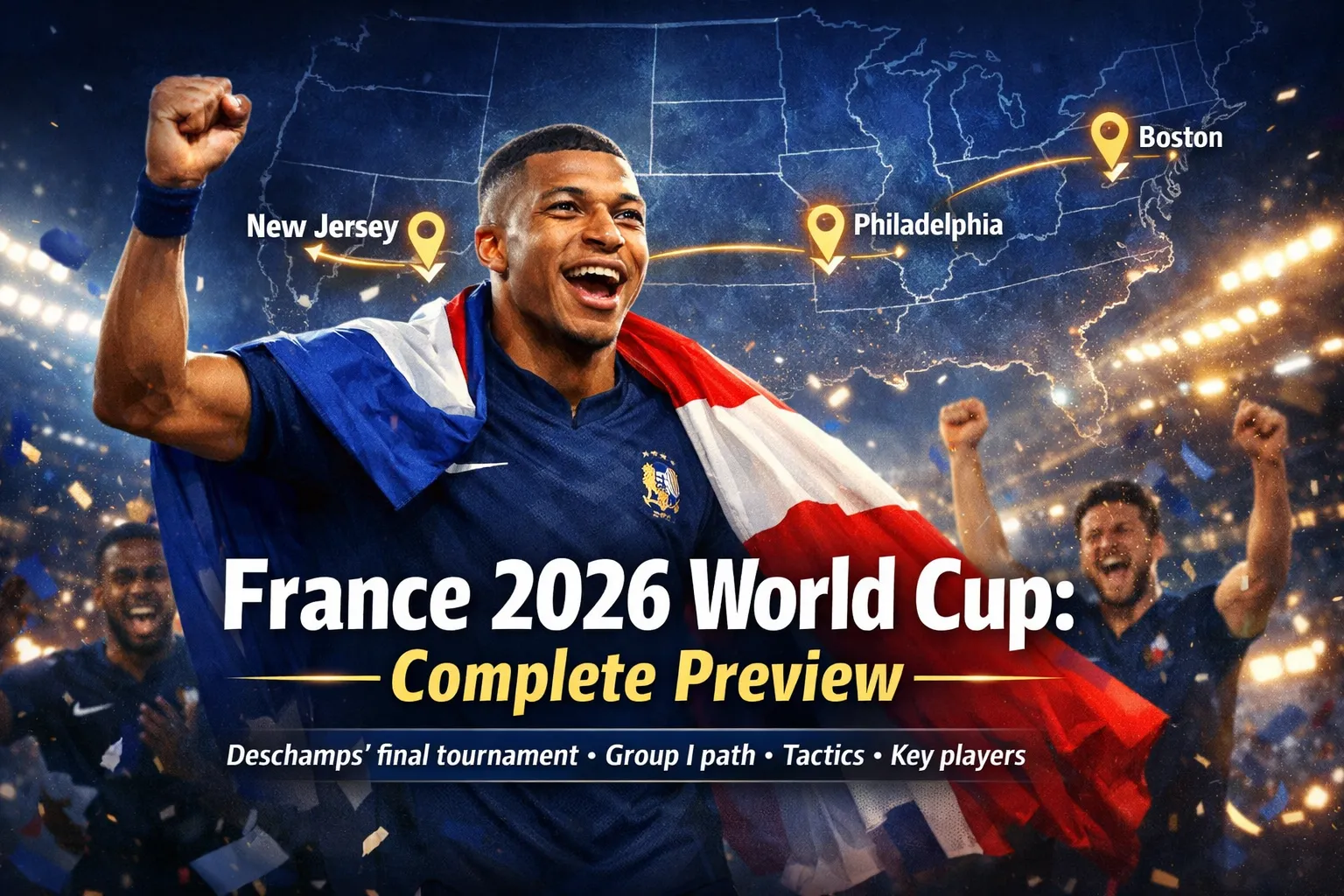
One specific note on France’s group stage preparation: all three of France’s Group I matches are in the Eastern region — New Jersey (vs Senegal), Philadelphia (vs playoff winner), and Boston (vs Norway). No cross-continental travel during the group stage. For a squad managing fitness across a long tournament, this logistical advantage is real and worth factoring into their preparation quality relative to teams who play group matches across multiple time zones.
Part 2: How France Play — Formation and Tactics
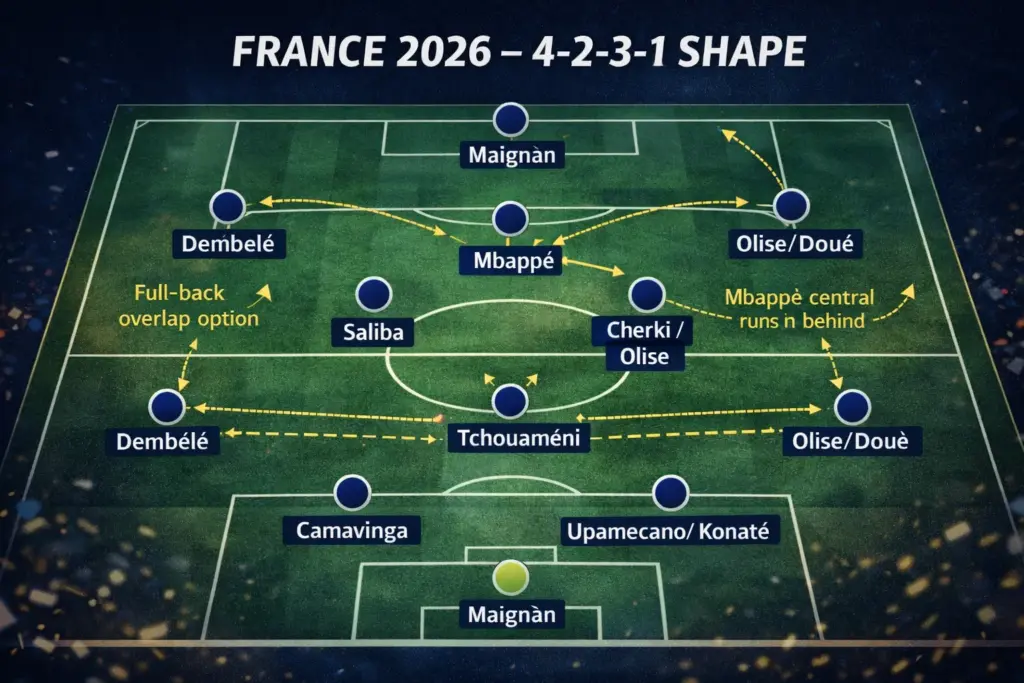
The Formation: 4-2-3-1
France’s base shape under Deschamps is a 4-2-3-1. In practice, the system operates with considerable flexibility — particularly in the attacking positions, where Mbappé, Dembélé, Olise, Doué, and Cherki can shift between roles depending on the opponent and game state.
The defensive foundation:
France’s qualifying record illustrated the defensive solidity that underpins everything: they allowed just 23 shots across six qualifying matches — an extraordinary figure that reflects how well the double pivot and the defensive shape functions.
Deschamps’ 4-2-3-1 keeps two midfielders sitting in front of the defensive line at all times. Tchouaméni provides the primary defensive shield — breaking up transitions, winning second balls, and giving the center-backs protection when France’s full-backs push forward. Camavinga provides more dynamic, box-to-box energy — carrying the ball forward, arriving into attacking positions, and providing the system’s athletic engine.
The attacking flexibility:
Above the double pivot, France have a selection headache that most international managers would welcome: too many world-class attacking options for the available positions.
The central attacking midfield role — vacated by Griezmann’s international retirement after Euro 2024 — is where the most genuine uncertainty exists. Rayan Cherki (Manchester City) is currently the favored option, with nine goals and seven assists in a rotational role at City this season. He provides exactly what the role requires: finding space between the lines, holding the ball under pressure, and distributing to the wide attackers around him.
Olise provides an alternative that gives Deschamps a different attacking profile — coming inside from the right and contributing directly to goals rather than primarily creating. His Bayern Munich form (nine goals and nine assists in 16 Bundesliga games) makes him impossible to ignore.
The Mbappé question: striker or wide?
Mbappé starts as France’s center-forward — the lone striker in the 4-2-3-1 system. But Deschamps rotates his attackers. Both Mbappé and Dembélé have been playing as striker for their respective clubs — the question of which begins in which position is genuinely open.
Bleacher Report’s analysis notes that Deschamps “is likely to deploy Dembélé in a way that actually sees him rotating with Mbappé during matches — the PSG star is a better crosser from wide than his teammate, so may well begin in that position.” The flexibility to switch their positions mid-match without losing shape or quality is a tactical asset most other nations cannot replicate.
France’s pressing and transition play:
When Deschamps has the right personnel available and motivated, France press high and counter-attack at extraordinary speed. Mbappé’s acceleration in transition is one of football’s most dangerous individual weapons — he consistently covers the distance from receiving position to goal faster than almost any other player alive. The wide attackers (Dembélé, Doué, Olise) provide the width that stretches defences and creates the space Mbappé exploits centrally.
Part 3: France’s Key Players
Kylian Mbappé — The Record-Chaser
Age at tournament: 26 — Club: Real Madrid — Group: I
France’s captain arrives at the 2026 World Cup with 12 goals in 14 World Cup matches — one short of Just Fontaine’s France all-time World Cup scoring record of 13, set across the 1958 tournament.
He can also match Cafu’s record of three consecutive World Cup final appearances (1994, 1998, 2002). If France reach the 2026 Final, Mbappé joins that list.
In 2025-26 at Real Madrid, he has scored 38 goals in 30 games — the most productive rate of any season in his already extraordinary career. He finished as La Liga’s top scorer the previous season.
The 2022 World Cup Final remains the defining moment of his international career to date — hat-trick in the final, France still lost. He had done everything individually that a player can do, and it was not enough. The 2026 World Cup is his second full opportunity to win the trophy his performances consistently suggest he deserves.
What to watch for: Mbappé’s runs in behind the defensive line — the moment when France plays into his feet and he turns to run at full pace toward goal. Also watch the Mbappé-Dembélé combination: when Dembélé has the ball wide and Mbappé makes a run inside the penalty area, the timing between them is elite-level. The June 26 match against Norway — and specifically against Haaland’s defensive workload — is the group stage’s defining individual matchup.
Ousmane Dembélé — The Ballon d’Or Returning from Injury
Club: PSG — Group: I
Dembélé won the 2025 Ballon d’Or — the award for the world’s best footballer — after a season in which he scored 35 goals and provided 14 assists in 53 games for PSG, helping them win the Champions League, Ligue 1, and the Coupe de France.
The early months of his 2025-26 season were complicated by hamstring and calf injuries that kept him out of several PSG fixtures. Since returning: three goals in three starts — a return to form that the Bleacher Report describes as having “immediately added life” to his game. As of February 2026, Dembélé is rebuilding toward his peak form ahead of the tournament.
His partnership with Mbappé — two players who have shared many of the same teams and played under the same system — is one of the most technically developed attacking partnerships in world football. They do not need to work out their combinations; they have been playing them for years.
What to watch for: Dembélé’s diagonal runs from the right flank cutting inside onto his stronger foot — creating shooting angles that his pace makes extremely difficult to close down. Also watch his pressing when France are out of possession: his intensity without the ball is often underestimated given his attacking reputation.
Michael Olise — The World’s Best Winger
Club: Bayern Munich — Group: I
Nine goals and nine assists in 16 Bundesliga games as of January 2026 [9]. Described by Yardbarker as “arguably the best winger in the world” — a statement that his Bayern Munich form makes difficult to dispute.
Olise moved from Crystal Palace to Bayern Munich in 2024 and has elevated his performance level every season since. What makes him particularly useful in France’s system is his positional versatility: he is a natural right winger, but Deschamps uses him as the creative attacking midfielder when Cherki is not selected, and he is devastating cutting inside from the right.
He is viewed widely as France’s best solution to the creative void left by Griezmann — not because he is a direct like-for-like replacement (Griezmann was a different player), but because his ability to arrive at goal-scoring positions from wide or central areas provides the same mixture of creation and direct contribution that Griezmann provided.
Rayan Cherki — The Emerging Architect
Club: Manchester City — Group: I
Cherki moved from Lyon to Manchester City in 2025 — placing him in one of European football’s most tactically demanding environments under Pep Guardiola. He has repaid that move with nine goals and seven assists in a rotational role at City this season.
For France, he is the current favorite for the central attacking midfield position — the no.10 role that Griezmann held. His profile is specific: finding pockets of space between midfield lines, receiving under pressure and distributing quickly to the wide attackers, and arriving late at goal-scoring positions. [10]
At 21 years old, the 2026 World Cup is his first major international tournament and his chance to establish himself as a genuine first-team regular in the global conversation.
The Double Pivot — Tchouaméni and Camavinga
Both Aurélien Tchouaméni and Eduardo Camavinga play for Real Madrid — giving France the unusual advantage of a club-level midfield partnership that has already built understanding across hundreds of Champions League and La Liga minutes together.
Tchouaméni provides the defensive shield. He sits in front of France’s center-backs, protecting them when the full-backs advance, breaking up opposition transitions, and recycling possession under pressure. He was central to France’s extraordinary qualifying defensive record.
Camavinga provides the dynamic complement — physically powerful, technically capable of carrying the ball forward, and willing to arrive into goal-scoring positions when France are in possession. His Champions League experience at Real Madrid means the 2026 World Cup stage holds no new pressure for him.
William Saliba — The Defensive Anchor
Club: Arsenal
“One of the best defenders in the world” — a characterization that Arsenal’s seasons have demonstrated comprehensively. Saliba’s combination of pace, composure on the ball, and physical presence makes him the foundation of France’s defensive structure.
He has logged Champions League experience, consistent Premier League Team of the Season recognition, and has become a regular starter in France’s qualifying cycle. His center-back partnership (with Upamecano or Konaté) is the only position where the exact pairing carries some uncertainty — but Saliba’s own place is not in question.
Désiré Doué — The Wildcard Weapon
Club: PSG
Post #8 introduced Doué as one of the tournament’s breakout candidates — and within France’s squad, that assessment holds. His role is the left wing or impact substitute position, and his profile makes him potentially devastating in the specific moments where a fresh, fast, unpredictable attacker is needed.
He was part of PSG’s treble-winning 2024-25 campaign and has Champions League final experience despite his age. If France are leading and need someone to run at tired defenders in the final 20 minutes of a knockout match, Doué is precisely that player.
Part 4: France’s Squad Overview
Likely Starting XI (4-2-3-1):
GK: Mike Maignan (AC Milan)
RB: Jules Koundé (Barcelona)
CB: William Saliba (Arsenal)
CB: Dayot Upamecano or Ibrahima Konaté (Bayern Munich/Liverpool)
LB: Lucas Digne (Aston Villa) or Théo Hernandez (AC Milan)
DM: Aurélien Tchouaméni (Real Madrid)
CM: Eduardo Camavinga (Real Madrid)
RAM: Ousmane Dembélé (PSG)
CAM: Rayan Cherki (Manchester City) or Michael Olise (Bayern Munich)
LAM: Désiré Doué (PSG) or Michael Olise
ST: Kylian Mbappé (Real Madrid)
Squad Depth by Position:
Goalkeepers: Maignan first choice. Lucas Chevalier and Alphonse Areola provide senior backup.
Defenders: Extraordinary depth. Koundé can play RB or CB. Saliba anchors the center. Upamecano and Konaté compete for the second CB slot. Digne and Théo Hernandez share left-back. Ferland Mendy provides further defensive cover.
Midfielders: Tchouaméni and Camavinga first choice double pivot. Warren Zaïre-Emery (PSG, age 19) provides exceptional young backup. Adrien Rabiot and Matteo Guendouzi add experienced alternatives.
Forwards/Attackers: Seven of eight forward spots “already close to being locked in” per L’Equipe reporting: Mbappé, Dembélé, Olise, Doué, Bradley Barcola (PSG), and two further names. The eighth spot is contested among Marcus Thuram, Randal Kolo Muani, Christopher Nkunku, Kingsley Coman, Florian Thauvin, Maghnes Akliouche, and Jean-Philippe Mateta.
Part 5: Group I — France’s Path Through the Group Stage
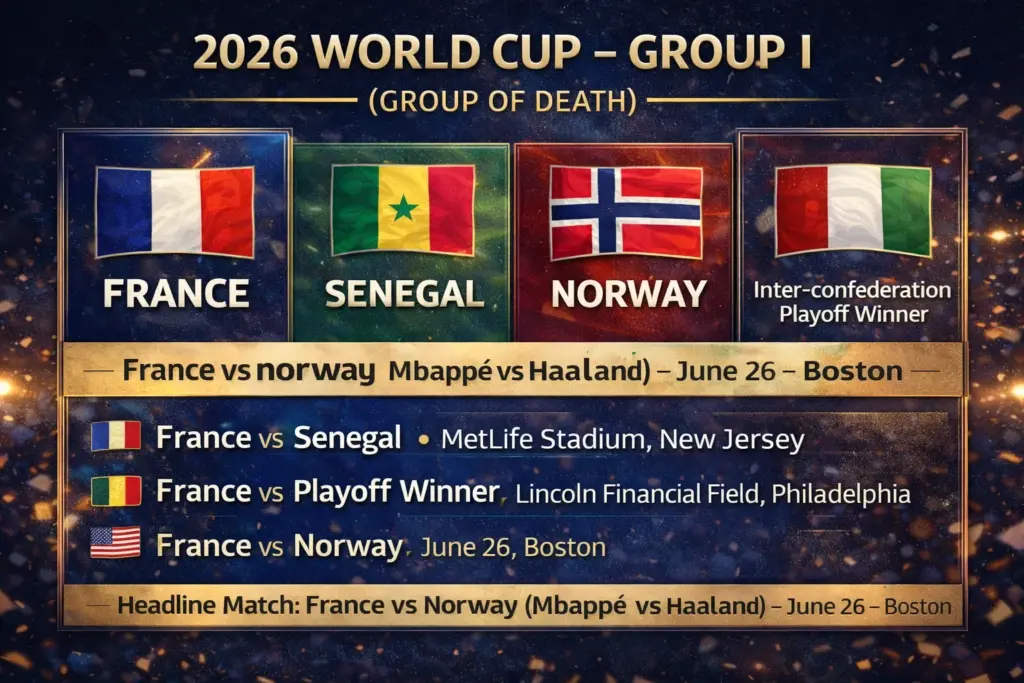
| Match | Date | Venue | Key note |
|---|---|---|---|
| France vs Senegal | Group I, Matchday 1 | MetLife Stadium, New Jersey — 3pm ET | France opener vs 2025 AFCON winners |
| France vs playoff winner | Group I, Matchday 2 | Lincoln Financial Field, Philadelphia — 5pm ET | France’s most manageable group fixture |
| Norway vs France | June 26 | Gillette Stadium, Boston — 3pm ET | Mbappé vs Haaland — the tournament’s defining group stage fixture |
Opponent by Opponent
Senegal: The 2025 Africa Cup of Nations winners bring physicality, organization, and the kind of collective discipline that makes them dangerous against any opponent — even the pre-tournament favorite. Senegal’s tactical setup under their manager prioritizes defensive compactness and physical duels in midfield — precisely the kind of match that can be uncomfortable for France’s technically superior but physically lighter midfield. Deschamps will need his double pivot to impose themselves physically from the first minute.
Inter-confederation playoff winner (Bolivia, Iraq, or Suriname): France’s most manageable group fixture. The playoff winner — confirmed March 2026 — will arrive as the group’s lowest-seeded team. France’s squad depth means Deschamps can manage minutes and rest key players without losing quality. The match in Philadelphia is France’s opportunity to build goal difference and squad confidence early.
Norway (the decider — June 26):
Mbappé against Haaland. The two most discussed individual matchups at the 2026 World Cup, in the same group, in the same match.
Norway return to the World Cup after a 28-year absence. Haaland has 55 international goals in 48 appearances — the most extraordinary international goal record in world football at the current moment. Alongside Arsenal’s Martin Ødegaard and Atlético Madrid’s Alexander Sørloth, Norway are a significantly more dangerous proposition than their seeding might suggest.
For France, this is the group stage match that demands their full strength and tactical focus. A draw could still allow France to qualify — but Deschamps’ preference will be to win the group and control the bracket path through the knockouts.
Eastern region advantage: All three France group matches are in the Eastern region — the same time zone, minimal travel, maximum preparation time between games. No other Pot 1 team in Group I has the same logistical setup.
How to Watch France at the 2026 World Cup
Broadcast rights holders for the 2026 World Cup include major networks in your region. Check your local listings closer to the tournament. We will update this section with specific channel info once confirmed.
France 2026 Match Tickets
Tickets for World Cup matches are sold via FIFA’s official portal. For information on ticket phases and pricing, visit the official FIFA ticketing website. We will provide specific links for France’s group matches here when available.
Part 6: France’s World Cup History
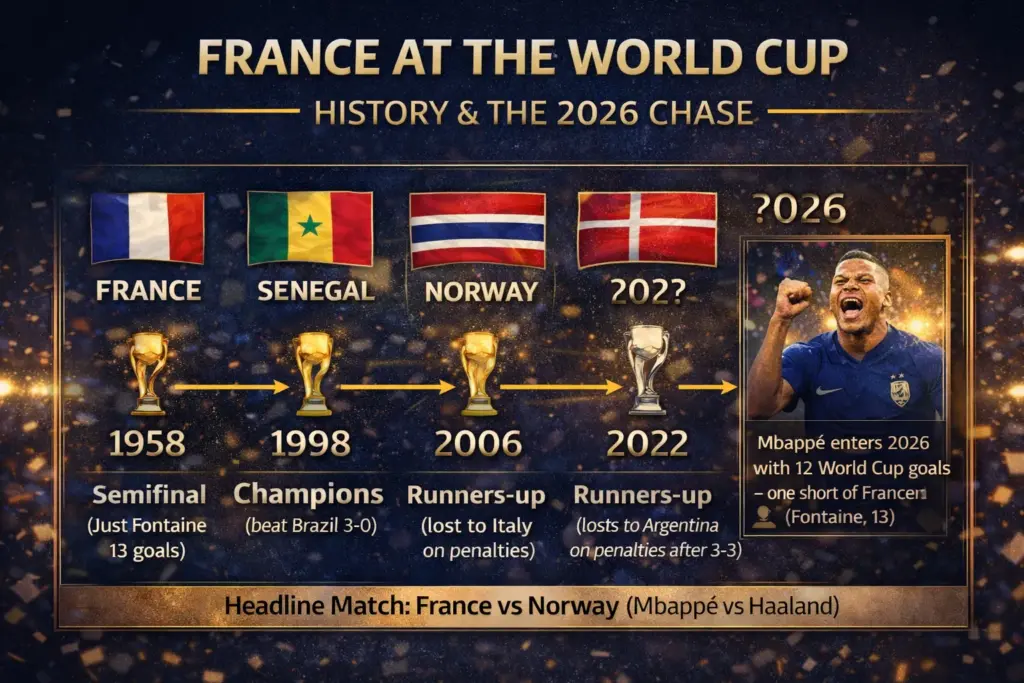
France have won the World Cup twice — and reached the Final four times. Their record in recent tournaments is the strongest of any team in the world.
1958 — Just Fontaine’s record:
France reached the semifinal — their best performance until 1998 — with Fontaine scoring 13 goals in the tournament. That record still stands as France’s all-time World Cup scoring record. Mbappé, with 12, is one goal away.
1998 — First title, on home soil:
Zinedine Zidane headed two goals in the final as France beat Brazil 3–0 in Paris. Deschamps — then a player — was France’s captain and lifted the trophy. He is the only person to win the World Cup with France as both a player (1998) and a manager (2018).
2006 — Zidane’s final, penalties:
France reached the final — Zidane’s infamous headbutt on Materazzi in extra time and subsequent red card preceded France’s penalty loss to Italy. A final that ended in controversy and defeat.
2018 — Deschamps delivers the second title:
France beat Croatia 4–2 in Moscow. Mbappé scored — the first teenager since Pelé to score in a World Cup final. Deschamps became only the third man in history to win the World Cup as both player and manager (after Brazil’s Mário Zagallo and Germany’s Franz Beckenbauer).
2022 — The Final that France won on the night but lost on penalties:
Argentina 3–3 France after extra time. Mbappé scored a hat-trick. Emiliano Martínez saved the decisive penalties. Argentina won 4–2 on penalties. France had fought back from 2–0 down to lead through Mbappé — and still lost. The closest France have come to back-to-back titles without achieving it.
The consecutive finals record:
If France reach the 2026 Final, they join West Germany (1982, 1986, 1990) and Brazil (1994, 1998) as the only nations to appear in three consecutive World Cup finals.
Part 7: Strengths, Weaknesses and Realistic Chances
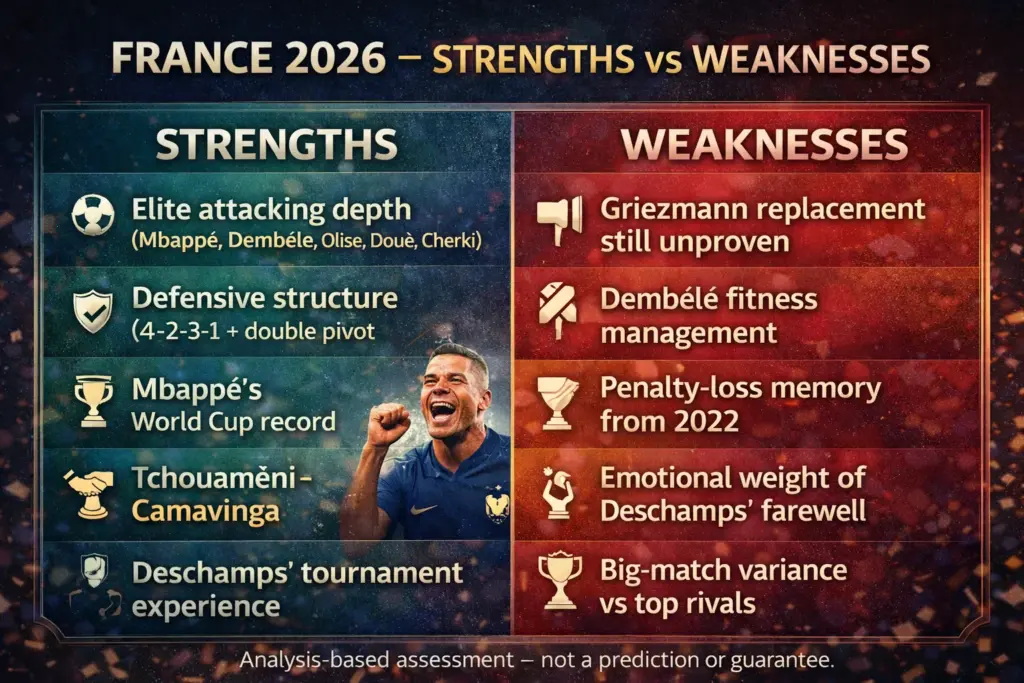
Strengths
The most dangerous attacking unit in the tournament: Mbappé as the striker, Dembélé and Olise wide, Doué and Cherki in reserve — France’s attacking options go deeper than any other squad. Deschamps has never had this range of attacking quality simultaneously available, and the combinations they can produce at full fitness represent a genuine nightmare for any defensive system.
Defensive solidity to match the attacking brilliance: Twenty-three shots allowed in six qualifying games is not a statistic that happens by accident. Deschamps’ double pivot and compact defensive block give France a structural foundation that their attacking dominance can rest on — they do not have to score three to win if their defense maintains its qualifying-level cohesion.
Mbappé’s World Cup record: Twelve goals in 14 World Cup matches at age 26 — already the second-highest tally in France’s history and approaching the all-time leading scorers in the tournament. A player of this quality at the peak of his powers, motivated by the specific loss of 2022, is the single most dangerous combination in international football.
Real Madrid double pivot chemistry: Tchouaméni and Camavinga have built their understanding across hundreds of club minutes at Real Madrid. International tournaments rarely allow time to develop that depth of understanding — France already have it in their most important structural partnership.
Weaknesses
The Griezmann replacement is unproven at this level: Cherki and Olise are excellent players. Neither has yet proven themselves across a full World Cup in a primary creative role. Griezmann’s ability to perform in the decisive moments of major tournaments — Euro 2016 final, World Cup 2018 final — was built on years of tournament experience that his replacements do not yet have.
Dembélé’s fitness is a subplot the squad cannot avoid: The 2025 Ballon d’Or winner arriving at the tournament while managing a return from early-season injury is a real variable. His fitness at 100% makes France’s attack exceptional; at 70–80%, the balance of the attacking unit shifts.
The 2022 penalty loss lives in the memory: France lost the most recent World Cup Final on penalties — to the team France will need to defeat if they meet Argentina again in 2026. Penalty preparation and the psychological weight of that specific loss is a real factor, particularly for the players who were on the pitch in Lusail.
Deschamps’ farewell could cut both ways: Knowing this is Deschamps’ last tournament could galvanize the squad — “one last mission for the manager” is a narrative with genuine motivational power. It could also create emotional weight that becomes a distraction in tight moments. Both are real possibilities.
Part 8: Scenario-Based Assessment
Clearly labelled as analysis — not a prediction or guarantee.
Group I expectation: France top the group. The most probable scenario has France beating the playoff winner comfortably, navigating Senegal’s physical challenge with Deschamps’ system, and producing one of the tournament’s signature moments in the Norway match on June 26. Even a draw against Norway with wins in the other two matches delivers group qualification.
The optimal path — three consecutive finals: France top Group I → navigate a manageable Round of 32 → reach the quarterfinals with squad health intact. From the quarterfinals, France’s squad depth, Mbappé’s individual ceiling, and Deschamps’ tournament management make them dangerous against any remaining opponent. A potential semifinal against England, Argentina, or Spain would be the defining test.
If everything aligns: France win the 2026 World Cup. Deschamps leaves as the greatest international manager of his era. Mbappé wins the trophy that his 2022 performance suggested was already his. Dembélé follows up a Ballon d’Or with a World Cup winner’s medal. The swansong is complete.
The risk scenarios:
- Dembélé’s fitness does not reach its peak level before the knockout stage — France’s wide threat narrows significantly
- Norway in the group stage is tighter than expected, and France enter the knockouts with less momentum than anticipated
- A penalty shootout against Argentina — if both teams make the Final — revisits 2022’s most painful moment for France
The historical comparison: France are consistently listed alongside Spain as the joint-favorites to win the 2026 World Cup by most European analysts. Their track record in consecutive tournaments — unlike Spain, who have had mixed World Cup results since 2010 — makes the “historical favorite” case easier to build. Reaching two consecutive finals and winning one of them is a tournament record that only the world’s elite nations can point to.
Common Myths — Corrected
“France rely on Mbappé and fall apart without him.”
France’s 2022 World Cup run — before the final — included matches where Mbappé was not dominant and France still won through defensive organization and collective quality. Deschamps has specifically built a squad with depth and tactical clarity so that no single player’s absence collapses the system. The double pivot, Saliba’s defensive leadership, and the attacking variety beyond Mbappé are all evidence of this.
“Dembélé winning the Ballon d’Or was a surprise with no basis.”
Dembélé won the 2025 Ballon d’Or after that phenomenal season for PSG — helping them win the Champions League, Ligue 1, and Coupe de France. The Ballon d’Or reflected an extraordinary season, not a reputational vote.
“France’s group is the hardest in the tournament so it will damage their chances.”
Playing in the Group of Death creates risk — but it also builds competitive intensity, focus, and match sharpness before the knockout stage. Teams that navigate a genuinely difficult group stage often arrive at the quarterfinals and semifinals better prepared than teams who coasted through an easier group. France’s squad depth means Deschamps can manage fitness and rotations even when matches are competitive.
“If Deschamps is leaving, the squad will have reduced motivation.”
The opposite argument is more compelling: players who have worked with Deschamps for years — some since under-age level — have a specific motivation to give him the best possible farewell. Tournament squads are rarely demotivated by a manager’s confirmed departure; they are more often galvanized by the desire to deliver a final win for someone they respect.
“France’s penalty record means they will lose any shootout.”
France lost the 2022 Final on penalties. They also won the 2022 quarterfinal against England on penalties. And the 2018 World Cup was won in regulation. Their penalty record is mixed rather than uniformly poor — unlike England’s specifically poor historical shootout record.
FAQs: France at the 2026 World Cup
What group is France in at the 2026 World Cup?
Group I — Senegal, Norway, and the inter-confederation playoff 2 winner (Bolivia, Iraq, or Suriname — confirmed March 2026).
When does France play at the 2026 World Cup?
France vs Senegal — MetLife Stadium, New Jersey (3pm ET); France vs playoff winner — Lincoln Financial Field, Philadelphia (5pm ET); Norway vs France — June 26, Gillette Stadium, Boston (3pm ET).
Who is France’s manager at the 2026 World Cup?
Didier Deschamps — in charge since 2012, confirmed his contract ends after 2026. He guided France to the 2018 World Cup title and the 2022 World Cup Final.
Who is France’s best player at the 2026 World Cup?
Kylian Mbappé — captain, 12 World Cup goals in 14 matches, 38 goals in 30 games this season for Real Madrid. Ousmane Dembélé — 2025 Ballon d’Or winner — provides equal billing as the squad’s other headline name.
What formation does France use?
A 4-2-3-1 — with Mbappé as the lone striker, Dembélé and Olise wide, Cherki or Olise centrally, and the Real Madrid double pivot of Tchouaméni and Camavinga in front of the defense.
Has France ever won the World Cup?
Yes, twice — in 1998 on home soil (beat Brazil 3–0) and in 2018 in Russia (beat Croatia 4–2). They were runners-up in 2006 (lost to Italy on penalties) and 2022 (lost to Argentina on penalties).
Can France reach three consecutive World Cup finals?
As scenario-based analysis: if France reach the 2026 Final, they become only the third nation to appear in three consecutive finals — after West Germany and Brazil. Their squad quality and recent form make this achievable. It is not guaranteed by any team’s quality alone.
Who replaces Griezmann for France?
Antoine Griezmann retired from international football after Euro 2024. The central attacking midfield role is being filled primarily by Rayan Cherki (Man City, nine goals and seven assists in a rotational role this season) and/or Michael Olise (Bayern Munich), who can play wide or centrally.
What is Mbappé’s World Cup scoring record?
12 goals in 14 World Cup matches — one short of Just Fontaine’s France all-time record of 13 (set across the 1958 tournament in six games). Mbappé is also approaching the all-time World Cup scoring record held by Miroslav Klose (16 goals).
Can France win the 2026 World Cup?
As scenario-based analysis: France are consistently identified among the two or three most likely champions. Their attacking depth, defensive solidity, Deschamps’ tournament experience, and Mbappé’s World Cup record make them a genuine favorite. The primary risks are Dembélé’s full fitness, the unproven Griezmann replacement, and the psychological weight of the 2022 penalty loss if they meet Argentina again.