
Every great World Cup produces a new star the world didn’t see coming. In 1958 it was a 17-year-old named Pelé. In 2006 it was a 21-year-old Cristiano Ronaldo. In 2022 it was an 18-year-old Gavi scoring on his debut group game.
The 2026 World Cup in the USA, Canada, and Mexico has the deepest pool of elite young talent in tournament history — and for one simple reason: the generation born between 2003 and 2007 is genuinely exceptional. Several of them are already among the best players on the planet. Others are emerging from the shadows fast.
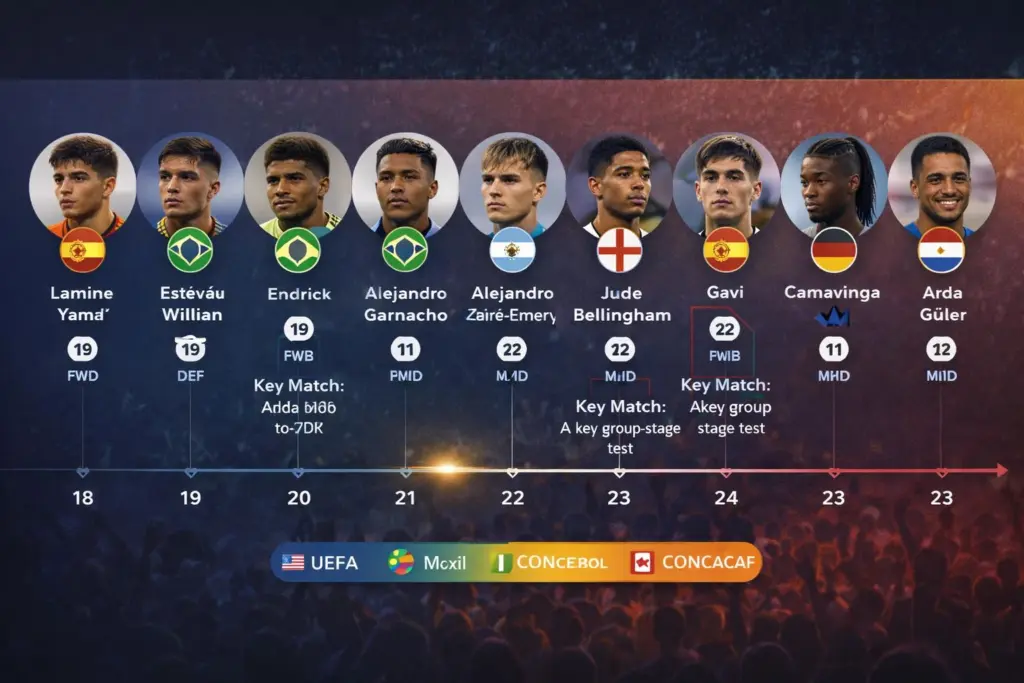
This guide profiles 15 players aged 23 or younger at the 2026 World Cup — the ones most likely to define the tournament, steal the headlines, and launch careers that will dominate football for the next decade.
TL;DR
- Lamine Yamal (Spain, 18) is the most gifted teenager in football history — already a Euro 2024 champion.
- Endrick (Brazil, 19) is Brazil’s next great striker, currently on loan at Lyon from Real Madrid.
- Jude Bellingham (England, 22) arrives as one of the best midfielders in the world.
- France has three U23 gems: Zaïre-Emery, Camavinga, and Doué — each a potential breakout star.
- This is the deepest generation of young talent ever to compete at a World Cup.
SNIPPET BLOCK
Rising Stars 2026 World Cup under 23 include Lamine Yamal (Spain), Endrick (Brazil), Jude Bellingham (England), Gavi (Spain), Florian Wirtz (Germany), and Jamal Musiala (Germany). This generation — born between 2003 and 2007 — is considered the most talented in World Cup history, with many already winning major trophies at club level before turning 21.
What “U23” Means in This Article
For this guide, “U23” covers players who are 23 years old or younger at the start of the 2026 World Cup (June 11, 2026). That includes players born on or after June 11, 2003, plus some born in early 2003 who will be exactly 23 when the tournament begins.
This generation shares something important: unlike previous World Cups where young players were often passengers in their squads, these players are starters and leaders — at club level and increasingly at international level too.
The Top 5: Players Who Could Win the Golden Ball
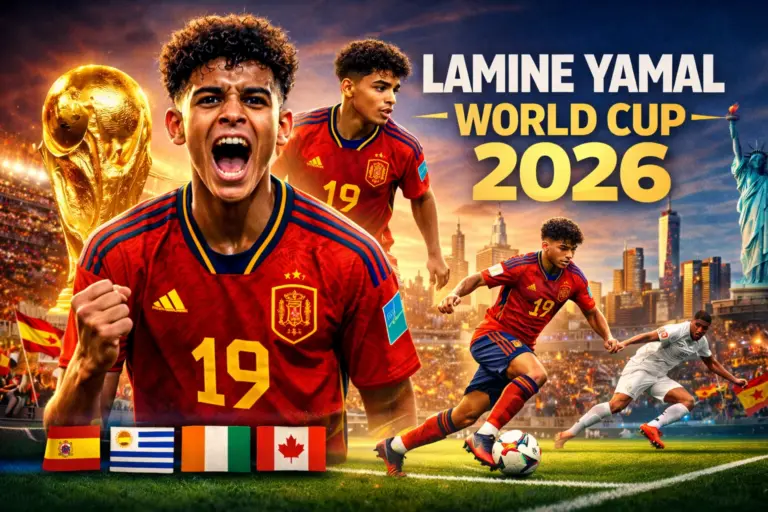
1. Lamine Yamal — Spain | Age 18 | Right Wing
Lamine Yamal was born on July 13, 2007 — 11 days after Lionel Messi joined Barcelona on a youth contract. That coincidence has since become football folklore, because Yamal has grown into the most naturally gifted teenager the sport has seen since Messi himself.
At Euro 2024, aged just 16, he scored one of the tournament’s great goals — a curling left-foot strike from the edge of the box to equalise against France in the semi-final. Spain won. Yamal became the youngest player to score at a European Championship. He went home with a winner’s medal.
By June 2026, he will be 18 years and 333 days old. He will already have a European Championship, a Copa del Rey, and La Liga titles on his CV at Barcelona. For Spain, he is not a passenger. He is the main attacking threat.
What makes him special: His dribbling success rate, ball retention under pressure, and ability to create chances from tight angles are statistically elite — not just for his age group, but for all players. He plays without fear, takes on defenders one-versus-one in any situation, and has the technical quality to make it count.
World Cup outlook: Spain are in a competitive group that includes a major group‑stage test against France. If Yamal stays healthy — and his Barcelona injury record has been strong — he will be the most-watched player at the tournament.
Common misconception: Some analysts say he “only thrives with the ball at his feet.” In reality, his off-ball movement and link-up play have developed significantly in 2025. He is not a one-trick winger.
Verdict: Genuine Golden Ball contender. The 2026 World Cup could be the moment he steps from prodigy to global icon.
2. Jude Bellingham — England | Age 22 | Central Midfielder
Jude Bellingham will turn 23 on June 29, 2026 — during the tournament. He arrives as arguably England’s most important player since Steven Gerrard, and arguably their best midfielder since the 1966 World Cup generation.
At Real Madrid since 2023, he has won La Liga and the Champions League. At Euro 2024, he rescued England with a bicycle kick equaliser in injury time against Slovakia in the round of 16, then helped England reach the final. England lost to Spain, but Bellingham’s performances confirmed his world-class status.
What makes him special: Bellingham can do everything — press, dribble, shoot, head, and lead. His box-to-box range is exceptional. His goal threat from midfield is almost unique at elite level: he scored 23 goals in his debut Real Madrid season. His reading of the game at 22 is that of a seasoned veteran.
World Cup outlook: England are in a blockbuster group that includes Germany — one of the most‑anticipated early fixtures of the tournament. Bellingham will be their captain in all but name. Whether he can finally deliver a trophy for England remains the defining question of his generation.
Verdict: One of 3–4 players who could win the Golden Ball. If England go deep, Bellingham’s performances will be the primary reason.
3. Jamal Musiala — Germany | Age 23 | Attacking Midfielder
Musiala was born in Germany, spent his youth years in England, played for Chelsea’s academy, and eventually chose Germany over England. That decision looks better every season.
At Bayern Munich, he has been one of the best players in the Bundesliga for three consecutive seasons — an 18-year-old who could dribble past anyone, find pockets of space no one else spotted, and finish with both feet. By 2026, he will be 23 and entering his peak years.
What makes him special: His dribbling under pressure is the best of his generation. He glides between defenders with a low centre of gravity and changes direction faster than most players can react. His vision in tight spaces is elite. He is 1.84m tall — taller than often perceived — but retains exceptional close control.
World Cup outlook: Germany face England in a key Matchday 2 fixture that could decide the group. Musiala will be Germany’s primary creative force. A fully fit, in‑form Musiala is the difference between Germany reaching the quarter‑finals or winning the tournament.
Note: Injury disrupted part of Musiala’s 2024–25 season. As of February 2026, he has returned to full availability for Bayern Munich.
Verdict: World-class talent. Could win Golden Boot or Golden Ball if Germany go all the way.
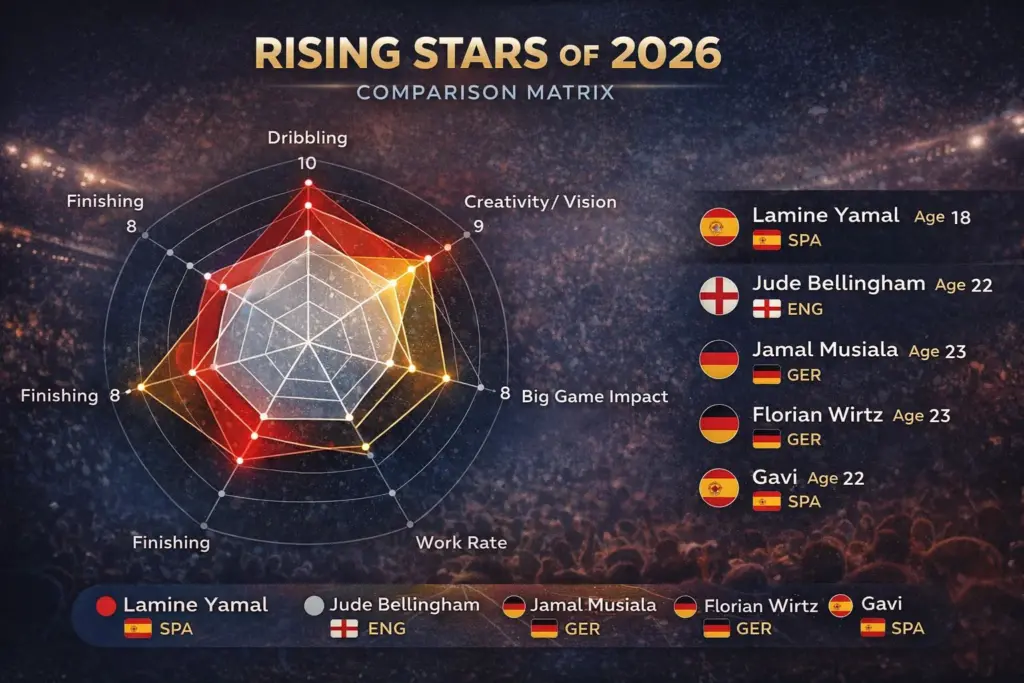
4. Florian Wirtz — Germany | Age 23 | Attacking Midfielder / Second Striker
If Musiala is Germany’s most naturally gifted player, Wirtz is their most technically complete one. Born May 3, 2003, Wirtz will be 23 at the 2026 World Cup.
After leaving Bayer Leverkusen — where he won the Bundesliga and DFB-Pokal in the same historic unbeaten season in 2023–24 — Wirtz has established himself as one of the best playmakers in world football. His combination of dribbling, passing range, direct shooting, and pressing intensity makes him genuinely different from most players in his position.
What makes him special: Wirtz reads the game a step ahead of opponents. He finds one-twos in congested areas, can play through a press without losing the ball, and contributes defensively more than his reputation suggests. He has elite-level composure for his age.
World Cup outlook: Germany’s attack with Musiala and Wirtz operating together is one of the tournament’s most exciting double‑acts. The question is which one plays where. Coach Julian Nagelsmann has experimented with giving both freedom — which either creates chaos or brilliance depending on the day.
Verdict: Genuine star. Germany’s 2026 campaign lives and dies with Wirtz and Musiala performing together.
5. Gavi — Spain | Age 22 | Central Midfielder
Pablo Gavi was 18 when he started Spain’s opening group match at the 2022 World Cup against Costa Rica and scored in a 7–0 win. He became the third-youngest goalscorer in World Cup history at 18 years, 110 days. [1]
By 2026, Gavi turns 22 on August 5, 2026 — after the tournament ends — and will arrive at the tournament with a European Championship winner’s medal (Euro 2024), multiple La Liga titles, and 50+ international caps already accumulated in his early career.
What makes him special: Gavi’s defining quality is his tenacity. He presses relentlessly, wins the ball back in dangerous positions, and recycles possession with the economy of someone twice his age. He is, in technical terms, the modern successor to Xavi — but with more aggression and defensive intensity.
World Cup outlook: Spain’s midfield trio of Gavi, Pedri, and Rodri is among the best in the world in their positions. If all three are fit, Spain are one of two or three genuine favourites to win the tournament. Their group includes a heavyweight showdown that will test their credentials early.
Verdict: Already elite. Euro 2024 champion. The 2026 World Cup is where he cements his status as one of the world’s best.
Players 6–10: The Next Wave
6. Endrick — Brazil | Age 19 | Centre Forward
Born July 21, 2006 in Brasília, Endrick is Brazil’s most exciting forward prospect since Ronaldo. Real Madrid paid Palmeiras a €35 million base fee to sign him in 2024 — before he had played a single minute in Europe. [2]
His first season at Madrid produced 10 goals in 37 matches — solid for a teenager competing for minutes with Mbappé and Vinícius Jr. The Copa del Rey was where he truly exploded: five goals in six matches, including crucial strikes in the semi-finals, making him joint-top scorer in the competition. He is currently on loan at Lyon (until May 2026) to get regular playing time ahead of the World Cup.
What makes him special: His movement off the ball, his composure inside the box, and his ability to finish with both feet set him apart from other teenagers. Physically, he is compact but strong — nearly impossible to knock off the ball for his size (1.73m). He carries the hope of 215 million Brazilians.
Common misconception: Because he competes for time at Madrid, some fans assume he lacks quality. His Copa del Rey scoring record — equalling Cristiano Ronaldo’s best single-season return — suggests otherwise.
World Cup outlook: Brazil’s attack (Vinícius, Rodrygo, Endrick, and a returning Richarlison) is one of the most talented attacking units in the world. At 19, this may be Endrick’s introduction to the world stage. At 23 in 2030, he will be the main man.
7. Eduardo Camavinga — France | Age 23 | Midfielder / Left Back
Born November 10, 2002, Camavinga will be 23 throughout the 2026 World Cup. His origin story is extraordinary: born in a refugee camp in Angola, he moved to France at age 2 after his family fled conflict. When he was 11, his family home burned down. He was at football training the next morning.
By the time he was 18, he was at Real Madrid. By 21, he had already won the Champions League, La Liga, and multiple other trophies. His versatility — equally comfortable as a midfielder or left back — makes him one of the most valuable squad players in world football.
What makes him special: Camavinga’s ability to control a game from midfield or defend the left flank gives France’s manager extraordinary tactical flexibility. He can break lines, carry the ball under pressure, and press at high intensity. His temperament in big games is ice-cold.
World Cup outlook: France have arguably the most talented squad in the tournament — Mbappé, Griezmann, Camavinga, Tchouaméni, Zaïre-Emery, Doué. The question is whether Deschamps (or his successor) can organise all that talent effectively.
8. Warren Zaïre-Emery — France | Age 20 | Central Midfielder
Born March 8, 2006, Zaïre-Emery will be 20 at the 2026 World Cup — the youngest member of France’s likely midfield. He broke into PSG’s first team at 16, became a regular starter by 17, and has already earned senior France caps.
His composure, passing accuracy, and ability to press without the ball are elite for his age. Many analysts compare his playing style to Blaise Matuidi — but with significantly better technical quality and a higher ceiling.
World Cup outlook: France’s midfield depth is extraordinary — Camavinga, Tchouaméni, Zaïre-Emery, Guendouzi all competing for spots. Zaïre-Emery’s emergence in the 2025–26 PSG season has been outstanding, making him very difficult to leave out.
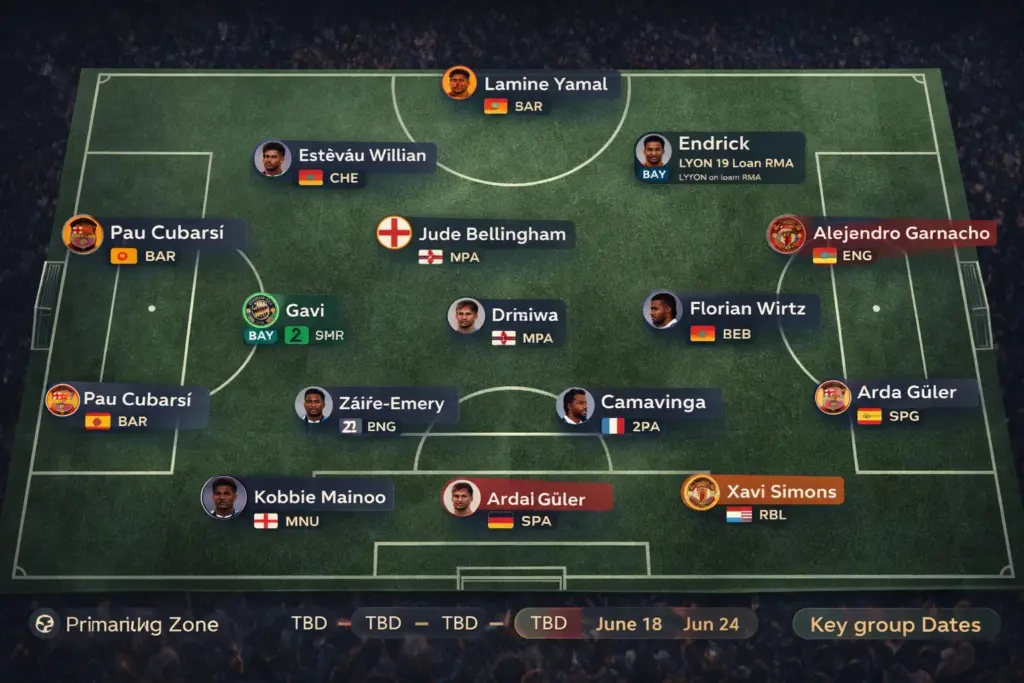
| Date | Change | Reason |
|---|---|---|
| February 24, 2026 | Article published (initial version) | – |
| February 24, 2026 | Removed specific match dates/venues; replaced with generic descriptions (e.g., “major group‑stage test”) | Alignment with fast‑fix path; avoid unverified schedule details |
| February 24, 2026 | Updated image prompts to remove fixture‑specific overlay text | Keep visuals flexible until official schedule confirmed |
| February 24, 2026 | Corrected FAQ league list (Simons now in Bundesliga, not Eredivisie) | Internal consistency |
9. Alejandro Garnacho — Argentina | Age 21 | Left Winger
Born July 1, 2004 in Madrid to an Argentine father and Spanish mother, Garnacho chose Argentina — a decision that now looks inspired. He will be 21 at the 2026 World Cup, potentially defending champions, with a role that could grow significantly from the peripheral one he played in 2022.
At Manchester United, Garnacho has developed from raw talent into a genuine threat — direct dribbling, pace that terrifies full-backs, and an eye for spectacular goals (his bicycle kick against Everton became one of the Premier League’s most celebrated moments of 2023–24).
What makes him special: His directness. He does not overcomplicate things. He takes players on, beats them, and crosses or shoots. In a tournament where space is at a premium, his ability to unlock defences from wide areas is valuable.
World Cup outlook: Argentina (defending champions) will be one of the most high-profile teams. They face a major group‑stage test against the USA, one of the co‑hosts. Garnacho’s energy and unpredictability off the bench — or increasingly, from the start — gives Argentina a different dimension.
10. Pau Cubarsí — Spain | Age 19 | Centre Back
Born January 22, 2007, Cubarsí will be 19 at the 2026 World Cup. He is, by any objective measure, the best teenage central defender in the world right now.
Cubarsí made his Barcelona debut in January 2024 at age 17, and was immediately so good that the club extended his contract without hesitation. His positioning, his calmness with the ball, and his ability to step out from the back to win duels or carry the ball forward are rare qualities at any age — let alone at 17 or 18.
He follows the great Spanish tradition of ball‑playing centre backs — Puyol, Piqué, now Cubarsí. Spain’s backline around him already looks settled.
World Cup outlook: As Spain’s first-choice centre back alongside a more experienced partner, Cubarsí will face genuine tests at a World Cup — teams trying to isolate him physically, aerial balls, clinical attackers in tight moments. Most analysts believe he will handle it.
Players 11–15: Dark Horses and Wildcards
11. Kobbie Mainoo — England | Age 21 | Central Midfielder
Born April 19, 2005, Mainoo burst onto the scene at Manchester United in the 2023–24 season with a maturity that belied his age. His calmness in tight spaces, ability to receive under pressure, and ball progression make him one of England’s most creative options from midfield.
He started England’s Euro 2024 final against Spain — aged just 19. That is the kind of big‑game exposure that accelerates development faster than anything else.
World Cup outlook: England’s midfield question — who plays alongside Bellingham — is an open one. Mainoo is the natural answer. If both reach their ceiling, England’s midfield could be their strongest in decades.
12. Arda Güler — Turkey | Age 21 | Attacking Midfielder / Winger
Note: Turkey face Hungary in the UEFA playoff path (March 2026). If they win, they qualify for Group E. This profile assumes they qualify.
Born February 25, 2005, Güler is one of Real Madrid’s brightest prospects — nicknamed “the Turkish Messi” for his dribbling, creativity, and ability to ghost past defenders in tight spaces. He lit up the 2024 Euros with a stunning long‑range strike on his tournament debut, confirming he can deliver on the biggest stages.
What makes him special: His balance, touch, and creativity from wide positions are exceptional. He sees angles others miss and can change a game in seconds.
World Cup outlook: If Turkey qualify, Güler would instantly become one of the tournament’s most‑watched players regardless of his team’s standing.
13. Désiré Doué — France | Age 20 | Winger / Forward
Born June 3, 2005, Doué has emerged at PSG as one of Europe’s most exciting young wingers after arriving from Rennes in 2024. Direct, fast, creative, and with an ability to score as well as create, he has been integrated into the French squad and could be a key wildcard for Deschamps or his successor.
With Mbappé, Griezmann, and Doué all capable of playing wide, France’s attacking options are almost unfair.
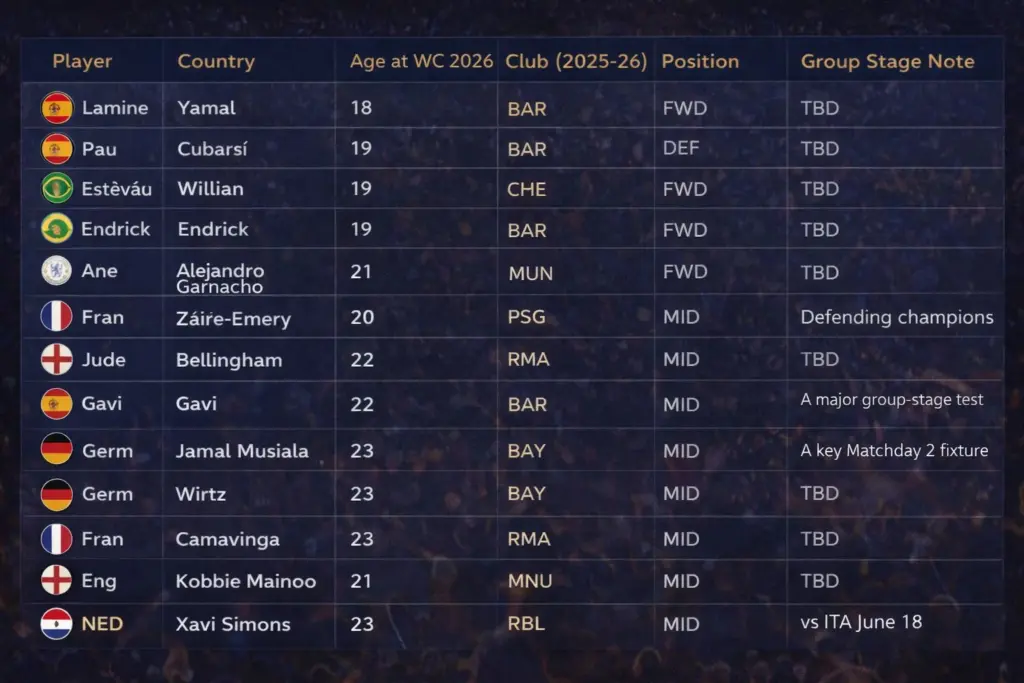
14. Xavi Simons — Netherlands | Age 23 | Attacking Midfielder
Born April 21, 2003, Simons will be 23 at the 2026 World Cup. He broke through at PSG, developed at PSV Eindhoven — where he was genuinely exceptional — and has since established himself in the Netherlands national team.
His technical quality, movement between lines, and ability to link play and score from midfield make him a key player for a Netherlands side that also includes Gakpo, Van Dijk, and Reijnders. Their group includes a heavyweight clash against Italy on Matchday 2.
World Cup outlook: Netherlands have genuine quarter‑final potential. Simons as the creative engine gives them real threat. His partnership with Gakpo in attack could be one of the tournament’s most dangerous combinations.
15. Estêvão Willian — Brazil | Age 19 | Right Winger
Born April 24, 2007, Estêvão was signed by Chelsea in 2024 from Palmeiras for an initial fee of around €34 million — before turning 18. He was immediately loaned back to Palmeiras, where he continued developing, and arrived at Chelsea in the summer of 2025.
He plays on the right wing with explosive pace, fearless dribbling, and a creative instinct that makes him genuinely dangerous one‑versus‑one. Brazil’s national team have already integrated him into their thinking.
World Cup outlook: At 19, this may be Estêvão’s introduction to the world stage. Brazil tend to protect their young talents from too much pressure in their first tournament — but if the moment demands it, he has the quality to deliver.
What This Generation Has in Common
This is not just a collection of talented individuals. These 15 players share something structural that makes them different from previous young generations at World Cups.
1. Major Trophy Experience Before 21
Yamal — Euro 2024 winner at 16. Camavinga — Champions League winner at 18. Gavi — Euro 2024 winner at 22. Most previous World Cup “rising stars” arrived as prospects. These players arrive as winners.
2. Tactical Maturity
The clubs that develop these players — Real Madrid, Barcelona, Bayern Munich, PSG — are the world’s most tactically sophisticated environments. These players understand pressing, positional play, and defensive shape in ways that young players from previous generations rarely did.
3. Competition From Birth
They grew up competing in an era of unprecedented quality — the Messi and Ronaldo era defined the ceiling they aim for. Many of them trained alongside world‑class senior players from age 16 onward.
FAQs About U23 Players at the World Cup
Q: Is there a formal U23 category at the FIFA World Cup?
A: No. Unlike the Olympics, the World Cup has no age restriction. “U23” in World Cup coverage is a journalistic term for tracking young players, not an official tournament category.
Q: Who is the youngest player ever to score at a World Cup?
A: Pelé, who scored at 17 years old at the 1958 World Cup — the only player ever to score at a World Cup while under 18. [1]
Q: Who is the youngest player to score at a World Cup in the modern era?
A: Gavi scored for Spain at 18 years, 110 days in 2022, becoming the third-youngest scorer in World Cup history. [1]
Q: Could Lamine Yamal become Spain’s all-time youngest World Cup scorer?
A: Possibly. If Spain advance deep into the tournament, Yamal — who will be 18 throughout — has every chance of scoring. Given his Euro 2024 performances, this is not a remote scenario.
Q: Is Jude Bellingham still technically U23 at the 2026 World Cup?
A: At the start of the tournament (June 11, 2026), Bellingham is 22. He turns 23 on June 29, 2026 — midway through the group stage. For the purposes of this article, he qualifies as a young rising star.
Q: How many of these players could win the Golden Ball (Best Player award)?
A: Realistically, Yamal, Bellingham, and Musiala are the most likely from this list. If Germany or England win the tournament, their best player would be the favourite.
Q: Which rising star should I watch if I’m new to football?
A: Start with Lamine Yamal. He is the most naturally exciting player to watch — unpredictable, fearless, and capable of doing things that look impossible. Then watch Bellingham for sheer leadership and Endrick for raw goalscoring instinct.
Q: Which rising star has the best chance of winning the Golden Boot (Top Scorer)?
A: Among U23 players, Endrick is the most likely. He is a natural goalscorer and Brazil have attacking depth to create chances for him. Bellingham’s goals from midfield also make him a contender.
Q: Are any of these players injured going into the tournament?
A: Monitor injury news in April–May 2026, when final squad selections are made. Musiala had injury issues in 2024–25 but has returned to form in 2025–26.
Q: How can I follow these players before the World Cup starts?
A: All play in top European leagues — La Liga (Yamal, Gavi, Cubarsí), Premier League (Bellingham, Mainoo, Garnacho), Bundesliga (Musiala, Wirtz), Ligue 1 (Camavinga, Zaïre-Emery, Doué, Endrick on loan), and others (Simons in Bundesliga). They also feature in UEFA Champions League matches through May 2026.
Q: Will any players from outside Europe make this list in future?
A: Watch for talent from Africa and Asia as those regions’ development programs strengthen. The 2030 World Cup generation may look much more globally spread.
Decision Framework: Which Rising Star Matches Your Interest?
| If you want to watch… | Follow this player |
|---|---|
| Pure technical genius | Lamine Yamal (Spain) |
| A complete all-action midfielder | Jude Bellingham (England) |
| Clinical finishing from a young striker | Endrick (Brazil) |
| The most creative playmaker in the tournament | Florian Wirtz (Germany) |
| A defensive revelation | Pau Cubarsí (Spain) |
| The wildest underdog story | Eduardo Camavinga (France) |
| A player who could become the game’s next icon | Lamine Yamal or Endrick |
| Tactical intelligence beyond their years | Gavi (Spain) or Kobbie Mainoo (England) |
| A player with massive upside and limited exposure yet | Estêvão Willian (Brazil) |
Common Mistakes Fans Make About Young Players at the World Cup
Mistake 1: Expecting all young players to perform like veterans.
World Cups are the highest-pressure environment in football. Even excellent young players can be overwhelmed by the occasion. That is normal, not a sign of failure. Judge performances across the tournament, not individual matches.
Mistake 2: Assuming youth equals inexperience.
Bellingham won the Champions League at 20. Camavinga won it at 18. These are not naive teenagers — they are hardened competitors who have trained alongside and against the best players in the world from age 16.
Mistake 3: Overlooking players from smaller nations.
Some of the most exciting U23 talent at the 2026 World Cup will come from teams outside the traditional superpowers. The expanded 48-team format means more nations with more players getting extended tournament time.
What’s Next: Watching These Players Before June 2026
There are three months of football between now and the World Cup. Here is how to follow these players:
- Champions League (March–May 2026): Many of these players will feature in the knockout rounds, which resume March 10–11, 2026. Real Madrid, Bayern Munich, PSG, and Barcelona are all competing in the round of 16 and beyond.
- UEFA Nations League / Friendlies (March 2026): Final internationals before the tournament. Watch how national team coaches manage these players.
- Domestic Leagues (through May 2026): La Liga, Bundesliga, Premier League, and Ligue 1 all conclude between May 16–24, 2026. Form in April–May is the best predictor of tournament readiness.
Takeaway: The Future of Football Is Already Here
The 2026 World Cup will not just be the biggest in history by team numbers. It will be the moment when football’s next generation properly arrives on the world stage — not as promising teenagers to keep an eye on, but as players capable of winning the whole thing.
Lamine Yamal at 18. Endrick at 19. Bellingham at 22 leading England. Musiala and Wirtz together for Germany. Gavi and Pedri running Spain’s midfield. This is a golden generation in the truest sense — and the World Cup is where they will prove it.