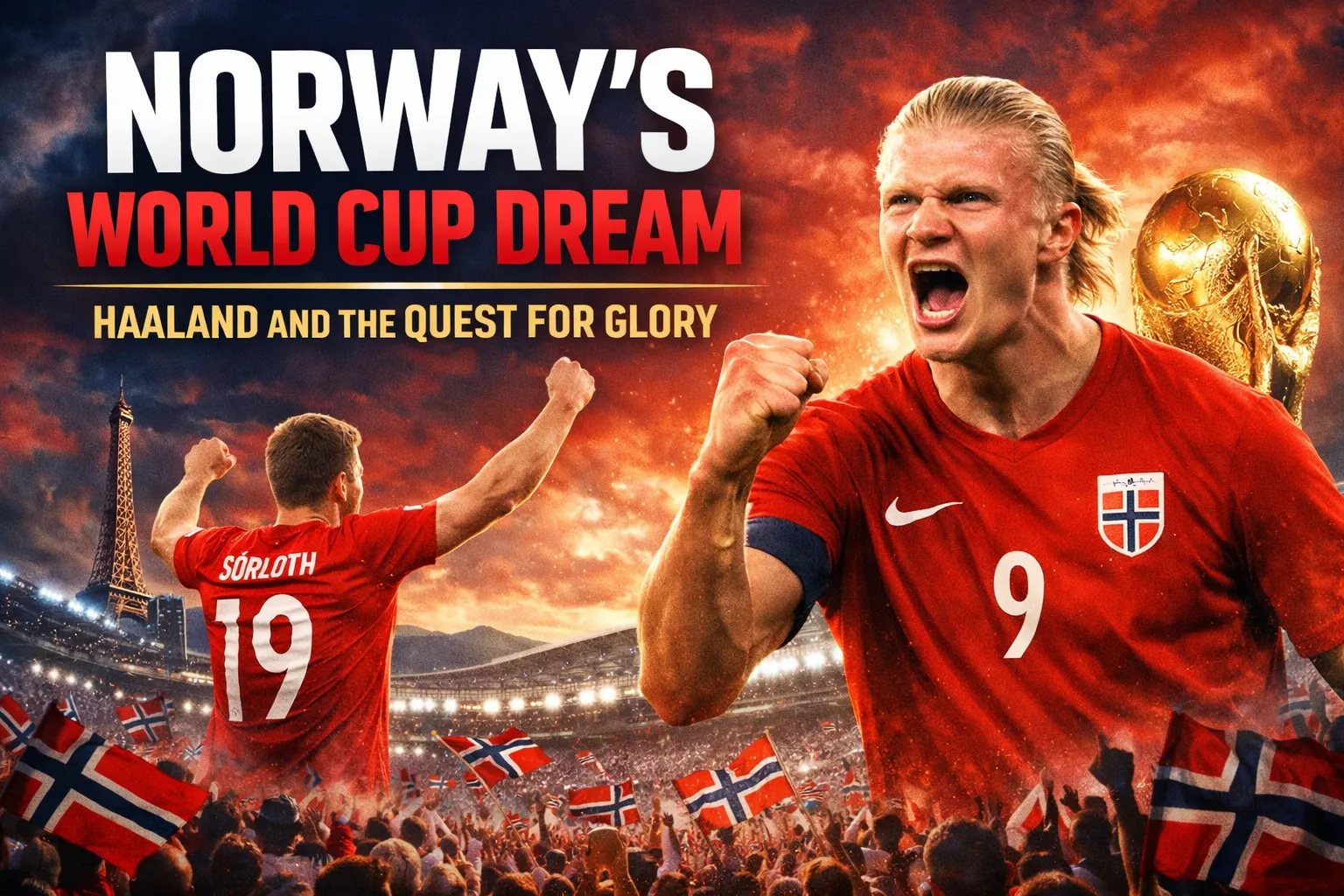

Erling Haaland 2026 World Cup impact on Norway can be understood in one simple way. Across their entire qualifying campaign — eight matches in UEFA Group G, against Italy, Israel, Moldova, Estonia, and others — Norway scored 37 goals. Haaland scored 16 of them, alone. That is 43 percent of everything Norway produced, from a single player.
He scored in every single match. He finished eight goals clear of the next-best scorer in all of UEFA qualifying. He scored five in one game, a hat-trick in another, and a brace in the winner-takes-all final qualifier against Italy at San Siro.
This is the first World Cup of Haaland’s career — and Norway’s first since 1998. For a player of this generation, at a tournament of this scale, it is a collision that has been building for years. Whether Norway can survive the Group of Death and give him the stage he deserves is one of the 2026 World Cup’s most compelling questions.
TL;DR
- Who he is: 25 years old at the 2026 World Cup; Norway’s all-time top scorer (55 goals in 48 appearances); considered one of the best players in the world
- Qualifying numbers: 16 goals in 8 matches — scored in all 8 — UEFA top scorer by 8 goals — matches Lewandowski’s European record
- The records: Fastest to 50 international goals (46 matches, beating Kane’s 71); fastest to 100 Premier League goals (111 apps, beating Shearer’s 124); fastest to 50 Champions League goals (49 matches)
- The group challenge: Group I — France, Senegal, Norway, playoff winner — one of the tournament’s hardest groups
- The supporting cast: Martin Ødegaard (7 qualifying assists, Arsenal captain), Alexander Sørloth (26 Norway goals), Antonio Nusa (RB Leipzig), Oscar Bobb (Man City)
- The constraint: Defensive depth is Norway’s clear weakness; if Haaland is isolated or injured, there is no direct replacement who can replicate his specific goal output — though Sørloth offers a different but still dangerous alternative
SNIPPET BLOCK
Erling Haaland is a 25-year-old Norwegian striker for Manchester City, widely considered one of the best players in the world. He arrives at his first World Cup in 2026 as Norway’s all-time top scorer with 55 goals in 48 appearances. In qualifying, he scored 16 goals in 8 matches — in every single game — finishing 8 clear of all UEFA rivals to match Robert Lewandowski’s European qualifying record. Norway are in Group I alongside France and Senegal — one of the tournament’s hardest groups. If Norway survive, Haaland’s power, positioning, and finishing make him a genuine Golden Boot contender and one of the most dangerous individuals in the tournament.
Who Is Erling Haaland? The Simple Profile
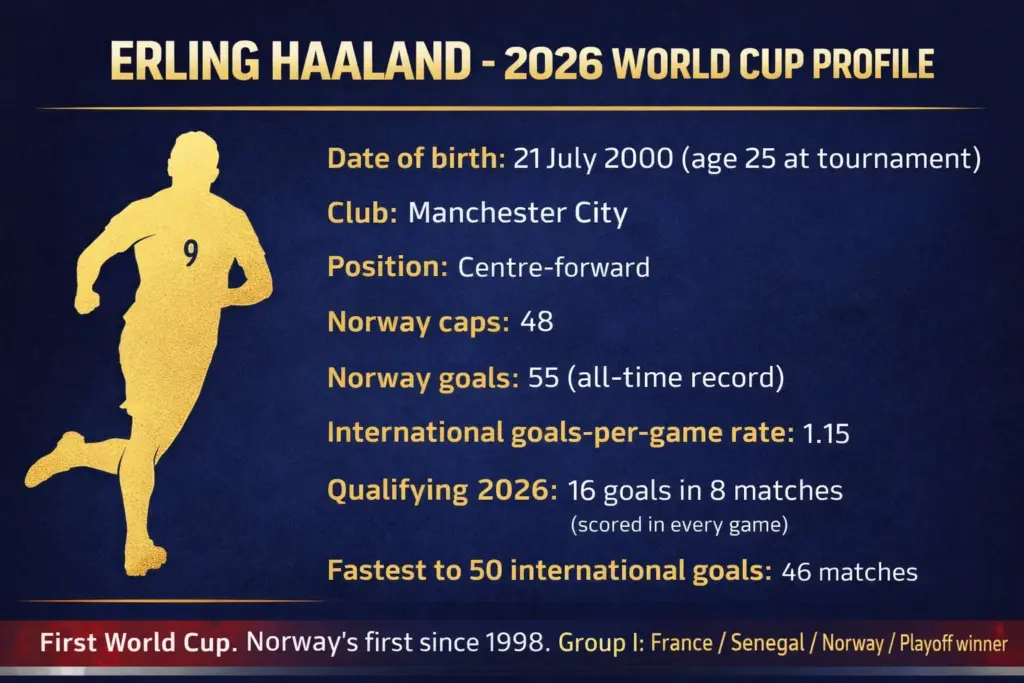
Erling Braut Haaland was born on July 21, 2000, in Leeds, England — where his father Alfie Haaland was playing for Manchester City at the time. He grew up in Bryne, Norway, and came through the youth academies of Bryne FK and Molde before moving to Red Bull Salzburg in 2019.
His career since then has been a sequence of records broken before the previous ones had time to settle:
- Joined Borussia Dortmund in 2020 — won the DFB-Pokal in 2021
- Moved to Manchester City in 2022 for €60 million — set the Premier League single-season scoring record in his debut campaign (36 goals), won the treble (Premier League, FA Cup, Champions League)
- Fastest player to 100 Premier League goals — 111 appearances (December 2, 2025), surpassing Alan Shearer’s record set after 124 matches
- Fastest player to 50 Champions League goals — 49 matches (September 2025)
- 300th career goal on June 26, 2025, aged 24 years and 340 days — second youngest in the 21st century to reach that landmark, behind only Kylian Mbappé
- Extended contract with Manchester City to 2034 in January 2025
At international level, Haaland has scored 55 goals in 48 appearances for Norway — making him the country’s all-time top scorer. He broke the previous record (held by Jørgen Juve since 1937) on October 10, 2024, when he scored a brace in a 3-0 Nations League win over Slovenia. He was 24 years old.
He will be 25 years old at the 2026 World Cup.
How Haaland Carried Norway to the World Cup
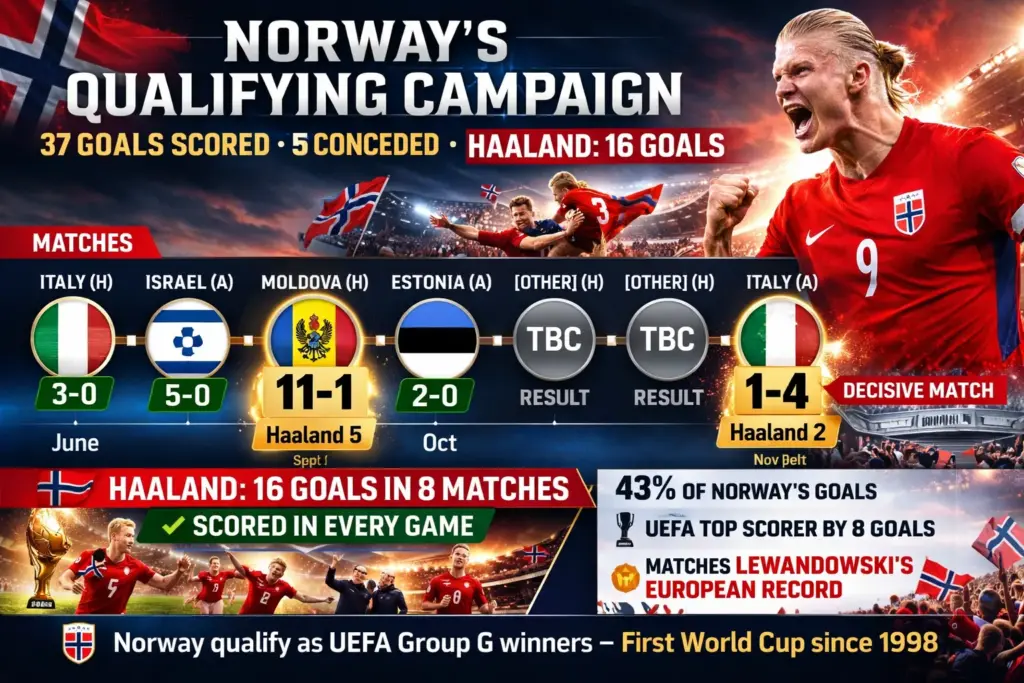
The story of Norway’s qualification for the 2026 World Cup is, to an unusual degree, the story of one man.
Norway finished as the highest-scoring team in all of UEFA qualifying — 37 goals scored, just 5 conceded across 8 matches. They topped their qualifying group (Group G) ahead of Italy, Israel, Moldova, Estonia, and [another team].
Haaland’s 16 goals in those 8 matches included:
- Five goals against Moldova (September 9, 2025) — in an 11-1 win that became the highest-scoring European qualifier in memory. Haaland became the first male European player to score five in a World Cup qualifier since Hans Krankl in 1977. Teammate Thelo Aasgard scored four more in the same match.
- Hat-trick against Israel (October 11, 2025) — in a 5-0 win. On this night, Haaland became the fastest player ever to reach 50 international goals — achieving it in just 46 matches, compared to Harry Kane’s previous record of 71 matches.
- Brace against Italy (November 16, 2025) — in San Siro, in the decisive qualifier. Italy needed a 9-goal win to overtake Norway on goal difference. Instead, Haaland scored twice in two minutes — a volley and a poacher’s finish — to seal a 4-1 win and Norway’s place at the World Cup.
By the end of qualifying, Haaland’s 16 goals matched Robert Lewandowski’s record for the most goals scored by a European player in a single World Cup qualifying campaign — the Polish striker’s tally from the road to Russia 2018. He finished 8 goals clear of his nearest rivals, including Harry Kane, Memphis Depay, and Marko Arnautović, who each scored 8.
He scored in every one of Norway’s 8 qualifying matches — only the second player in history to achieve that feat in a World Cup qualifying campaign.
What this means for the World Cup: No single player dominated European qualifying the way Haaland did. The logical extrapolation — that he will be one of the tournament’s most dangerous attackers — is not hype. It is pattern recognition.
How Haaland Plays: The Complete Centre-Forward
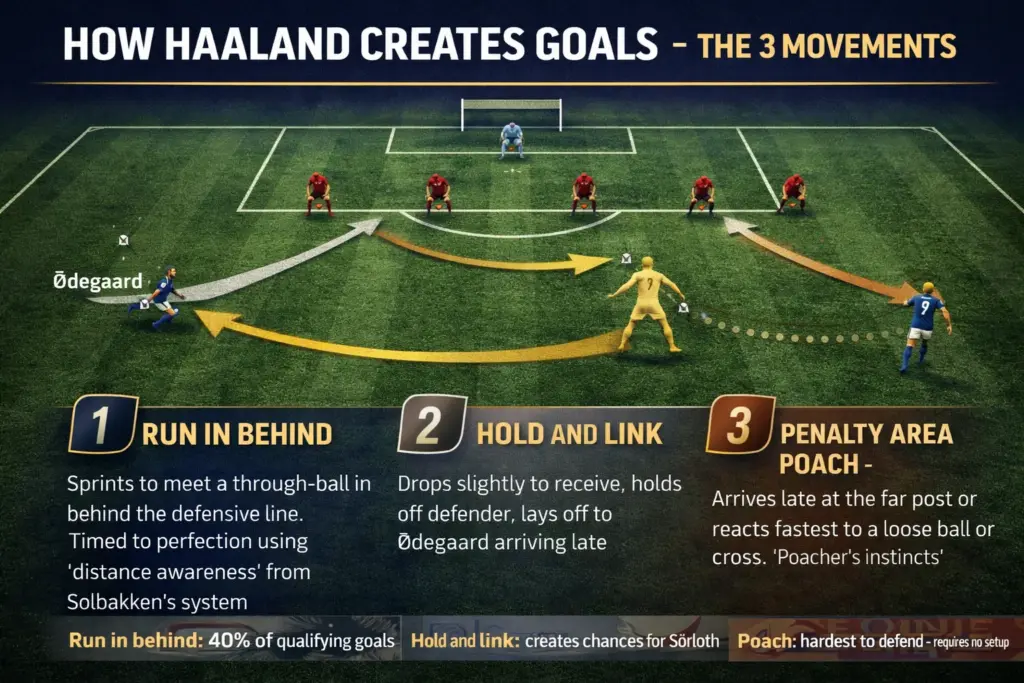
Haaland is not a technically elaborate player in the manner of Messi or Yamal. He does not dribble through defenses. He does not drop deep to orchestrate. He is, instead, arguably the most evolved version of the modern center-forward — a player whose specific skill set has been refined to a point where it becomes almost impossible to neutralize.
Movement and timing. Haaland’s primary weapon is his movement before the ball arrives. He times his runs with precision — reading the defensive line, finding the gap, arriving exactly as the ball reaches the space. This is what Solbakken means when he talks about “distances” — the synchronization that allows Haaland’s runs to connect with Ødegaard’s passes.
Power and finishing inside the box. He is 6ft 4in (194cm) and physically dominant — capable of holding off defenders, winning aerial duels, and finishing with both feet and his head. The volley against Italy in the decisive qualifier was a technically difficult finish executed with apparent ease. The second goal — reading the flight of the ball to arrive at the right spot — was pure instinct.
Goals-per-game at every level. At Manchester City in the Premier League: the fastest to 100 goals in the competition’s history. In the Champions League: the fastest to 50 goals. In international football: the fastest to 50 goals. The rate of scoring is consistent across every context, against every quality of opponent.
The one gap. Haaland is not primarily a chance creator. His assist numbers at international level are modest compared to the goal tallies. He depends on service — and at the 2026 World Cup, that service depends almost entirely on Ødegaard’s fitness and form. When the supply line is cut off, Haaland can go quiet.
The Supporting Cast: Who Feeds Haaland?
Norway’s attacking system is designed around creating the conditions for Haaland to score. Understanding who supplies him is essential to understanding Norway’s World Cup chances.
Martin Ødegaard — the architect
Arsenal captain. 67 caps for Norway. 4 goals, 18 assists in international football. In qualifying, he provided 7 assists — more than any other player in Norway’s entire campaign.
Ødegaard suffered an MCL injury at club level in October 2025 and did not play in the final two qualifiers, though he was present with the squad. His fitness for the World Cup is the single most important variable for Norway’s chances beyond Haaland himself — without Ødegaard, the supply line to Haaland becomes significantly less reliable.
Solbakken says Ødegaard’s role is to “find passing lanes others can’t” — the precision threading that turns Haaland’s movement into goals. He is also Norway’s primary trigger for their high press, initiating defensive transitions from the front.
Alexander Sørloth — the different threat
Atlético Madrid striker. 26 goals in 68 Norway appearances. At 1.95m (6ft 5in), Sørloth is one of the most physically imposing strikers in the world — described by analysts as “arguably the most devastating second-choice forward” at the tournament.
He can partner Haaland in a twin-tower formation or replace him entirely. While he doesn’t replicate Haaland’s specific goal-poaching instincts, his aerial prowess and hold-up play offer a dangerous alternative. Having a world-class striker as a backup is an advantage few nations at 2026 will share.
Antonio Nusa — the unpredictable element
RB Leipzig. Age 20. Norway’s “X-factor” — an explosive young winger who provides pace and directness on the counter. He scored Norway’s opening goal in the 4-1 qualifier victory over Italy. At 20, the World Cup is his first major international stage.
Oscar Bobb — the club connection
Manchester City. A midfielder who has forced his way into Pep Guardiola’s first-team plans — meaning he understands instinctively how to play alongside Haaland after doing it in training daily.
Sander Berge and the defensive core
Berge provides midfield aggression and physicality. Julian Ryerson (Borussia Dortmund) is Norway’s key defensive full-back — he committed the most fouls of any Norway player in qualifying but also made the most defensive tackles. Ørjan Nyland is the established goalkeeper.
Norway’s Tactical Identity: Solbakken’s System Explained
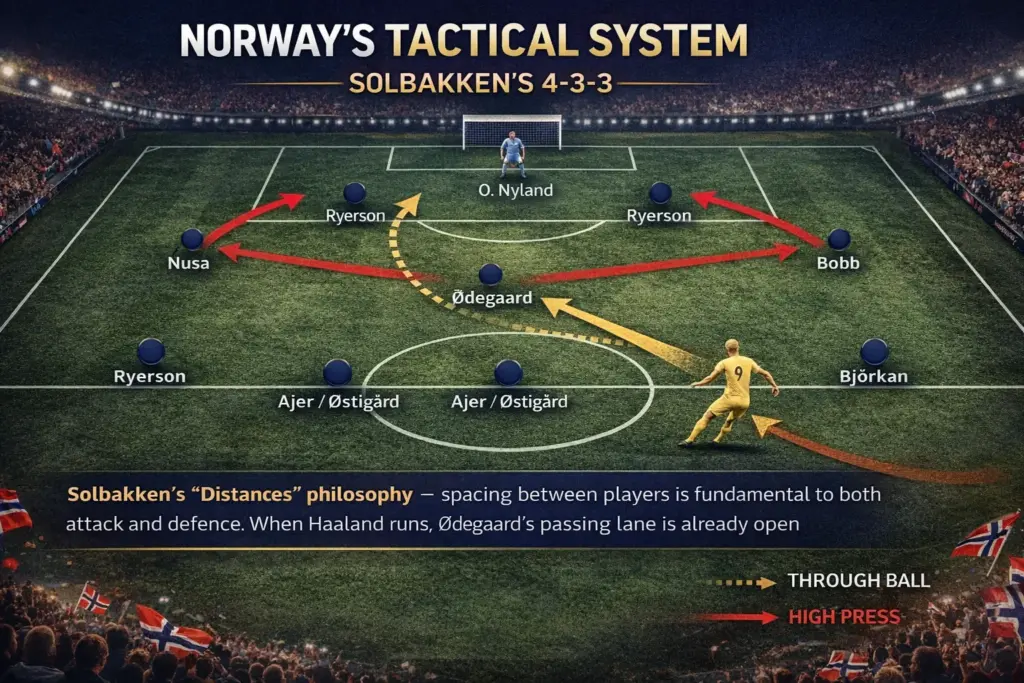
Ståle Solbakken has managed Norway since December 2020. He received a contract extension in December 2025 through August 2028 — he will be in charge for the World Cup and the subsequent European qualifying cycle. His record: 31 wins from 52 matches.
The transformation Solbakken has engineered is from a reactive, counter-attacking Norway to a possession-dominant, front-foot pressing team — a shift that mirrors what the best European club sides have spent a decade developing.
His philosophy is built on one word: “distances.”
“Distances. They’re fundamental, not only for our zonal defending to function, but also to ensure the ball carrier always has the right passing options when we attack.”
In practice, this means:
- In possession: Players maintain precise spacing so that when Haaland makes his run, Ødegaard’s pass is already threading into open space rather than into a crowded area
- Out of possession: A compact 4-3-3 that transitions fluidly into a pressing diamond, with Ødegaard triggering the press from the front
- In transition: Rapid, vertical attacks that exploit the space created by the press — Haaland’s movement in behind is most effective in exactly these moments
Norway qualified with 37 goals and only 5 conceded across 8 matches — evidence that this is not a one-dimensional attacking system. The structure holds defensively too.
The weakness that every analyst identifies is the same one: what happens when the defensive structure is stretched? Norway’s bench depth behind the first-choice defensive line is not at the same level as their attacking options. Against the very best attacking teams — France, Brazil, Argentina — the defensive resilience will be tested in ways the qualifying campaign did not.
Group I: Norway’s Path Through the Hardest Group
Norway are in Group I with France, Senegal, and a playoff qualifier.
(France Preview) calls Group I the “Group of Death” for a reason. France are Pre-tournament favorites with Mbappé as the world’s most dangerous attacker. Senegal are AFCON champions with a physical style that disrupts anyone who underestimates them. The playoff qualifier adds uncertainty.
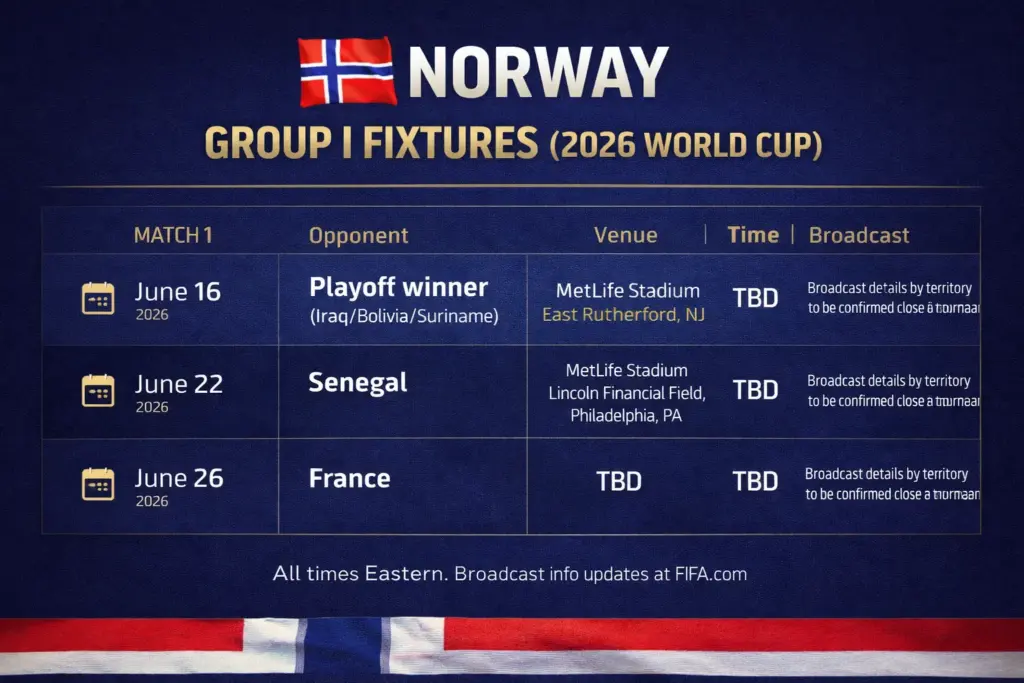
Norway’s group schedule (confirmed venues):
| Date | Opponent | Venue | Time (ET) | Broadcast |
|---|---|---|---|---|
| June 16 | Playoff 2 winner (Iraq/Bolivia/Suriname) | MetLife Stadium, NJ | TBD | TBD |
| June 22 | Senegal | MetLife Stadium or Lincoln Financial Field, PA | TBD | TBD |
| June 26 | France | TBD | TBD | TBD |
The pathway logic: The manageable opening fixture is against the playoff qualifier — a match Norway should approach as three points. Then comes the defining sequence: Senegal and France. If Norway win their opener convincingly, they arrive at the Senegal match with momentum and margin for error. A draw against Senegal with a point from France would likely be enough to advance as a group qualifier or one of the eight best third-place teams.
The Haaland factor in the Group of Death: If there is a stage where Haaland’s individual brilliance matters most, it is in exactly these matches. Norway do not need to beat France — they need to extract enough from the group to reach the Round of 32. Haaland’s ability to produce a goal from a single chance, even against a dominant opponent, is the reason this is plausible rather than hopeful.
Haaland vs The Golden Boot: The Honest Assessment
(Golden Boot Predictions) placed Haaland as a Tier 2 Golden Boot contender — a realistic dark horse rather than the outright favorite — for a specific reason: the Group of Death.
The three conditions for winning the Golden Boot are: team making a deep run, player being the primary scorer with penalty duties, and at least one weaker opponent in the group stage to build an early lead.
Haaland meets conditions two and three — he is Norway’s unquestioned primary scorer, with the playoff qualifier providing an early-goal platform. Condition one — team making a deep run — is the question mark.
If Norway exit at the group stage, Haaland might score 2-3 goals but cannot accumulate the 6-8 goals needed to seriously challenge Mbappé or Kane. If Norway advance through the Round of 32 and into the quarterfinals, Haaland becomes the most dangerous Golden Boot candidate in the tournament — because his scoring rate at international level (1.15 goals per game) suggests he would be producing in every match.
The DraftKings odds for the Golden Boot as of December 2025 had him at +1400 — behind Mbappé (+600) and Kane (+650), but above Yamal and Lautaro.
The honest verdict: If Norway progress deep, Haaland wins it. The if is the entire question.
Norway’s World Cup History: Context for 2026
Norway’s last World Cup appearance was in 1998 — France. In that tournament, they finished third in their group (behind Morocco and France) but advanced as one of the best third-place finishers. In the Round of 16, they were eliminated 1-0 by Italy. Their most famous moment from that tournament came in the group stage: a 2-1 win over Brazil.
This is Norway’s first World Cup in 27 years.
For the generation of Norwegian players that Solbakken has built — Haaland, Ødegaard, Sørloth, Nusa — the qualification itself is historic. None of them were born when Norway last played at a World Cup. For Haaland specifically, who was born in Leeds in 2000 while his father Alfie was playing in England, the 2026 World Cup is his first and possibly his peak opportunity.
The question being asked in Norway is not whether Haaland is good enough. It is whether the structure around him, and the group they have been drawn into, will give him the platform to show it.
Strengths, Weaknesses and the Verdict
Strengths:
- Haaland’s goal rate at every level is unmatched — 1.15 per game internationally, faster than anyone in history to multiple goal milestones
- Ødegaard is one of Europe’s best creative midfielders — the Haaland-Ødegaard combination is a world-class attacking partnership
- Sørloth as a backup striker is a luxury no other nation has — a genuine Plan B with real quality, offering a different but still dangerous alternative
- Solbakken’s system is tactically coherent and defensively organised, not just attack-minded
- Norway’s qualifying form (37 goals, 5 conceded) was statistically the most dominant of any European team
Weaknesses:
- Group I is one of the hardest groups in the tournament — France (favourites) and Senegal (AFCON champions) represent elite opposition before the Round of 32
- Ødegaard’s fitness is the single biggest individual vulnerability — without him, the supply to Haaland becomes significantly less reliable
- Defensive depth beyond the first choice back four is limited — injury to Ryerson or Ajer would be a serious problem
- Haaland’s first major international tournament — no one knows how he will manage the psychological weight of the World Cup stage at this level
- Norway’s tactical system relies on spacing and synchronization that works under training conditions — elite teams will disrupt those distances deliberately
The verdict: Norway are one of the tournament’s most compelling teams to follow — not because they will win it, but because the ceiling is genuinely unknown. If Ødegaard is fit, the group is navigated, and Haaland finds form in the knockout rounds, a quarterfinal is achievable. A semifinal is not impossible. Beyond that, the defensive questions are too significant. But “beyond that” is already Norway’s best World Cup finish in decades.
Whatever happens, watch every Norwegian match. When Haaland is in form, this is the most watchable football of any nation at the tournament.
FAQs: Erling Haaland and Norway at the 2026 World Cup
How old is Erling Haaland at the 2026 World Cup?
Haaland was born July 21, 2000. He will be 25 years old throughout the 2026 World Cup (which runs June 11–July 19). He turns 26 on July 21 — two days after the Final.
How many goals has Haaland scored for Norway?
55 goals in 48 international appearances — making him Norway’s all-time top scorer. He broke the previous record (Jørgen Juve, held since 1937) in October 2024, at age 24. His international goals-per-game rate is approximately 1.15 — among the highest in history for outfield players.
What records did Haaland set in World Cup qualifying?
16 goals in 8 qualifying matches (UEFA Group G), scoring in every single game (only the second player ever to do so in a World Cup qualifying campaign). He was UEFA’s top qualifier scorer by 8 goals. His tally matched Lewandowski’s European qualifying record. He also became the fastest player to 50 international goals (46 matches) during qualifying — beating Kane’s record of 71 matches.
What group are Norway in at the 2026 World Cup?
Group I — alongside France, Senegal, and a playoff qualifier (from Iraq/Bolivia/Suriname). This is widely described as one of the tournament’s most competitive groups.
When do Norway play at the 2026 World Cup?
June 16 (vs playoff qualifier), June 22 (vs Senegal), June 26 (vs France). All matches in the northeastern USA — MetLife Stadium, Gillette Stadium, or Lincoln Financial Field.
How can I watch Norway’s matches?
Broadcast information will be confirmed closer to the tournament. In the US, matches are expected to air on FOX/FS1 (English) and Telemundo/Universo (Spanish). In the UK, rights are held by BBC and ITV. Check local listings for other regions.
Is Haaland a Golden Boot favourite?
He is a Tier 2 contender — realistic dark horse, not the outright favourite. The key constraint is Norway’s Group of Death: if they exit at the group stage, his tally is limited. If they advance deep into the knockouts, he becomes the most dangerous Golden Boot candidate in the field based on his international scoring rate. DraftKings odds as of December 2025: +1400 (behind Mbappé at +600 and Kane at +650).
What club does Haaland play for?
Manchester City. He has scored 100 Premier League goals faster than any player in history (111 matches), reached 50 Champions League goals faster than any player (49 matches), and has a contract with the club until 2034.
Who creates goals for Haaland at Norway?
Martin Ødegaard is the primary creator — 7 assists in qualifying alone, 18 international assists across his career. He is Arsenal captain and one of Europe’s best midfielders. Ødegaard’s fitness is the single most important supporting variable for Norway’s World Cup chances.
Has Norway ever beaten a major nation at a World Cup?
Yes — their most famous World Cup moment is a 2-1 victory over Brazil at the 1998 World Cup in France. That was the last time Norway played at a World Cup.
What is Haaland’s style of play?
A complete modern center-forward — elite movement and timing of runs, dominant physical presence (6ft 4in), clinical finishing with both feet and head, and an extraordinary ability to score goals from minimal service. He is less involved in build-up than Mbappé or Lewandowski — his primary value is scoring, not creating.