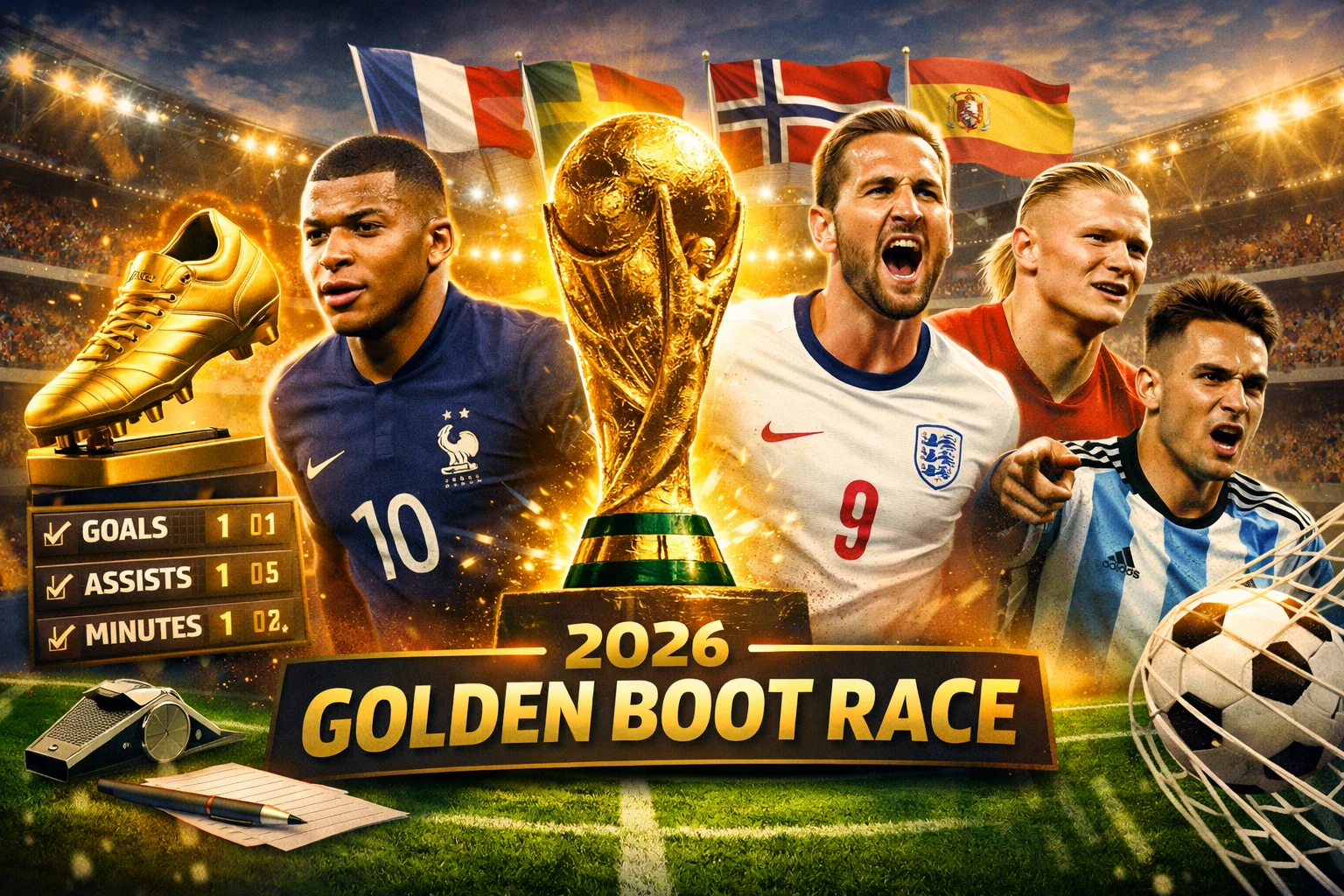

2026 World Cup Golden Boot is the World Cup’s most watched individual race: one player, one number, the most goals at the tournament. It stands above every other individual award because it is objective — count the goals, find the winner.
The 2026 World Cup adds one more layer of intrigue. For the first time, players have a potential eight matches instead of seven — one additional game for every player who goes all the way. The total number of matches jumps from 64 to 104. Goals will be plentiful, and the race from June to July will be one of the tournament’s defining storylines.
The three headliners are already clear. Kylian Mbappé is the defending Golden Boot winner. Harry Kane won it in 2018 and is in the form of his career. Erling Haaland brings an international goal rate that no other player alive can match — and this is his first World Cup. Behind those three: Lamine Yamal, Lautaro Martínez, Ousmane Dembélé, and half a dozen credible wildcards.
This guide covers the history, the records, every credible contender ranked and assessed, the factors that determine winners — and a clear, scenario-based view of who wins the 2026 Golden Boot.
Informational note on odds: This article references market odds from DraftKings Sportsbook as reported by Fox Sports (December 5–8, 2025) as one data point reflecting how analysts assess probability. They are presented for informational context only — not as betting recommendations. Odds change frequently; check directly with licensed operators in your jurisdiction.
TL;DR
- The award: Most goals scored across the entire tournament — officially presented since 1982
- No player has ever won it twice — 2026 would be historic for either Mbappé or Kane
- The record: Just Fontaine, 13 goals in 1958 — untouched for 68 years
- The headliners: Mbappé (2022 winner, 8 goals), Kane (2018 winner, 6 goals), Haaland (55 international goals, first WC)
- The key factor: Team depth of run + penalty duties + at least one weaker group opponent
- The 2026 twist: 8 matches maximum vs 7 previously — one more goal-scoring game for deep runners
What Is the Golden Boot — and How Is the Winner Decided?
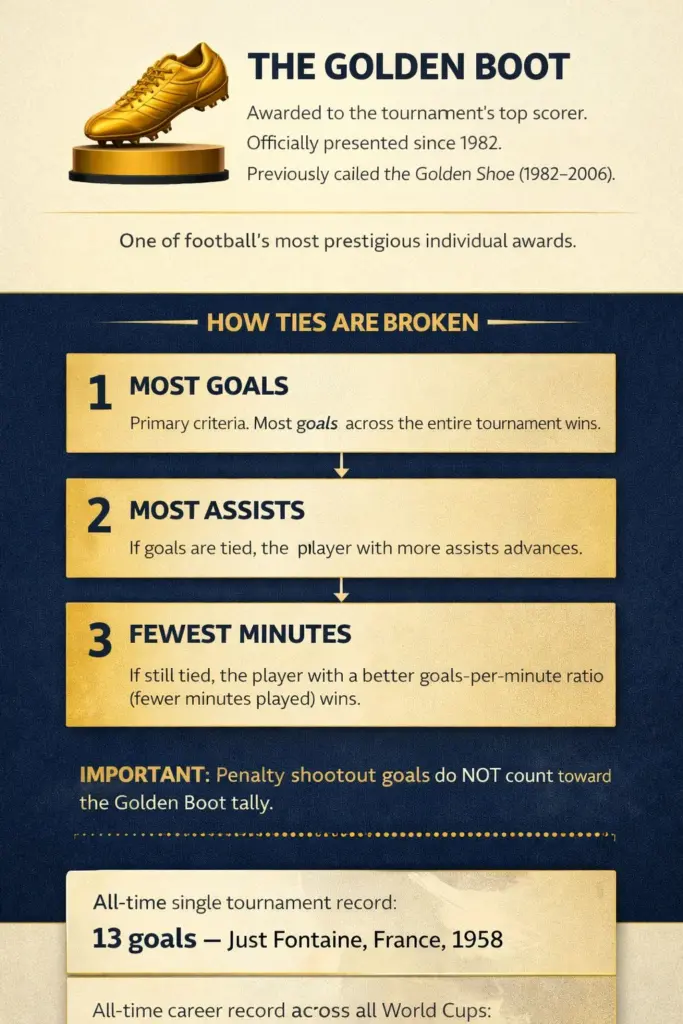
The Golden Boot goes to the player who scores the most goals across the entire tournament — group stage through Final. Every goal counts equally, regardless of when or against whom it was scored.
If two or more players finish level on goals, a tiebreaker applies. First: assists — most assists wins. Second: fewest minutes played — the player with the better goals-per-minute ratio advances. This secondary tiebreaker exists precisely to reward efficiency.
One important rule: penalty shootout goals do not count. Only goals scored in regular time and extra time are included in the tally. A player who scores five times in open play but never in a shootout counts five. A player who scores twice in open play and three times in shootouts counts two.
The award has been officially presented since 1982 — before that, top scorers were recognized informally. The name was Golden Shoe from 1982 to 2006; renamed Golden Boot in 2010.
The most remarkable fact in its history: No player has ever won the Golden Boot at two different World Cups. Every tournament has produced a different winner — from Oleg Salenko (Russia, 1994) to Ronaldo (Brazil, 2002) to Kane (England, 2018) to Mbappé (France, 2022).
That makes 2026 doubly compelling. Both Mbappé and Kane are previous winners. If either claims a second, they write themselves into the award’s history uniquely.
The Records Within Reach in 2026
The single tournament record — Fontaine’s 13: Just Fontaine scored 13 goals for France at the 1958 World Cup in Sweden across six matches. He scored in every single game. The record has stood for 68 years. No player has come close — the second-highest total at a single modern tournament is 8, shared by Ronaldo (2002) and Mbappé (2022).
With the 2026 tournament offering a maximum of 8 matches — one more than in 2022 — Fontaine’s record is theoretically within reach for the first time since 1958. Whether any single player can maintain the scoring frequency required across eight matches is another question. However, the possibility now exists in a way it did not in the 7-match format.
The career record — Klose’s 16: Miroslav Klose holds the all-time career record with 16 goals across four World Cups. Mbappé, with 12 goals in 14 matches entering 2026, is the active player closest to that record. Eight maximum matches in 2026 gives him the opportunity to approach — and potentially equal — Klose’s mark.
The last time a Golden Boot winner also lifted the trophy: 2002 — Ronaldo, Brazil, 8 goals. In the 22 World Cups before 2026, only five Golden Boot winners were on the tournament-winning team. Most often, the top scorer plays for a team that goes deep but not all the way.
Every Contender Ranked — Tier by Tier
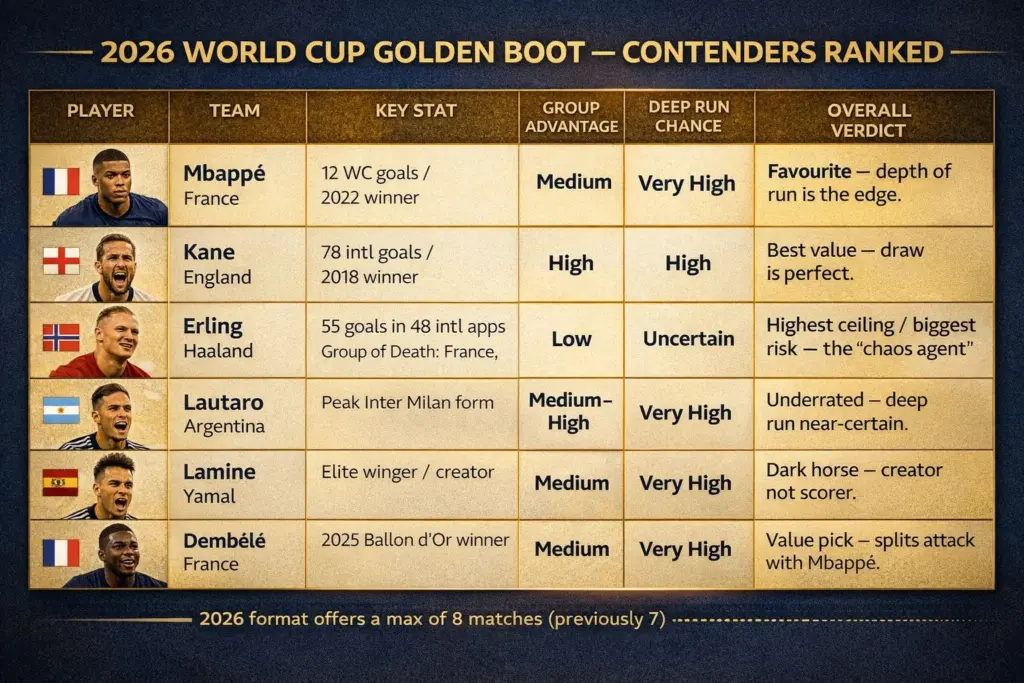
Tier 1 — The Two Favourites
Kylian Mbappé — France (Group I)
DraftKings odds (Dec 5, 2025): +600 — market favorite
Mbappé is the defending Golden Boot winner. His 2022 haul of 8 goals included a hat-trick in the Final — the most dramatic possible way to top a scoring chart. He enters 2026 in the best individual form of his career: 41 goals and 8 assists across all competitions in 2025–26 (Goal.com, February 2026).
The case for Mbappé is straightforward: he is the primary striker for one of the tournament’s two or three most likely finalists, he is France’s designated penalty taker, and his goal-scoring rate at international level has been consistent across multiple tournaments.
The case against is equally clear: Group I is the tournament’s Group of Death. France play Senegal, Norway (including Haaland), and the inter-confederation playoff winner — none of whom are the kind of weaker opposition where a top scorer can build a 3–4 goal cushion in the group stage. Mbappé also shares France’s attack with Dembélé, Olise, and Doué — multiple players who will contribute goals and reduce his individual accumulation in any given match.
What has to happen: France reach the semifinal or Final, Mbappé contributes in at least four or five of those matches, and his lead over rivals in the group stage is not undermined by France’s competitive fixtures. In this scenario: likely 7–9 goals total.
Harry Kane — England (Group L)
DraftKings odds (Dec 5, 2025): +650
Kane won the Golden Boot in Russia in 2018 with 6 goals. He is now England’s all-time leading scorer with 78 goals in 112 caps, has scored 9 goals in 9 England appearances under Tuchel, and is producing 39 goals and 5 assists across all competitions at Bayern Munich this season. FourFourTwo ranked him the world’s #1 striker in December 2025.
The post-draw analysis from multiple sources converged on the same verdict: the 2026 draw was exceptional for Kane. Group L includes Panama — the same team Kane scored a hat-trick against in the 2018 group stage, contributing three of his six Golden Boot goals in a single match. Panama conceded 11 goals in three group-stage matches in 2018. A similar defensive performance in 2026 could provide Kane with the multi-goal platform he needs to build an insurmountable early lead. England are also considered a genuine semifinalist, potentially giving Kane the match volume required. Kane is England’s designated penalty taker — a consistent source of additional goals at major tournaments.
Post-draw analyst comment (bestpickssports.com, January 2026): “The draw could not have been better for Harry Kane. Drawing Panama in Group L is a massive advantage for the England captain, mirroring the scenario that helped him win the award in 2018.”
What has to happen: England reach the semifinal, Kane scores a brace or hat-trick against Panama in the group stage (building an early lead), and he converts at least two or three additional goals in the knockout rounds. In this scenario: likely 6–9 goals total.
The head-to-head with Mbappé: On paper, Kane has the better group draw — Panama provides a clear goal-accumulation opportunity that Mbappé does not have in Group I. Mbappé has the better individual ceiling in terms of pure quality. Whether team run or individual brilliance matters more ultimately decides which of the two claims a second Golden Boot.
Tier 2 — The Wildcard Case
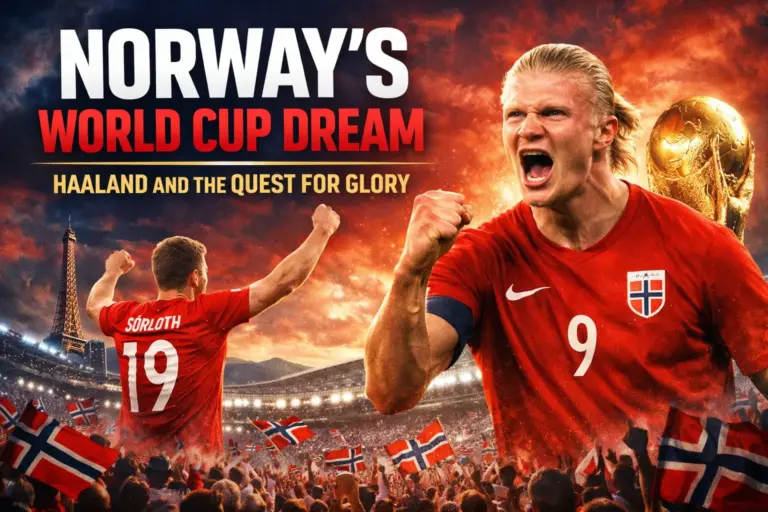
Erling Haaland — Norway (Group I)
DraftKings odds (Dec 5, 2025): +1400
Haaland has never played at a World Cup. That changes in 2026. His international record — 55 goals in 48 Norway appearances — is one of the most extraordinary goal rates in international football history. In 2026 qualifying specifically, he scored 16 goals in 8 qualifying matches — the highest scoring tally of any European qualifier.
The case for Haaland is purely goal-scoring instinct: he scores regardless of opponent quality. As sports betting dime noted, before his prominence at Dortmund and City, he scored 8 goals in 6 Champions League games for RB Salzburg. He simply finds ways to score, and Norway’s qualification means he now has the platform.
The case against is the draw: Group I puts Haaland against France (one of the tournament’s elite defenses) and Senegal (physically powerful and well-organized) before Norway even reach the knockouts. Norway is not expected to make a deep run. If they exit in the Round of 32, Haaland plays a maximum of four matches — limiting his total even at the highest goal-per-match rate.
What has to happen: Norway survive their Group of Death (at minimum, finish as one of the 8 best third-place teams), advance past the Round of 32, and ideally reach the quarterfinal. In this scenario — even with Norway eliminated in the QF — Haaland’s goal rate in those 5–6 matches could still produce 7+ goals and a realistic Golden Boot challenge. If Norway reach only the Round of 32: his maximum is 4 matches, and the race becomes very difficult mathematically.
The Haaland paradox: He is simultaneously the player with the highest per-game scoring rate at international level and the one whose overall total is most at risk from an early team exit. No other contender carries that same combination of ceiling and floor. For the neutral fan, he is the most exciting variable in the entire race—a “chaos agent” whose raw power could either drag Norway through the Group of Death or produce a series of brilliant but meaningless goals in a heroic early exit.
Lautaro Martínez — Argentina (Group J)
DraftKings odds (Dec 5, 2025): +2000
Lautaro is the most underrated contender on the list. Argentina — the defending champions — are one of the most likely teams to reach the Final, which gives him a potential 8-match window. Group J includes Jordan (making their World Cup debut) — a guaranteed goal-scoring opportunity in the group stage. Jordan conceded an average of 2.1 goals per game in Asian qualifying. This is the exact type of opponent against which Golden Boot races are won.
His Inter Milan form has been described as “peak of his game” — he arrives in 2026 as one of Europe’s most clinical center-forwards. And critically: if Messi’s participation is limited or his involvement is reduced, Lautaro becomes Argentina’s primary goal-accumulation player.
Post-draw analysis (bestpickssports.com, January 2026): “Defending champions Argentina have a relatively comfortable path in Group J. Jordan is the lowest-ranked team and presents a prime scoring opportunity. With Messi likely facilitating, Lautaro should have plenty of chances.”
What has to happen: Argentina reach the semifinal or Final, Messi operates in a deeper creative role (giving Lautaro the striker’s scoring burden), and Lautaro converts his opportunities across 6–8 matches. In this scenario: realistic 6–8 goal total. His odds at +2000 represent the significant underestimation of how likely Argentina are to go deep.
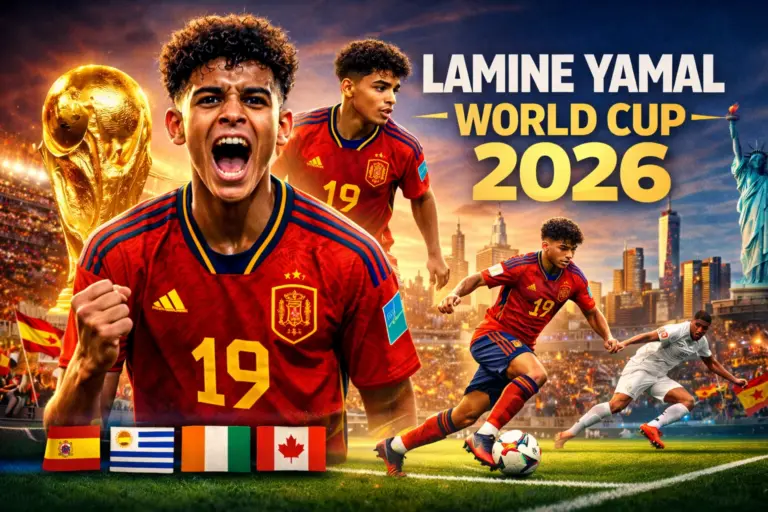
Lamine Yamal — Spain (Group H)
DraftKings odds (Dec 5, 2025): +1800
Yamal’s odds reflect two things: Spain are expected to go deep (meaning he has match volume), and his individual quality is undeniable. His profile as a winger and creator rather than a central striker is what separates him from the Tier 1 contenders — Golden Boot winners are almost universally central forwards or attacking midfielders who accumulate goals directly.
If Spain reach the Final, Yamal will contribute goals and assists throughout — but converting that into a Golden Boot-winning tally against the world’s elite defences, from a wide position, is a harder path than the central strikers above him.
Best case: Spain go deep, Yamal scores in multiple knockout rounds, and his group stage goals against Cabo Verde and Saudi Arabia provide an early accumulation base. A realistic total in this scenario: 4–6 goals — which could still win a Golden Boot in a tight year.
Tier 3 — The Longshots Worth Understanding
Ousmane Dembélé (France) — +2000
The 2025 Ballon d’Or winner. His goal-scoring evolution under Luis Enrique and then PSG’s system makes him a genuine goal threat — not just a creator. The complication: he shares France’s attack directly with Mbappé. When France has two world-class scorers in the same team, the Golden Boot goal-totals tend to split between them. Dembélé’s odds reflect value if France go deep and Dembélé, rather than Mbappé, becomes the primary accumulator.
Cristiano Ronaldo (Portugal) — +1800
Approaching 41 and almost certainly playing his final World Cup. His Nations League 2025 form — scoring in both the semifinal and final — demonstrates he still contributes at international level. He has 13 World Cup goals across five tournaments but has never won the Golden Boot. Portugal’s group and knockout draw determine whether he has the match volume for a realistic challenge. His penalty duties for Portugal keep him relevant.
Nick Woltemade (Germany) — +2000
Germany’s primary striker and an emerging story: 4 qualifying goals including the decisive header that secured Germany’s qualification. Physical (6’6″), technically developing, and leads the line for Julian Nagelsmann’s side. Germany are a credible quarterfinal team, giving him potential match volume. His tournament debut status is the key risk.
Vinicius Jr (Brazil) — longer odds
Transitioned from wide forward to focal point of Brazil’s attack under Carlo Ancelotti. Brazil’s multiple attacking options (Raphinha, Rodrygo, Endrick) risk splitting goal contributions — the same challenge that has historically prevented Brazil from producing individual Golden Boot winners despite consistent team performances. His odds reflect genuine quality with a structural goal-sharing risk.
The Golden Boot Decision Framework
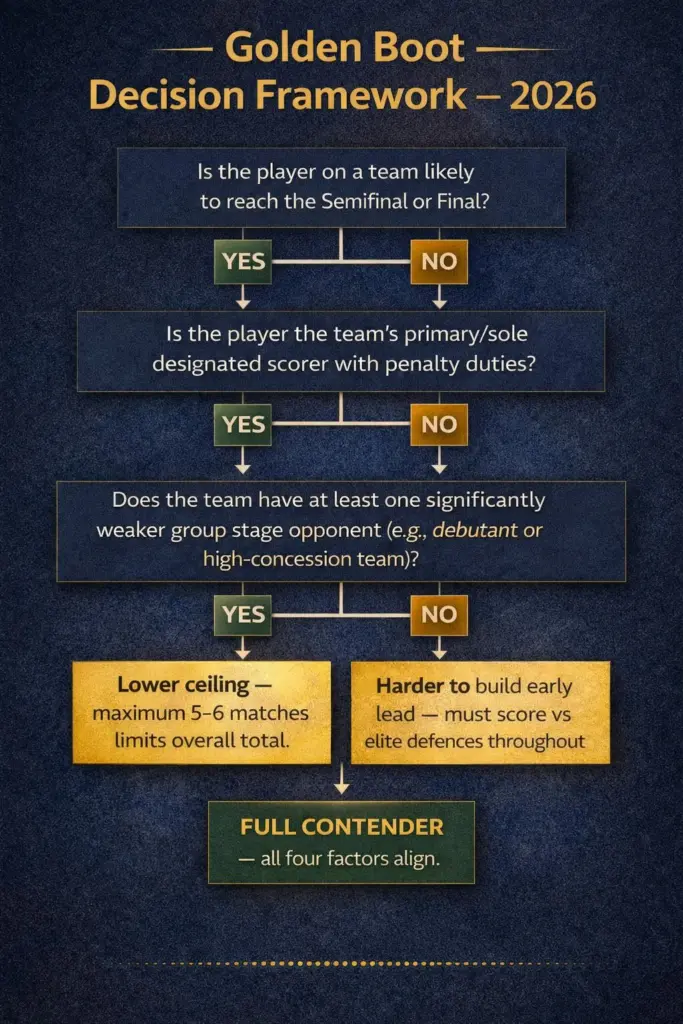
Three factors consistently separate Golden Boot winners from players who simply score at major tournaments.
Factor 1 — Team depth of run: The Golden Boot winner almost always plays for a team that reaches at least the quarterfinal. More matches mean more goal opportunities. A player eliminated in the Round of 32 plays 4 matches. A finalist plays 8. That four-match difference is the single biggest variable in the race.
Factor 2 — Primary scorer with penalty duties: Players who share goal-scoring responsibility with multiple elite teammates rarely win the Golden Boot. Mbappé and Dembélé sharing France’s attack creates precisely this challenge. Kane for England, and Haaland for Norway (Norway’s essentially only attacking option), benefit from being the clear #1 goal accumulator on their respective teams.
Factor 3 — At least one weaker group stage opponent: The group stage provides the best opportunity for multi-goal hauls against less defensively organized opposition. Kane’s hat-trick against Panama in 2018 was decisive. In 2026, England draw Panama again. Haaland has no equivalent — Group I presents France and Senegal as group stage obstacles. This asymmetry in group draws is real and analytically significant.
Applying the framework:
| Contender | Team reaches SF/F? | Primary scorer? | Easy group fixture? | Overall |
|---|---|---|---|---|
| Mbappé | Very likely | Partial (shares w/Dembélé) | No (Group of Death) | Favourite despite weaker group |
| Kane | Likely | Yes (primary + penalties) | Yes (Panama) | Best structural fit |
| Haaland | Uncertain | Yes (Norway’s only option) | No (France/Senegal) | Highest ceiling, highest risk |
| Lautaro | Very likely | Likely (if Messi creates) | Yes (Jordan) | Most underrated |
| Yamal | Very likely | No (creator not scorer) | Partial | Dark horse only |
Golden Boot Historical Winners — The Context
Every Golden Boot race benefits from historical context — understanding the patterns that have produced winners helps assess 2026.
Selected key winners and what made them possible:
- 1958 — Just Fontaine (France), 13 goals: The untouched record. Scored in every game. France reached the third-place match — 6 games total. The pre-modern defensive era helped, but 13 goals in 6 games remains the benchmark.
- 1986 — Gary Lineker (England), 6 goals: A reminder that Golden Boot winners do not always play for the best team. England were knocked out in the quarterfinal. Lineker scored efficiently across fewer matches.
- 2002 — Ronaldo (Brazil), 8 goals: The last time a Golden Boot winner also lifted the trophy. Brazil won every match — giving Ronaldo 7 games and consistent goal-scoring opportunity at every stage.
- 2006 — Miroslav Klose (Germany), 5 goals: The lowest winning total in recent tournaments — a reflection of how competitive defenses had become. Klose later set the all-time career record with 16 goals across four tournaments.
- 2018 — Harry Kane (England), 6 goals: Kane scored 6 goals including 3 against Panama. England reached the semifinal — giving him 7 matches. Three of his goals were penalties. The hat-trick against Panama, mirrored by 2026’s Group L, is the template he is attempting to reproduce.
- 2022 — Kylian Mbappé (France), 8 goals: Including a hat-trick in the Final. France were runners-up — 7 matches. Mbappé scored in five of seven games.
Pattern across recent winners: The winning total in the modern era typically falls between 6 and 8 goals. With an extra match available in 2026’s format, a winning total of 7–9 goals is the realistic expectation. A player scoring 6 goals in a 7-match final run might not be sufficient if a rival on a similar run accumulates 8 or 9.
Common Myths — Corrected
“The best player at the tournament wins the Golden Boot.” Not necessarily — and the statistics confirm it. Only once in the official award’s history (1982, Paolo Rossi) did the Golden Ball best player winner also win the Golden Boot. Most often they are different players. Messi won the 2022 Golden Ball without the Golden Boot. The Golden Boot rewards goal accumulation; the Golden Ball rewards overall contribution.
“Penalty goals don’t count toward the Golden Boot.” Partial myth — open-play penalties (won and scored during regular play) absolutely count toward the Golden Boot tally. Only penalty shootout goals (the kick-for-kick format used to decide tied knockout matches) are excluded. Kane’s three penalties in 2018 all counted. Mbappé’s penalty in the 2022 Final counted.
“Haaland is the favourite because he has the best club goal record.” Club goals and international tournament goals are different competitions. Haaland is unquestionably the world’s most prolific club scorer — but he has never played a World Cup match, and Norway are in the Group of Death. His international record (55 goals in 48 appearances) is extraordinary, but the structural difficulty of Group I and Norway’s uncertain tournament depth means he is a high-ceiling, high-risk contender rather than the straightforward favourite his club form might suggest.
“The Golden Boot winner always comes from the world champion.” The opposite is more true. In 22 tournaments before 2026, only five Golden Boot winners were on the winning team. Most recently: 2002, Ronaldo with Brazil. A deep-running runner-up or semifinalist — with more difficult matches and thus more goals required at every stage — is actually the more common source of Golden Boot winners.
FAQs: 2026 World Cup Golden Boot
What is the World Cup Golden Boot?
The award given to the tournament’s top goal scorer — the player with the most goals across the entire competition. Officially presented since 1982.
Has any player ever won the Golden Boot twice?
No — every World Cup has produced a different winner. Both Mbappé (2022) and Kane (2018) are previous winners; a second Golden Boot for either would be a first in the award’s history.
What is the all-time single tournament goal record?
13 goals — Just Fontaine (France), 1958 World Cup in Sweden. The record has stood for 68 years and remains the most unreachable individual achievement in World Cup history.
Who is the all-time World Cup top scorer across all tournaments?
Miroslav Klose (Germany) — 16 goals across four World Cups (2002, 2006, 2010, 2014).
Do penalty shootout goals count toward the Golden Boot?
No — only goals scored in regular time and extra time count. Open-play penalties (during a match) do count. Penalty shootout goals (kick-for-kick after extra time) do not.
Who won the Golden Boot at the 2022 World Cup?
Kylian Mbappé (France) — 8 goals, including a hat-trick in the Final. Runner-up: Lionel Messi (Argentina) — 7 goals.
Who won the Golden Boot at the 2018 World Cup?
Harry Kane (England) — 6 goals, including a hat-trick against Panama and three penalties total.
How many goals does a player typically need to win the Golden Boot?
In the modern era (2002–2022): between 5 and 8 goals. With 2026’s extra match opportunity (8 maximum vs 7 previously), a winning total of 7–9 goals is the realistic expectation — though a very high-scoring semifinal or final can produce totals outside that range.
Is Erling Haaland the favourite to win the Golden Boot?
Market odds at DraftKings (December 2025) placed him fourth at +1400 — behind Mbappé (+600), Kane (+650) and Messi (+1200). His international goal rate is unmatched, but his group draw (Group of Death) and Norway’s uncertain tournament depth are the constraints. He is the highest ceiling/highest risk contender in the field.
When will we know who won the 2026 World Cup Golden Boot?
The award is presented at the conclusion of the Final — July 19, 2026, MetLife Stadium, New Jersey. The race is effectively decided by the semifinal stage for players not in the Final itself.