


Wales World Cup 2026 qualification hopes rest on two play-off matches in March. After ending a 64-year World Cup drought by qualifying for Qatar 2022, Craig Bellamy’s side are trying to do something no Welsh team has ever done: reach back-to-back World Cups. Standing in their way is Bosnia and Herzegovina in Cardiff on 26 March, followed potentially by Italy or Northern Ireland on 31 March. Here is the full story.
TL;DR
- Wales did not qualify automatically — they finished second in UEFA Group J behind Belgium.
- They sealed their play-off place with a 7-1 demolition of North Macedonia, earning home advantage for both play-off matches.
- Semifinal: Wales vs Bosnia and Herzegovina — 26 March 2026 — Cardiff City Stadium.
- Final (if Wales win): Wales vs Italy or Northern Ireland — 31 March 2026 — Cardiff City Stadium.
- If Wales qualify, they enter Group B alongside Canada, Switzerland and Qatar.
- Manager: Craig Bellamy, who took charge in July 2024 after Rob Page’s departure.
- This would be Wales’ second consecutive World Cup — something the nation has never achieved.
SNIPPET BLOCK
Wales are not yet qualified for the 2026 World Cup. They finished second in UEFA Group J and must win two play-off matches in March. Their semifinal is at home against Bosnia and Herzegovina in Cardiff on 26 March 2026. If they win, they host the Path A final on 31 March against either Italy or Northern Ireland. If Wales qualify, they join Canada, Switzerland and Qatar in World Cup Group B.
Wales World Cup 2026: Why Wales Are in the Playoffs
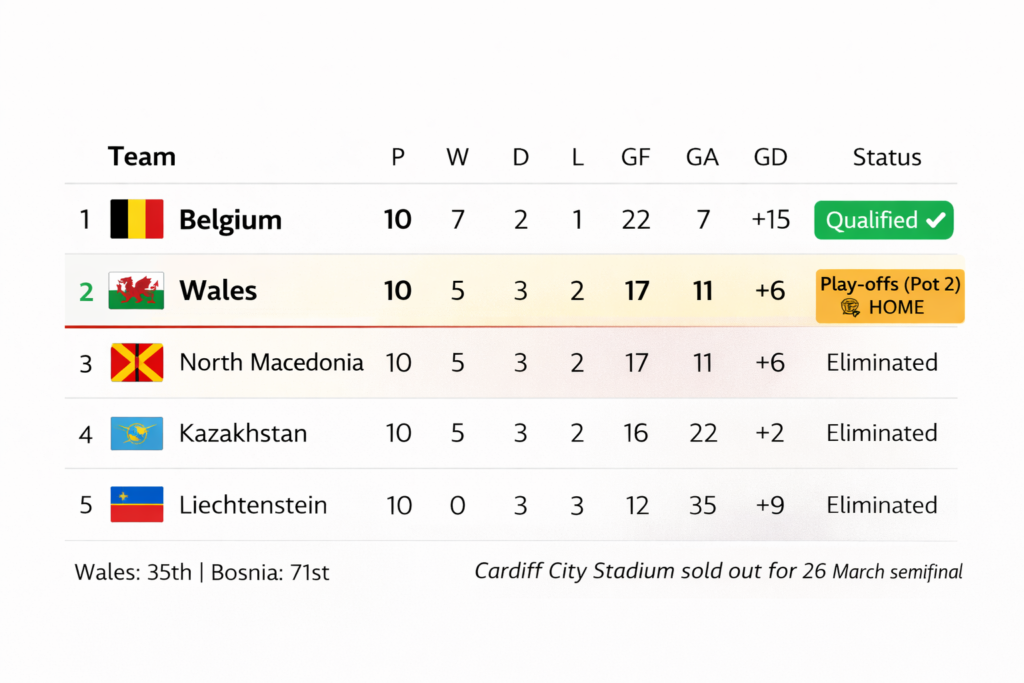
Group J consisted of five teams: Belgium, Kazakhstan, Liechtenstein, North Macedonia and Wales. The group winners, Belgium, qualified directly for the World Cup finals, while the runners-up, Wales, advanced to the second round — the play-offs.
Belgium were simply too strong. Kevin De Bruyne, Jeremy Doku and a resurgent Red Devils squad won the group with authority. Wales could not match them head-to-head — Wales lost 2-4 to Belgium — but they held off every other challenger convincingly.
Wales hammered North Macedonia 7-1 in Cardiff to clinch second place in Group J, finishing just behind Belgium in their push for a spot at the 2026 World Cup.
Rampant Wales thrashed North Macedonia 7-1 as skipper Harry Wilson scored a hat-trick, with David Brooks, Brennan Johnson, Daniel James and Nathan Broadhead also on the scoresheet.
Bellamy said: “I said to the players at the end I am not a perfect person, I haven’t come across anyone who is. But maybe I take a little bit of that back because that was as close to the perfect performance as I have seen. That was incredible. We were just so clean with the ball and that allows you to have good chances.”
The 7-1 result did more than secure second place. Bellamy’s side already had a play-off ticket in their back pocket thanks to their Nations League triumph, but locking down the runners-up spot brought a massive advantage — Pot 2 seeding, which means Wales host both the semifinal and the final if they get there.
Craig Bellamy’s side secured their place by finishing second behind Belgium in qualifying Group J and will be the home team for the one-off match and in the final should they get there.
Wales World Cup 2026: The Playoff Route — Two Matches, Cardiff, Everything at Stake
Wales have home advantage for every remaining match. That is huge — and it is a direct reward for their Pot 2 seeding and the quality of their qualifying campaign.
Wales host Bosnia and Herzegovina at the Cardiff City Stadium on Thursday 26 March. A victory would set up a winner-takes-all match against Italy or Northern Ireland in the capital on Tuesday 31 March for a place at the FIFA World Cup finals.
Match 1 — Semifinal
Wales vs Bosnia and Herzegovina
Date: 26 March 2026
Venue: Cardiff City Stadium, Cardiff
Format: Single leg. Extra time and penalties if level after 90 minutes.
Match 2 — Final (if Wales win)
Wales vs Italy or Northern Ireland
Date: 31 March 2026
Venue: Cardiff City Stadium, Cardiff
One match. One World Cup place.
Cardiff City Stadium holds around 33,000 supporters. On nights like this — when Wales have something at stake — it becomes one of the most atmospheric venues in British football. The supporters, the Red Wall, the noise: it is a genuine home advantage. Tickets for both games are already sold out.
Craig Bellamy has called on the Red Wall to play their part: “The atmosphere that we’re able to generate at home, it’s definitely going to help. The momentum can change, there can be stoppages of three or four minutes, but that’s where we need the supporters to be at their best. The fans, they’ve got experience in these moments.”
Craig Bellamy felt optimistic after watching footage of recent Bosnia and Herzegovina games, saying: “I’ve seen a lot of strengths from them but I’ve seen a lot of weaknesses as well.”

Wales World Cup 2026: Who Are Bosnia and Herzegovina?
Bosnia and Herzegovina are currently 71st in the FIFA World Rankings but finished runners-up in their qualifying group under head coach Sergej Barbarez to book their place in the play-offs.
Bosnia finished as runners-up in their qualifying group, earning their place in the play-offs through consistent performances across the campaign. While they lack the star power of their 2014 World Cup squad that featured players like Edin Džeko in his prime, Bosnia remain a well-organized and difficult team to break down.
The centrepiece of the Bosnia squad is still their captain. Edin Džeko is a two-time Premier League winner with Manchester City and is the all-time leading appearance holder and goalscorer for his country. At 39, Džeko is in the final chapters of an extraordinary career. A World Cup appearance — Bosnia’s only came in 2014 — would be a fitting final chapter.
The Bosnians will be without the luxury of home advantage, but they’ve shown throughout qualifying that they can compete away from home. Their game plan will likely be pragmatic — stay compact defensively, frustrate Wales, and look to exploit any opportunities on the counter-attack.
Bellamy has done his homework, noting: “Their physicality is exceptional, they’re disciplined, well coached and they’re experienced. They get behind the ball very quickly. In transition, they’re exceptional. One of the better teams in Europe. They always end up with an effort on goal, so we have to be aware of that.”
Wales are clear favourites on paper. The FIFA ranking gap is significant — Wales are 35th, while Bosnia are 71st. Home advantage tilts things further. However, single-leg knockout football has no respect for rankings, and Bellamy’s side cannot afford a slow start in front of an expectant Cardiff crowd.
Craig Bellamy: The Manager Building a New Identity
Craig Bellamy only took over as manager in July 2024. He inherited a squad that had reached Qatar 2022 and two consecutive European Championships — but a team also navigating a generational transition. The era of Gareth Bale, who retired in January 2023, was over. Wales needed a new identity.
Under Bellamy, Wales have rediscovered their attacking identity. The former Liverpool striker has encouraged his team to play expansive, front-foot football, and the results have been impressive.
Bellamy said after Wales sealed their play-off spot: “Big congratulations to Scotland who qualified automatically for the World Cup by beating Denmark 4-2. I love seeing the home nations do well, I really do. That’s given us more incentive. For me personally, I want to be joining them.”
Discipline, accountability and pride in the shirt remain at the centre of his approach. Bellamy has spoken about the need to embrace the pressure rather than fear it.
The former Wales international, who won 78 caps during his playing career, is now channelling that experience into management. He wants qualifying to become a habit, not an exception. Bellamy wants Wales to be part of football’s top tier and expects qualifying to become a habit rather than an aspiration.
Wales’ Key Players
Harry Wilson is the captain and, based on his qualifying performances, the most influential figure in Bellamy’s system. His hat-trick in the 7-1 win over North Macedonia illustrated both his technique and his end product from wide positions. He creates, he scores, and he sets the tone. Bellamy has been effusive in his praise: “It’s very difficult to speak highly enough of him. What I like about him is that his journey hasn’t been easy. He’s had a lot of ups and downs, but even when he wasn’t starting at Fulham, when he came to us, he was in good shape.”
Brennan Johnson is Wales’ most explosive attacking threat — direct, fast and comfortable one-on-one with defenders. The Tottenham winger is the player most likely to create something from nothing in tight play-off conditions.
Daniel James brings relentless energy and pace from the left channel. His pressing and transition runs constantly stretch opposition defences and give Wales a vertical option when they need to break quickly.
David Brooks provides creativity from deep in the attacking third — comfortable receiving between the lines and distributing into final-third situations. His contribution to the 7-1 win underlined how important he is when fully fit.
Nathan Broadhead added goals and movement throughout qualifying, offering the pressing intensity Bellamy demands from his attacking unit.
In goal, Wales have experienced options. Karl Darlow has featured regularly during qualifying, while Danny Ward and Adam Davies provide capable alternatives. Cardiff City Stadium has staged many of Wales’ most significant nights, and whoever starts will need composure in those moments.
Wales’ World Cup History: From 1958 to 2022
Wales have only appeared at two World Cups in their entire history — and that is the foundation of why this moment matters so much.
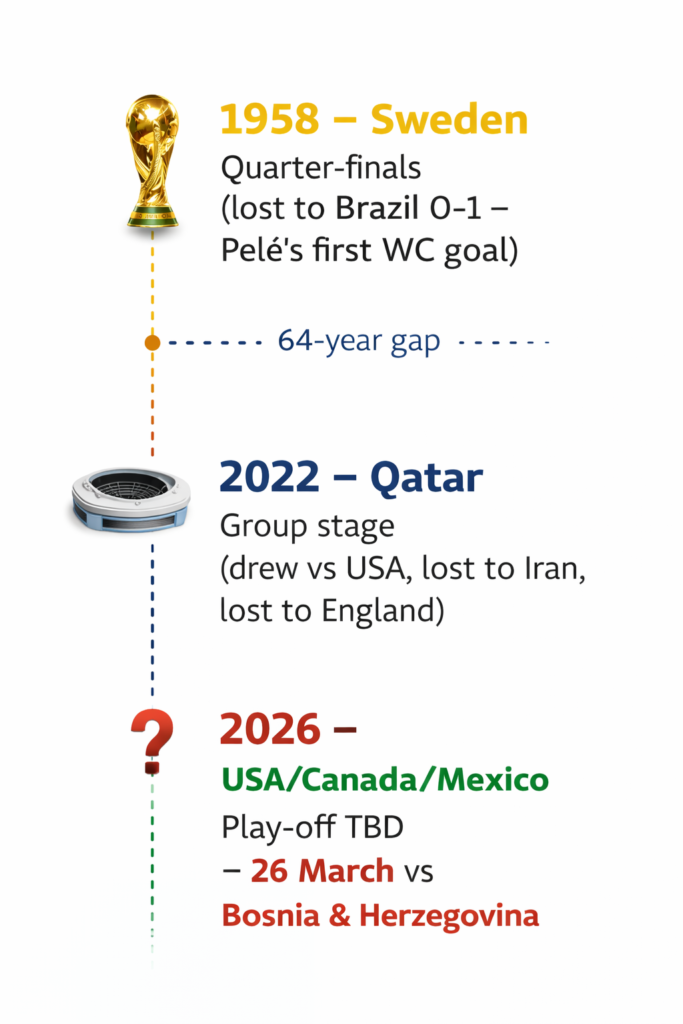
1958 — Sweden: Wales’ greatest World Cup story and still the stuff of legend. Their standout campaign coming way back in 1958, when they battled all the way to the quarter-finals. They navigated a complex qualifying route involving play-offs against Israel, drew all three group games, then beat Hungary in a play-off to advance. Their run ended in the quarterfinals — a 1-0 defeat to Brazil, with the match-winner scored by a 17-year-old named Pelé. It was Pelé’s first World Cup goal.
2022 — Qatar: Having gone more than 60 years without qualifying, Wales returned to international football’s biggest stage in Qatar in 2022. They earned their place at the World Cup in Qatar by navigating a similarly tense play-off route, defeating Austria in the semifinal before securing qualification with a dramatic victory over Ukraine.
They eventually finished bottom of Group B, which contained England, USA and Iran. A famous Gareth Bale penalty earned a draw against the USA in their opener. Then came a 0-2 defeat to Iran — two late goals breaking Welsh hearts. Then a 0-3 loss to England sent them home. However, they were there. They experienced it. And that experience now runs through this squad.
2026 — The attempt: Back-to-back World Cups would be an historic first. Wales have never done it. If Bellamy’s team gets through in March, they make history.
If Wales Qualify: Group B at the World Cup
Should Wales make it to the 2026 FIFA World Cup they will take on Canada, Switzerland and Qatar in Group B following the draw that took place last December.
Wales would open against co-hosts Canada in Toronto on June 12 if they can make it.
Group B breakdown:
Canada are a co-host nation, playing with the enormous emotional weight of a home tournament. They qualified automatically as hosts. Their Golden Generation — Alphonso Davies, Jonathan David, Tajon Buchanan — makes them a genuine contender to advance from the group. Playing them in Toronto is a tough opener.
Switzerland are one of Europe’s most consistent performers — disciplined, organised, and reliable. They qualified automatically from their group and are among the harder draws from Pot 1’s middle tier. They are not flashy, but they are very difficult to beat.
Qatar return to the World Cup as a previous host (2022). Their home tournament was a significant cultural moment but a sporting disappointment — they were the earliest host nation ever eliminated, going out after two group games. At a neutral venue, they face a different challenge.
For Wales, this group is manageable. Canada are the biggest test — playing at home, with crowd support, in front of their own fans. Switzerland require respect. Qatar are beatable. Win against Qatar, compete against the others, and qualification from the group is achievable.
Wales’ Strengths and Vulnerabilities
✅ What Wales have going for them
Home advantage in both play-off matches. Cardiff City Stadium on big nights is an intimidating environment. The Red Wall is one of the most vocal and unified supports in British football. Both the Bosnia semifinal and the potential final are at home — a massive structural advantage. Tickets for both matches are already sold out.
Attacking cohesion under Bellamy. The 7-1 demolition of North Macedonia was not an aberration — it was the clearest evidence yet that Bellamy’s front-foot, attacking approach is working. Wales are genuinely dangerous going forward now in a way they were not in their more pragmatic phases.
Play-off experience. Wales have previous for reaching the World Cup through the play-off tournament. The 2022 route — beating Austria and Ukraine under pressure in single-leg knockouts — is directly relevant experience. These players know what it takes.
Depth in forward positions. Johnson, James, Wilson, Brooks and Broadhead give Bellamy real options. Opponents cannot simply plan for one forward threat — Wales have multiple players capable of changing a game.
Captain in form. Harry Wilson has become a pivotal figure since the appointment of Bellamy, scoring nine goals in that period. His leadership and creativity will be vital.
❌ Where Wales can be exposed
The post-Bale transition is still incomplete. Gareth Bale carried Welsh football on his back for over a decade. No single player in this squad has that level of individual match-winning quality. Wales now win through collective effort, which is admirable — but in a single-leg knockout, one moment of individual brilliance from an opponent is enough.
Physical intensity over 90 minutes. Against a Bosnia side that will sit deep and stay compact, Wales need to maintain their pressing intensity for 90 minutes. Fatigue in the final 20 minutes of a tight match is a risk.
Final-third efficiency. Despite the 7-1 scoreline against North Macedonia, Wales have sometimes struggled to convert chances against more organised opposition. Against Italy in a hypothetical final — or against a Bosnia side defending deep — clinical finishing will be essential.
Squad depth beyond the first eleven. The drop in quality when Wales’ best players are unavailable or fatigued is noticeable. An injury to Wilson or Johnson in the semifinal would be a significant blow.
The Back-to-Back Dream — What It Would Mean
Their appearance at Qatar 2022 ended their 64-year World Cup drought, and the Dragons are determined to build on that breakthrough rather than let it become a one-off achievement.
Back-to-back World Cup appearances would represent a golden era for Welsh football and cement this generation’s legacy.
That context is important. Wales reaching Qatar 2022 was momentous — but it also carried a fear that the drought might simply resume afterwards. Six decades passed between 1958 and 2022. Could another long absence follow?
Qualifying for 2026 would answer that question definitively. It would say that Welsh football has changed structurally, not just got lucky in a play-off. It would say that Bellamy’s era is building continuity, not chasing a one-off. For a nation that has spent so much of its football history watching from the outside, that continuity would be as meaningful as the qualification itself.
FAQs: Wales World Cup 2026
Has Wales qualified for the 2026 World Cup yet?
No. Wales must win two play-off matches in March 2026. They face Bosnia and Herzegovina in their semifinal on 26 March at Cardiff City Stadium.
How did Wales get to the play-off?
Wales finished as runners-up in UEFA Group J behind Belgium, which earned them a Pot 2 seeding and home advantage for all play-off matches.
Who does Wales play in the play-off?
First: Bosnia and Herzegovina at home in Cardiff on 26 March 2026. If they win, they host the Path A final on 31 March against either Italy or Northern Ireland.
What group would Wales be in at the World Cup?
Group B alongside Canada, Switzerland and Qatar.
When would Wales’ first World Cup game be?
Wales would open against co-hosts Canada in Toronto on June 12.
Who is the Wales manager?
Craig Bellamy, who took charge in July 2024. He played for Wales as a forward and won 78 caps during his career.
When did Wales last play at a World Cup?
Qatar 2022, where they finished bottom of Group B. Their best-ever World Cup finish was the quarterfinals at the 1958 tournament in Sweden.
Have Wales ever been to back-to-back World Cups?
No. This has never happened in Welsh football history. It would be a historic achievement.
Are Wales favourites against Bosnia and Herzegovina?
Yes — Wales are ranked 35th, Bosnia are ranked 71st, and Wales have home advantage. However, single-leg knockout football means upsets are always possible.
Who are Wales’ key players for the play-off?
Harry Wilson (captain, creative threat), Brennan Johnson (pace and directness), Daniel James (energy from wide), David Brooks (creativity) and Nathan Broadhead (pressing intensity and goals).
Key Takeaway
Wales have home advantage, tournament play-off experience, a settled and improving squad, and a manager with genuine ambition. The path is clear: win on 26 March, win on 31 March, and join Scotland at the World Cup — which would be a moment Welsh football fans would talk about for decades.
Bosnia and Herzegovina are not soft opponents. Italy in a final would be one of the biggest nights in the history of Welsh football. None of this is easy. However, Wales have proved in recent years that pressure brings out their best.
The Red Wall will be at Cardiff City Stadium on March 26. The question is whether Bellamy’s Dragons will give them something to roar about.
This article will be updated immediately after the 26 March semifinal and 31 March final results.