
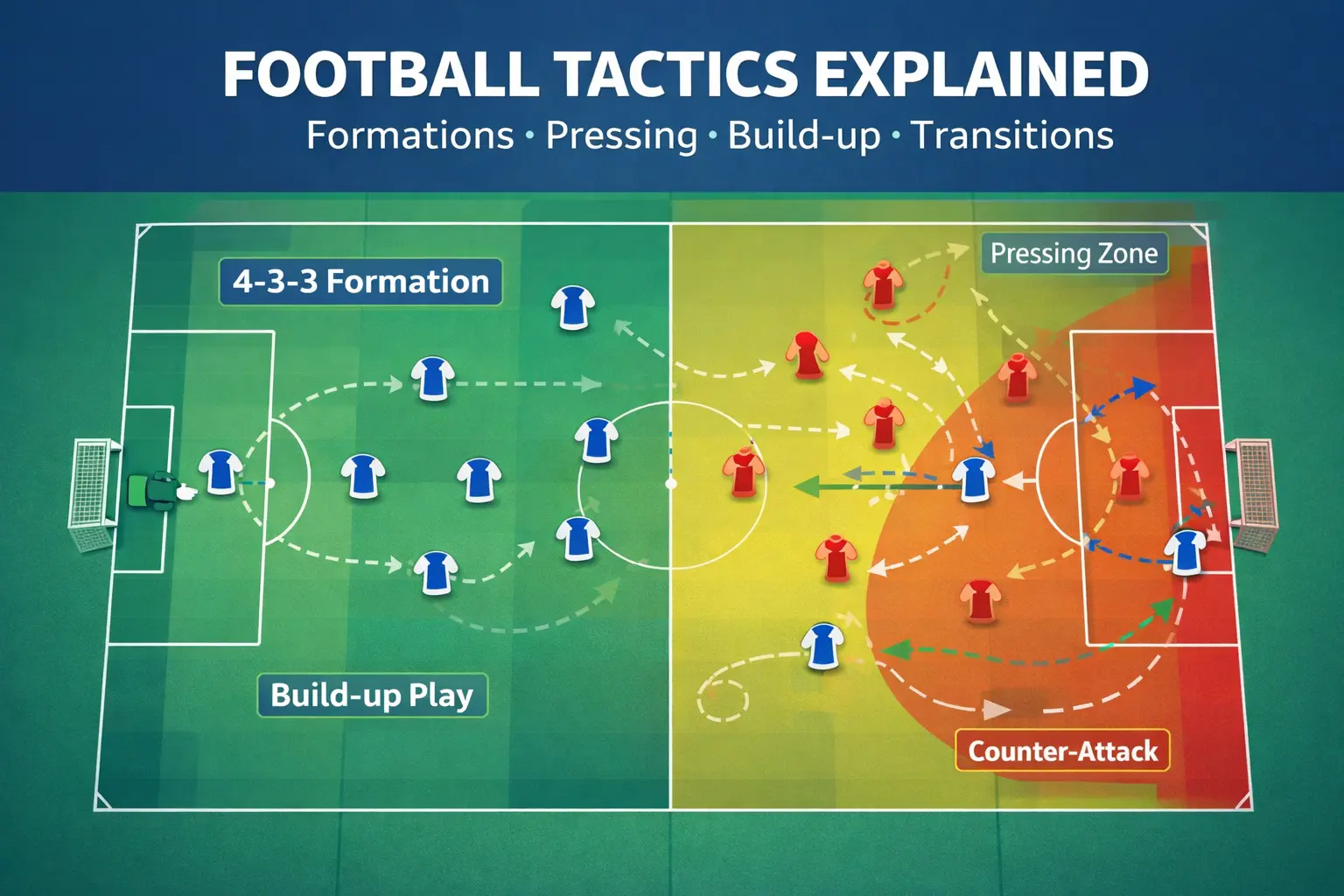

You are watching a match. One team looks completely in control. They pass calmly, move in patterns, and the opposition cannot seem to touch the ball. Then the other team wins it back — and within five seconds they have scored.
Neither of those things happened by accident.
This guide explains exactly what is going on beneath the surface: formations, pressing, build-up play, transitions, attacking patterns — and how to spot all of it in real time during the 2026 World Cup.
TL;DR
- Your formation is just the starting shape—shown as numbers (like 4-3-3: 4 defenders, 3 midfielders, and 3 forwards).
- Shapes are just skeletons; tactics are the actual muscle and movement that happens once the whistle blows.
- The game moves through four distinct phases: attacking, defending, and the two critical moments in between them.
- Pressing is simply hunting the ball; the closer you are to their goal, the more intense it gets.
- Build-up is the organized road trip from your own goalkeeper all the way to the opponent’s net.
- Counter-attacks are lightning-fast strikes that catch the other team while they are messy and disorganized.
- Set pieces like corners decide nearly 40% of games, making them high-stakes tactical chess matches.
SNIPPET BLOCK
Football tactics describe how a team organizes its 11 players to attack, defend, and transition between the two. The starting structure is called a formation, written as a sequence of numbers representing defenders, midfielders, and forwards (for example: 4-3-3). But formations are only a framework — the real tactical picture is shaped by how a team presses, builds up play, exploits space, and reacts when possession changes hands.
Part 1: What Is a Formation — And How Do You Read One?
The Numbers Explained
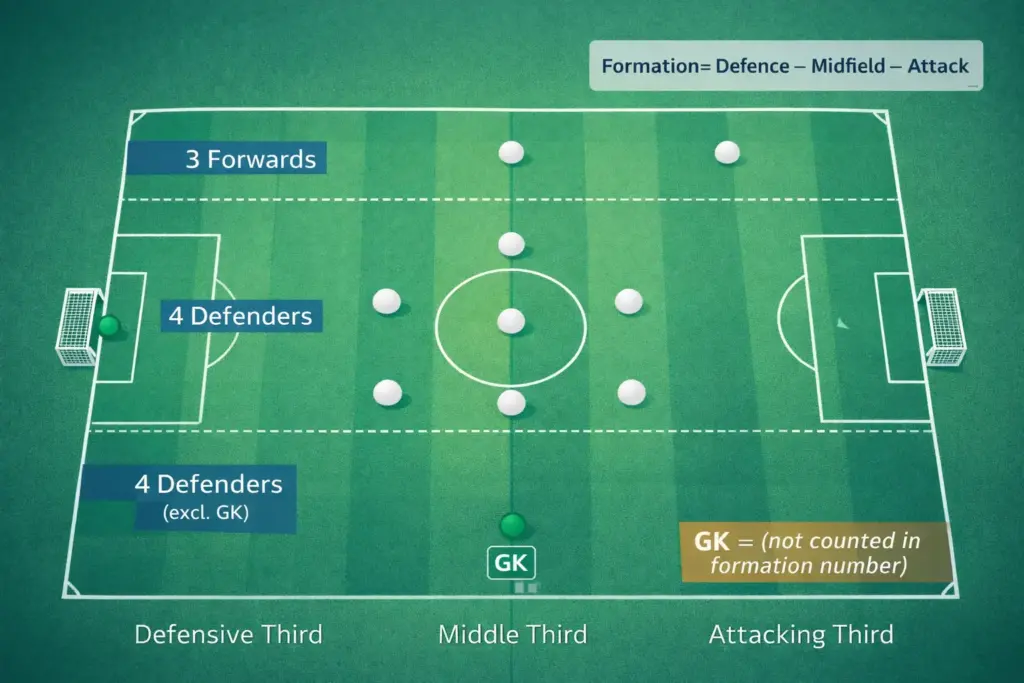
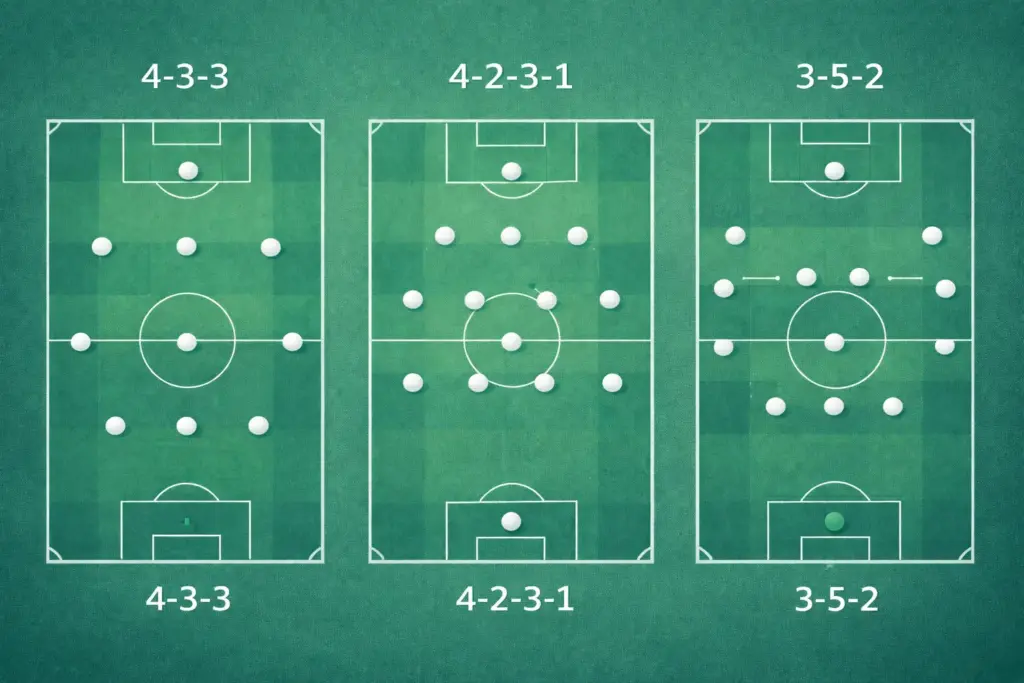
A football formation is written as a sequence of numbers that describes how 11 outfield players are distributed from defense to attack. The goalkeeper is never counted — the numbers always refer to the 10 outfield players only.
Example: 4-3-3
- 4 defenders (two centre-backs + two full-backs)
- 3 midfielders
- 3 forwards (two wingers + one central striker)
Example: 4-2-3-1
- 4 defenders
- 2 defensive (holding) midfielders
- 3 attacking midfielders
- 1 centre-forward
Example: 3-5-2
- 3 centre-backs
- 5 midfielders (usually two wing-backs + three central)
- 2 forwards
The numbers are always read from the goalkeeper outward — defense first, then midfield, then attack.
A Formation Is a Starting Point — Not a Script
This is the most important thing to understand about formations. The numbers describe where players start before the match begins. What happens in actual play is far more fluid.
A team listed as a 4-3-3 might defend as a 4-5-1 (the two wide forwards drop back to help), attack as a 3-2-5 (a centre-back pushes forward, full-backs join the attack), and transition as a completely different shape depending on who wins the ball and where.
The formation is the skeleton. Tactics are everything built on top of it.
Part 2: The Six Formations You Will See at the 2026 World Cup
4-3-3 — The Modern Standard
The 4-3-3 is the most widely used formation in elite football in 2025. Spain, Argentina, and many other 2026 World Cup contenders use variants of it.
How it looks in attack: Two wide forwards (wingers) stretch the opposition defense toward the touchlines, creating space in the center. The three midfielders control the middle of the pitch and support the lone central striker with late runs.
How it looks in defence: The two wide forwards track back and press the opponent’s wide defenders. The three midfielders press as a compact unit. The back four holds its shape.
Biggest strength: The three central midfielders create a numerical advantage against teams playing two midfielders — meaning more passing options and easier ball progression. The shape also generates natural passing triangles all over the pitch.
Biggest weakness: The lone central striker can be outnumbered by two center-backs and receive very little support close to goal. The three midfielders can be overloaded if the opposition plays four in midfield.
2026 example: Spain’s style under manager Luis de la Fuente is built on a 4-3-3 framework — high press, short passing combinations, and wide forwards who cut inside onto their stronger foot.
4-2-3-1 — The Flexible All-Rounder
The 4-2-3-1 is arguably the most adaptable formation in modern football. It provides defensive security and attacking creativity in equal measure.
The key feature: the double pivot. Two defensive midfielders sit side-by-side in front of the center-backs. Their job is to protect the defense, win second balls, and recycle possession. This security frees the full-backs to push forward aggressively — often at the same time.
Behind the central striker, a number 10 (attacking midfielder) links the midfield to the attack. This player drops between the lines to receive the ball, turns, and plays the final pass.
How it shifts in play:
- In possession: frequently becomes a 2-4 or even 3-2-5 shape as full-backs and the number 10 push forward
- Out of possession: drops into a compact 4-4-1-1 or 4-5-1, with the attacking players tracking back
Biggest strength: Versatility. The same formation suits possession-based play, counter-attacking, and high-pressing with only minor adjustments in player roles.
Biggest weakness: The lone striker can be isolated. The number 10 can be man-marked out of a match if not managed carefully by teammates.
2026 example: Argentina have frequently used a 4-2-3-1 variant with Lionel Messi operating as a free-roaming number 10 — dropping deep to collect the ball and link play rather than staying high as a traditional attacking midfielder.
3-5-2 — Width Through Wing-Backs
The 3-5-2 uses three center-backs instead of four, replacing the two traditional full-backs with two wing-backs — players who must cover the entire length of their flank in both attack and defense.
The big trade-off: You gain an extra midfielder centrally, which can overload the opposition in the middle of the pitch. You lose traditional wide defenders — the wingbacks must do both jobs. They sprint forward to create width in attack and sprint back to form a back-five when the team defends.
How it defends: When the opponent has the ball, the wing-backs often drop alongside the three centre-backs, creating a 5-4-1 or 5-3-2 defensive shape — compact, hard to break down through the middle.
Biggest strength: Central midfield dominance. Five players in the middle zone can swamp the opposition and control the game’s tempo. Three centre-backs provide excellent defensive cover, particularly against pace in behind.
Biggest weakness: Wingbacks require elite fitness and positional intelligence — they run more than almost any other position in football. If they are caught out of position, wide areas are exposed with no full-back covering.
4-2-2-2 and 4-4-2 Variants — The Classic Foundations
The 4-4-2 is football’s historical baseline — the formation most associated with the game’s traditional development. It is less fashionable in 2026 than it was in the 1990s, but versions of it remain effective, particularly for counter-attacking teams.
Why it endures: The 4-4-2 naturally “pairs” players — two strikers work together, two central midfielders work together, two wide midfielders provide width, two centre-backs cover each other. This simplicity makes communication and collective defending straightforward to coach.
The modern 4-2-2-2 is a cousin — two defensive midfielders, two attacking midfielders in the half-spaces (between wingers and the centre), and two strikers. It overloads central areas and creates threats from multiple directions.
2026 example: Diego Simeone’s Atletico Madrid — home to several 2026 World Cup players — became famous for a compact 4-4-2 defensive block combined with rapid counterattacks. The principles of that system will appear in how several South American and African nations approach the tournament.
3-4-3 and 5-3-2 — Defensive Solidity or Attacking Intent
The 3-4-3 and its variants have become associated with coaches who want maximum attacking presence while maintaining the security of three central defenders. Coaches like Ruben Amorim at Manchester United use it as their near-exclusive system.
The 5-3-2 is a fundamentally defensive setup — five defenders, three midfielders, two strikers — designed to be very difficult to break down while remaining a threat on the counter. Several 2026 World Cup nations will use this approach when facing technically superior opponents.
Part 3: The Four Phases of Play
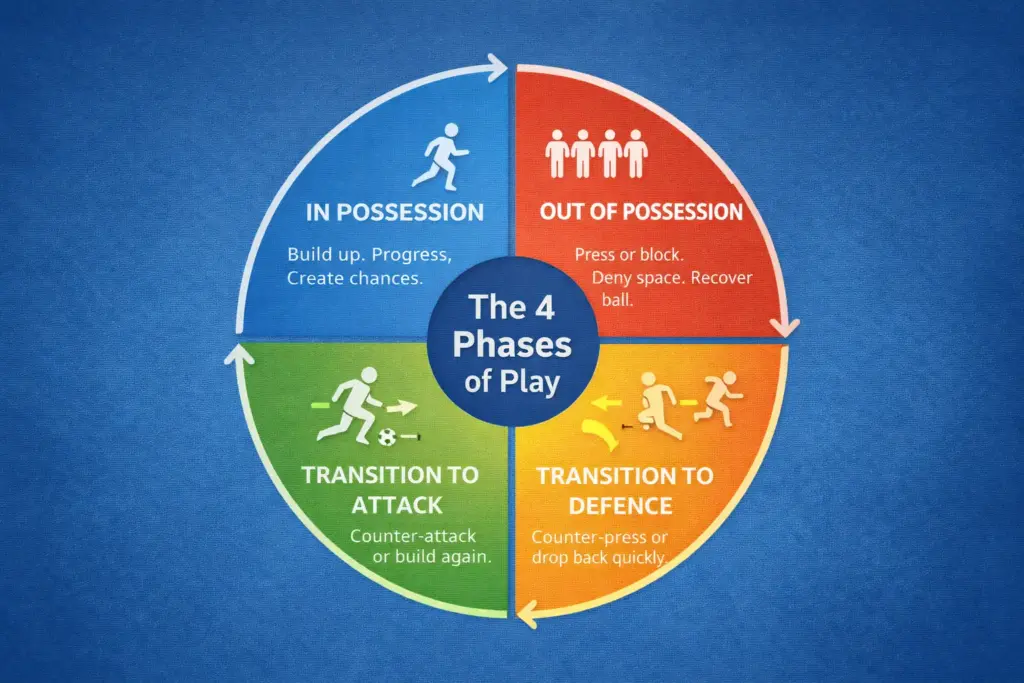
Every moment in football falls into one of four phases. Understanding these phases is the key to understanding what any team is trying to do at any given moment.
Phase 1 — In Possession (Attacking Phase)
When a team has the ball, their goal is to move it toward the opponent’s goal in a way that creates a clear scoring chance. This phase is where formations, passing patterns, and individual creativity all combine.
Teams in possession are trying to:
- Progress the ball forward through the thirds
- Create numerical overloads (more attackers than defenders in a zone)
- Find a player in space between or behind the opposition’s defensive line
- Create a clear shooting opportunity from a dangerous position
The shape a team uses in possession often looks very different from their starting formation. Full-backs push forward. A midfielder drops between the centre-backs to help build. Wingers move inside. The formation shifts constantly.
Phase 2 — Out of Possession (Defensive Phase)
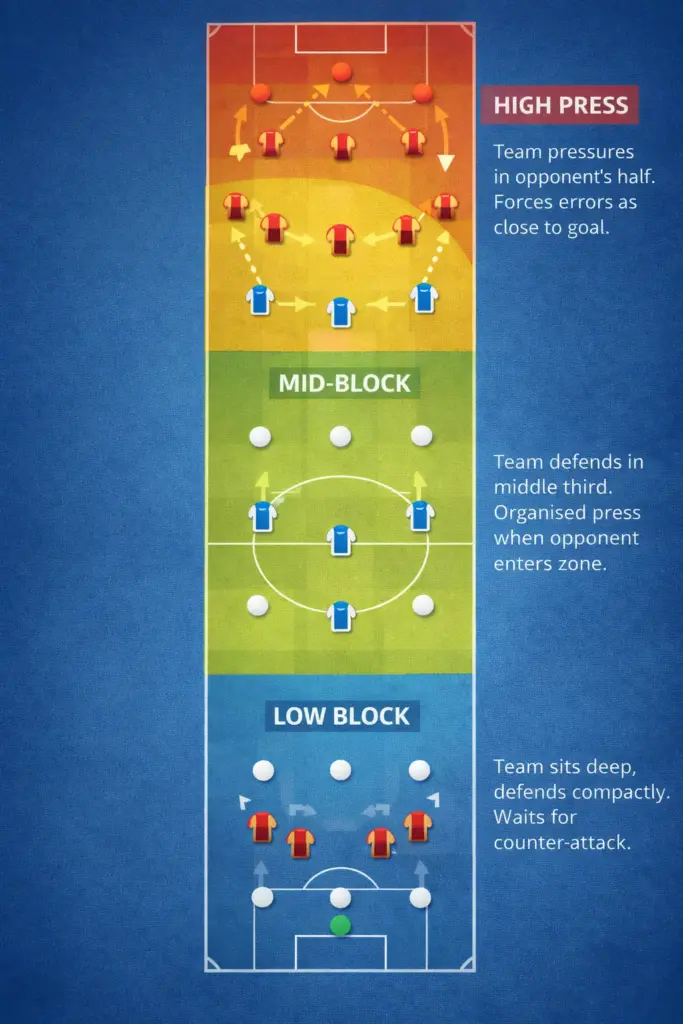
When the opponent has the ball, a team organises to prevent them from creating good chances. There are three broad approaches — and which one a team uses is one of the most fundamental tactical decisions a coach makes.
High press: The team presses aggressively in the opponent’s half, trying to win the ball back immediately in a dangerous position. Requires enormous collective energy. Best used when the opponent is comfortable in possession (because forcing errors in their own half leads to short-range scoring opportunities). Liverpool’s “gegenpressing” under Jürgen Klopp was the defining modern version — immediately pressuring the opponent the moment the ball is lost, often with multiple players arriving from different angles.
Mid-block: The team retreats to the middle third and organizes a disciplined defensive shape there, pressing only when the opponent enters a specific zone. More energy-efficient than a high press. Allows the team to invite possession and press in areas where they have good coverage.
Low block: The team sits very deep — often with eight or nine players behind the ball — compressing the space between the lines and making it almost impossible to play through them. The intention is to absorb pressure, remain compact, and strike rapidly when possession is won. Requires huge collective discipline and intelligent positional defence. It is not passive — it is a deliberate, structured tactic.
Phase 3 — Transition to Attack (Positive Transition)
The moment a team wins the ball back. What happens in the next five seconds is often more important than any carefully planned pattern.
A team in positive transition has two choices:
Counter-attack: Win the ball and immediately play forward — fast, direct, before the opponent can reorganise. Most dangerous when the opponent was pressing high and has left space in behind. The 2022 World Cup saw Saudi Arabia, Morocco, and Japan all use rapid counterattacks to devastating effect against far more highly ranked opponents.
Slow down and build: Win the ball, keep it, and patiently recover shape before attacking again. Common when a team already leads or when the opponent’s press means direct passes forward are risky.
Phase 4 — Transition to Defence (Negative Transition)
The moment a team loses the ball. What the losing team does in the next five seconds often determines whether the opponent scores.
Counter-press (gegenpressing): Immediately chase the ball back, with multiple players surrounding the new ball-carrier. Goal: win it back before the opponent can organize. This is what gegenpressing specifically refers to — the aggressive collective chase the moment possession is lost.
Organised retreat: All players drop behind the ball quickly and re-establish the defensive shape. Less aggressive, but safer.
Part 4: Build-Up Play — How Teams Move the Ball Forward
Build-up play is the organised process of moving the ball from the goalkeeper or defence into attacking positions. It is the “first chapter” of an attacking move — before the final pass, before the shot — and it is where tactical battles are won or lost most regularly.
The Basic Structure
Most teams build from the back using one of two base shapes:
2-3 build-up: Two centre-backs spread wide, with one defensive midfielder dropping between them to form a triangle. This gives three passing options out of the back while freeing the full-backs to advance.
3-2 build-up: Three players form the first line (two centre-backs + one midfielder who drops), two players form the second line above them. Full-backs often push higher as the team advances.
The Goal of Build-Up Play
Build-up is not just passing for the sake of it. Every pass should have a purpose: drawing opponents out of position, switching the ball to find a free player, or creating a numerical overload in the zone where the next attack will come from.
The concept of “fixing” an opponent is central. By positioning a player in a certain zone, a team forces at least one opponent to track or mark them — which opens space somewhere else. If the opponent does not follow, that player is free to receive.
Press Triggers — How Teams Break Build-Up
When a team is defending against an opponent building from the back, they look for specific moments to press aggressively rather than holding their shape. These moments are called press triggers:
- Bad touch — the ball bounces away awkwardly from the receiving player
- Back-pass to the goalkeeper — especially if the keeper does not have great passing ability
- Player with their back to goal — facing their own net with a defender behind them
- Ball near the sideline — limited passing options; the touchline acts as an extra defender
When a press trigger occurs, the nearest pressing player accelerates immediately and teammates follow — cutting off passing lanes collectively, not just chasing individually.
Part 5: Key Tactical Concepts Explained
The Double Pivot
Two defensive midfielders play side-by-side. They shield the defence, win second balls, circulate possession under pressure, and press as a pair when the opponent builds. This shield allows teammates to take attacking risks because they know solid cover always remains directly behind them on the pitch.
Teams with a double pivot at the 2026 World Cup: most 4-2-3-1 users, including many of the tournament’s European nations.
The False Nine
This creative centre-forward regularly drops into midfield to receive the ball instead of staying high like a traditional striker. When they drop, centre-backs face a dilemma: follow them and leave space empty, or stay put and let them receive the ball. Teammates then charge rapidly into the open gaps left behind. [14]
The concept is most associated with Lionel Messi’s role at Barcelona under Pep Guardiola in 2009–2012 and with Argentina’s national team in recent years.
Inverted Winger
A winger who plays on the “wrong” side — a right-footed player on the left flank, or a left-footed player on the right. Instead of running to the byline and crossing, they cut inside toward the center of the pitch, onto their stronger foot. This creates shooting opportunities and overloads in the central areas.
Many of the 2026 World Cup’s most exciting players operate as inverted wingers: cutting inside and arriving in the shooting positions rather than providing traditional wide service.
Zonal Marking vs. Man-Marking
Zonal marking: defenders cover spaces rather than specific opponents. When an opponent runs through their zone, they engage them. When the opponent leaves, they stay. This is the default approach of most modern football teams. It requires collective organization but is very difficult to overload with clever movement.
Man-marking: a specific defender is assigned to follow a specific opponent wherever they go. Effective for neutralizing one exceptional player but vulnerable to coordinated movement that drags defenders out of position. Most commonly seen at set pieces.
Set Pieces — The Underrated Tactical Battleground
Corners, free kicks, and penalties are collectively called set pieces. They receive less tactical discussion than open play, but they are enormously important — roughly 40% of goals at the 2022 World Cup came from set pieces.
Attacking set pieces involve pre-planned routines: players making specific runs at specific moments to find space or create blocks. Defending set pieces involves either zonal marking (defenders holding positions in the danger zones) or man-marking (tracking specific opponents).
Part 6: The Tactics Spotter’s Guide — What to Watch For During a Match
Use this guide during the 2026 World Cup to identify what you are seeing in real time.
Spotting the formation:
Watch the team in their defensive shape (when they do not have the ball). Count the defenders: three or four? Count the midfielders. The defensive shape is usually close to the listed formation.
Spotting the press intensity:
Watch where the front players are when the opponent has the ball in their own half. Are they pressing aggressively near the opponent’s centre-backs? That is a high press. Are they waiting in their own half? That is a mid or low block.
Spotting a counter-attack:
When the defending team wins the ball, watch how quickly the first forward pass travels. A ball played directly forward within two or three touches after winning possession is almost certainly a designed counter-attack.
Spotting build-up play:
Watch the goalkeeper and centre-backs when they have the ball. Do they play short to a dropping midfielder (3-2 build-up)? Or do they play long directly to a forward? The answer tells you whether the team prioritises patient build-up or direct play.
Spotting the double pivot:
In midfield, watch for two players who consistently stay deep side-by-side — rarely advancing beyond the halfway line, always available to receive from the defenders and protect the space in front of the back four. That is the double pivot.
Spotting an inverted winger:
Watch the wide forwards. If the left winger cuts inside to shoot or pass toward the centre rather than running toward the corner flag, they are an inverted winger.
Spotting a press trigger:
Watch for moments when a whole team suddenly accelerates toward the ball together — often triggered by a back-pass, a bad touch, or a player facing their own goal. That collective movement is a pre-planned press trigger.
Part 7: Key Positions Glossary
A quick reference for position names you will hear throughout the 2026 World Cup.
| Term | Meaning |
| GK | Goalkeeper |
| CB | Centre-back — central defender |
| FB / Full-back | Wide defender (left or right) |
| WB / Wing-back | Wide player in a 3-back system; must attack and defend the full flank |
| DM / Holding mid | Defensive or holding midfielder; sits deep and protects the defence |
| Pivot | A deep-lying midfielder who acts as the passing hub; “single pivot” = 1, “double pivot” = 2 |
| CM | Central midfielder — box-to-box player |
| AM / No. 10 | Attacking midfielder; links midfield and attack; often the team’s creative hub |
| False nine | A centre-forward who drops into midfield to receive; drags defenders out of position |
| Winger | Wide forward who stretches the defence toward the touchline |
| Inverted winger | Winger playing on their “wrong” side; cuts inside rather than crossing |
| SS / Second striker | Forward who plays behind the main striker; links midfield and attack |
| CF / No. 9 | Centre-forward — the main striker; primary goal-scoring target |
| Gegenpressing | Immediate collective press the moment possession is lost |
| Half-space | The area between the centre and the wide zone; most dangerous creative area in modern football |
Common Myths — Corrected
“The formation tells you everything about how a team plays.”
A 4-3-3 can be a high-pressing possession system (Spain), a counter-attacking system (Nigeria), or a physical direct system. The formation is the structure. The style, press height, build-up method, and individual roles describe how it actually functions. Never assume — watch what a team does, not just what they are listed as.
“More possession means you are winning.”
Portugal had 54% possession and lost to South Korea in 2022 group play. Spain had the most possession in Euro 2024 and won it — but Germany also had very high possession in their tournament and went out in the quarterfinals. Possession is a tool, not the goal. What matters is what you do with it.
“The best team always wins.”
Actually, tactics often bridge gaps. Tactically organised teams regularly beat more talented opponents. Morocco reached the 2022 World Cup semifinals using a disciplined low block. Saudi Arabia beat Argentina with a high line that caught forwards offside. Tactics make the difference whenever raw ability remains unequal.
“Defending is just the goalkeeper and the centre-backs.”
Modern football defending is a collective exercise involving all 11 players. When a team “defends,” their striker is pressing the opponent’s goalkeeper. Their wingers are cutting off passing lanes. Every player has a specific defensive role and position.
“A team playing a low block is just parking the bus.”
A low block is a deliberate tactical system. It requires 10 players to hold a specific shape under sustained pressure, recognise moments to press without breaking the structure, and transition instantly when the ball is won. It is extremely demanding to execute correctly — which is why Morocco’s 2022 run was admired tactically, not dismissed as lucky.
FAQs: Your Tactics Questions, Answered
What is a football formation?
A formation describes how the 11 outfield players (not including the goalkeeper) are positioned across the pitch. It is written as a sequence of numbers from defence to attack — for example, 4-3-3 means four defenders, three midfielders, and three forwards.
What is the best football formation?
There is no single best formation. The most effective formation depends on the players available, the opponent, and the style the coach wants to implement. The 4-3-3 and 4-2-3-1 are the most widely used at elite level in 2026, but many successful teams use 3-5-2, 4-4-2 variants, and other systems.
What does pressing mean in football?
Pressing means actively chasing the ball when the opponent has it, trying to win possession back rather than waiting passively. Teams press at different heights — high press (in the opponent’s half), mid-block (in the middle third), or low block (deep in their own half).
What is a double pivot in football?
A double pivot is two defensive midfielders playing side-by-side in front of the defence. They protect the centre-backs, recycle possession, and cover the space between the midfield and defensive lines.
What is a false nine?
A false nine is a player who nominally plays as a centre-forward but regularly drops into midfield to receive the ball. This drags centre-backs out of position and creates space for midfielders to run into. Lionel Messi has frequently operated in this role for Argentina.
What is gegenpressing?
Gegenpressing (from German: “counter-pressing”) is the tactic of pressing the opponent immediately and collectively the moment possession is lost. The idea is to win the ball back before the opponent can organize — ideally in a dangerous position. Jürgen Klopp’s Liverpool were the most famous modern practitioners.
What is an inverted winger?
An inverted winger plays on the “opposite” flank to their stronger foot — a right-footed player on the left side, or vice versa. Instead of crossing from the byline, they cut inside onto their stronger foot, creating shooting and passing opportunities centrally.
How do I understand what I am watching during a match?
Start with three questions: (1) Where does the pressing team apply pressure — high, mid, or low? (2) When the team builds from the back, do they play short or long? (3) When possession changes, how quickly do both teams react? Those three observations tell you most of what you need to understand any tactical match-up.
Why do teams sometimes change formation during a match?
Coaches change formations to respond to the scoreline (protecting a lead or chasing a goal), to cope with a red card, to exploit a weakness in the opposition, or to counter the opponent’s adjustments. A team trailing 1–0 might switch from a 4-2-3-1 to a 3-4-3 to add an extra attacker. These in-game adjustments are a fundamental part of modern tactical management.
What is a transition in football?
A transition is the moment possession changes hands — from one team to the other. The five seconds after a transition are often the most dangerous and most tactically significant moments in a match. Teams specifically train their “positive transition” (winning the ball) and “negative transition” (losing the ball) behavior.


