

Cape Verde at the 2026 World Cup begins with a country of ten volcanic islands in the Atlantic Ocean, a population of about 525,000 — smaller than the city of Liverpool — and a football association that joined FIFA in 1986 and entered its first World Cup qualifying campaign for the 2002 tournament. On October 13, 2025, in front of their own fans at the Estádio Nacional in Praia, Cape Verde beat Eswatini 3-0 and qualified for the World Cup.
Cape Verde will play in the World Cup for the first time after beating Eswatini 3-0 to win their group in African qualifying for the 2026 World Cup. The archipelago of volcanic islands off the western coast of Africa secured one of the automatic spots for the continent. It will be one of the smallest countries by population ever to feature in the tournament.
Now the Blue Sharks face Spain, Uruguay and Saudi Arabia in Group H. This is their story.
TL;DR
- Cape Verde qualified on October 13, 2025 — their first-ever World Cup appearance.
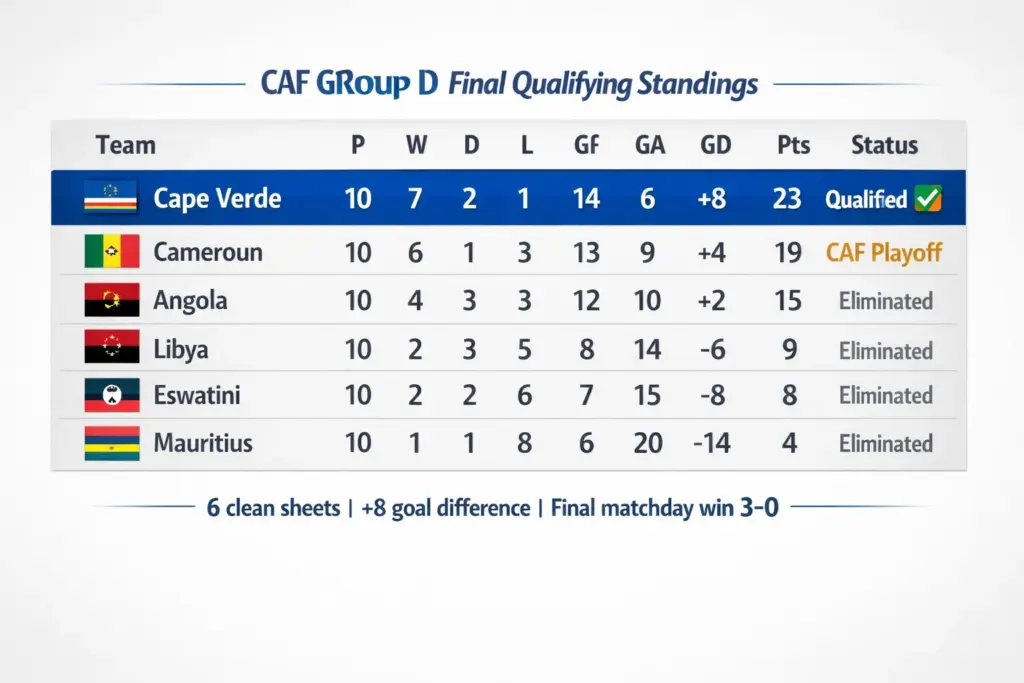
- They topped CAF Group D with 7 wins, 2 draws, 1 loss — finishing 4 points ahead of Cameroon.
- They recorded 6 clean sheets in qualifying and kept their nerve on the final matchday.
- Group H: Spain, Uruguay, Saudi Arabia, Cape Verde.
- Fixtures: June 15 vs Spain (Atlanta), June 21 vs Uruguay (Miami), June 26 vs Saudi Arabia (Houston).
- Manager: Bubista (Pedro Leitão Brito) — in charge since 2020, leading the most successful period in the national team’s history.
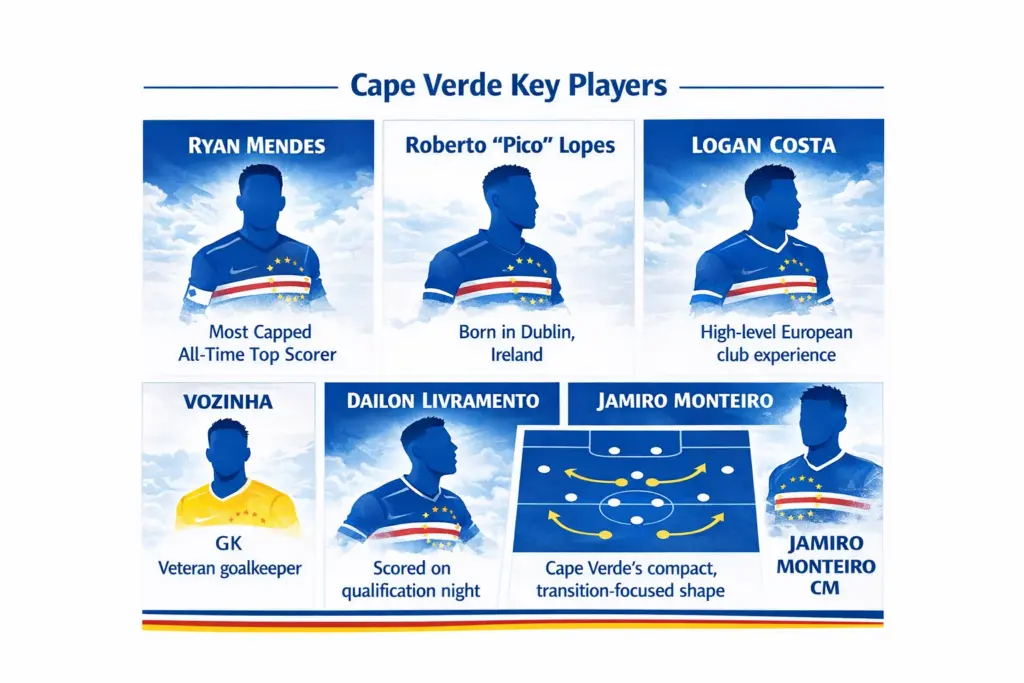
- Captain: Ryan Mendes — Cape Verde’s most capped player and all-time top scorer, and 36 at the tournament.
- Notable: Roberto “Pico” Lopes — born in Dublin, Ireland, now a World Cup player for Cape Verde.
- Population: about 525,000 — one of the smallest nations ever to reach the World Cup finals.
- Nickname: Tubarões Azuis — Portuguese for “Blue Sharks.”
Snippet Block
Cape Verde qualified for the 2026 World Cup on October 13, 2025 — their first-ever appearance at the tournament. The Blue Sharks topped CAF Group D with seven wins, finishing four points ahead of Cameroon. They are in World Cup Group H alongside Spain, Uruguay and Saudi Arabia. Their first match is June 15 against Spain at Atlanta Stadium, followed by games against Uruguay on June 21 in Miami and Saudi Arabia on June 26 in Houston. Manager Bubista has led Cape Verde through the most successful spell in the team’s history since taking charge in 2020.
Cape Verde at the 2026 World Cup: The Night Cape Verde Changed Everything
Cabo Verde made history on Monday, October 13, 2025, by officially qualifying for the 2026 FIFA World Cup — the nation’s first-ever appearance in the global tournament. The Blue Sharks cemented their spot by defeating Eswatini 3-0 in their decisive final qualifier match in Praia. The crucial victory was secured through second-half goals from Dailon Livramento, Willy Semedo, and veteran Stopira.
The match itself carried enormous emotional weight before a ball was kicked. Cape Verde needed to win — or, depending on Cameroon’s result, a draw could have been enough. They came out and played as if results elsewhere did not exist, scoring three second-half goals to make the victory emphatic.
Pushed to their limits by Cameroon throughout the qualifiers, the Blue Sharks chose to finish with a statement. Buffeted by swirling winds in the first half, Bubista’s men finally broke through after the break: Dailon Livramento opened the scoring from close range. Willy Semedo doubled the lead from close range, pouncing on a rebound set up by Ryan Mendes. The celebration was completed in stoppage time when 37-year-old Stopira, who had come on late in the match, scored the third goal — a fitting symbol for the veteran.
Stopira — 37 years old, a veteran who had spent his career hoping this moment would come — scored Cape Verde’s third goal in stoppage time. The image of an ageing defender scoring the final goal of a historic qualification tells you everything about what this team is built on.
Following their historic qualification, FIFA president Gianni Infantino congratulated Cape Verde on reaching the World Cup for the first time and noted that the team would feature in at least three matches at the expanded tournament.
Cape Verde at the 2026 World Cup: The Numbers That Tell the Qualifying Story
Cape Verde closed its qualifying campaign with an outstanding record of seven wins, two draws, and just one defeat — showcasing consistency, maturity, and a clear identity on the pitch.
This performance allowed Cabo Verde to top Group D of the African Qualifiers, finishing ahead of traditional powerhouses Cameroon and Angola.
The group they topped contained Cameroon — Africa’s most experienced World Cup nation with eight previous tournament appearances — alongside Angola, Libya, Eswatini and Mauritius.
Under the leadership of coach Pedro Leitão Brito, known as Bubista, the squad displayed exceptional discipline and determination. Cabo Verde’s defence was a key factor in their success, achieving six clean sheets throughout the qualifying campaign.
Six clean sheets in ten matches. That is the foundation of a team that knows what it is: organised, hard to beat and capable of defending a lead when qualification matters.
They started the final matchday two points ahead of Cameroon. Cape Verde finished Group D on 23 points, four ahead of Cameroon, who were held at home to a goalless draw by Angola.
Cape Verde at the 2026 World Cup: The Population Story
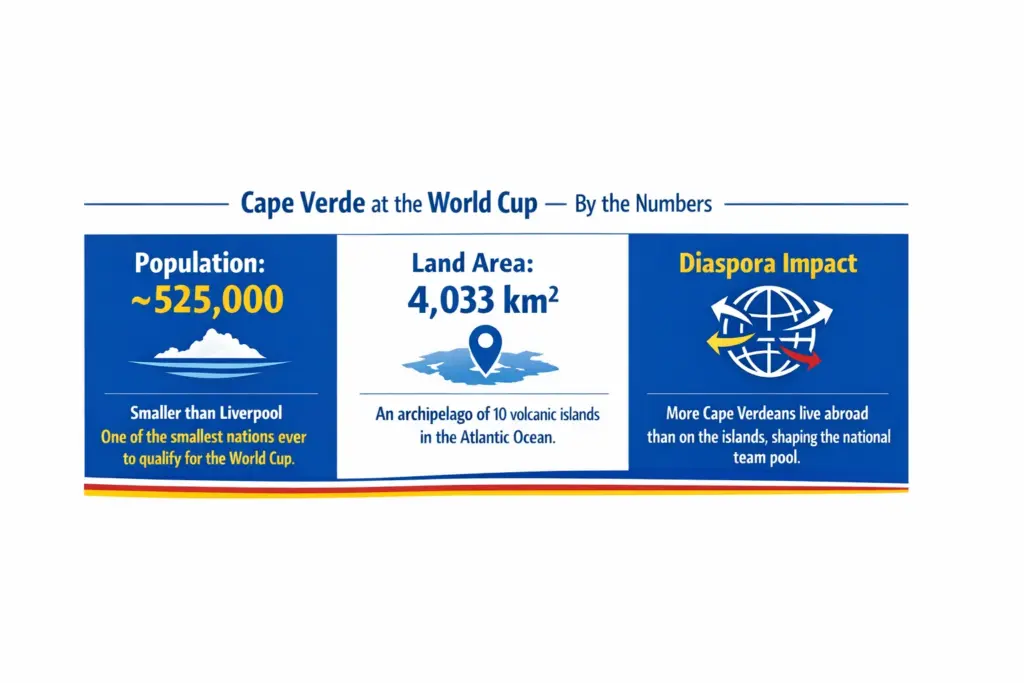
Cape Verde will appear in the finals of the FIFA World Cup for the first time in 2026. On October 13, 2025, they qualified for the finals for the first time after a 3-0 victory over Eswatini. At the time of qualification, Cape Verde was highlighted as the smallest country by land area and the second least-populated country to qualify for the World Cup, with a land area of 4,033 square kilometres and a population of just over 525,000. After Curaçao also qualified, Cape Verde no longer held those exact distinctions alone, but the broader point remained the same: this is one of the smallest nations ever to reach the World Cup.
Iceland, who qualified for the 2018 World Cup with a population of approximately 335,000, had long been the benchmark for a nation of this size reaching the tournament. Cape Verde now sit alongside Iceland and Curaçao as part of one of the most striking small-country stories in World Cup history.
To put that in context: Cape Verde’s entire population is smaller than the crowds that will attend the World Cup in a single week. The country has more people living abroad in diaspora communities than living on the islands themselves.
Cape Verdeans abroad, who are more numerous than the population of the islands themselves, are a major source of players for the national team.
This diaspora dimension is central to understanding Cape Verde’s squad. Players born and raised in Portugal, the Netherlands, Luxembourg, France, Ireland and elsewhere represent Cape Verde — connected to the islands through family, culture and identity rather than geography. The squad that qualified for the World Cup is itself a map of the Cape Verdean diaspora.
Cape Verde at the 2026 World Cup: Manager Bubista
Bubista has taken Cape Verde to three major tournaments in his time as manager since taking over in 2020. Under his stewardship, the team reached the Africa Cup of Nations quarter-finals for the second time in its history in 2023. He played for his country as a defender and later returned to shape the most successful coaching spell the national side has known.
Pedro Leitão Brito — universally known as Bubista — arrived as manager in 2020 and has overseen a period of consistent achievement that Cape Verde’s football history had never previously seen. Two Africa Cup of Nations appearances and a quarter-final run. And now a World Cup.
The team is usually described as organised, defensively solid and dangerous in transition under Bubista.
That tactical clarity has given Cape Verde something every national team needs but few small nations find — a consistent identity that players trust and execute regardless of the opponent. Against Cameroon, they defended it. Against Eswatini, they attacked from it. Against Spain in Atlanta, they will need to defend it with everything they have.
Ryan Mendes: The Captain Writing His Final Chapter
Ryan Mendes is Cape Verde’s most capped player and highest goalscorer of all time. The forward is 36 and will be playing at the World Cup at the end of a long international career.
Mendes brings extensive international experience to Cape Verde after a career that has taken him through France, England, Turkey and the Middle East.
Mendes has spent his career moving between European football and the Middle East — a career path typical of players from smaller footballing nations who are not given a clear pathway into Europe’s elite clubs. Lille, Nottingham Forest, Le Havre — clubs where he contributed without ever becoming a headline name in the European football conversation.
At the World Cup, that changes. Mendes becomes Cape Verde’s talisman on the world stage — the player who has waited longest for this moment, who has worn the Blue Sharks shirt through qualifying campaigns that failed and qualifying campaigns that finally succeeded.
His World Cup appearance places him alongside the great veteran debutants — players who reached the tournament late in long careers and turned their first World Cup into a farewell worthy of everything that came before it.
Roberto “Pico” Lopes: Born in Dublin, World Cup Player
This is one of the World Cup’s most extraordinary individual stories — and it has barely been told in English.
Roberto Lopes, known as “Pico,” was born in Dublin, Ireland, and chose to represent Cape Verde internationally.
Roberto Lopes was born in Dublin, grew up in the Republic of Ireland’s youth football system, and represented Irish youth teams before eventually switching his international allegiance to Cape Verde — the nation of his heritage. He is a centre-back who has played at a competitive European level and is one of Cape Verde’s most reliable defensive performers.
A man born in Dublin. Playing at the World Cup. For Cape Verde.
The story encapsulates the diaspora reality that defines Cape Verde’s squad. Lopes did not grow up on the volcanic islands of the Atlantic. He grew up in Ireland, as a Cape Verdean-Irish young man navigating a dual identity. Choosing Cape Verde — committing to representing the nation of his heritage when his homeland of birth offered another path — is the kind of decision that gives every small national team its emotional core.
Cape Verdeans abroad, who are more numerous than the population of the islands themselves, are a major source of players for the national team.
Lopes is the most visible example of this reality — but the entire squad is built on it.
Cape Verde’s Full Key Players
Among Cape Verde’s key names for the 2026 World Cup are goalkeeper Vozinha; defenders Stopira, Roberto Lopes, Logan Costa and Wagner Pina; midfielders Kevin Pina and Jamiro Monteiro; and forwards Dailon Livramento, Garry Rodrigues, Willy Semedo, Hélio Varela, Nuno da Costa and captain Ryan Mendes.
Vozinha is Cape Verde’s most experienced shot-stopper and one of the leaders behind those six qualifying clean sheets. His composure gives the side a dependable defensive foundation.
Logan Costa is one of the squad’s highest-profile defenders by club pedigree. His experience in a major European league gives Cape Verde an important anchor at centre-back alongside Roberto Lopes.
Jamiro Monteiro provides technical quality in central midfield — the most technically accomplished of Cape Verde’s midfield options and the player most capable of controlling tempo and distributing the ball in transition situations.
Dailon Livramento emerged as one of Cape Verde’s most reliable goal threats during qualification. His goal against Eswatini on qualification night underlined his ability to arrive into the box from advanced areas.
Garry Rodrigues brings wide attacking experience and the habit of scoring in crucial moments — including the late winner against Ghana at the 2023 Africa Cup of Nations that sent Cape Verde through as group winners.
Cape Verde at the 2026 World Cup: Group H
Group H is set for the 2026 FIFA World Cup, featuring Spain, Cape Verde, Saudi Arabia and Uruguay.
Group H is — on paper — an extremely difficult draw for a debutant nation. Cape Verde were placed among the lower-seeded teams in the group stage, and the draw produced two former World Cup champions and the team that famously beat Argentina in 2022.
Spain arrive as the group’s strongest side and one of the tournament favourites. Cape Verde vs Spain on June 15 in Atlanta is the Blue Sharks’ most daunting fixture — and their most watched.
Uruguay are two-time World Cup champions and one of South America’s most tactically disciplined nations. They bring physical intensity, pedigree and experience. Uruguay are the group’s second-strongest team on paper.
Saudi Arabia famously beat Argentina 2-1 in Qatar 2022 — one of the tournament’s great upsets. For Cape Verde, Saudi Arabia is the most obviously winnable game in the group — a potential three points that could make all the difference.
Cape Verde’s Group H Fixtures
Game 1 — Cape Verde vs Spain
June 15: Cape Verde vs Spain — Atlanta Stadium (12 p.m. ET).
Cape Verde’s first-ever World Cup match — against one of the strongest teams in the tournament. The occasion is enormous: Atlanta, tens of thousands of fans, and the full weight of a World Cup debut. For Cape Verde, this match is about establishing themselves — competing for 90 minutes and showing that their qualifying campaign was not a one-off.
Game 2 — Cape Verde vs Uruguay
June 21: Cape Verde vs Uruguay — Miami Stadium in Miami Gardens, Florida (6 p.m. ET).
The tactical challenge of Group H’s second match. Uruguay’s defensive organisation and physical intensity is exactly the type of opponent Cape Verde’s counter-attacking, defensively solid system is built to frustrate. A point here — a disciplined, resilient draw — would be a remarkable result and potentially enough to keep qualification hopes alive.
Game 3 — Cape Verde vs Saudi Arabia
June 26: Cape Verde vs Saudi Arabia — Houston Stadium (8 p.m. ET).
The game Cape Verde must target for points. Saudi Arabia are beatable, and Bubista’s team, playing their third group game with nothing to lose if eliminated and everything to gain if still alive, will be at their most dangerous.
Cape Verde’s Football History: From 1978 to 2026
The Cape Verde national football team played its first match on April 19, 1978, against Guinea, a match they lost 1-0. Following the federation’s affiliation with the Confederation of African Football and FIFA in 1982, the national team entered Africa Cup of Nations qualification for the first time in 1992 and began World Cup qualifying in the early 2000s.
Cape Verde’s football history spans just under 50 years. From their first match in 1978, through FIFA affiliation in the 1980s, through their first World Cup qualifying campaign in the early 2000s, to their first World Cup appearance in 2026 — the journey covers nearly five decades.
Along the way, the Africa Cup of Nations became Cape Verde’s most meaningful competitive platform. They reached the AFCON quarter-finals in 2013 and 2023 — their best continental results before the World Cup qualification. Those runs gave the team experience of knockout football at a major tournament and the belief that they could compete at that level.
Cape Verde qualified for the 2023 Africa Cup of Nations and were drawn into Group B. They defeated Ghana 2-1 in the first group-stage match when Garry Rodrigues scored a late match-winning goal in stoppage time. In their second match, Cape Verde defeated Mozambique 3-0. This result, along with other results in the group, meant that Cape Verde entered the final group match already having secured passage to the knockout stage as group winners.
The habit of performing when it matters — late goals, clean sheets, controlled qualifying campaigns — runs through Cape Verde’s recent competitive history. It is not an accident. It is the product of Bubista’s consistent approach and a squad that has been built around a clear and stable identity.
How Cape Verde Play: The Blue Sharks’ System
Under Bubista, Cape Verde are generally associated with a compact defensive structure and quick transitions.
The team’s approach can be described this way:
When defending: The midfield sits tight in front of the back line, compressing central space and forcing opponents wide. Logan Costa and Roberto Lopes defend the box with physicality and discipline. The wide players also work back, helping create a compact block that is difficult to play through.
When transitioning: The moment Cape Verde win possession, the system shifts quickly into attack. Ryan Mendes or Dailon Livramento make runs in behind the opposition defensive line. Garry Rodrigues and Hélio Varela stretch the field wide. The midfield looks forward early, avoiding the slow build-up that would allow organised teams to reset their shape.
The six qualifying clean sheets tell you exactly how effective this system is. Against Cameroon — a stronger opponent on paper — Cape Verde held firm when they needed to. Against Eswatini — a more limited opponent — they scored three goals in the second half when they needed to attack.
Adaptability within a fixed structure is Bubista’s most important coaching quality. Cape Verde know who they are, and they execute it.
Cape Verde’s Strengths and Vulnerabilities
What Cape Verde bring
Defensive solidity that outperformed expectations. Finishing four points ahead of Cameroon with six clean sheets is not an accident. Cape Verde have a genuine defensive system that is difficult to break down.
Tournament experience from multiple AFCONs. Unlike some debutants who arrive at the World Cup having never experienced a major tournament’s intensity, Cape Verde have been through multiple Africa Cup of Nations campaigns, including knockout rounds. That experience — handling elimination pressure, managing difficult group games — is directly transferable.
Diaspora depth gives squad coverage across positions. Players from Portugal, the Netherlands, Luxembourg, France, Ireland and beyond mean Cape Verde can draw on experience from multiple football cultures and league systems. The squad has more tactical diversity than its ranking suggests.
Nothing to lose, with Saudi Arabia the obvious target match. Against Spain and Uruguay, Cape Verde’s goal is to compete, limit damage and stay organised. Against Saudi Arabia, they will be freer to express themselves — and that is when their counter-attacking system is most dangerous.
Where Cape Verde can be exposed
The quality gap against Spain is significant. Spain are among the tournament favourites, with a squad of players from Europe’s elite clubs. Cape Verde have far fewer players competing at that level. In open play against Spain’s technical press and possession dominance, Cape Verde will be under sustained pressure for long periods.
Limited depth beyond the first eleven. The squad’s quality drops after the starting line-up. Injuries to key players — Mendes, Logan Costa, Jamiro Monteiro — would significantly reduce their competitive level.
Ryan Mendes’ age. Mendes is the captain and talisman — but three group games across Atlanta, Miami and Houston will test his physical reserves. His influence may need to be managed carefully across the three fixtures.
What This Means for Cape Verdean Football
Cape Verde’s qualification for the 2026 World Cup marks a turning point in its sporting history. The achievement sparked a deep sense of national pride that goes beyond football, symbolising unity and hope for the nation’s new generation.
For a country of about 525,000 people, a World Cup appearance generates visibility and opportunity that cannot be quantified in football terms alone. Cape Verde — an archipelago better known internationally as a tourism destination — will have their flag and anthem at the world’s biggest sporting event for at least three matches in the summer of 2026.
For players like Ryan Mendes, Dailon Livramento and Roberto “Pico” Lopes, the World Cup is an opportunity to reach audiences who have never heard of them.
For the next generation of Cape Verdean football players — children on the islands, children in diaspora communities in Lisbon, Rotterdam, Dublin and Luxembourg City — watching their national team play against Spain on a June afternoon in Atlanta is the moment that changes what feels possible.
Frequently Asked Questions
Has Cape Verde ever been to a World Cup before?
No — 2026 is their first-ever World Cup appearance. They had gone through previous qualifying cycles without reaching the finals before finally breaking through in 2025.
How did Cape Verde qualify for the 2026 World Cup?
Cape Verde topped CAF Group D with seven wins, two draws and one loss, finishing four points ahead of Cameroon. They secured qualification with a 3-0 win over Eswatini on October 13, 2025.
What group are Cape Verde in at the 2026 World Cup?
Group H, featuring Spain, Cape Verde, Saudi Arabia and Uruguay.
When are Cape Verde’s World Cup matches?
June 15 vs Spain in Atlanta, June 21 vs Uruguay in Miami, and June 26 vs Saudi Arabia in Houston.
Who is Cape Verde’s manager?
Bubista — Pedro Leitão Brito — has been in charge since 2020 and is the coach of the most successful period in the team’s history.
Who is Cape Verde’s best player?
Ryan Mendes is the all-time top scorer and most capped player, serving as captain. Logan Costa is one of the squad’s highest-profile players by club pedigree.
Who is Roberto “Pico” Lopes?
Roberto Lopes, known as “Pico,” was born in Dublin, Ireland. He chose to represent Cape Verde rather than Ireland and will appear at the World Cup as one of the tournament’s most remarkable individual stories.
How many people live in Cape Verde?
Cape Verde has a population of just over 525,000 — making them one of the smallest nations ever to qualify for the World Cup.
What is Cape Verde’s nickname?
Tubarões Azuis — Portuguese for “Blue Sharks.”
What is Cape Verde’s best result before the World Cup?
Two AFCON quarter-final appearances — in 2013 and 2023. The 2023 run included a 2-1 win over Ghana and victories over Mozambique before elimination in the quarter-finals.
Key Takeaway
Cape Verde’s qualification is the story of a diaspora nation — people scattered across Portugal, the Netherlands, Luxembourg, Ireland and beyond, connected to ten volcanic Atlantic islands by heritage and identity rather than geography. Their squad reflects that reality: born in Dublin, developed in European leagues, unified under a blue flag on the pitch in Praia.
Bubista has built something durable. Six clean sheets in qualifying. Three major tournament qualifications as coach. A team that knows what it is and executes it regardless of the opponent.
The World Cup begins on June 15 for the Blue Sharks — against Spain in Atlanta. There will be no easy moment, no gentle introduction, no sympathetic draw. Just Spain, a full stadium, and Cape Verde’s first World Cup match.
After decades of international football — from that 1-0 defeat to Guinea in 1978 to this — the Blue Sharks are ready.