
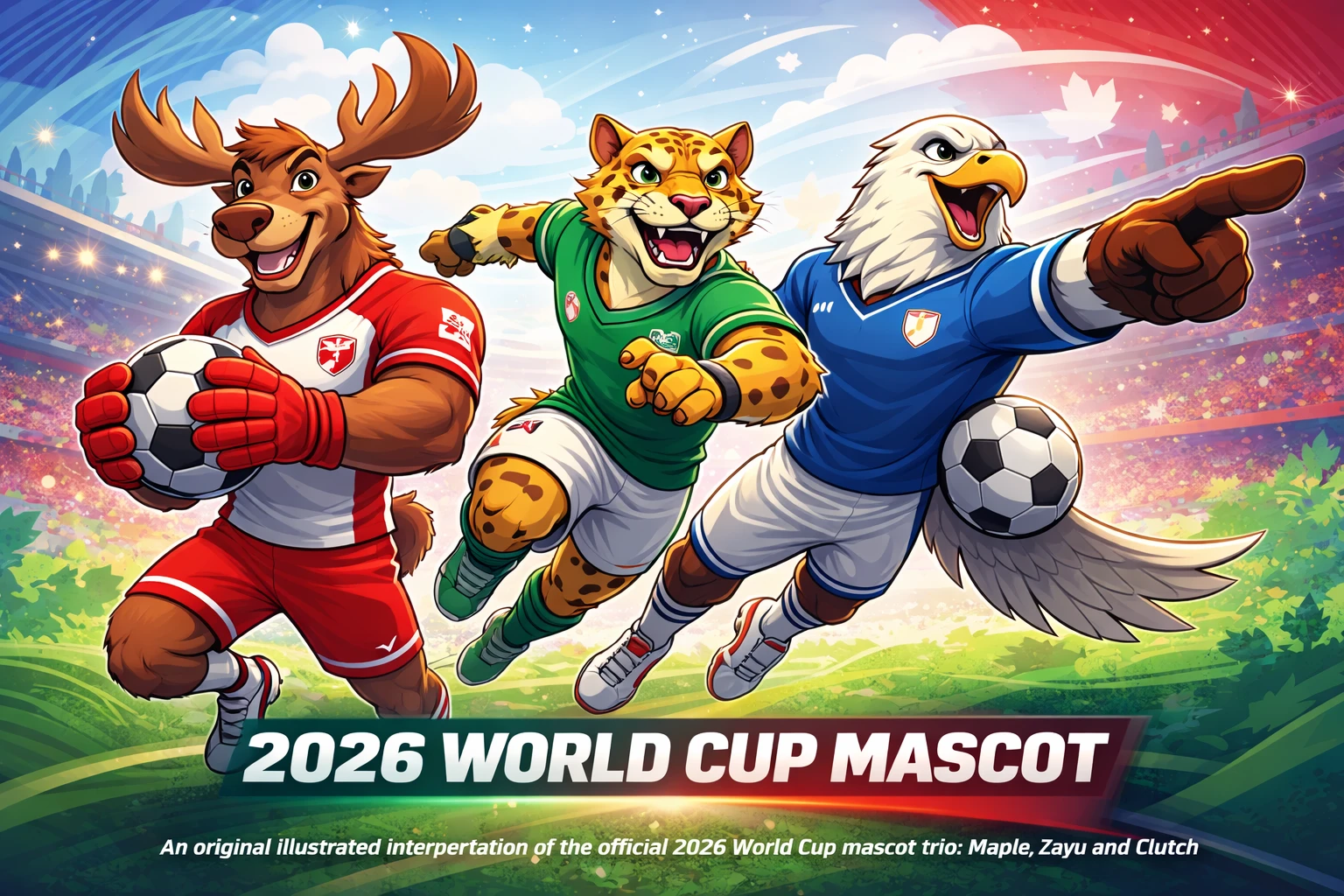

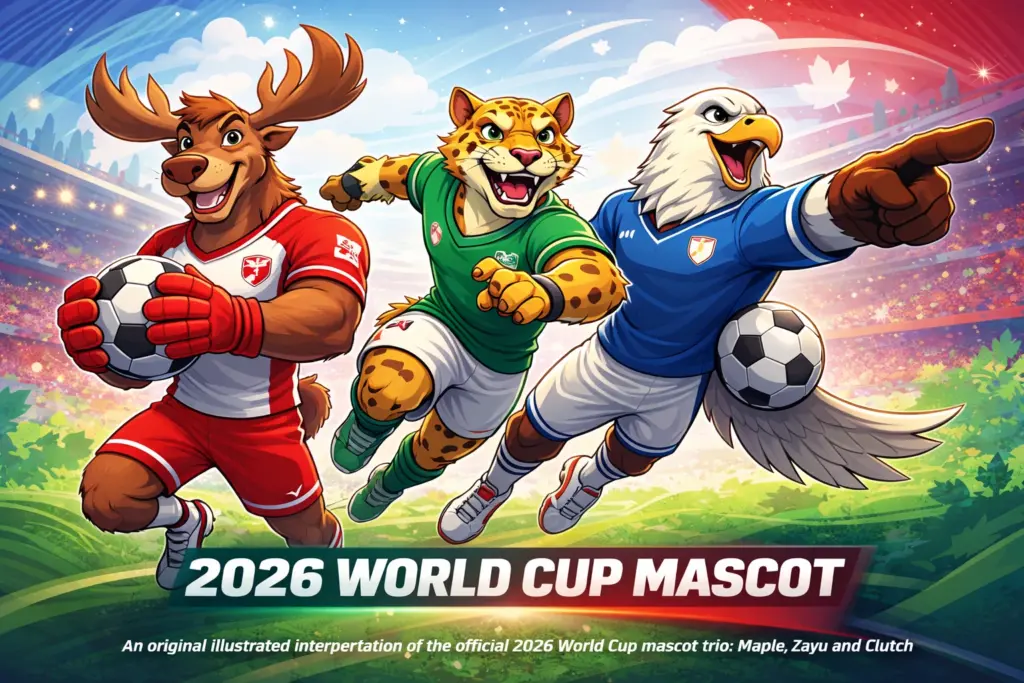
2026 World Cup mascot coverage is different from every previous men’s tournament because FIFA has not chosen one official character for the event. Instead, the FIFA World Cup 2026 has three official mascots: Maple for Canada, Zayu for Mexico, and Clutch for the United States.
Whether you are a lifelong football fan or following your first World Cup, here is everything you need to know about the 2026 World Cup mascot lineup: the names, the design meaning, the reveal, the history, and how this trio fits the first men’s World Cup ever co-hosted by three nations.
TL;DR
- The 2026 World Cup has three official mascots: Maple™, Zayu™ and Clutch™
- Maple represents Canada and is a moose
- Zayu represents Mexico and is a jaguar
- Clutch represents the United States and is a bald eagle
- FIFA officially unveiled the mascots on September 25, 2025
- The mascots were created to reflect the culture, heritage and spirit of the three host nations
- The 2026 tournament runs from June 11 to July 19, 2026, features 48 teams, and includes 104 matches
Snippet: The 2026 World Cup mascots are Maple™, Zayu™ and Clutch™ — a three-character lineup representing Canada, Mexico and the United States. FIFA unveiled the trio in September 2025 ahead of the first men’s World Cup ever co-hosted by three nations. Together, the mascots represent local culture, shared passion for football and the continental scale of the 2026 tournament.
2026 World Cup Mascot Names: Who Are Maple, Zayu and Clutch?
The 2026 World Cup mascots are Maple™, Zayu™ and Clutch™. FIFA introduced the trio on September 25, 2025, presenting each character as the representative of one host nation.
Maple is the Canadian mascot. Maple is a moose and a goalkeeper, designed to reflect creativity, resilience and leadership. FIFA also links the character to the maple leaf, one of Canada’s most recognizable national symbols.
Zayu is the Mexican mascot. Zayu is a jaguar and a striker, created to express agility, ingenuity, strength and cultural pride. FIFA says the character draws on the rich heritage and spirit of Mexico.
Clutch is the United States mascot. Clutch is a bald eagle and a midfielder, built around ideas of courage, optimism, adventure and unity. The bald eagle is one of the clearest national symbols in American iconography, so the choice is easy for younger fans to recognize instantly.
This three-way setup is the key fact many fans miss. There is no single official 2026 World Cup mascot name. The official mascot identity for the tournament is the Maple-Zayu-Clutch trio.
2026 World Cup Mascot Design: What Do Maple, Zayu and Clutch Look Like?
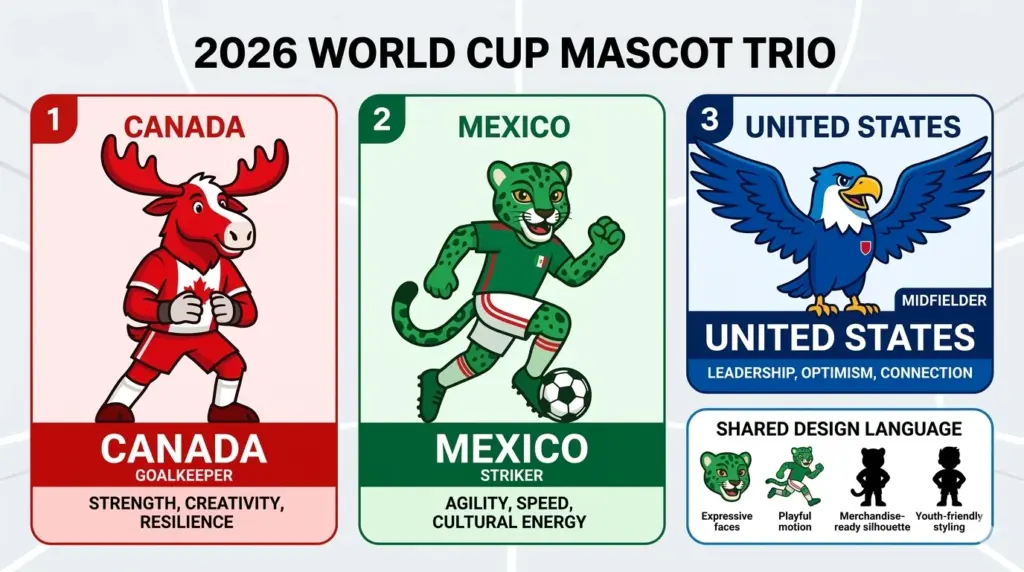
Maple, Zayu and Clutch are designed as bright, family-friendly sports characters. However, they are not copies of each other in different colours. Each one is built around a different animal, playing role and national identity.
Maple’s design: Maple appears in red and white and is styled as a moose goalkeeper. The design leans into creativity, movement and street-style energy. The character connects visually to Canada without relying on a complicated visual story.
Zayu’s design: Zayu appears in green and is styled as a jaguar striker. The jaguar gives the mascot speed, athleticism and a stronger sense of on-pitch threat than many earlier World Cup mascots. FIFA also positions Zayu as a celebration of Mexican culture, tradition and joy.
Clutch’s design: Clutch appears in blue and is styled as a bald eagle midfielder. The design communicates leadership and lift, which makes sense for a bird mascot. FIFA describes Clutch as adventurous, optimistic and socially energetic.
Shared design language: All three mascots are expressive, playful and built for licensing, animation and youth engagement. That matters because mascots do more than appear on posters. They need to work in merchandise, fan zones, digital platforms and games.
Unlike the original single-mascot concept sometimes assumed by fans, the official 2026 mascot system is not built around one regional cultural figure. It is built around three distinct national mascots that come together to symbolize unity, diversity and shared passion for the game.
2026 World Cup Mascot Format: Why Three Host Nations Have Three Mascots
The 2026 World Cup is historic for several reasons, but the most obvious is the hosting arrangement. The tournament is being staged across Canada, Mexico and the United States, with 16 host cities, 48 teams and 104 matches.
That scale changes the mascot logic.
Previous tournaments usually had one mascot because one country hosted the event. Even some co-hosted tournaments still treated the branding as a shared package. In 2026, FIFA took the more literal route: one mascot for each host nation.
That decision solves a real branding problem. A single mascot for three countries can easily feel vague, forced or politically over-balanced. A trio allows each country to have a clear symbol while still keeping one tournament identity.
It also makes the 2026 mascot concept easier to understand at a glance:
- Maple = Canada
- Zayu = Mexico
- Clutch = United States
For families, casual fans and younger audiences, that is much cleaner than a single catch-all character. It also gives FIFA more flexibility across merchandising, activations, digital campaigns and storytelling.
In that sense, the 2026 World Cup mascots are not just cute tournament branding. They are a practical response to the first men’s World Cup ever co-hosted by three nations.
The Full History of World Cup Mascots
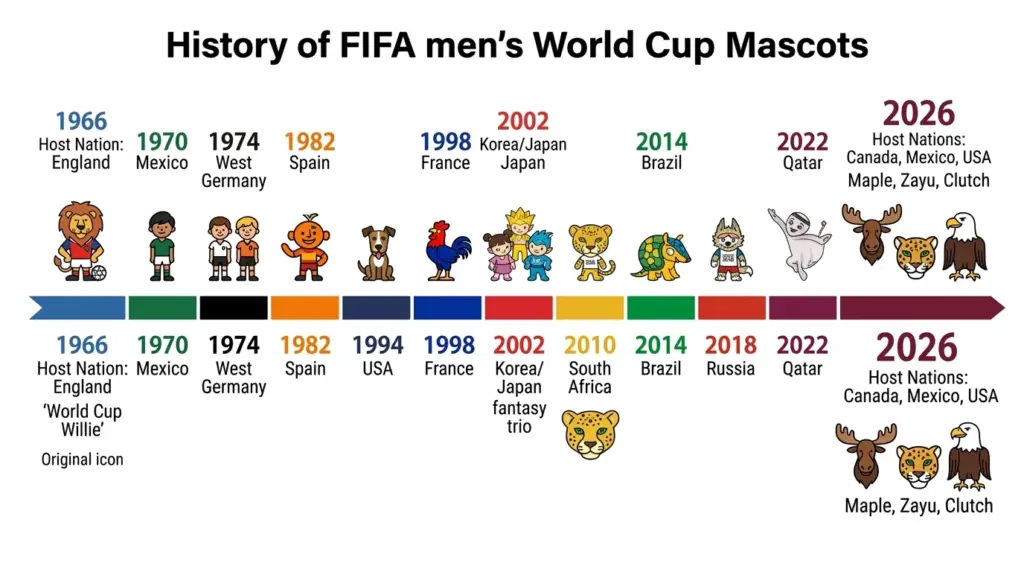
Every men’s World Cup since 1966 has had an official mascot or mascot set. Here is the complete history:
| Year | Host Nation | Mascot Name | Character |
|---|---|---|---|
| 1966 | England | World Cup Willie | Lion in a football kit — first ever World Cup mascot |
| 1970 | Mexico | Juanito | Young boy in Mexico kit and sombrero |
| 1974 | West Germany | Tip and Tap | Two boys in German kit |
| 1978 | Argentina | Gauchito | Gaucho boy with hat, neckerchief and football styling |
| 1982 | Spain | Naranjito | Smiling orange character |
| 1986 | Mexico | Pique | Jalapeño pepper with moustache and sombrero |
| 1990 | Italy | Ciao | Stick-figure mascot built from football elements |
| 1994 | United States | Striker | Dog in football kit |
| 1998 | France | Footix | Blue cockerel |
| 2002 | Korea/Japan | Ato, Kaz and Nik | Futuristic fantasy trio |
| 2006 | Germany | Goleo VI and Pille | Lion mascot with talking football companion |
| 2010 | South Africa | Zakumi | Leopard with green hair |
| 2014 | Brazil | Fuleco | Armadillo |
| 2018 | Russia | Zabivaka | Wolf |
| 2022 | Qatar | La’eeb | Floating character inspired by traditional headwear |
| 2026 | Canada/Mexico/USA | Maple, Zayu and Clutch | Moose, jaguar and bald eagle representing the three host nations |
Key Facts From the History
- World Cup Willie began the official mascot tradition in 1966
- 2002 and 2026 are the clearest examples of multi-character mascot sets in men’s World Cup history
- La’eeb in 2022 was one of the most abstract mascot designs FIFA has used
- Maple, Zayu and Clutch give 2026 a host-by-host mascot identity rather than a single shared symbol
- World Cup mascots usually mix national symbolism, child-friendly design and commercial appeal
2026 World Cup Mascot Reveal: How Were Maple, Zayu and Clutch Chosen?
FIFA’s official rollout makes the broad framework clear even if it does not publish every internal sketch and shortlist. The key idea is simple: each mascot was developed to reflect the culture, heritage and spirit of its host nation, while the three characters together represent unity, diversity and shared passion across the tournament.
That official framing helps explain the choices.
A moose works immediately for Canada because it is a familiar national animal and fits a strong, friendly mascot design. A jaguar works for Mexico because it carries speed, power and deep cultural resonance. A bald eagle works for the United States because it is an instantly recognizable national symbol.
FIFA also gave each mascot a football role:
- Maple is a goalkeeper
- Zayu is a striker
- Clutch is a midfielder
Those roles make the trio feel like a functioning team rather than three disconnected brand assets.
The reveal itself happened on September 25, 2025. Two days later, Maple, Zayu and Clutch made their first public appearance at the Global Citizen Festival in New York’s Central Park, where FIFA presented them in front of a large live audience.
That sequence matters because it shows how FIFA is using the mascots: not just as static logos, but as live-event characters, merchandising anchors and digital entertainment assets.
Maple vs Zayu vs Clutch: What Makes Them Different?
Most World Cup mascots are memorable because they have one strong hook. Willie is the lion. Footix is the cockerel. Fuleco is the armadillo. Zabivaka is the wolf.
The 2026 World Cup mascots work differently. Their strength is not just one character design. It is the relationship among the three characters.
Maple stands out for creativity and resilience. The goalkeeper role fits the character because it gives Maple a protective, organizing presence.
Zayu stands out for movement, cultural energy and attacking flair. Of the three, Zayu is the most obviously built around speed and danger on the pitch.
Clutch stands out for leadership and connection. A midfielder is supposed to link the game together, so Clutch functions as the bridge character in the trio.
That is what makes the 2026 group different from previous World Cup mascots. FIFA did not try to create one symbol broad enough to cover a continent. Instead, it built three national mascots with one shared tournament purpose.
For fans, that makes the branding easier to read. For FIFA, it creates more storytelling range. For retailers, it creates more collectible merchandise. For the tournament itself, it turns the mascot concept into a small team that mirrors the host structure.
2026 World Cup Mascot Merchandise and Official Products
Like every modern World Cup mascot campaign, Maple, Zayu and Clutch already appear across official products and digital activations.
- Plush toys and keychains
- T-shirts and other apparel
- Country-specific mascot items for Canada, Mexico and the United States
- Multipack merchandise featuring all three mascots together
- Digital appearances in FIFA’s gaming ecosystem, including FIFA Heroes
- Promotional appearances at tournament-related live events and fan-facing campaigns
This is one place where the three-mascot strategy becomes especially useful. Fans can choose the mascot linked to their host nation, or collect the full trio as a set.
The official FIFA Store already lists mascot-themed merchandise for the 2026 tournament, including shirts, toys and multipacks. FIFA has also confirmed that Maple, Zayu and Clutch will be playable under the FIFAe umbrella through FIFA Heroes, which gives the mascot campaign a digital life beyond stadium branding.
Because inventory and regional availability can change, the safest route for buyers is to check FIFA’s official store and official tournament channels first.
Common Questions About the 2026 World Cup Mascots
Are there really three official mascots for the 2026 World Cup?
Yes. FIFA’s official 2026 World Cup mascot lineup is Maple, Zayu and Clutch — one mascot for each host nation.
What animals are the 2026 World Cup mascots?
Maple is a moose, Zayu is a jaguar and Clutch is a bald eagle.
Which country does each mascot represent?
Maple represents Canada, Zayu represents Mexico and Clutch represents the United States.
When were the 2026 World Cup mascots revealed?
FIFA officially unveiled the trio on September 25, 2025.
Will the mascots appear throughout the tournament?
Yes. FIFA’s official messaging presents them as central fan-facing characters for the build-up and the tournament itself, across merchandising, activations and digital experiences.
FAQs
Q: What is the 2026 World Cup mascot called?
A: The 2026 World Cup does not have one single mascot. It has three official mascots: Maple, Zayu and Clutch.
Q: What does the 2026 World Cup mascot represent?
A: The 2026 World Cup mascot system represents the three host nations through three official characters. Maple reflects Canada, Zayu reflects Mexico and Clutch reflects the United States, while the trio together symbolizes unity, diversity and shared passion for football.
Q: When was the 2026 World Cup mascot revealed?
A: FIFA officially revealed Maple, Zayu and Clutch on September 25, 2025.
Q: Which World Cup had the first mascot?
A: The 1966 World Cup in England introduced the first official mascot, World Cup Willie.
Q: How many World Cup mascot tournaments have there been?
A: Every men’s FIFA World Cup since 1966 has had an official mascot or mascot set, including the 2026 tournament.
Q: Can I buy official 2026 World Cup mascot merchandise?
A: Yes. Official mascot merchandise is available through FIFA’s official store, with products for the trio and for individual host-nation mascots.
Q: Why did FIFA use three mascots instead of one?
A: The 2026 tournament is the first men’s World Cup co-hosted by three nations. FIFA used three mascots to give Canada, Mexico and the United States each a distinct representative while keeping one shared tournament identity.
Conclusion: Why the 2026 World Cup Mascots Matter Beyond Football
Every World Cup mascot says something about its tournament.
World Cup Willie said England wanted a symbol the world could remember. La’eeb gave Qatar a more abstract, floating and culturally specific visual identity. Maple, Zayu and Clutch tell a different story.
They say the 2026 World Cup is too big, too continental and too multi-national for a single simple symbol.
That is why the official mascot concept works. Maple, Zayu and Clutch are not competing brand ideas. They are a three-part system built for the first men’s World Cup ever shared by Canada, Mexico and the United States.
For fans attending the tournament, the mascots will appear across merchandise, promotions, digital campaigns and event experiences. For fans watching from home, they will become part of the visual language of the summer of 2026.
Get to know all three. This World Cup does not have one mascot face. It has a full front three.