
The 2026 FIFA World Cup brings 48 nations and hundreds of elite players to North America. But certain names will define the tournament. Some are at the peak of their powers. Some are writing the final chapter of extraordinary careers. Some are stepping onto the biggest stage for the very first time.
This guide covers every player worth following — organised by category, explained in context, and with a clear “what to watch for” so you know exactly what you are looking at when they play.
TL;DR
- The match-up everyone wants: Mbappé (France) vs Haaland (Norway), Group I — confirmed, June 26
- First World Cup: Erling Haaland — 55 international goals, never played at a World Cup before
- Likely final World Cup: Ronaldo (~41), Modrić (~40), Son, and possibly Messi (participation unconfirmed as of Feb 2026)
- The youngest superstar: Lamine Yamal turns 19 one week before the Final
- Most pivotal for host nation: Christian Pulisic (USA), Alphonso Davies (Canada), Raúl Jiménez (Mexico)
- The Golden Boot contenders to watch: Haaland, Mbappé, Kane, Vinicius Junior
SNIPPET BLOCK
The 2026 FIFA World Cup features several of the best footballers ever to play the game alongside a new generation of extraordinary young talent. The headline names are Kylian Mbappé (France, 2018 winner and 2022 finalist), Erling Haaland (Norway, first World Cup, 55 international goals), Vinicius Junior (Brazil), and Jude Bellingham (England). Veterans Cristiano Ronaldo (~41), Luka Modrić (~40), and Son Heung-min are expected to play their final World Cups. Lamine Yamal — who turns 19 one week before the Final — represents the sport’s immediate future.
How This Guide Is Organised
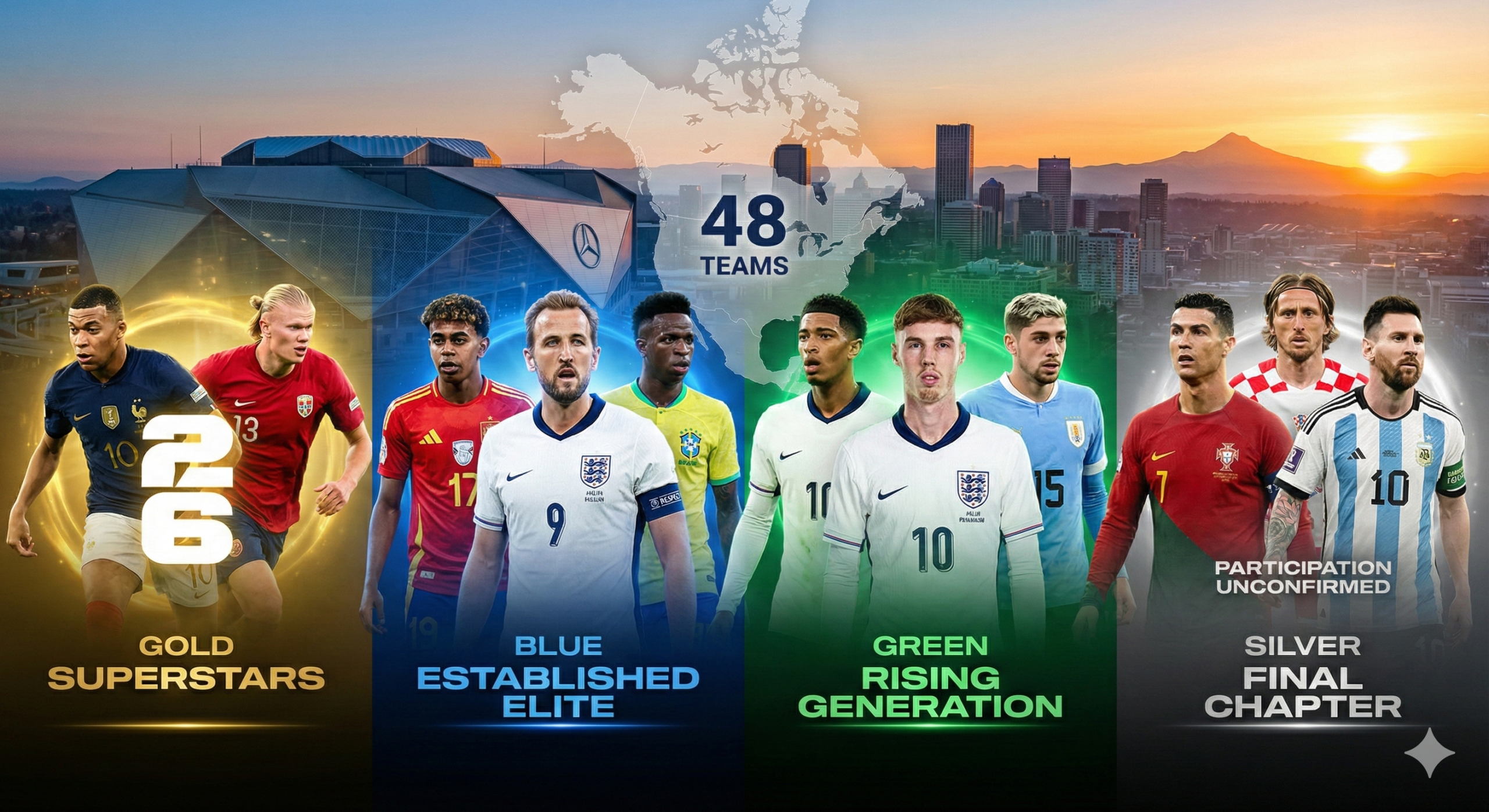
Twenty-plus players, four categories:
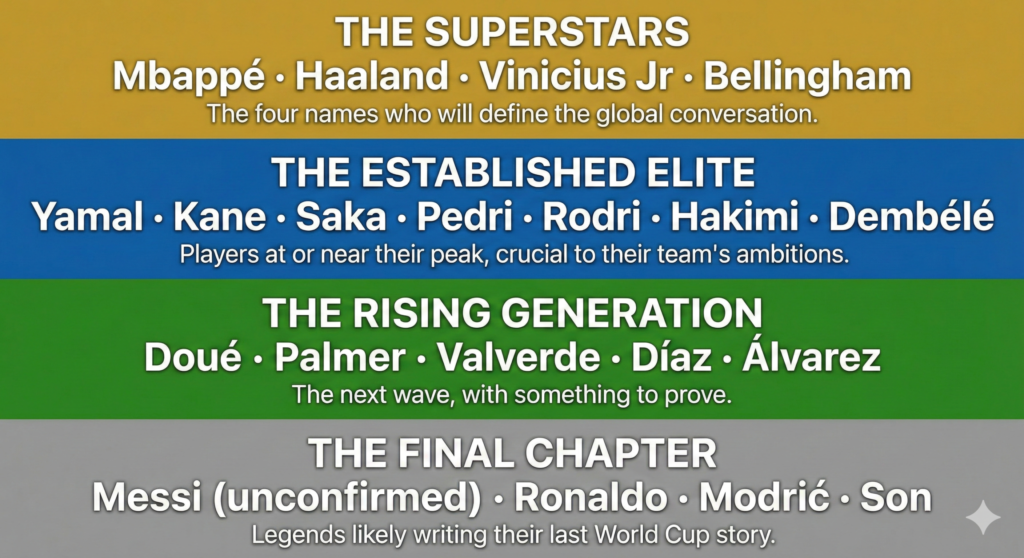
- The Superstars — the four names who will define the global conversation
- The Established Elite — players at or near their peak, crucial to their team’s ambitions
- The Rising Generation — the next wave, with something to prove
- The Final Chapter — legends likely writing their last World Cup story
Plus: a Host Nation Spotlight, a Golden Boot Contenders section, and a “Pick Your Player to Follow” decision framework.
The Superstars — Four Players Who Define the Tournament
These four names will generate the most column inches, the most social media traffic, and the most memorable moments of the 2026 World Cup. Each is in their prime. Each is capable of carrying their nation to the Final.
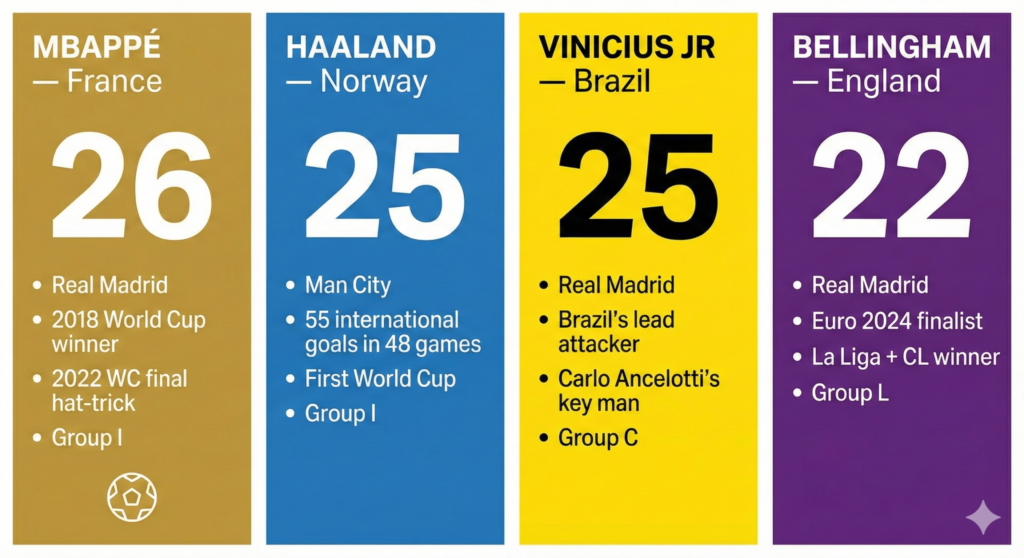
Kylian Mbappé (France) — The Favourite to Win It All
Group: I — Age at tournament: 26 — Club: Real Madrid
Mbappé arrives at the 2026 World Cup with more World Cup final experience than almost any active player on earth. He won the World Cup in 2018 as a teenager. He scored a hat-trick in the 2022 final against Argentina — only the second player in history to score three goals in a World Cup final, after Geoff Hurst in 1966 — and still finished on the losing side.
That is the defining tension of his career at international level: extraordinary individual performance, and the weight of what comes next. The 2026 World Cup is his chance to add the world title that his statistics say he has already earned.
At Real Madrid this season, he has scored 25 goals in 20 combined La Liga and UEFA Champions League matches — numbers that make the Golden Boot conversation start with his name.
What to watch for: Mbappé is at his most dangerous in transition — receiving the ball in space and accelerating toward goal. Watch where he positions himself when France wins the ball back. Also watch his relationship with Dembélé and Doué — France’s attacking unit is exceptionally gifted, and their combination play in the final third is among the best in world football.
The match that defines his tournament: France vs Norway, June 26, Gillette Stadium. Mbappé against Haaland. The two best players in the world right now, in the same group, facing each other.
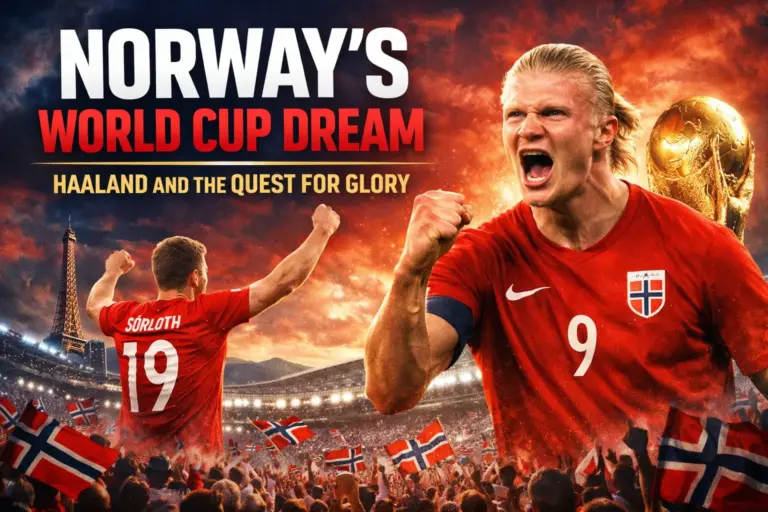
Erling Haaland (Norway) — The World’s Best Goalscorer at His First World Cup
Group: I — Age at tournament: 25 — Club: Manchester City
In 48 international appearances for Norway, Haaland has scored 55 goals. That is not a misprint. (Last Verified: Feb 2026).
That extraordinary return — better than one goal per game for his country — makes him statistically the most dangerous striker in the tournament. The 2026 World Cup is, remarkably, his first. Norway last qualified in 1998, when Haaland was not yet one year old.
“Simply put, Haaland is the best goalscorer in the world right now,” Fox Sports wrote in their post-draw analysis of December 2025. He is supported by Atlético Madrid’s Alexander Sørloth and Arsenal’s Martin Ødegaard — making Norway a far more dangerous proposition than their seeding might suggest.
What to watch for: Haaland does not operate like a traditional centre-forward who is constantly on the ball. He can go quiet for long periods — and then appears from nowhere in the penalty area at the exact moment the ball arrives. Do not take your eyes off him just because he has not touched the ball in 20 minutes. His movement in behind defensive lines is exceptional.
The storyline: Norway’s path through Group I — against France, Senegal, and the playoff winner — will almost certainly require at least one extraordinary Haaland performance to survive. The weight of his nation’s 28-year World Cup absence rests, to a large degree, on his shoulders.
Vinicius Junior (Brazil) — South America’s Most Dangerous Attacker
Group: C — Club: Real Madrid
With Neymar’s era at international level behind him, the responsibility of leading Brazil’s attack belongs fully to Vinicius Junior now. Brazil are five-time World Cup champions who have not won the tournament since 2002 — one of international football’s longest outstanding debts. Under new manager Carlo Ancelotti (appointed to the Brazil job after his success at Real Madrid), Vinicius will be the player their entire attacking system is designed to liberate.
He brings pace, close control, and the ability to change a match in a single moment. At Real Madrid, he has been one of the best attacking players in European football. The question that always follows him — converting that club performance into World Cup impact — is the one 2026 will answer definitively.
What to watch for: Vinicius is most effective when receiving the ball wide and driving at defenders at full speed. Watch his starting position — he tends to drift across from the left flank to create central overloads. When the Brazilian midfield recycles quickly and plays into his feet on the turn, he is almost unplayable. Brazil vs Morocco in Group C (June 13, MetLife Stadium) is his first major test.
Jude Bellingham (England) — The Midfielder Redefining His Position
Group: L — Age at tournament: ~22 — Club: Real Madrid
Bellingham has led Real Madrid to both the La Liga title and the Champions League in his time at the club. He led England to the final of Euro 2024. At approximately 22 years old when the 2026 World Cup begins, he is already operating at a level that most midfielders reach only in their late twenties, if at all.
His role for England is unique — he is not a traditional central midfielder who stays deep and distributes. He arrives into the penalty area from deep positions, scores goals, manufactures opportunities, and presses aggressively when England are out of possession. In many ways, he is England’s most important player — more central to their system than even Harry Kane, who provides the finishing point that Bellingham’s movement creates.
What to watch for: Watch Bellingham’s runs from midfield into the box, particularly when England attack down the left. Also watch his communication with Saka on the right — their combination allows England to overload the right side and switch quickly to create space. England vs Croatia on June 17 is his defining early test — Croatia’s disciplined midfield will be designed specifically to limit his influence.
The Established Elite — Players at Their Peak
These players are not quite at the global superstar conversation level of the four above — but each is among the best in the world in their position and indispensable to their nation’s ambitions.
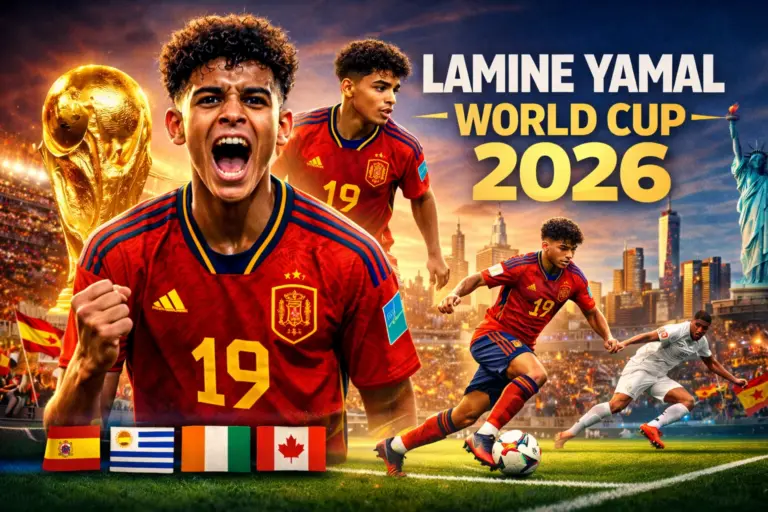
Lamine Yamal (Spain) — The Youngest Superstar
Group: H — Age at tournament: ~18/19 — Club: Barcelona
Yamal will turn 19 one week before the World Cup Final. He has already won the European Championship with Spain and La Liga with Barcelona. Football’s next great superstar is already here — and he will be barely old enough to vote in some countries when he plays on the sport’s biggest stage.
What to watch for: Yamal plays on the right side of Spain’s attack, cutting inside onto his left foot. His combination play with Pedri in central areas and his ability to draw fouls in dangerous positions are key Spain weapons. Watch him against Uruguay’s experienced defensive line in Group H.
Harry Kane (England) — The Lethal Finisher
Group: L — Club: Bayern Munich
England’s captain and all-time leading goalscorer: 78 goals in 112 international caps. (Last Verified: Feb 2026). Since moving to Bayern Munich in 2023, he has scored 76 goals in 75 Bundesliga matches — the kind of consistency that defines elite strikers.
Kane’s World Cup record remains the thing he most wants to address. He won the Golden Boot at Russia 2018 with six goals, but England were knocked out in the semifinals. He has never won a major international trophy. The 2026 World Cup — with England’s most talented generation in decades around him — is his clearest opportunity yet.
What to watch for: Kane’s off-ball movement is world-class — he creates space for Bellingham and Saka by drawing centre-backs toward him, then releasing into channels. When the ball reaches him, he is clinical from almost any angle. He may not be the flashiest player in the England squad; he is their most important.
Bukayo Saka (England) — England’s Most Reliable Performer
Group: L — Club: Arsenal
Twice England Men’s Player of the Year. The first name on Thomas Tuchel’s England team sheet. Saka provides something quietly irreplaceable: pace, creativity, reliability, and the ability to influence a match even on a poor collective day.
Pedri (Spain) — The Midfield Architect
Group: H — Club: Barcelona
Pedri is the engine of Spain’s possession system — the player who makes the passing triangles click, whose vision and ball retention under pressure allow Spain to maintain control of matches against teams pressing them aggressively. Alongside Yamal and Rodri, he forms one of football’s most technically complete midfield-to-attack combinations.
Rodri (Spain) — Spain’s Most Important Player You Might Not Notice
Group: H — Club: Manchester City
Rodri operates as Spain’s defensive midfielder — the player who sits between the defense and the attack, wins second balls, recycles possession, and breaks up opponents’ transitions. When he plays, Spain looks composed and cohesive. When he is missing, they are a different team.
Achraf Hakimi (Morocco) — The World’s Best Attacking Defender
Group: C — Club: PSG (Champions League winners, 2024–25 season)
The best attacking right-back in world football, according to multiple analysts. Hakimi’s pace, crossing ability, and defensive solidity make him the template for the modern full-back role — a player who provides the attacking width of a winger while covering the defensive duties of a traditional right-back.
Ousmane Dembélé (France) — The 2025 Ballon d’Or Winner
Group: I — Club: PSG
According to Fox Sports’ post-draw analysis, Dembélé won the Ballon d’Or in 2025 — the award for the world’s best footballer. [15] He was “the best player in the world in 2025,” continuing exceptional club form after turbulent years at Barcelona and Borussia Dortmund. He is a 2018 World Cup champion and started in the 2022 final.
The Rising Generation — The Next Wave
These are players who arrive at the 2026 World Cup with something to prove — the right age, the right moment, and the right stage to announce themselves globally.
Désiré Doué (France) — The Wildcard
Group: I — Club: PSG
Young, lightning-fast, creative, and already with Champions League final experience. Doué could form part of a French attack — Mbappé, Dembélé, Doué — that is the most frightening attacking unit in the tournament.
Cole Palmer (England) — The Creative Threat
Group: L
A rising English talent who could prove crucial to England’s attacking options beyond the established names.
Federico Valverde (Uruguay) — The Complete Midfielder
Group: H — Club: Real Madrid
A “relentless, do-it-all midfielder” who does everything: pressing, ball-carrying, goalscoring, defending. Uruguay needs their experienced players to deliver in a difficult Group H containing Spain.
Julián Álvarez (Argentina) — The Defending Champions’ Other Weapon
Group: J — Club: Atlético Madrid
Álvarez won the 2022 World Cup with Argentina and has continued developing at Atlético Madrid. Now approximately 26, he is capable of playing an “even larger role” in Argentina’s campaign.
Luis Díaz (Colombia) — The Group K X-Factor
Group: K — Club: Bayern Munich (summer 2025 move from Liverpool)
19 goals and thriving at one of Europe’s biggest clubs, Díaz brings Colombia the kind of individual match-winning quality that can alter tight knockout games.
The Final Chapter — Legends at Their Last World Cup
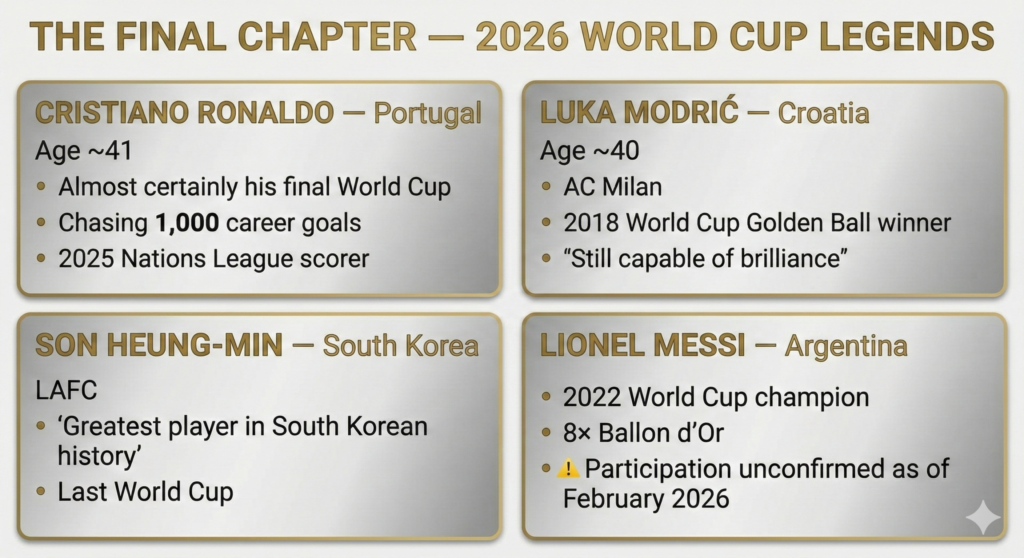
Cristiano Ronaldo (Portugal) — The Last Campaign
Group: K — Age at tournament: ~41 — Club: Al-Nassr
Ronaldo will be approximately 41 years old when the 2026 World Cup begins. He continues to play at professional level for Al-Nassr and has remained relevant at international level in a way almost no player has at his age.
In Portugal’s 2025 UEFA Nations League campaign — which they won, beating Spain in the final on penalties — Ronaldo scored in both the semifinal and the final. [4] He is closing in on 1,000 career professional goals.
Luka Modrić (Croatia) — The Maestro’s Farewell
Group: L — Age at tournament: ~40 — Club: AC Milan
Modrić turned 40 in September 2025. He left Real Madrid in the summer of 2025 after 13 extraordinary years, joining AC Milan — and is still playing at a high level.
Son Heung-min (South Korea) — A Farewell to the Biggest Stage
Group: A — Club: LAFC (moved from Tottenham, summer 2025)
Considered the greatest player in South Korean football history. Son moved to LAFC in the summer of 2025 and has taken to MLS with 12 goals and 3 assists in 13 matches.
Lionel Messi (Argentina) — The Unresolved Question
Group: J — Club: Inter Miami
⚠️ Important note: As of the December 2025 draw, Fox Sports reported that Messi “hasn’t committed to playing for Argentina next summer.” CBS Sports, reporting around the same time, describes him as “expected to play his last-ever major international soccer tournament.” These two positions reflect genuine uncertainty — his participation is unconfirmed as of February 2026.
This article will be updated as soon as Messi’s participation status is officially confirmed.
Host Nation Spotlight
Christian Pulisic (USA) — Captain America
Group: D — Club: AC Milan — Caps/goals: 82 caps, 32 goals, age 27
Pulisic is the USA’s most experienced and recognized international footballer. If he is in form in the summer of 2026, “the Americans’ chances of making a deep run will dramatically increase” — Fox Sports.
Alphonso Davies (Canada) — The Home Nation’s Star
Group: B — Club: [European club — details TBC at time of writing]
Davies is Canada’s most internationally recognized player and the face of Canadian football’s rise. Playing at a World Cup on home soil, in front of a Canadian crowd at BMO Field in Toronto, carries a weight of significance for the country’s football development.
Raúl Jiménez (Mexico) — The Weight of El Quinto Partido
Group: A — Age at tournament: ~34 — Caps/goals: 121 caps, 34 goals
Jiménez is Mexico’s attacking talisman — the player their forward line is structured around. At 34, this is almost certainly his final World Cup, and it comes on home soil.
Golden Boot Contenders
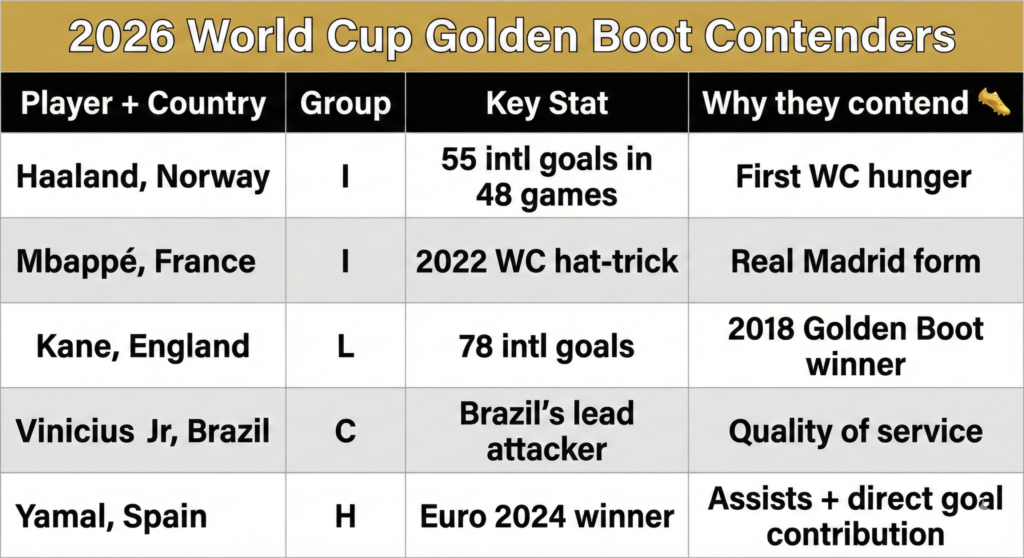
The Golden Boot is awarded to the tournament’s top scorer.
| Player | Country | Group | Why They Contend |
| Erling Haaland | Norway | I | 55 goals in 48 international games; first WC hunger |
| Kylian Mbappé | France | I | 2022 final hat-trick; Real Madrid form this season |
| Harry Kane | England | L | 78 international goals; 2018 Golden Boot winner |
| Vinicius Junior | Brazil | C | Brazil’s primary attacking outlet; quality of service |
| Lamine Yamal | Spain | H | Spain’s creative hub; assists + direct goal contribution |
📺 How to Watch These Stars
| Region | Primary Broadcaster | Digital Streaming |
| USA | FOX Sports / Telemundo | Fox Sports App / Peacock |
| Canada | CTV / TSN / RDS | TSN+ |
| Mexico | Televisa / TV Azteca | ViX |
| UK | BBC / ITV | BBC iPlayer / ITVX |
Pick Your Player to Follow: A Decision Framework
Not sure who to centre your 2026 World Cup experience around? Use this guide.
- If you want history: Follow Erling Haaland (Norway).
- If you want the favourite: Follow Kylian Mbappé (France).
- If you want the hosts: Follow Christian Pulisic (USA).
- If you want the future: Follow Lamine Yamal (Spain).
- If you want legacy: Follow Cristiano Ronaldo (Portugal) or Luka Modrić (Croatia).
Common Myths — Corrected
“Messi is confirmed to play at the 2026 World Cup.”
As of February 2026, this is not confirmed. Fox Sports (December 2025) explicitly stated he had not committed to playing.
“Ronaldo is too old to make a difference.”
Ronaldo scored in both the semifinal and the final of the 2025 UEFA Nations League.
FAQs: 2026 World Cup Players
Is Messi playing at the 2026 World Cup?
Participation is unconfirmed as of February 2026.
Is this Haaland’s first World Cup?
Yes. Norway qualified for 2026 after a 28-year absence.