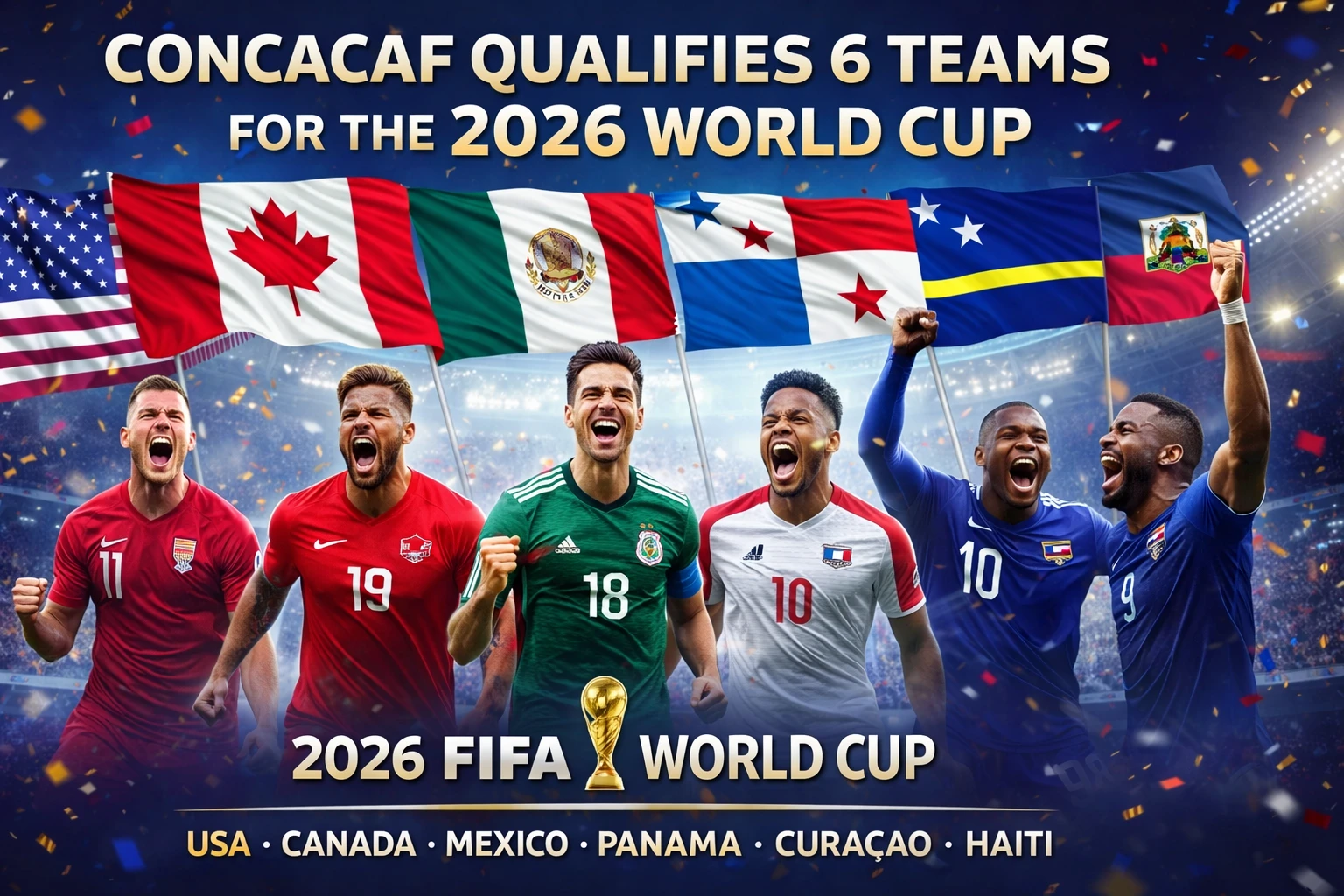

CONCACAF qualified 6 teams for the 2026 World Cup through a mix of automatic host berths and a three-round regional qualifying campaign. On the night of November 18, 2025, six matches kicked off simultaneously across three CONCACAF qualifying groups. When the final whistles blew, three smaller football nations had made history. Curaçao — an island of around 156,000 people — qualified for the World Cup for the first time ever. Haiti qualified for the first time in 52 years, playing their decisive match on the island of Curaçao because the security situation in Port-au-Prince made home football impossible. Panama leapfrogged from second to first in the final hours, overtaking Suriname through a combination of their own win and a result that went their way.
It was one of the most dramatic final matchdays CONCACAF qualifying has produced.
This guide explains exactly how CONCACAF’s six World Cup spots were filled — the format, the rounds, the drama, and what happens next with two more spots still available via the Inter-Confederation Playoffs in March 2026.
TL;DR
- CONCACAF received 6 direct World Cup spots for 2026 — the most ever allocated to the region.
- Three spots went to the host nations: USA, Canada and Mexico — who qualified automatically without playing a single qualifying match.
- The remaining 3 direct spots were decided through a three-round qualifying tournament involving all other 32 CONCACAF member nations.
- The 3 qualified teams: Panama (Third Round Group A winner), Curaçao (Group B winner — first World Cup ever), Haiti (Group C winner — first World Cup since 1974).
- Two more CONCACAF spots are still available via the Inter-Confederation Playoffs in March 2026 — Jamaica and Suriname represent CONCACAF.
- The qualifying format ran from March 2024 to November 2025 across three rounds.
- Highest-profile absentees: Costa Rica, Honduras and Trinidad & Tobago all missed out entirely.
Snippet Block
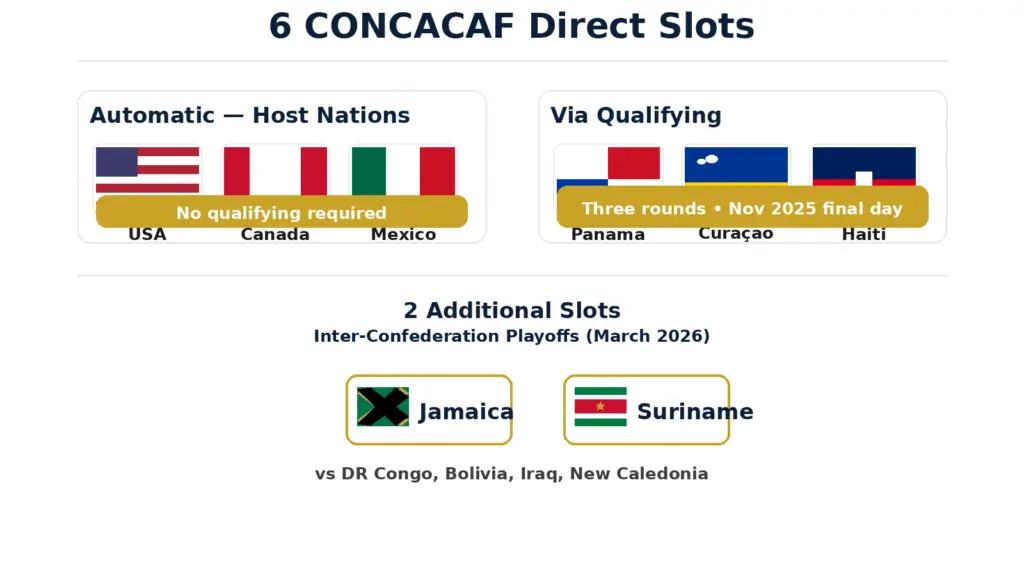
CONCACAF received six direct World Cup spots for 2026. Three went automatically to host nations USA, Canada and Mexico. The other three were decided through a three-round qualifying tournament: Panama won Group A, Curaçao won Group B — qualifying for the first time ever — and Haiti won Group C, returning to the World Cup for the first time since 1974. Jamaica and Suriname, the two best runners-up, advance to the Inter-Confederation Playoffs in March 2026 for two additional spots.
CONCACAF Qualified 6 Teams for the 2026 World Cup: How Many Spots Did the Region Get?
CONCACAF has six direct qualification places for the 2026 FIFA World Cup, plus two additional places available through the inter-confederation play-offs.
Six direct spots is a significant upgrade from recent World Cups, where CONCACAF typically received three or four automatic places. The expansion of the tournament from 32 to 48 teams meant every confederation received more spots — and CONCACAF, as the host confederation, benefited substantially.
However, the host nation arrangement creates an unusual situation: the United States, Canada and Mexico qualify automatically as co-hosts, and their automatic entries come out of CONCACAF’s allocation. In practical terms, that leaves three direct places to be won through CONCACAF qualifying, plus the two inter-confederation play-off opportunities.
So the full CONCACAF picture is:
- 3 automatic: USA, Canada, Mexico (hosts — no qualifying required)
- 3 via qualifying: Panama, Curaçao, Haiti
- 2 via IC Playoffs: Jamaica and Suriname still competing (March 2026)
- Maximum possible: 8 CONCACAF teams at 2026 — the most in the confederation’s history
CONCACAF Qualified 6 Teams for the 2026 World Cup: The Qualifying Format Explained
On 28 February 2023, CONCACAF announced the qualifying format for the 2026 World Cup qualification. CONCACAF saw 32 nations enter the race to make the World Cup. Canada, Mexico and the USA were exempt as hosts.
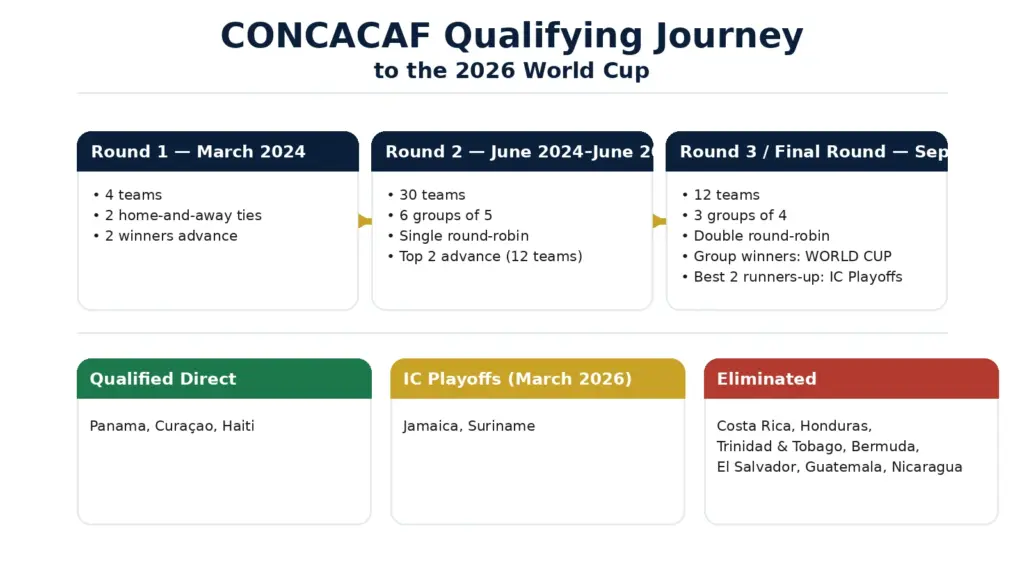
Round 1 — The Lowest-Ranked Nations Fight for Their Place (March 2024)
Four CONCACAF teams, ranked 29 to 32 based on the FIFA rankings of December 2023, were divided into two matchups, played on a two-legged home-and-away basis.
The four lowest-ranked CONCACAF nations — Anguilla, British Virgin Islands, Turks and Caicos Islands and US Virgin Islands — competed for two spots in Round 2.
Anguilla and British Virgin Islands eliminated Turks and Caicos Islands and US Virgin Islands, respectively, on penalties. Both ties went to penalties — a dramatic start to the longest qualifying campaign in CONCACAF’s history.
Two small island nations from the Caribbean punched their way into Round 2 to face opponents ranked far above them. Neither ultimately made it further — but the format gave them the chance that a simple seeded system would have denied.
Round 2 — Six Groups, One Round-Robin, 12 Teams Advance (June 2024–June 2025)
Thirty teams — the two winners from the first round and CONCACAF teams ranked 1 to 28 — were drawn into six groups of five teams. They played single round-robin matches, with two home games and two away games each, and the group winners and runners-up advanced to the third round.
Twelve teams advanced from Round 2 — the six group winners and six runners-up. This was the stage where Panama, Jamaica, Costa Rica, Honduras, Haiti, Curaçao, El Salvador, Guatemala, Suriname, Trinidad and Tobago, Nicaragua and Bermuda all advanced.
Notably, traditional CONCACAF heavyweights El Salvador, Costa Rica and Honduras all made it through. So too did Suriname — a nation that had never previously qualified for the World Cup — and Bermuda.
Round 3 (Final Round) — Three Groups, Drama on the Final Day (September–November 2025)
The Final Round of the CONCACAF Qualifiers to the 2026 FIFA World Cup featured 12 national teams divided into three groups of four. Each team competed in a home-and-away round-robin format, playing six matches across three FIFA windows.
Group A: Panama, El Salvador, Guatemala, Suriname.
Group B: Jamaica, Curaçao, Trinidad and Tobago, Bermuda.
Group C: Costa Rica, Honduras, Haiti, Nicaragua.
At the conclusion of the Final Round, the top team from each group earned direct qualification to the FIFA World Cup. In addition, the two best second-place finishers from across the three groups advanced to the FIFA Intercontinental Playoff.
CONCACAF Qualified 6 Teams for the 2026 World Cup: The Six Qualified Teams
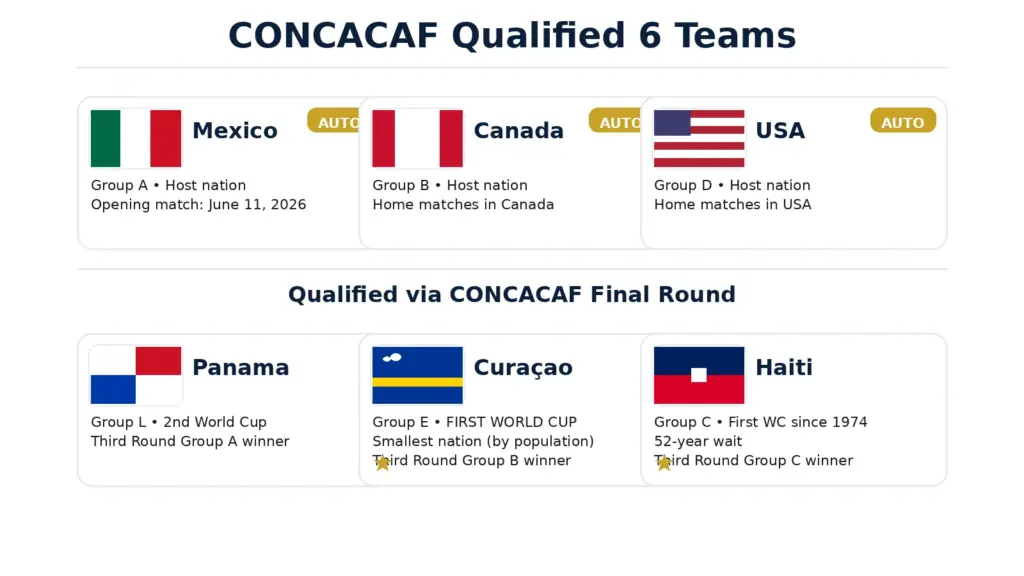
🇺🇸 United States — Automatic (Host)
The United States qualified automatically as a co-host nation. Unlike past host cycles, the USA entered the 2026 tournament having already qualified on merit for Qatar 2022.
In the Final Draw, the USA were placed in Group D.
For the USA, the 2026 World Cup is about more than just football — it is the culmination of a decade-long infrastructure and investment push to make American soccer a genuine force.
🇨🇦 Canada — Automatic (Host)
Canada qualified automatically as a co-host. They qualified on merit for Qatar 2022 — their first World Cup since 1986 — ending a 36-year absence.
In the Final Draw, Canada were placed in Group B.
The Canada games in Toronto and Vancouver will be among the most emotionally charged domestic sporting events Canada has ever hosted.
🇲🇽 Mexico — Automatic (Host)
Mexico qualified automatically as a co-host — and will host the tournament’s opening match at Estadio Azteca on June 11, 2026.
In the Final Draw, Mexico were placed in Group A.
For Mexico, the 2026 World Cup carries the specific weight of the “quinto partido” conversation — the country’s long-running frustration at not reaching the quarterfinals in the modern era. Playing at home gives El Tri the kind of advantage they rarely get at a World Cup.
🇵🇦 Panama — Third Round Group A Winner
Panama’s qualification for the 2026 World Cup was settled in dramatic fashion on the final matchday.
Panama finished top of Group A after beating El Salvador 3–0, while Suriname lost 3–1 to Guatemala. The swing in results meant Panama ended as group winners and World Cup qualifiers.
It was just the second time Panama have ever made it to the World Cup, the last coming in 2018.
In the Final Draw, Panama were placed in Group L.
🇨🇼 Curaçao — Third Round Group B Winner (World Cup Debut)
Curaçao became the smallest nation by population ever to qualify for the World Cup, as a 0–0 draw at second-placed Jamaica preserved their one-point lead atop the group.
An island of around 156,000 people. An unbeaten qualifying record. And now a place on the biggest stage.
In the Final Draw, Curaçao were placed in Group E alongside Germany, Ecuador and Ivory Coast.
The full story of Curaçao’s historic qualification — including Dick Advocaat’s resignation on February 23, 2026 and the appointment of Fred Rutten — is covered in our dedicated Curaçao World Cup 2026 article.
🇭🇹 Haiti — Third Round Group C Winner (Return After 52 Years)
Haiti’s return to the World Cup is the other extraordinary story of CONCACAF qualifying — and it deserves the same attention as Curaçao’s debut.
Haiti qualified for the World Cup with a 2–0 win over Nicaragua.
Haiti will return to the World Cup for the first time in over 52 years. Their only previous World Cup appearance was in 1974 in West Germany — when Emmanuel Sanon scored against Italy to become the first player to beat Italian goalkeeper Dino Zoff in 1,142 minutes of international football.
Haiti’s qualifying campaign was played against the backdrop of a genuine national crisis. Haiti — who have had to stage “home” matches away from Port-au-Prince due to security concerns — played Nicaragua in Curaçao.
In the Final Draw, Haiti were placed in Group C with Brazil, Morocco and Scotland. Scotland’s opening match is scheduled to be against Haiti on June 13 in the Boston area.
CONCACAF Qualified 6 Teams for the 2026 World Cup: The Inter-Confederation Playoffs
The qualifying story is not completely finished. A play-off tournament involving six teams — one each from AFC, CAF, CONMEBOL and OFC, plus two from CONCACAF — will decide the final two FIFA World Cup berths.
CONCACAF’s two Inter-Confederation Playoff representatives are Jamaica and Suriname — the two best runners-up from the three Third Round groups.
The play-offs will be held in March 2026 in Guadalajara and Monterrey in Mexico.
The full playoff bracket:
- Semi-final 1 (March 26): New Caledonia vs Jamaica → Final 1 (March 31): Winner vs DR Congo (seeded)
- Semi-final 2 (March 26): Bolivia vs Suriname → Final 2 (March 31): Winner vs Iraq (seeded)
By April 1, 2026, the full 48-team field for the World Cup will be confirmed.
The Biggest Absentees: Costa Rica, Honduras and Trinidad & Tobago
Remarkably, we will not see Costa Rica, Honduras or Trinidad and Tobago take their place at the World Cup.
Costa Rica — five World Cup appearances including a quarterfinal in 2014 — finished second in Group C but missed out on the inter-confederation play-off places.
Honduras — eight World Cup appearances including a memorable 1982 campaign — also failed to take a play-off place.
Trinidad and Tobago — famous for their 2006 World Cup qualification — fell short in Group B despite advancing from Round 2.
The CONCACAF qualifying format for 2026 produced three first-time or returning qualifiers — Curaçao, Haiti and Panama — while eliminating nations with far more World Cup history. That is the brutal reality of competitive regional qualifying, and it makes the stories of Panama, Curaçao and Haiti all the more significant.
CONCACAF Qualified 6 Teams for the 2026 World Cup: What It Means for the Tournament
CONCACAF’s six qualified teams — three host nations and three earned qualifiers — are spread across multiple groups at the 2026 tournament:
- Group A: Mexico (host)
- Group B: Canada (host)
- Group C: Haiti (qualified)
- Group D: United States (host)
- Group E: Curaçao (qualified)
- Group L: Panama (qualified)
Instead of one “CONCACAF super-group,” the confederation’s story is distributed: hosts anchoring three separate groups, and three earned qualifiers dropped into very different football ecosystems.
Decision Framework: Following CONCACAF Teams at the 2026 World Cup
Use this guide to find which CONCACAF teams to follow:
If you want the host nation atmospheres: Follow Mexico (Group A), Canada (Group B) and the USA (Group D) — three hosts, three different venues, three different vibes.
If you want the underdog story: Curaçao (Group E) is the smallest nation ever at the tournament. Every match they play is a piece of football history.
If you want the comeback story: Haiti (Group C) haven’t been to the World Cup since 1974, and they qualified while unable to stage competitive matches in Port-au-Prince.
If you want the “revenge fixture” angle: Panama (Group L) share a group with England again after the 2018 meeting.
If you want to watch the March drama unfold first: Jamaica vs New Caledonia on March 26 and Suriname vs Bolivia on March 26 — with the winners facing DR Congo and Iraq respectively on March 31 to earn the final two World Cup spots.
Frequently Asked Questions
How many teams does CONCACAF send to the 2026 World Cup?
Six directly — three host nations (USA, Canada, Mexico) and three qualifying winners (Panama, Curaçao, Haiti). Two additional CONCACAF teams, Jamaica and Suriname, compete in the Inter-Confederation Playoffs in March 2026 for two more spots. The maximum possible is eight CONCACAF teams.
How did the CONCACAF qualifying format work?
Three rounds: Round 1 featured the four lowest-ranked teams in home-and-away ties, Round 2 featured 30 teams in six groups of five with the top two advancing, and Round 3 featured 12 teams in three groups of four, with group winners qualifying directly and the two best runners-up going to the Inter-Confederation Playoffs.
Why didn’t the USA, Canada and Mexico play qualifying matches?
They qualified automatically as co-hosts of the 2026 tournament.
When did CONCACAF qualifying take place?
The campaign ran from March 2024 through November 2025. The Inter-Confederation Playoffs conclude on March 31, 2026.
Who are the two CONCACAF teams in the Inter-Confederation Playoffs?
Jamaica and Suriname — the two best second-placed finishers from the Third Round groups. They face New Caledonia and Bolivia in the semi-finals, with the winners then facing DR Congo and Iraq in the finals on March 31.
Is this the first time CONCACAF has had six teams at a World Cup?
This is the first World Cup cycle where CONCACAF has six direct berths available, though three are taken by hosts. With the potential Inter-Confederation Playoff additions, eight CONCACAF teams at the 2026 World Cup would be the most ever.
When is Haiti’s first match at the 2026 World Cup?
Scotland’s opening group match is scheduled to be against Haiti on June 13 in the Boston area.
What happened to Costa Rica and Honduras in qualifying?
Both fell short of being among the two best runners-up across the three Third Round groups, so neither reached the Inter-Confederation Playoff tournament.
Which CONCACAF nations have never qualified for the World Cup?
Suriname, if they lose the Inter-Confederation Playoffs, remains one of the notable nations still chasing a first-ever World Cup appearance, along with many smaller Caribbean and Central American teams.
Key Takeaway
CONCACAF’s 2026 qualifying campaign produced a final matchday where three simultaneous narratives resolved in ninety minutes on November 18, 2025: Panama surged to first, Curaçao became the smallest nation ever to qualify, and Haiti returned after 52 years while staging decisive matches away from home due to security concerns.
The three host nations were already confirmed. The three earned spots tell the real story of a region that produced drama, history and extraordinary individual narratives in equal measure. And with Jamaica and Suriname still alive in the Inter-Confederation Playoffs in March 2026, the CONCACAF story has not finished being written.