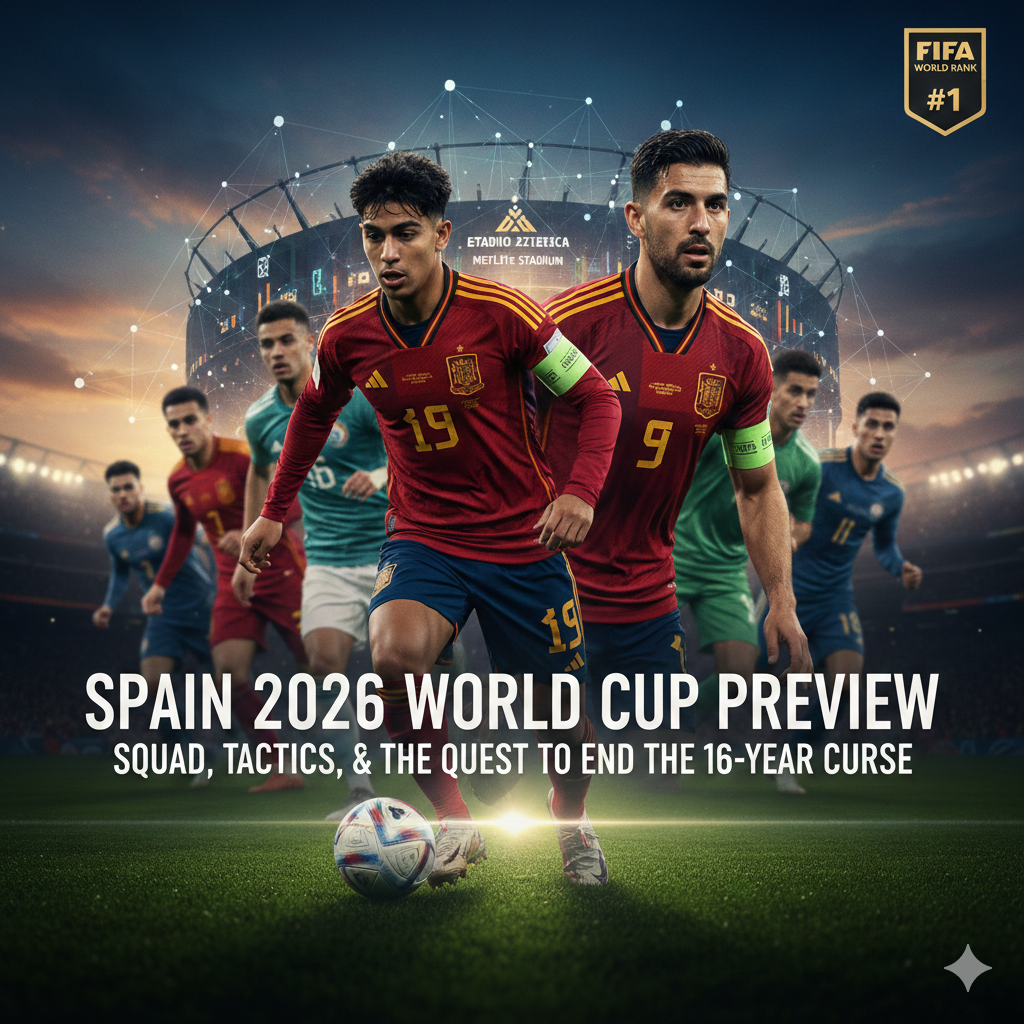
Spain arrive at the 2026 World Cup as the team most analysts pick to lift the trophy. They are FIFA’s world number one ranked team. They are the reigning European champions. They have the deepest, most technically gifted squad at the tournament.
They also have not won a World Cup knockout match in 16 years.
This preview covers everything you need to understand Spain at the 2026 World Cup — how they play, who their key players are, what their Group H looks like, where their vulnerabilities lie, and what a realistic path to the Final looks like.
TL;DR
- Ranking: FIFA #1 — widely regarded as the pre-tournament favorite
- Manager: Luis de la Fuente — guided Spain to Euro 2024 title
- Formation: 4-3-3 — possession-based with directness and high press
- Group H: Spain, Uruguay, Saudi Arabia, Cabo Verde
- The star: Lamine Yamal — will turn 19 exactly 48 hours before the Final [9]
- The key concern: Spain without Rodri are a different team — and history shows it
- World Cup record since 2010: Group stage exit (2014), Round of 16 (2018, 2022)
- Manager’s mandate after the draw: “Win, win, and win.”
SNIPPET BLOCK
Spain enter the 2026 FIFA World Cup as reigning European champions and the world’s number-one ranked team under manager Luis de la Fuente. They play a 4-3-3 possession system built around Lamine Yamal (right wing), Nico Williams (left wing), Rodri (defensive midfielder), and Pedri (central midfielder). Spain are in Group H alongside Uruguay, Saudi Arabia, and Cabo Verde. Despite being the pre-tournament favourite, Spain have not won a World Cup knockout match since the 2010 Final — making 2026 the tournament where they must turn sustained excellence into a global title.
Part 1: Spain’s Manager — Luis de la Fuente
Luis de la Fuente is not a name that generates the same global recognition as Pep Guardiola or Jürgen Klopp. But within Spanish football, his credentials are deep and his influence on the current generation of players is profound.
De la Fuente spent 12 years in the Spanish national team setup before taking the senior job — managing the U-19, U-21, and Olympic teams and working directly with many of the players now representing Spain at the 2026 World Cup. He was appointed senior manager in 2022, and in 2024 he guided Spain to their fourth European Championship title.
He became “the first Spain manager since Vicente del Bosque to win a major tournament” — a significant achievement given the weight that comparison carries. Del Bosque was the manager of Spain’s 2010 World Cup and 2012 European Championship sides.
His tactical approach is an evolution of Spain’s possession identity — the modern expression of the system that defined international football between 2008 and 2012 — but with added directness and physicality. He has integrated wingers who attack defenders rather than simply recycle possession, and midfielders who attack the box rather than only circulate the ball.
After the December 2025 draw placed Spain in Group H, De la Fuente issued one of the clearest mandates any World Cup manager has stated publicly: “We have to win, win, and win. It’s the only thing we can control since we have a huge responsibility.”
The context matters. He wanted Spain to win the group, not just qualify — because finishing as group runners-up in Group H could mean facing Argentina in the Round of 32.
Part 2: How Spain Play — Tactics and Formation
The Formation: 4-3-3
Spain’s starting structure is a 4-3-3 — four defenders, three midfielders, three forwards. But what happens within that structure is where Spain become genuinely difficult to play against or to defend against. [8]
In possession — the attacking shape:
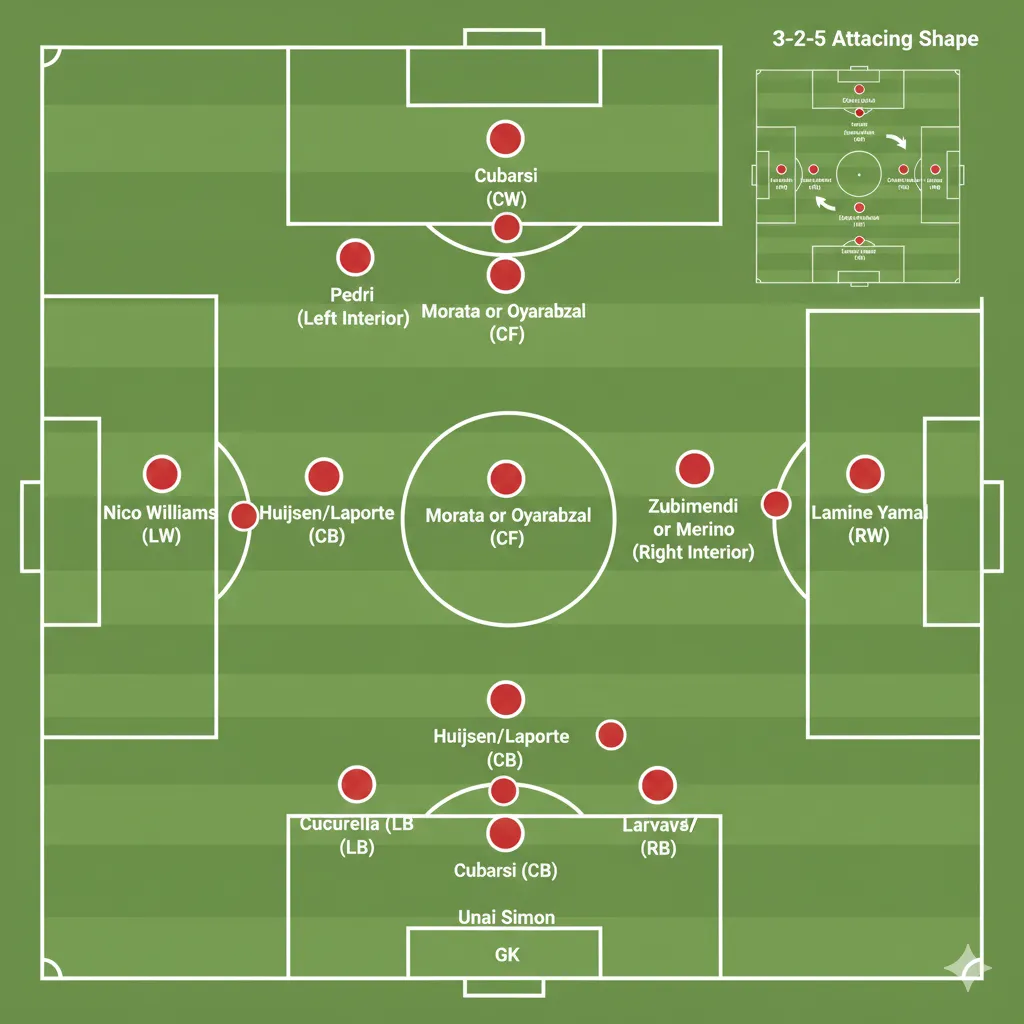
When Spain have the ball in their own half, the shape frequently shifts into something closer to a 3-2-5 attacking structure:
- Rodri drops between the two centre-backs, forming a back three
- Both full-backs push high up the pitch simultaneously — creating width
- The two interior midfielders (Pedri + one of Zubimendi/Merino/Fabian Ruiz) take positions in the half-spaces
- Yamal and Nico Williams provide wide attacking threats from both flanks
- The central striker (Morata/Oyarzabal) provides the target
The result: five players in advanced attacking positions, supported by two midfielders, with three players forming the defensive base. The opposition must defend a very wide, very deep attacking structure.
The passing triangles:
Spain’s system is built on creating passing triangles all over the pitch. At any moment, the player on the ball has at least two passing options who themselves have two options. This structure makes it very difficult to press Spain effectively — every press creates a free player somewhere else on the pitch.
Out of possession — the press:
De la Fuente’s Spain are not content simply to wait and defend. When they lose the ball, their forwards immediately press the opponent’s defensive line. Yamal and Williams are aggressive ball-hunters; Pedri and the interior midfielders press the opponent’s midfield; Rodri screens the central space.
The system is described as a modern evolution of tiki-taka: “adding a punch of directness and physicality that they’ve perhaps lacked in the past.” Wingers who can take on their man and drive at goal; midfielders who run beyond the striker and arrive at goal-scoring positions.
The Rodri Test — Spain’s Critical Dependency
The single most important tactical question about Spain in 2026 is not about their system in its ideal form. It is about what happens when Rodri does not play.
The evidence is uncomfortable for Spain supporters. In November 2025, with Rodri absent from key matches, Spain drew 2–2 with Turkey in their final qualifying match — a result that was heavily analyzed given how dominant they had been throughout the campaign. In the UEFA Nations League Final, Spain was beaten by Portugal — in a match Rodri did not play.
Rodri’s role in Spain’s system is specific and irreplaceable in the short term. He is the player who:
- Drops between the centre-backs to create the back-three base in possession
- Provides the “calm connector” when opponents press Spain’s midfield
- Screens the defensive line when Spain’s full-backs push forward
- Breaks up transitions before they become dangerous counter-attacks
Martin Zubimendi (Arsenal) is the primary alternative — an excellent defensive midfielder in his own right — but Rodri’s combination of physical presence, tactical intelligence, and passing range is unique. “One wrong injury turns a favorite into a nervous team” is how SportsOrca characterized the situation in December 2025.
For Spain to win the 2026 World Cup, Rodri needs to stay fit for eight consecutive matches across 39 days.
Part 3: Spain’s Key Players
Lamine Yamal — The Youngest Superstar on Earth
Already a European champion, La Liga winner, Copa del Rey winner — and he achieves all of this before his 18th birthday. Yamal will turn 19 exactly 48 hours before the 2026 World Cup Final.
At Euro 2024, he registered four assists and one goal across seven matches — contributing to the tournament’s decisive moments at an age when most footballers are still developing in reserve or youth football. He finished second in the 2025 Ballon d’Or voting — the highest placement ever for a teenager.
He plays on Spain’s right wing and is described as the #1 right winger in the world by FourFourTwo’s rankings. His technical profile: exceptional close control, a left-footed cutting run from the right flank toward goal, and the ability to both create and score in high-pressure moments.
The 2026 World Cup on North American soil — in the open, fast pitches and large stadiums of the USA and Mexico — is a near-perfect environment for a player of his style and age. Every Spain match is potentially a Yamal masterclass.
Rodri — The Engine Spain Cannot Lose
Rodri won the 2024 Ballon d’Or, recognising him as the best footballer in the world — an award won primarily for his role in Spain’s Euro 2024 triumph and his performances for Manchester City.
He does not score the goals or make the dribbles that define highlight reels. What he does instead is make Spain’s entire attacking system possible. Without him sitting as the deep pivot — protecting the defence as the full-backs push forward, recycling possession under pressure, and triggering the press — Spain’s shape loses its structural coherence.
For the casual viewer: Rodri is the player to watch when Spain are building from the back. If he is comfortable and controlling the tempo, Spain will dominate. If he is being pressed hard and making uncharacteristic errors, Spain are in a difficult match.
Pedri — The Creative Heartbeat
After injury problems in previous seasons, Pedri has returned to form under Hansi Flick at Barcelona. He is now described as “one of the best midfielders in the world” — his passing accuracy, ball retention under pressure, and vision in tight spaces are central to Spain’s ability to circulate the ball through midfield and into the final third.
The combination of Rodri (security), Pedri (creativity), and a third midfielder (Zubimendi for control, Merino for physicality, Fabian Ruiz for technical refinement) gives De la Fuente exceptional midfield flexibility.
Nico Williams — The Left Wing Threat
If Yamal receives most of the attention on Spain’s right flank, Williams provides balance and genuine danger on the left. Playing for Athletic Bilbao, he has established himself as “one of the best forwards in La Liga” — direct, quick, capable of beating defenders with pace or technique.
The Yamal-Williams wing partnership is the fastest, most technically capable wide attacking pair in the tournament. Their combination at Euro 2024 was one of the defining features of Spain’s success.
Alvaro Morata and Mikel Oyarzabal — The Striking Solutions
Spain’s striking options are not household names in the way Mbappé or Haaland are — and this is actually an underappreciated part of their system. Spain do not rely on a single elite centre-forward; they rely on forwards who fit the system.
Morata (captain, lifted the Euro 2024 trophy) is the experienced tournament leader — strong in the air, mobile, and excellent at holding up the ball to allow the midfielders and wingers to arrive. Oyarzabal provides a different profile: a technically precise finisher who has scored 16 goals under De la Fuente, including in multiple consecutive November 2025 matches. De la Fuente described his goal-scoring as a “striker trait Spain have craved for years: repeatability.”
Part 4: Spain’s Squad Overview
Likely Starting XI (4-3-3):
GK: Unai Simon (Athletic Bilbao)
RB: Dani Carvajal (Real Madrid) — if fit; Pedro Porro (Tottenham) as alternative
CB: Pau Cubarsi (Barcelona)
CB: Dean Huijsen (Real Madrid) or Aymeric Laporte (Athletic Bilbao)
LB: Marc Cucurella (Chelsea) or Alejandro Grimaldo (Bayer Leverkusen)
Pivot/DM: Rodri (Manchester City)
Interior: Pedri (Barcelona)
Interior: Fabian Ruiz (PSG) or Martin Zubimendi (Arsenal) or Mikel Merino (Arsenal)
RW: Lamine Yamal (Barcelona)
CF: Alvaro Morata or Mikel Oyarzabal (Real Sociedad)
LW: Nico Williams (Athletic Bilbao)
Part 5: Group H — Spain’s Path Through the Group Stage
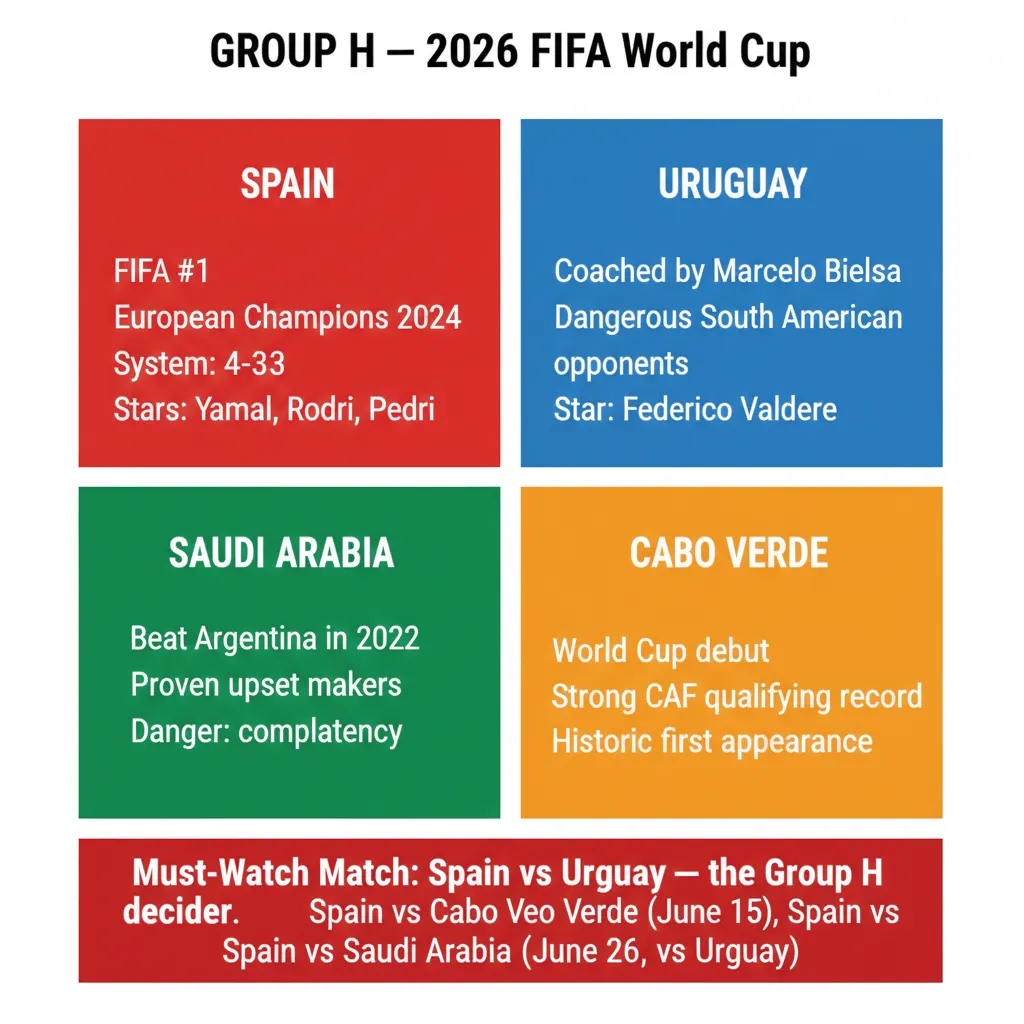
| Match | Date | Key fact | Venue |
| Spain vs Cabo Verde | June 15 | Spain’s opener — Cabo Verde’s World Cup debut | Hard Rock Stadium, Miami |
| Spain vs Saudi Arabia | June 21 | De la Fuente specifically warned about underestimating them | AT&T Stadium, Arlington |
| Spain vs Uruguay | June 26 | The Group H decider — Valverde vs Rodri/Pedri | MetLife Stadium, East Rutherford |
Opponent by Opponent
Cabo Verde (debut): The easiest fixture on paper — but De la Fuente was explicit about respecting every opponent. Cabo Verde qualified with seven wins from ten CAF matches. Their debut should bring a committed, well-organized team with nothing to lose. Spain should win. The margin matters for goal difference.
Saudi Arabia: The team that produced 2022’s biggest upset by beating Argentina 2–1. Spain under De la Fuente take the lesson seriously — he specifically mentioned Saudi Arabia by name after the draw when explaining his “win, win, win” mandate. Saudi Arabia press high, play on the counter, and set their defensive line to catch opponents offside — a system that requires Spain to be precise and patient rather than direct.
Uruguay (the decider): Managed by Marcelo Bielsa — one of football’s most tactically demanding coaches, famous for extremely high-energy, physically relentless pressing systems. Uruguay’s squad includes Federico Valverde (Real Madrid — one of the world’s best midfielders) and a core of experienced South American professionals. This match most likely decides Group H first place — and Spain’s bracket path through the knockouts.
Part 6: Spain’s World Cup History
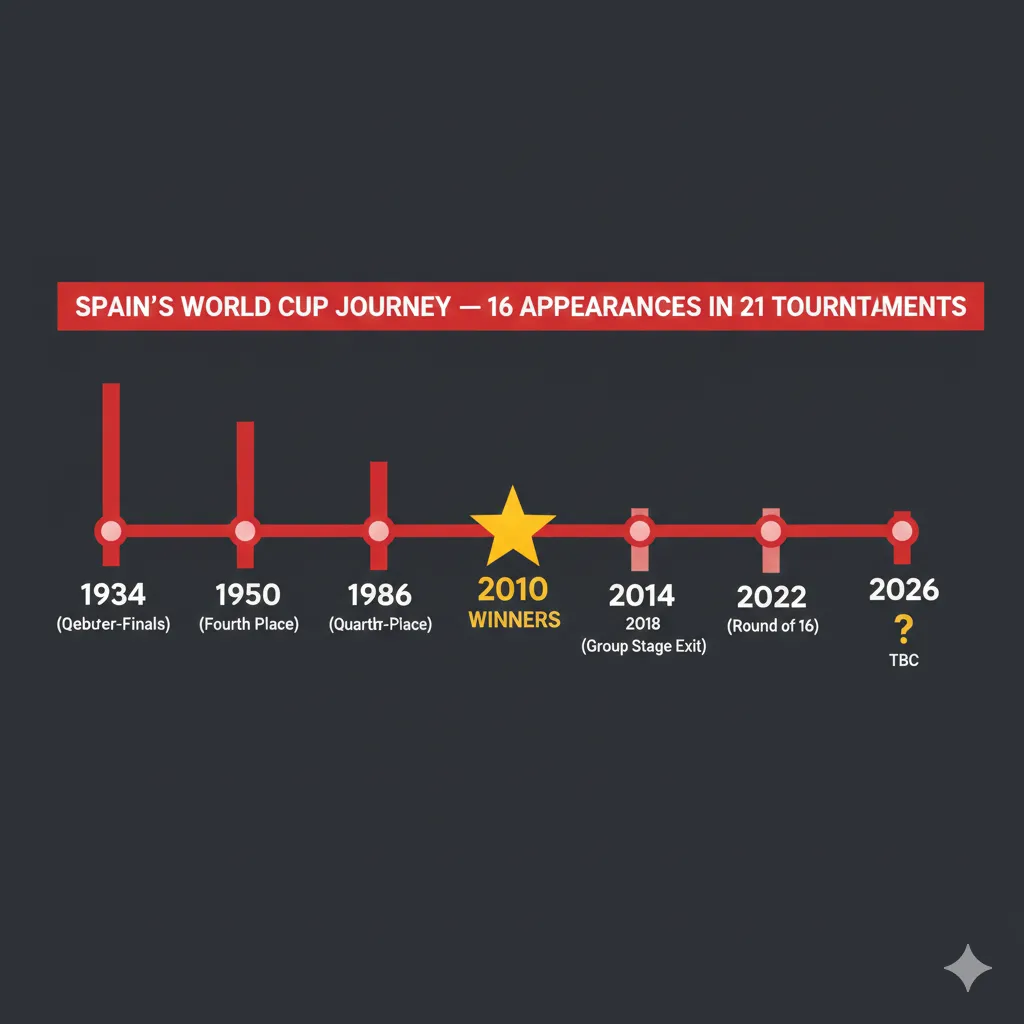
Spain have qualified for 16 of 21 World Cups.
The golden era (2008–2012): Spain’s most dominant international run in history — European Championship 2008, World Cup 2010, European Championship 2012. The 2010 World Cup win in South Africa was historic: the first European nation to win a World Cup outside of Europe, delivered by Andrés Iniesta’s extra-time goal against the Netherlands.
The World Cup curse since 2010: Despite their quality at club level and their European Championship success in 2024, Spain’s World Cup performances since 2010 have consistently underdelivered:
- 2014: Eliminated at the group stage — the defending champions knocked out in the opening round
- 2018: Eliminated in the Round of 16 — beaten by Russia on penalties
- 2022: Eliminated in the Round of 16 — beaten by Morocco on penalties
The pattern is stark: Spain have not won a World Cup knockout match since beating the Netherlands in the 2010 Final. Every tournament since has ended in the Round of 16 or earlier, with two of the three exits coming via penalty shootouts.
Part 7: Strengths, Weaknesses, and Realistic Chances
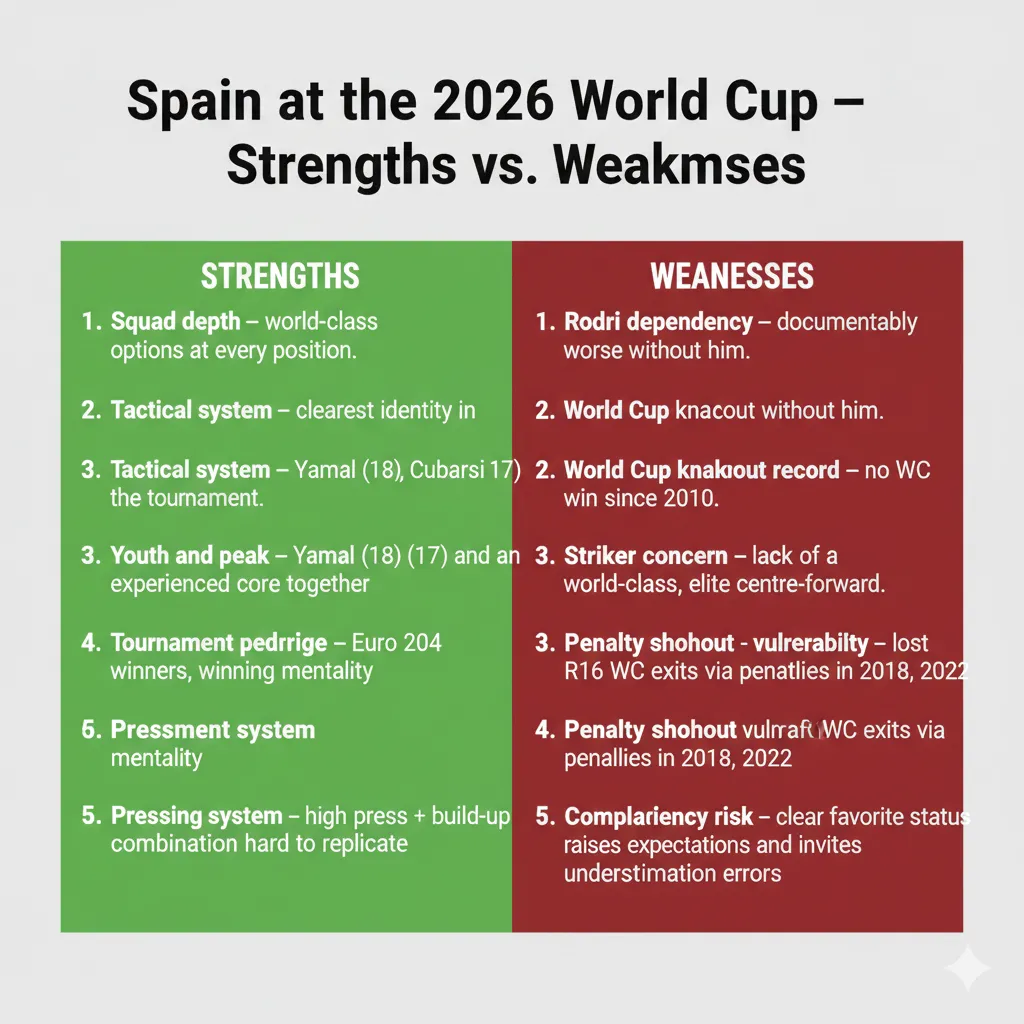
Strengths
Squad depth: Spain have world-class options at every position. If Rodri is injured, Zubimendi steps in — an elite midfielder in his own right. If Yamal is unavailable, Dani Olmo or other attacking midfielders provide quality alternatives. De la Fuente has used 26 players across qualifying and clearly trusts multiple combinations.
The clearest tactical identity in the tournament: Every player in the squad understands the system deeply. The passing patterns, the press triggers, the build-up shapes — they are second nature to players who have worked under De la Fuente at youth and senior level. Teams can prepare for Spain’s system; stopping it is much harder.
Yamal at 18 going on 19: Having a player of this quality at this age — hungry, fearless, in perfect physical condition, and already with major tournament experience — is a structural advantage. He will only get better as the tournament progresses.
Weaknesses
The Rodri dependency is real: The evidence exists in actual results. Spain with Rodri are World Cup favourites. Spain without Rodri are a very good team with a structural problem. Managing his fitness through eight matches across 39 days is De la Fuente’s most important practical challenge.
No World Cup knockout wins since 2010: Two penalty shootout exits (2018, 2022) and one group stage elimination (2014) in three World Cups. The system that wins European Championships has not yet translated to World Cup knockout success. Whether 2024 broke that mental barrier, or whether the World Cup knockout specifically carries a different psychological weight, is a question only 2026 can answer.
Part 8: Scenario-Based Assessment — Can Spain Win?
Clearly labeled as analysis, not a prediction or guarantee.
Most likely group stage outcome (scenario-based): Spain win Group H. De la Fuente’s “win, win, win” mandate reflects both genuine belief and tactical necessity — first place keeps them away from the most dangerous possible Round of 32 opponent (Argentina).
The realistic ceiling: Most independent analysts identify Spain as the joint-favorite alongside France to win the 2026 World Cup. Football España stated directly in November 2025: “Spain will head into the 2026 World Cup as the favorites to lift the trophy.” The caveat: the World Cup has a specific history of eliminating Spain before they should go out.
Watch Guide & Broadcast Info
Where to Watch: In Spain, matches will be broadcast on RTVE. In the United States, English language coverage is provided by FOX Sports, with Spanish language coverage on Telemundo.
Common Myths — Corrected
“Spain will just pass the ball endlessly and bore opponents to death.”
The tiki-taka era is not this Spain team. De la Fuente’s system adds directness, pressing intensity, and attacking incision to Spain’s possession foundation. Yamal and Williams are both willing and capable of taking on defenders; the midfielders arrive into goal-scoring positions. This is not a passive system.
“Spain are too young and inexperienced to win a World Cup.”
Yamal is 18 going on 19 — but Cubarsi, Williams, and several other young players have already won the European Championship. Tournament experience is not missing; it was built in 2024. The blend of youth and senior experience in the squad is deliberate and proven.
FAQs: Spain at the 2026 World Cup
What group is Spain in at the 2026 World Cup?
Group H — Spain, Uruguay, Saudi Arabia, and Cabo Verde.
Who is Spain’s manager at the 2026 World Cup?
Luis de la Fuente — in charge since 2022. He guided Spain to the Euro 2024 title, making him “the first Spain manager since Vicente del Bosque to win a major tournament.”
Who is Spain’s best player at the 2026 World Cup?
Lamine Yamal — right winger, Barcelona, turns 19 exactly 48 hours before the Final — is Spain’s most exciting and influential player. Rodri — Manchester City defensive midfielder and 2024 Ballon d’Or winner — is their most structurally important player.
When does Spain play at the 2026 World Cup?
Group H dates: Spain vs Cabo Verde (June 15), Spain vs Saudi Arabia (June 21), Spain vs Uruguay (June 26). Knockout dates depend on results.