
The 2026 FIFA World Cup draw is done. Twelve groups, 48 nations, and one question every football fan immediately asked: who got the hardest draw?
This guide covers every group from A to L — the teams, the key match, the storyline to follow, and a clearly labeled scenario-based prediction. Whether you are following one team or want to understand the full picture, this is your reference for the entire group stage.
Important note on six missing teams: As of February 2026, six spots remain unfilled — four from UEFA playoffs and two from inter-confederation playoffs, both decided in March 2026. Where a group contains a TBC spot, the playoff candidates are listed clearly.
TL;DR
- 12 groups of 4 teams, draw held December 5, 2025 in Washington D.C.
- Hardest group by consensus: Group I (France, Norway, Senegal + playoff winner) — most analysts’ pick for Group of Death
- Closest contest for second: Group J (Argentina, Algeria, Austria, Jordan)
- Most anticipated match: France vs Norway (Mbappé vs Haaland, Group I)
- Best storyline: England vs Croatia (Group L, June 17) — 2018 World Cup semifinal rematch
- Biggest home advantage: Mexico (Estadio Azteca, altitude 2,240m, Groups A matches)
- Four debut nations: Curaçao (E), Jordan (J), Uzbekistan (K), Cabo Verde (H)
- Six groups have a TBC playoff team (A, B, D, F, I, K) — updated March 2026
SNIPPET BLOCK
The 2026 FIFA World Cup group stage features 12 groups of four teams, determined by the draw on December 5, 2025, at the Kennedy Center in Washington D.C. The 48 qualified nations are split into Groups A through L. The top two teams in each group advance automatically, and the eight best third-placed teams also progress to the new Round of 32. As of February 2026, six spots are still to be confirmed via playoffs in March 2026.
How to Read This Guide
For every group you will find:
- The teams — confirmed plus any TBC playoff spots
- The key match — the fixture that is most likely to decide the group
- The storyline — what makes this group worth following
- Difficulty rating — Hard / Balanced / Open (based on cross-referencing analyst consensus from ESPN, NBC Sports, and RotoWire)
- Scenario prediction — clearly labeled as analysis, not fact; scenario-based only
Group A: Mexico, South Korea, South Africa, TBC (UEFA Playoff D)
| Team | Status |
| Mexico | Confirmed (host) |
| South Korea | Confirmed |
| South Africa | Confirmed |
| UEFA Playoff D winner | TBC — March 2026 (Denmark, Czech Republic, Republic of Ireland, or North Macedonia) |
Difficulty rating: Balanced
Host city: Mexico City (Estadio Azteca/Banorte) + Guadalajara (Estadio Akron)
The key match: Mexico vs South Korea — scheduled June 18, Guadalajara. These two teams both expect to advance; the match between them almost certainly decides who finishes first and who finishes second — with potentially very different knockout bracket paths resulting.
The storyline: Mexico opens the entire 2026 World Cup against South Africa on June 11 at Estadio Azteca — the most symbolic possible start. Two of Mexico’s three group games are in Mexico City at altitude (~2,240 metres above sea level). This is a historically significant home advantage: opposition teams not acclimatised to altitude typically see performance drop in the first 60–70 minutes, particularly in physical intensity. Mexico’s failure to advance beyond the round of 16 at the last eight consecutive World Cups is known domestically as “el quinto partido” (the fifth game) — reaching the fifth game (the round of 16) but never the sixth. On home soil, the pressure to break that sequence is immense.
South Korea bring the quality of Son Heung-min and a squad built on European football experience across the top five leagues. South Africa — in the opening match — are not here to make up the numbers; they reached the 2022 World Cup round of 16 and operate with collective defensive discipline and dangerous transition play. The UEFA Playoff D winner (most likely Denmark or Czech Republic if form holds) adds a European wildcard.
Scenario prediction (analysis — not a guarantee): Mexico and the UEFA Playoff D winner most likely advance. South Korea are strong enough to push both and could finish as one of the best third-placed teams. South Africa face the steepest challenge.
Group B: Canada, Switzerland, Qatar, TBC (UEFA Playoff A)
| Team | Status |
| Canada | Confirmed (host) |
| Switzerland | Confirmed |
| Qatar | Confirmed |
| UEFA Playoff A winner | TBC — March 2026 (Bosnia and Herzegovina, Italy, Northern Ireland, or Wales) |
Difficulty rating: Balanced
Host city: Toronto (BMO Field) — Canada’s group games
The key match: Canada vs UEFA Playoff A winner. If Italy qualify through the playoff — widely considered the most likely outcome given Italy’s ranking and reputation — this becomes a generational match for Canadian football: the host nation facing one of football’s most celebrated nations at the World Cup for the first time.
The storyline: Canada’s 2022 World Cup was their first since 1986 — and they lost all three group games, though they played with quality and promise. Their 2026 appearance comes as co-hosts, with BMO Field in Toronto sold out and an enormous multi-cultural fanbase driving the atmosphere. The question is whether the 2022 experience has matured the squad into genuine knockout contenders.
Switzerland quietly keep qualifying for World Cups and consistently reach the knockout stage. They have not been eliminated in the group stage since 2010. Their style is physically demanding, tactically disciplined, and very difficult to break down — making them the group’s most dangerous “overlooked” team. Qatar returns four years after hosting, having earned their place this time through AFC qualifying — a notable development for Gulf football.
The UEFA Playoff A winner is the group’s most significant unknown: if Italy qualify, the group becomes considerably harder. If a smaller nation (Northern Ireland, Wales) wins through, the group opens considerably. This single result shapes the entire narrative.
Scenario prediction (analysis): Switzerland and Canada the likeliest qualifiers as top two. The playoff winner’s identity changes the balance significantly. Qatar faces a tough path but are no longer tournament novices.
Group C: Brazil, Morocco, Scotland, Haiti
| Team | Status |
| Brazil | Confirmed |
| Morocco | Confirmed |
| Scotland | Confirmed |
| Haiti | Confirmed |
Difficulty rating: Hard (top two)
The key match: Brazil vs Morocco. Two of global football’s most compelling and watchable teams — technically gifted Brazil against the African nation that rewrote what was possible for the continent in 2022. This is the group’s defining fixture.
The storyline: Brazil have not won a World Cup since 2002. That is not a small footnote — it is the central narrative of Brazilian football for 24 years. Every World Cup brings the weight of that history. They arrive at 2026 with genuine quality: a mix of established stars and a new generation of attackers playing across Europe’s elite clubs. But their 2022 campaign ended in a penalty shootout loss to Croatia in the quarterfinals, and questions about their tactical structure have persisted.
Morocco return as the team that genuinely shocked the world in 2022 — the first African nation to reach a World Cup semifinal. [28] Their tactical approach under Walid Regragui is well-understood now: a compact defensive structure, intelligent transitions, collective pressing, and the ability to neutralise far more individually talented opponents. They are not an underdog anymore. They are a known quantity — and a very dangerous one.
Scotland end a 28-year World Cup absence. Their last appearance was France 1998. Getting here was a genuine achievement and will generate enormous support. Realistically, their goal is to compete and show their development — perhaps even claim a point against Brazil or Morocco. Haiti is also making a notable appearance, representing Caribbean football at the sport’s biggest stage.
Scenario prediction (analysis): Brazil and Morocco most likely advance as top two. Scotland and Haiti will compete fiercely for any points available. This group produces at least one result that surprises — the only question is how surprising.
Group D: USA, Paraguay, Australia, TBC (UEFA Playoff C)
| Team | Status |
| USA | Confirmed (host) |
| Paraguay | Confirmed |
| Australia | Confirmed |
| UEFA Playoff C winner | TBC — March 2026 |
Difficulty rating: Balanced
Host city: Los Angeles/Inglewood (SoFi Stadium) — USA opens here vs Paraguay
The key match: USA vs Paraguay, June 11 at SoFi Stadium. The United States play their first World Cup match on home soil in 32 years. A win in front of a capacity crowd in Los Angeles sets the tone for the entire US campaign.
The storyline: The 2026 World Cup is the USA’s big moment — co-hosts, 11 venues, 78 matches, and an opportunity to genuinely change the nation’s relationship with football. The USMNT squad in 2026 is likely the most talented in US history — a generation of players formed through European academies and developed in the world’s elite leagues.
Paraguay are a CONMEBOL qualifier who should not be underestimated. South American football at this level means hard-fought, physical, tactically organized matches — Paraguay will not play to lose. Australia are a consistent Asian qualifier with European-based players and a work-rate that makes them difficult to break down. The UEFA Playoff C winner adds another element of uncertainty.
Scenario prediction (analysis): USA expected to advance, potentially as group winners. The second spot is competitive between Australia and the playoff winner. Paraguay has the quality to complicate both.
Group E: Germany, Ecuador, Côte d’Ivoire, Curaçao
| Team | Status |
| Germany | Confirmed |
| Ecuador | Confirmed |
| Côte d’Ivoire | Confirmed |
| Curaçao | Confirmed (debut) |
Difficulty rating: Balanced
The key match: Germany vs Ecuador. Two technically ambitious teams with contrasting styles — Germany’s high press and structured build-up against Ecuador’s athletic, European-experienced midfield. This likely decides first and second place.
The storyline: Germany are chasing redemption. They went out in the group stage at both the 2018 and 2022 World Cups — two of the biggest upsets in modern tournament history for a nation that won the tournament as recently as 2014. Under Julian Nagelsmann, they have rebuilt with a clear playing identity: possession, pressing, and young talent. Jamal Musiala and Florian Wirtz are the creative nucleus of this side. Whether Musiala returns to full fitness after a 2025 injury is the team’s key question mark.
Ecuador punched well above their weight in CONMEBOL qualifying — finishing ahead of Brazil in the table at one stage — despite playing under a 3-point deduction. Moisés Caicedo (Chelsea), Piero Hincapié (Arsenal), and Willian Pacho (PSG) represent a generation of Ecuadorian players thriving in Europe’s elite competitions.
Côte d’Ivoire are one of West Africa’s most technically gifted nations — the 2023 AFCON champions — and should not be dismissed as makeweights. Curaçao make their historic debut here. Facing Germany, Ecuador, and Côte d’Ivoire in their first-ever World Cup is an extraordinary challenge, but reaching this stage at all is their achievement.
Scenario prediction (analysis): Germany and Ecuador most widely projected to advance. Côte d’Ivoire are capable of points. Curaçao’s debut will be celebrated whatever the results.
Group F: Netherlands, Japan, Tunisia, TBC (UEFA Playoff B)
| Team | Status |
| Netherlands | Confirmed |
| Japan | Confirmed |
| Tunisia | Confirmed |
| UEFA Playoff B winner | TBC — March 2026 (Ukraine, Poland, Sweden, or Albania) |
Difficulty rating: Hard
The key match: Netherlands vs Japan. Two of the most tactically interesting teams in the tournament — the Netherlands with their history of total football and modern structural identity questions; Japan with the most precisely coordinated pressing system of any Asian team.
The storyline: The Netherlands reached the 2022 World Cup quarterfinals and are built on a combination of experience (Virgil van Dijk in defence) and emerging talent. Their tactical identity has oscillated between possession-based and counter-attacking depending on the game — which RotoWire notes creates “unresolved identity” that makes them harder to predict than their squad quality alone suggests.
Japan are one of the tournament’s genuine dark-horse contenders. Their qualifying campaign was efficient, their press intensity is among the highest in the tournament, and their squad — built largely from players in the Bundesliga and other European leagues — is their most experienced and technically developed ever. They famously beat Germany and Spain in the group stage of the 2022 World Cup, becoming the first Asian team to beat two former world champions in a single World Cup.
Tunisia play with disciplined defensive organization. The UEFA Playoff B winner — most likely Ukraine or Poland given recent form — adds further depth to an already competitive group.
Scenario prediction (analysis): Netherlands and Japan the likeliest qualifiers. The playoff winner and Tunisia both capable of complicating that picture. Japan’s press will trouble every team in this group.
Group G: Belgium, Egypt, Iran, New Zealand
| Team | Status |
| Belgium | Confirmed |
| Egypt | Confirmed |
| Iran | Confirmed |
| New Zealand | Confirmed |
Difficulty rating: Balanced — Open
The key match: Belgium vs Iran. Both teams will consider themselves strong enough to qualify. Their direct meeting likely decides second place behind Belgium.
The storyline: Belgium’s famous “golden generation” — built around players like Kevin De Bruyne, Romelu Lukaku, Axel Witsel, and Jan Vertonghen — has been slowly transitioning for several years. Whether those players (many now in their early-to-mid 30s) are still at their peak by July 2026, or whether a newer generation has fully taken over, is Belgium’s central question. They have consistently underperformed at major tournaments relative to their squad quality — reaching the 2018 World Cup third place being their high point.
Egypt represent one of Africa’s most resilient qualifying sides. Iran brings collective tactical organization and a defensive structure that makes them very difficult to break down. New Zealand make history as OFC’s first ever guaranteed World Cup representative — a milestone for Oceania football. Their goal is to compete and demonstrate that the Pacific can participate meaningfully in the world’s biggest tournament.
Scenario prediction (analysis): Belgium widely expected to top the group. Second place between Iran and Egypt is genuinely open. New Zealand will work hard to take points from anyone.
Group H: Spain, Uruguay, Saudi Arabia, Cabo Verde
| Team | Status |
| Spain | Confirmed |
| Uruguay | Confirmed |
| Saudi Arabia | Confirmed |
| Cabo Verde | Confirmed (debut) |
Difficulty rating: Hard (top two)
The key match: Spain vs Uruguay. The world’s number one ranked team against one of South America’s most physical, combative, and experienced sides. This group’s defining fixture will set the tone for both nations’ knockout paths.
The storyline: Spain arrive at the 2026 World Cup as European champions, FIFA world number one, and one of the pre-tournament favourites. Their 4-3-3 possession system — built on passing triangles, high press, and quick transitions — is the defining style of modern elite football. The question for Spain is not whether they are good enough, but whether they can maintain focus through a group stage that contains both a dangerous South American opponent and a nation with a history of upsets.
Saudi Arabia famously beat Argentina 2–1 at the 2022 World Cup — one of the most stunning upsets in the tournament’s history. They arrive with the memory of that moment as both inspiration and evidence that group stage results at this level are never certain.
Cabo Verde make their debut in what is, on paper, the toughest possible introduction to World Cup football — facing the world’s number-one team in their opening match. Their qualification story (seven wins from ten CAF matches) shows this is a team with genuine character. The result of the Spain match matters less than the experience of being there.
Scenario prediction (analysis): Spain and Uruguay the clear favourites to advance. Saudi Arabia dangerous as proven upset makers. Cabo Verde will bring an atmosphere and a moment to remember.
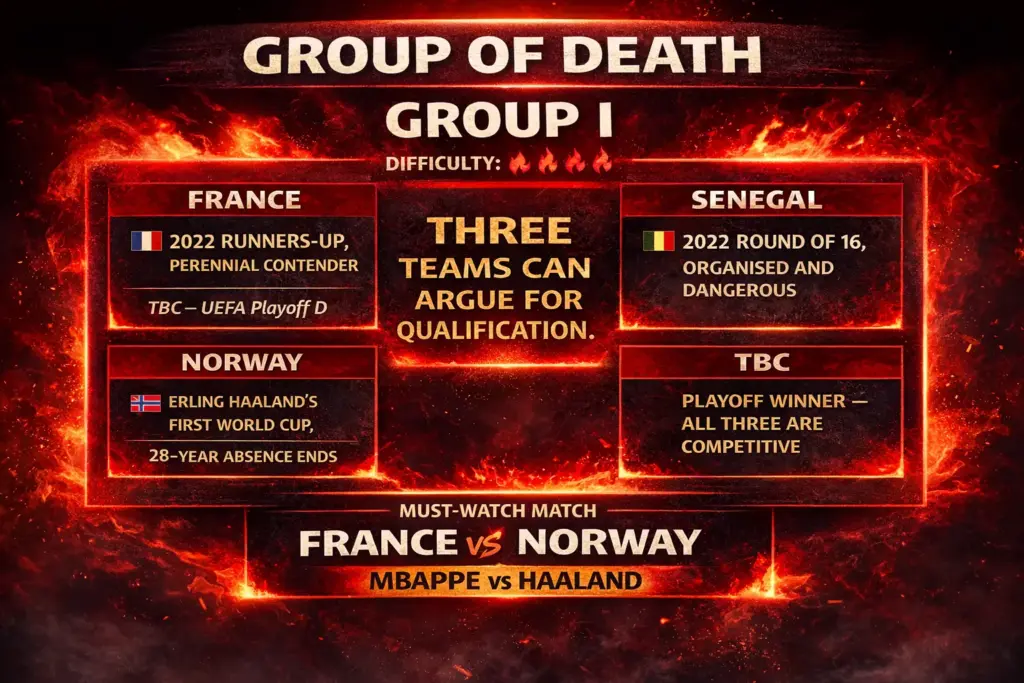
Group I: France, Senegal, Norway, TBC (Inter-confederation Playoff 2)
| Team | Status |
| France | Confirmed |
| Senegal | Confirmed |
| Norway | Confirmed |
| Inter-conf. Playoff 2 winner | TBC — March 2026 (Iraq, Bolivia, or Suriname) |
⚠️ DIFFICULTY RATING: HARD — The consensus Group of Death
The key match: France vs Norway — Kylian Mbappé against Erling Haaland. Probably the most anticipated individual match-up of the entire 2026 group stage. Two of the best players on the planet, in their primes, at the World Cup for the first time playing each other.
The Group of Death verdict: Multiple independent analysts — ESPN, NBC Sports, RotoWire — identify Group I as the hardest group in the 2026 World Cup. The reasoning: France are 2022 runners-up and perpetual contenders. Norway brings Erling Haaland to his first ever World Cup after a 28-year absence from the tournament. Senegal are 2022 round-of-16 finishers with a physically and tactically mature squad. The inter-confederation playoff winner adds a fourth team capable of taking points from any of the three above. In a group of four, three teams have legitimate arguments for advancing — meaning one elite or near-elite nation goes home in the group stage.
The storyline: Norway’s qualification ended a 28-year World Cup absence and gave Erling Haaland — the leading scorer in the Premier League and arguably the best striker in the world — his first opportunity to play at football’s biggest stage. The French will fancy themselves to win the group, but with Haaland in the form he has been in, a goal against France is entirely credible. Senegal is disciplined, physical, and dangerous — their Sadio Mané era gave way to a new generation of players with European experience.
Scenario prediction (analysis): France most widely projected to advance. The second spot between Norway and Senegal is one of the tournament’s most genuinely uncertain group-stage questions. The inter-confederation playoff winner faces an extremely tough challenge in all three matches.
Group J: Argentina, Algeria, Austria, Jordan
| Team | Status |
| Argentina | Confirmed |
| Algeria | Confirmed |
| Austria | Confirmed |
| Jordan | Confirmed (debut) |
Difficulty rating: Hard (top two)
The key match: Argentina vs Algeria. Defending world champions against one of Africa’s strongest qualifiers. This is the most anticipated opening match in the group and likely the most talked-about fixture in the Central/Eastern draw zone among neutral fans.
The storyline: Argentina open their title defense in Group J — and their first match, against Algeria, sets the tone immediately. Lionel Messi returns to the World Cup as defending champion, which changes the emotional dynamic entirely compared to his years of near misses. How Argentina’s squad has evolved since Qatar 2022, and how much Messi’s role has shifted given the natural march of time, is the group’s central question.
Austria return to the World Cup for the first time since France 1998 — a 28-year absence — after topping their UEFA qualifying group. This is a different Austria to the one that last appeared: built on Bundesliga professionals, physically demanding, tactically organized under Ralf Rangnick’s pressing-based system.
Algeria are not here to make up the numbers. Their North African football culture is rich and deeply passionate, and their qualifying performance earned this place. Jordan make their World Cup debut against the defending champions — a fixture that underlines just how far the 2026 format has stretched opportunity to nations who would never have qualified under the 32-team structure.
Scenario prediction (analysis): Argentina and Austria most widely projected to advance. Algeria have the quality to complicate both. Jordan’s debut will produce at least one memorable moment.
Group K: Portugal, Colombia, Uzbekistan, TBC (Inter-confederation Playoff 1)
| Team | Status |
| Portugal | Confirmed |
| Colombia | Confirmed |
| Uzbekistan | Confirmed (debut) |
| Inter-conf. Playoff 1 winner | TBC — March 2026 (DR Congo, Jamaica, or New Caledonia) |
Difficulty rating: Balanced
The key match: Portugal vs Colombia. Two technically capable, entertaining teams with the potential to produce the group’s best football. The result almost certainly determines who finishes first.
The storyline: Cristiano Ronaldo is approximately 41 years old when the 2026 tournament begins. His participation — and the scale of his role if he plays — is one of the tournament’s most widely discussed personal storylines. Portugal’s squad is deep and talented beyond Ronaldo: Bruno Fernandes, Rafael Leão, Bernardo Silva, Rúben Dias. Whether this is Ronaldo’s final World Cup appearance (almost certainly yes) adds an unavoidable emotional layer to every Portugal match.
Colombia’s qualifying campaign was one of CONMEBOL’s more impressive — they have a generation of technically gifted players performing at the highest European club level. Uzbekistan makes their debut against one of football’s most famous nations — their Group K opening against Portugal will be one of the tournament’s most vivid examples of the 48-team expansion creating extraordinary new storylines.
Scenario prediction (analysis): Portugal and Colombia most likely to advance. The inter-confederation playoff winner could take points from any team on a given day. Uzbekistan’s debut will be celebrated regardless of results.
Group L: England, Croatia, Ghana, Panama
| Team | Status |
| England | Confirmed |
| Croatia | Confirmed |
| Ghana | Confirmed |
| Panama | Confirmed |
Difficulty rating: Balanced
The key match: England vs Croatia, June 17. One of the 2026 World Cup’s most loaded fixtures — a direct rematch of the 2018 World Cup semifinal, when Croatia beat England 2–1 in extra time. England and Croatia have met three times since; England won 1–0 at Euro 2020. The World Cup stage, however, carries its own weight.
The storyline: Eight years is a long time, but the 2018 semifinal loss has not been forgotten in English football. That match — in Moscow — is where Harry Kane’s golden boot tournament ended and where England’s latest generation of talent fell short. The 2026 version features a Thomas Tuchel-managed England, likely with the same core stars (Kane, Jude Bellingham, Bukayo Saka) now several years more experienced and motivated.
Croatia’s situation is fascinating. Luka Modrić, the 2018 tournament’s best player, will be approximately 40 years old at the 2026 World Cup — and still playing at the highest level. This could genuinely be his final competitive match at this stage. Croatia have consistently overperformed relative to their population size; dismissing them on the basis of age is a mistake their opponents have made before and regretted.
Ghana and Panama provide quality without the tier-one names — both are capable of the kind of point-gathering that can push group qualification in unexpected directions.
Scenario prediction (analysis): England and Croatia most widely projected as qualifiers. Ghana capable of points against either. Panama disciplined and difficult. The group contains one of the tournament’s most emotionally charged opening fixtures.
The Host Nations — How Their Groups Compare
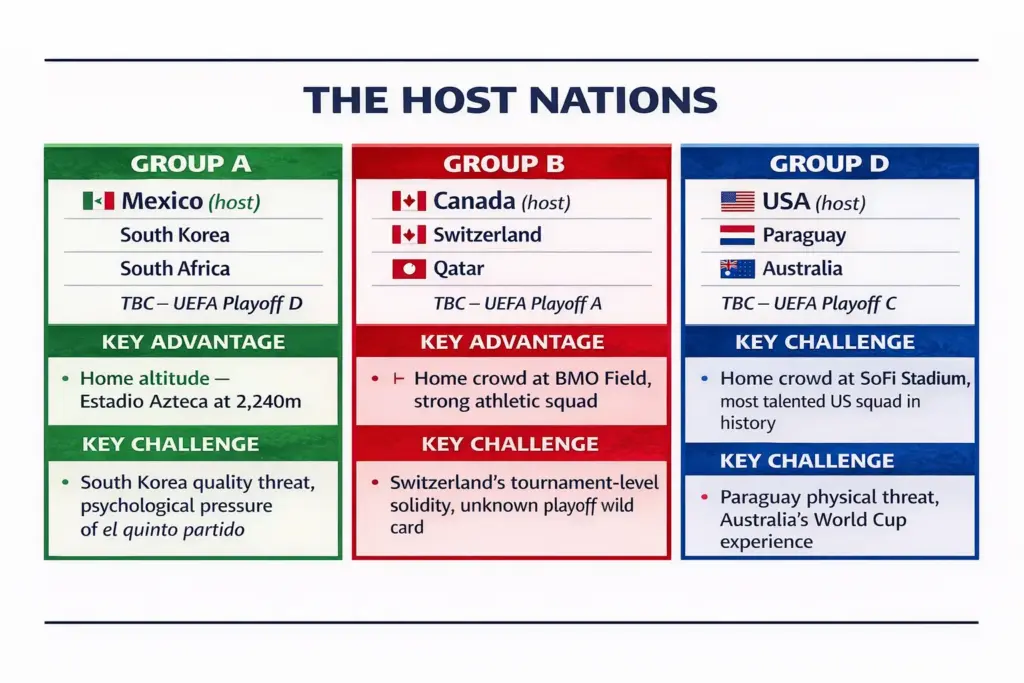
All three host nations have drawn groups that are navigable — none face the extreme difficulty of Group I or J. But none have a certainty either.
Mexico (Group A) benefit most from home conditions. Altitude at Estadio Azteca is a genuine physical factor; opponents not prepared for it fade in the second half of matches. South Korea, however, are quality opposition, and the psychological weight of “el quinto partido” — Mexico’s 8-tournament streak of exiting at the round of 16 — follows them everywhere.
Canada (Group B) face the unknown of the UEFA Playoff A winner as their critical fixture. If Italy qualify, the group is significantly harder. Switzerland are quality opponents. Qatar are not the weakest team in any group anymore.
USA (Group D) have the most manageable draw of the three hosts on paper. Paraguay and Australia are competitive but not elite-tier opponents. The playoff C winner completes the picture. With the home crowd at SoFi Stadium in Inglewood, and then potentially further venues in their home country as they progress, the USA have structural advantages that go beyond the 90 minutes.
The Group of Death: Groups I and J
By every analytical measure, Group I — France, Norway, Senegal, and the inter-confederation playoff winner — is the tournament’s toughest group. The reasoning is simple: three teams (France, Norway, Senegal) are each capable of qualifying; one will not.
Group J — Argentina, Algeria, Austria, Jordan — is the second-most discussed “death group” candidate. A defending world champion, a strong African qualifier, a returning European nation with a high-press system, and a debut nation make it one of the most diverse and contested groups of the tournament.
The verdict: Group I takes the official “Group of Death” designation for 2026. Group J is the most dramatically loaded. Group H (Spain, Uruguay) is the strongest top-two. Group F (Netherlands, Japan, Tunisia, playoff winner) is the most tactically interesting.
Which Groups Should Casual Fans Prioritise?
A decision framework — based purely on entertainment value, narrative stakes, and tactical interest:
If you want the most dramatic football: Watch Group I (France vs Norway) and Group J (Argentina vs Algeria). The stakes are highest, the talent densest, and the potential for surprises greatest.
If you want the best single match: Watch France vs Norway for Mbappé vs Haaland, or England vs Croatia for the 2018 semifinal rematch narrative.
If you want to watch the hosts: All three host nations play memorable opening matches. Mexico vs South Africa (June 11, Estadio Azteca) opens the tournament. USA vs Paraguay (SoFi Stadium) is the American football moment 32 years in the making. Canada vs UEFA Playoff A winner at BMO Field, Toronto (June 12) is one of football’s most anticipated beginnings for a nation still building its identity.
If you want the best tactical football: Watch Japan in Group F — their pressing system is the most precisely executed of any team in the tournament. Or watch Spain in Group H for the purest expression of modern possession-based football.
If you want to follow a debut nation: Curaçao (Group E, vs Germany) offers the most extraordinary contrast — the smallest nation ever to qualify against a former four-time world champion. Jordan (Group J, vs Argentina) are another debut nation against another extraordinary opponent.
Common Myths — Corrected
“The Group of Death always produces the most memorable matches.”
Not necessarily. Some of the most dramatic group stage matches happen in “balanced” or “open” groups where the qualifying spots are genuinely contested between four evenly matched teams. Group A (with Mexico’s home advantage and South Korea’s quality) could produce more surprises than the analyst consensus suggests.
“Host nations always have the easiest draw.”
Not always true — host nations are placed in Pot 1 and cannot face each other in the group stage, which provides some protection. But the draw is otherwise random. Canada’s group could include Italy (if the UEFA playoff goes that way), which is not an easy group by any measure.
“Third place always means going home.”
Not at the 2026 World Cup. The eight best third-placed teams from the 12 groups advance to the Round of 32. A team that finishes third in a hard group — collecting 4–5 points — has a genuine chance of advancing, especially if other groups produce low-scoring, difficult football.
“You can predict the group stage accurately.”
The 2022 World Cup group stage included Saudi Arabia 2–1 Argentina, Japan beating Germany and Spain, and Morocco eliminating Belgium. The 2018 group stage included Germany going out in the group stage as defending champions. Predictions are useful for context — they are not reliable as outcomes.
FAQs: 2026 World Cup Groups
What are the 2026 World Cup groups?
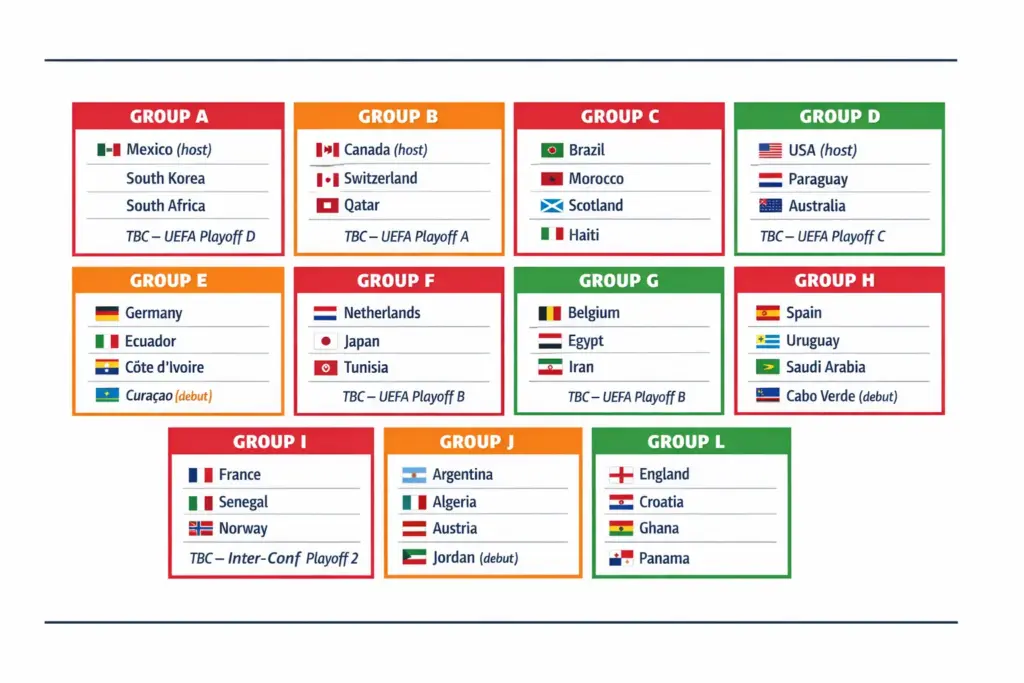
Groups A through L, each containing four teams. Group A: Mexico, South Korea, South Africa, TBC (UEFA Playoff D). Group B: Canada, Switzerland, Qatar, TBC (UEFA Playoff A). Group C: Brazil, Morocco, Scotland, Haiti. Group D: USA, Paraguay, Australia, TBC (UEFA Playoff C). Group E: Germany, Ecuador, Côte d’Ivoire, Curaçao. Group F: Netherlands, Japan, Tunisia, TBC (UEFA Playoff B). Group G: Belgium, Egypt, Iran, New Zealand. Group H: Spain, Uruguay, Saudi Arabia, Cabo Verde. Group I: France, Senegal, Norway, TBC (Inter-confederation Playoff 2). Group J: Argentina, Algeria, Austria, Jordan. Group K: Portugal, Colombia, Uzbekistan, TBC (Inter-confederation Playoff 1). Group L: England, Croatia, Ghana, Panama.
Which is the hardest group at the 2026 World Cup?
By analyst consensus from ESPN, NBC Sports, and RotoWire, Group I — France, Norway, Senegal, and the inter-confederation playoff winner — is the hardest group. Three teams with strong claims to qualify means one genuine contender exits in the group stage.
Will Mbappé and Haaland play against each other in the 2026 World Cup group stage?
Yes — France and Norway are both in Group I, so Kylian Mbappé and Erling Haaland will face each other during the group stage.
When is England vs Croatia at the 2026 World Cup?
June 17, 2026. Both nations are in Group L alongside Ghana and Panama.
What group is Argentina in?
Group J, alongside Algeria, Austria, and Jordan (debut).
What group is Spain in?
Group H, alongside Uruguay, Saudi Arabia, and Cabo Verde (debut).
What group is Brazil in?
Group C, alongside Morocco, Scotland, and Haiti.
Is this Erling Haaland’s first World Cup?
Yes. Norway qualified for 2026 after a 28-year absence — their last appearance was France 1998. This is Haaland’s first World Cup.
Is this Cristiano Ronaldo’s last World Cup?
Almost certainly yes, given he will be approximately 41 when the tournament begins. Portugal are in Group K alongside Colombia, Uzbekistan, and the inter-confederation playoff winner.
Are all 48 teams confirmed for the 2026 World Cup groups?
As of February 2026, no. Six spots remain: four from the UEFA playoffs (Groups A, B, D, F) and two from the inter-confederation playoffs (Groups I and K). All six will be confirmed after the March 2026 playoff matches.