

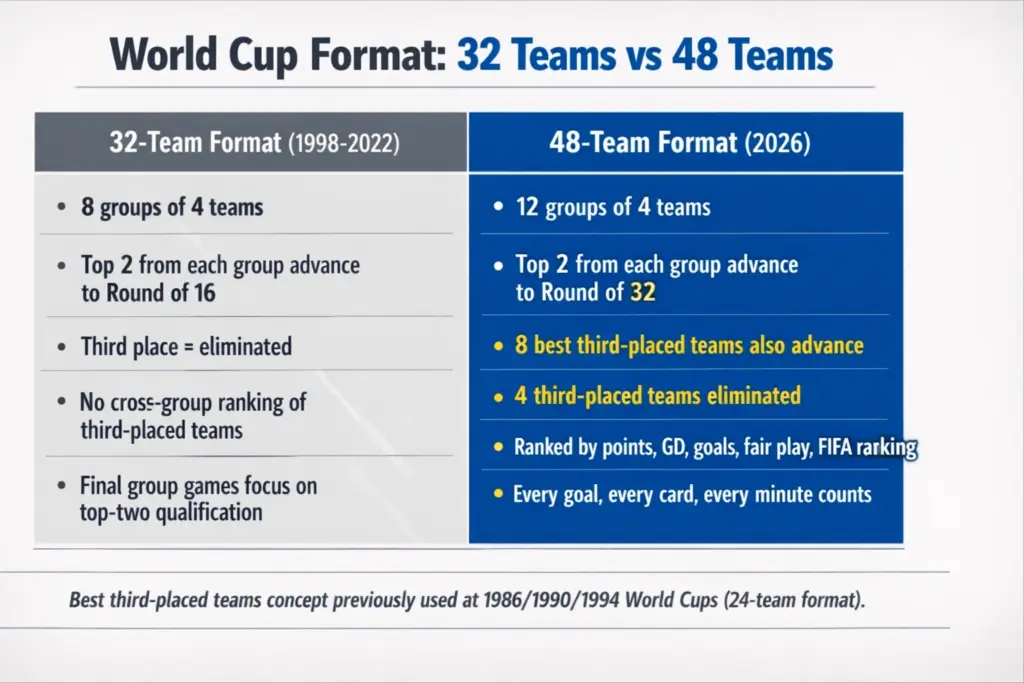
The 2026 World Cup has 12 groups. Only eight of the twelve third-placed teams go through to the knockout stage. The other four go home. This is the first men’s World Cup to send 8 of 12 third-placed teams through — a much larger version of a mechanism previously used at the 1986, 1990 and 1994 World Cups — and it remains one of the most misunderstood parts of the tournament’s expanded format. This guide explains exactly how it works, how FIFA decides which eight teams advance, what happens to their bracket position, and why the final matchday of every group will be unlike anything fans have seen before.
TL;DR
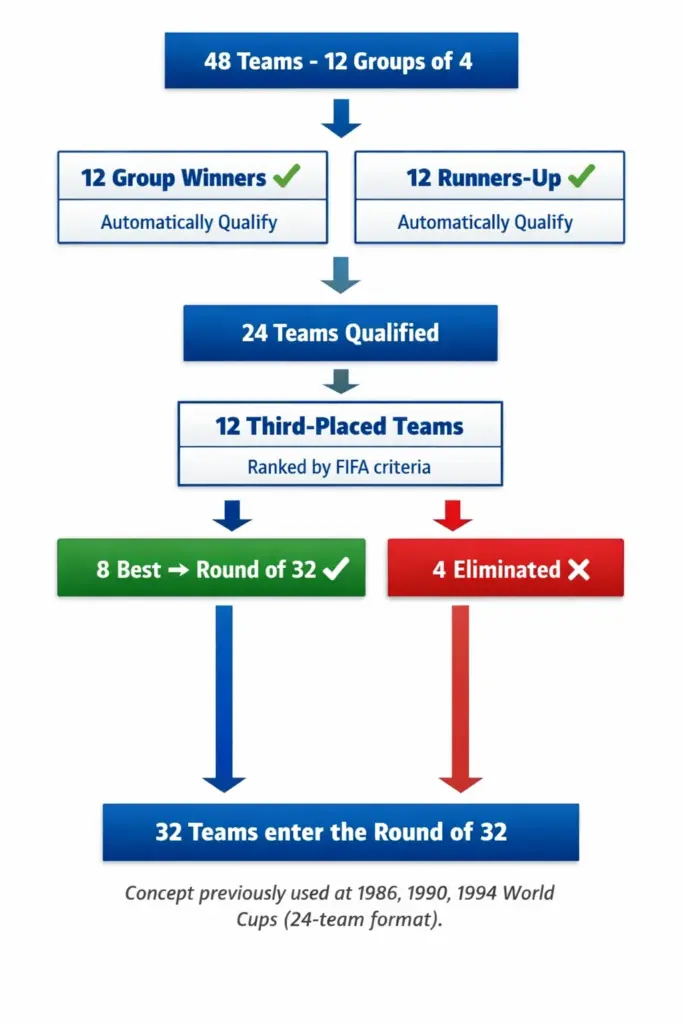
- There are 12 groups of four teams. The top two from each qualify automatically — that is 24 teams.
- To fill a 32-team knockout bracket, FIFA also takes the 8 best third-placed teams from across all 12 groups.
- The other 4 third-placed teams are eliminated — they do not qualify despite finishing in the top three.
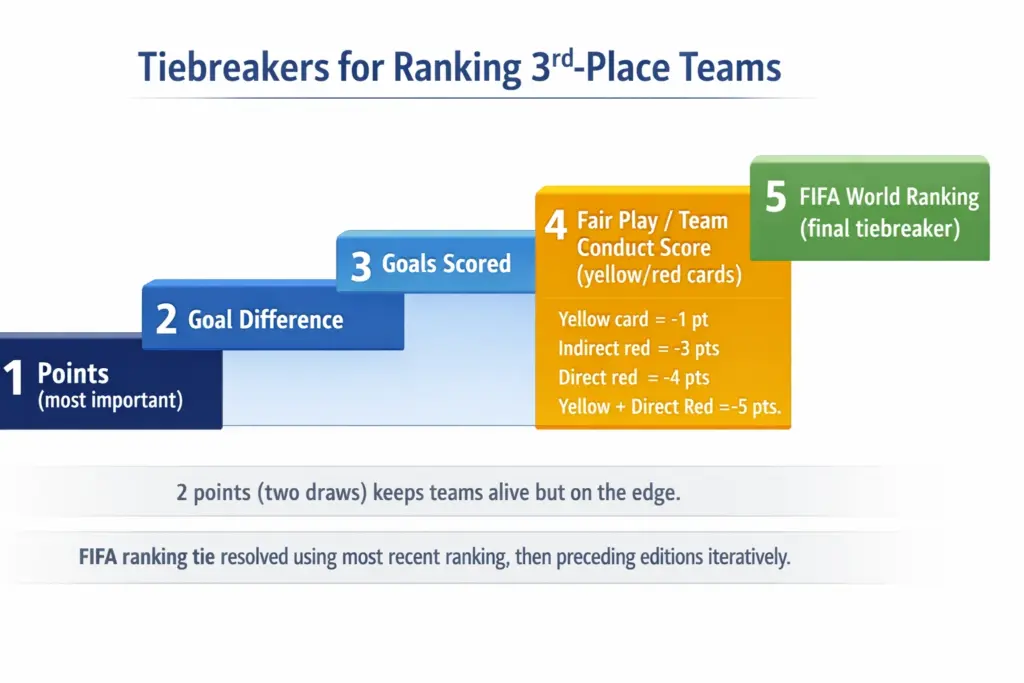
- Third-place teams are ranked by: points → goal difference → goals scored → fair play score → FIFA ranking.
- A single yellow card, a single goal, or even the FIFA ranking can be the difference between advancing and going home.
- Under FIFA’s pre-mapped Round of 32 matrix, advancing third-placed teams are assigned to group winners rather than runners-up.
- FIFA has 495 pre-mapped scenarios covering every possible combination — the bracket locks automatically once the group stage ends, with no additional draw.
SNIPPET BLOCK
At the 2026 World Cup, 8 of the 12 third-placed teams advance to the Round of 32. The 4 that miss out are eliminated. FIFA ranks all 12 third-placed teams using points, then goal difference, then goals scored, then fair play score, then FIFA ranking. The best eight go through. Advancing third-placed teams are assigned to face group winners in the Round of 32 under FIFA’s pre-mapped matrix. The bracket is determined automatically using one of 495 pre-planned scenarios based on which groups the advancing third-placed teams came from.
2026 World Cup Third-Placed Teams: Why This Rule Exists
To understand why this rule was created, you need to understand the maths of the new format.
The 2026 FIFA World Cup expanded to 48 teams, split into twelve groups of four, with the top two teams in each group and the eight best third-placed teams progressing to a new Round of 32, as approved by the FIFA Council on March 14, 2023. This is the first expansion and format change since 1998. (FIFA World Cup 2026 Competition Regulations, Article 12)
The arithmetic is straightforward. Twelve groups produce 12 winners and 12 runners-up — 24 teams in total. But the Round of 32 needs exactly 32 teams. The gap is eight. Those eight spots are filled by the best third-placed finishers from across all 12 groups.
The 2026 World Cup will add a new knockout round — the Round of 32 — which includes the top two teams from each group plus the eight best third-place teams. The number of total matches will jump from 64 to 104, extending the tournament to 39 days. (FIFA World Cup 2026 Official Schedule)
This is not an arbitrary or unprecedented idea. The concept of best third-placed teams advancing has existed in men’s World Cups before: at the 1986, 1990 and 1994 tournaments, which featured 24 teams in six groups, the four best third-placed teams advanced to the Round of 16. (FIFA World Cup History) UEFA also used a version of it at Euro 2016 and Euro 2020. The concept works. It keeps teams competing aggressively to the final whistle rather than settling for a draw that secures third place and nothing else.
The Exact Tiebreaker Order: How FIFA Ranks the 12 Third-Placed Teams
This is the part that matters most — and the part most articles get wrong or leave incomplete.
FIFA ranks all 12 third-placed teams together using a strict, sequential tiebreaker system. The criteria are applied in order. If teams are equal on one criterion, the next one is applied. The process continues until the eight advancing teams are identified.
The third-place teams in the group stage will be ranked by these criteria, in order: 1. Points. 2. Goal difference. 3. Goals scored. 4. Team conduct score. 5. FIFA world ranking. (FIFA World Cup 2026 Competition Regulations, Article 13)
Criterion 1 — Points
Points come first, always. A team that wins one group game and loses two has 3 points. A team that draws all three has 3 points. They are equal here — so the next criterion decides.
The maximum points a third-placed team can have is 6 (two wins, one loss). The minimum is 0 (three losses). In practice, most third-placed teams will have between 1 and 4 points — enough to potentially qualify among the best eight, depending on results across all 12 groups.
A team with 4 points (one win, one draw, one loss) is almost always safe. A team with 3 points (one win, two losses) is likely safe but not guaranteed. A team with 2 points (two draws, one loss) is on the edge. A team with 1 point (three draws) is unlikely to advance. A team with 0 points does not advance.
Criterion 2 — Goal Difference
If two or more third-placed teams have the same number of points, goal difference separates them. Goals scored minus goals conceded, across all three group games.
This is where the tactical calculus gets interesting. A third-placed team that loses their final group game 1-0 may finish with a better goal difference than one that loses 3-1 — even if both finish on the same points. Defending well even in defeat has concrete consequences.
Criterion 3 — Goals Scored
If points and goal difference are equal, total goals scored across all three group games is the next separator. This is the criterion that directly rewards attacking ambition. A team that scores three goals across its three games advances ahead of a team that scores one, even if both concede the same number.
This criterion alone — combined with criterion two — means teams finishing third have a strong incentive to attack and score as many goals as possible in every group game, even when a result is already secure.
Criterion 4 — Team Conduct Score (Fair Play)
Fair play points are used not only to rank the best third-placed teams, but also to decide final positions inside each group when teams are level on points. A single late yellow card could be the difference between qualifying for the Round of 32 or packing your bags early.
The fair play score is calculated from disciplinary records across all three group games, according to FIFA World Cup 2026 regulations:
- Yellow card: -1 point
- Indirect red card (second yellow): -3 points
- Direct red card: -4 points
- Yellow card followed by direct red card: -5 points. (FIFA World Cup 2026 Competition Regulations, Article 13)
A team with no cards has a fair play score of 0 — the highest possible. A team with three yellow cards across three games has a score of -3.
This means: in a scenario where two teams are level on points, goal difference and goals scored, the team with fewer bookings advances. A rash challenge in the dying minutes of a group game — a yellow card that seemed irrelevant at the time — could end a nation’s World Cup.
Criterion 5 — FIFA World Ranking
If teams are still level after all previous criteria, the FIFA world ranking is used as the next separator. According to Article 13 of FIFA’s 2026 Competition Regulations, the most recent FIFA ranking is applied first. If teams remain tied, the immediately preceding published ranking edition is used, and this process continues iteratively “until a decision can be made.” (FIFA World Cup 2026 Competition Regulations, Article 13)
This is the only criterion in the tiebreaker sequence that has nothing to do with performance at the tournament itself. A team that played brilliantly but has a low FIFA ranking could lose out to a team that played identically but is ranked higher in the global standings.
What This Means in Practice: Real Scenarios
The tiebreaker system creates genuinely dramatic situations. Here are three scenarios that illustrate how fine the margins can be.
Scenario A — The Yellow Card Decides
Two teams both finish third in their respective groups with 3 points, 0 goal difference and 2 goals scored. One team picked up three yellow cards across the group stage (fair play score -3). The other picked up one yellow card (fair play score -1). The team with one yellow card advances. The team with three goes home. A booking in a game played ten days earlier, in a match that had already been decided, ends the campaign.
Scenario B — The Late Goal Counts
A team is winning 2-0 in their final group game with five minutes left. They are already third. Their goal difference is currently +1 — putting them in ninth place among the third-placed teams. They push forward and score a third goal. Goal difference becomes +2. They jump to sixth. They qualify. The goal at 88 minutes, in a game already won, was the most important goal of the tournament.
Scenario C — The FIFA Ranking Saves You
Five teams are level on points, goal difference and goals scored. Four of them have identical fair play records. The fifth used two extra yellow cards. Four teams go through. One goes home because of those two bookings. Among the four teams with identical fair play records, FIFA ranking becomes the separator — and a team ranked 35th advances over a team ranked 42nd, despite identical performances at the tournament.
None of these scenarios are far-fetched. They are the logical consequences of the system — and they will happen in June.
The 495 Scenarios: How the Bracket Locks Automatically
This is the most technically complex part of the new format — and it is worth understanding even at a high level.
There are 12 groups (Group A to Group L). Each group produces one third-placed team. Only eight of those 12 third-placed teams qualify for the knockout stage. There are 495 possible combinations to select 8 teams out of 12. Each combination represents a unique tournament pathway that must be accounted for in advance. FIFA has created a predefined knockout mapping for every one of these combinations. The full list of scenarios is laid out in Annex C of FIFA’s official World Cup 2026 Competition Regulations. (FIFA World Cup 2026 Competition Regulations, Annex C)
In simpler terms: before the tournament begins, FIFA already knows the answer to every possible question about which third-placed teams face which opponents in the Round of 32. There will be no additional draw after the group stage. The moment the final group results are confirmed, a computer applies the relevant scenario from the 495 options and the bracket is set.
For each possible set of eight third-placed teams, FIFA has already specified which group winner they face, which match number they are assigned to, and which side of the bracket they occupy. This removes any need for additional draws or discretionary decisions after the group stage.
Why 495? The mathematics of combinations. Choosing 8 specific teams from 12 groups produces exactly 495 unique possible outcomes — a fact of combinatorics, not an arbitrary FIFA decision. Each of those 495 outcomes has a different bracket implication, and FIFA has mapped every single one.
Teams are protected from immediate rematches. No side can face another team from its own group in the Round of 32 — a safeguard built directly into FIFA’s predefined mappings rather than left to chance. (FIFA World Cup 2026 Competition Regulations, Article 12)
This matters for fans trying to predict knockout-stage matchups. Unlike at previous World Cups, the Round of 32 bracket cannot be fully predicted until all 12 groups are complete. A result in Group K on the final matchday might change which Group D third-placed team qualifies — which then changes who faces which group winner in the Round of 32. The interconnection between groups is greater than at any previous World Cup.
How Third-Placed Teams Are Paired in the Round of 32
One point that is widely misunderstood: in the Round of 32, advancing third-placed teams are assigned to face group winners under FIFA’s pre-mapped matrix — not runners-up.
Under FIFA’s pre-mapped Round of 32 matrix, advancing third-placed teams are assigned to group winners rather than runners-up. The specific pairing depends on which eight groups produce the advancing third-place teams, following a matrix of 495 possible combinations. (FIFA World Cup 2026 Competition Regulations, Annex C)
This means group winners face a harder Round of 32 draw than runners-up. A group winner guaranteed to face a third-placed team might seem advantaged — but third-placed teams that advanced with 6 points are capable of defeating group winners who scraped through with 7. The margin is not always as large as it sounds.
Runners-up, by contrast, face a mixed draw: under the pre-mapped matrix, some runners-up are paired against other runners-up, while others face group winners. (FIFA World Cup 2026 Competition Regulations, Annex C)
How This Changes How Teams Play
The 8-best rule fundamentally changes group-stage tactics in ways that previous World Cup formats rarely required.
Losing teams keep attacking. In the old 32-team format, a team that lost its first two games was almost certainly eliminated before the final group match. The motivation to play the third game was honour, not advancement. Under the new format, a team that loses its first two games but wins the third can still finish third with 3 points — and potentially qualify among the best eight. Every game matters until the last whistle of the group stage.
Goal difference becomes a strategic tool. Teams already guaranteed third place have a direct incentive to score as many goals as possible, even in games they cannot win. A team managing a 2-0 lead at 80 minutes used to see out the game. Now they might push for a third goal — knowing it could be the margin that separates them from elimination.
Yellow cards are weighed differently. A defender who might previously have committed a tactical foul to stop a dangerous counter-attack has to think twice. Not just because of suspension risks, but because the yellow card itself could be the tiebreaker that ends the campaign.
The format is geared towards encouraging teams to be ambitious and punishes those who get comfortable. The formula incentivizes attacking football, whereas discipline and tactical brains have become more important than before. With this enlarged tournament, one goal can swing the balance of power, one yellow card could prove to be the difference, and a referee’s decision might be talked about long after the game is over. (ESPN — 2026 World Cup Format Explained)
Has This Worked at Other Tournaments?
Yes — and the results have been dramatic.
The concept of best third-placed teams advancing was first used at men’s World Cups in 1986, and repeated in 1990 and 1994. At the 1986 World Cup, for example, Bulgaria and Uruguay advanced as two of the four best third-placed teams from the six groups. (FIFA World Cup Archive)
More recently, UEFA used the best-third-placed-teams format at Euro 2016 (24 teams, 6 groups, 4 best third-placed teams advanced) and again at Euro 2020. Northern Ireland, Ireland and Hungary all advanced as third-placed teams in 2016. Hungary went on to beat Austria and push Belgium to extra time before losing 4-0. Ireland beat Italy. Northern Ireland gave Wales a competitive game in the Round of 16. The third-placed teams were not passengers.
Euro 2020 repeated the format. Ukraine advanced as a third-placed team and beat Sweden in the Round of 16 before losing to England in the quarterfinals — becoming one of the tournament’s surprise package sides.
The precedent is clear: third-placed teams that qualify through this system are legitimate competitors. They are not there to make up the numbers. They have earned their place.
Frequently Asked Questions
How many third-placed teams advance at the 2026 World Cup?
Eight. From the 12 third-placed finishers across all 12 groups, the 8 best advance to the Round of 32. The other four are eliminated. (FIFA World Cup 2026 Competition Regulations, Article 12)
What are the tiebreakers for third-placed teams?
In order: points, goal difference, goals scored, team conduct score (fair play), and FIFA world ranking. (FIFA World Cup 2026 Competition Regulations, Article 13)
How is the fair play score calculated?
According to FIFA regulations: yellow card = -1 point; indirect red (second yellow) = -3 points; direct red = -4 points; yellow card followed by direct red = -5 points. (FIFA World Cup 2026 Competition Regulations, Article 13)
Do all third-placed teams play in the Round of 32?
No — only the eight best advance. The specific match-ups involving the third-placed teams depend on which eight third-placed teams qualify for the Round of 32.
Who do third-placed teams face in the Round of 32?
Under FIFA’s pre-mapped matrix, advancing third-placed teams are assigned to face group winners — not runners-up. (FIFA World Cup 2026 Competition Regulations, Annex C)
Can a third-placed team face a team from their own group in the Round of 32?
No. Teams are protected from immediate rematches — no side can face another team from its own group in the Round of 32. (FIFA World Cup 2026 Competition Regulations, Article 12)
What are the 495 scenarios?
There are 495 possible combinations of 8 teams drawn from 12 groups. FIFA has pre-mapped every single one of these combinations in Annex C of the official competition regulations — meaning the bracket locks automatically once the group stage ends, with no additional draw required. (FIFA World Cup 2026 Competition Regulations, Annex C)
What happens if the FIFA ranking is also tied?
According to Article 13 of FIFA’s 2026 Competition Regulations, the most recent FIFA ranking is used first. If teams remain tied, the immediately preceding published ranking edition is used, and this process continues iteratively “until a decision can be made.” (FIFA World Cup 2026 Competition Regulations, Article 13)
Can a third-placed team win the World Cup?
Technically yes — once in the Round of 32, all teams are level and play single-elimination. A third-placed team could win five consecutive knockout matches and claim the trophy.
Has a third-placed team ever won a major tournament using this system?
Not the World Cup — but at Euro 2016 and Euro 2020, third-placed teams reached the quarterfinals and beyond. The format has proven capable of producing genuine deep runs.
Decision Framework: Will My Team Advance as Third?
Use this quick reference to assess whether a third-placed finish is likely to be enough:
Almost certainly advances:
- 6 points (two wins, one loss)
- 4 points (one win, one draw, one loss) with positive goal difference
Likely advances — depends on other groups:
- 4 points with neutral or slight negative goal difference
- 3 points (one win, two losses) with strong goal difference and goals scored
On the edge — needs other results to go your way:
- 3 points with poor goal difference
- 2 points (two draws, one loss)
Almost certainly eliminated:
- 1 point (three draws — unusual but possible)
- 0 points (three losses)
Key rule of thumb: If your team finishes third with 4 or more points, start booking Round of 32 travel. With 3 points, watch the other groups nervously. With 2 or fewer, the World Cup is likely over.
Common Misconceptions
“Third place always means you’re out.”
Not at this World Cup. Eight of the twelve third-placed teams advance. Finishing third is genuinely viable — especially from a difficult group where two strong teams take the top two spots.
“You just need to finish third — any third place is fine.”
Wrong. Only the eight best third-placed teams advance. The four worst are eliminated. The difference between 8th and 9th among 12 third-placed teams could be a single yellow card or a single goal.
“The bracket is redrawn after the group stage.”
No. FIFA has pre-mapped all 495 possible combinations before the tournament starts. Once the final group results are known, the bracket locks automatically — no additional draw takes place. (FIFA World Cup 2026 Competition Regulations, Annex C)
“This is completely new to football.”
It is new to the 48-team World Cup format, but the concept of best third-placed teams advancing was used at the 1986, 1990 and 1994 World Cups (24-team format), and more recently at Euro 2016 and Euro 2020. The 2026 version expands the scale to 8 of 12 teams advancing.
Key Takeaway
The 8-best-third-placed-teams rule is the most consequential format change in World Cup history since the tournament expanded to 32 teams in 1998. It keeps more nations alive longer, turns every group game into a multi-variable mathematical puzzle, and means a single yellow card — or a goal scored in injury time of a game already decided — can determine whether a country goes home or plays in the knockout stage.
For fans watching: pay attention not just to your team’s group but to what is happening across all 12 groups simultaneously. The final matchday of the group stage — June 25–27, 2026 — will be the most complex, dramatic simultaneous football stretch in the tournament’s history: 24 matches across three days, all with implications for the eight third-placed qualification spots that teams are fighting for.


