

2026 World Cup host cities define the scale of the biggest tournament in FIFA World Cup history — 48 teams, 104 matches, 39 days, and 16 stadiums spread across three countries. It is the first men’s World Cup ever hosted by three nations simultaneously, and the geographic scale is unlike anything the tournament has attempted before. From the opening match at Mexico City Stadium (Estadio Azteca) on June 11, 2026 to the final at New York New Jersey Stadium (MetLife Stadium) on July 19, 2026, the World Cup touches 11 US cities, three Mexican cities and two Canadian cities. This guide covers every host city and stadium — what to know, what makes each one special, and which matches are being played there.
TL;DR
- 16 host cities across three countries: 11 in the USA, 3 in Mexico, 2 in Canada.
- The opening match is on June 11 at Mexico City Stadium / Estadio Azteca.
- The final is on July 19 at New York New Jersey Stadium / MetLife Stadium in East Rutherford, New Jersey.
- The semifinals are at Dallas Stadium / AT&T Stadium on July 14 and Atlanta Stadium / Mercedes-Benz Stadium on July 15.
- The third-place match is at Miami Stadium / Hard Rock Stadium on July 18.
- Guadalajara is the only host city limited to group-stage matches.
- The cities are grouped into three travel clusters for the tournament: Western, Central and Eastern.
- The USA hosts 78 matches. Canada and Mexico host 13 each.
Snippet Block
The 2026 FIFA World Cup is hosted across 16 cities in the United States, Canada and Mexico — the first men’s World Cup hosted by three nations. The USA hosts 11 venues and 78 matches, including all matches from the quarterfinals onward. Canada hosts matches in Toronto and Vancouver. Mexico hosts in Mexico City, Guadalajara and Monterrey. The opening match is June 11 at Mexico City Stadium / Estadio Azteca. The final is July 19 at New York New Jersey Stadium / MetLife Stadium in East Rutherford, New Jersey.
2026 World Cup Host Cities: Why Three Countries? The Story Behind the Joint Bid
The 2026 FIFA World Cup will be jointly hosted by 16 cities — 11 in the United States, three in Mexico and two in Canada. It is the first men’s World Cup to be hosted by three nations. FIFA awarded the tournament to the United 2026 bid in 2018, and the case for the bid rested heavily on existing infrastructure, large-capacity stadiums and the ability to stage the expanded 48-team tournament without building an entirely new host network from scratch.
Mexico’s role is historic. With previous World Cups in 1970 and 1986, Mexico becomes the first country to host or co-host the men’s tournament three times. Mexico City Stadium — still better known worldwide as Estadio Azteca — is the only venue in history to stage matches at three separate men’s World Cups.
The United States last hosted the World Cup in 1994. Canada has hosted FIFA tournaments before, but never the men’s senior World Cup. Under the official 2026 format, the United States hosts 78 matches, while Canada and Mexico host 13 each.
The scale is enormous. FIFA’s host-city map stretches from Vancouver on the Pacific coast to the New York/New Jersey area on the Atlantic side, making this a genuinely continental tournament rather than a compact single-country event.
2026 World Cup Host Cities: The Three Regions and How the Tournament Is Organised
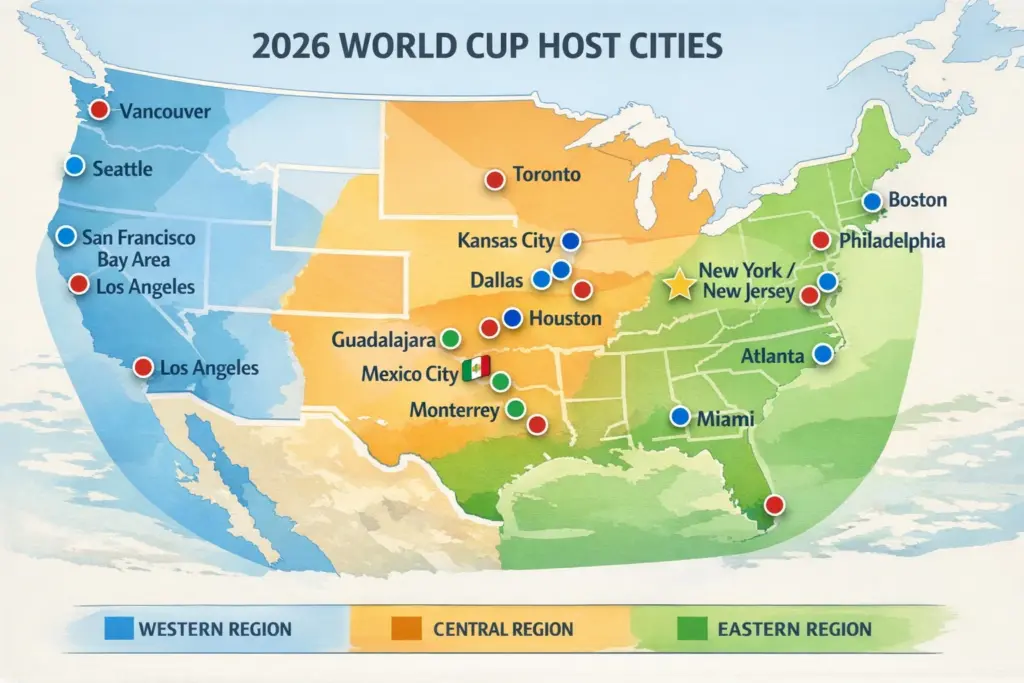
For planning and travel, FIFA groups the host cities into three broad regions: Western (Vancouver, Seattle, San Francisco Bay Area, Los Angeles), Central (Guadalajara, Mexico City, Monterrey, Houston, Dallas, Kansas City), and Eastern (Atlanta, Miami, Toronto, Boston, Philadelphia, New York/New Jersey).
That regional structure matters. In the group stage, travel is more clustered than a simple continent-wide zig-zag. As the competition moves into the knockout rounds, matches become more concentrated in the USA, with all games from the quarterfinals onward staged there.
Official Schedule & Live Tracker
For the latest fixture list, venues and results, readers should use FIFA’s official tournament schedule page. That is the most reliable source for kickoff dates, stadium assignments and any official schedule updates.
2026 World Cup Host Cities and Stadiums
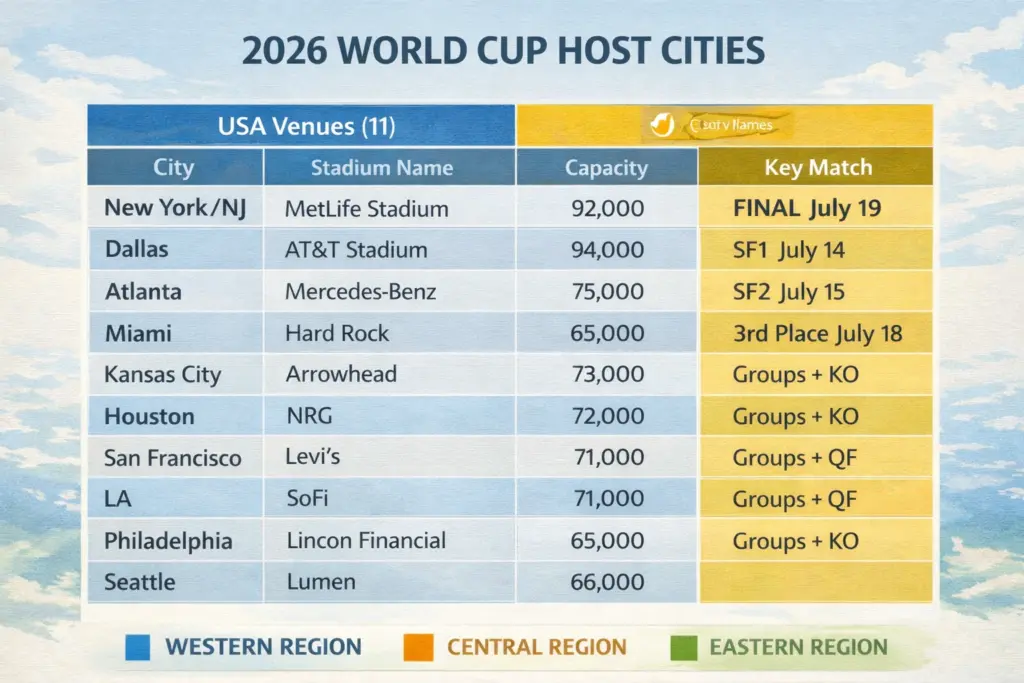
United States — 11 Cities
New York / New Jersey — MetLife Stadium
Tournament role: HOSTS THE FINAL (July 19)
Capacity: 82,500
Location: East Rutherford, New Jersey
Regular tenants: New York Giants and New York Jets
Region: Eastern
MetLife Stadium — officially New York New Jersey Stadium during the tournament — is the centrepiece of the entire event. FIFA confirmed it as the host of the 2026 World Cup final, and the venue will stage eight matches in total.
The stadium is one of the largest in the NFL, with an official capacity of 82,500, and its location in the Meadowlands puts it within reach of Manhattan while technically sitting in New Jersey. For international visitors, it offers what finals weekend always demands: major-hotel capacity, global flight access and the gravitational pull of the New York metropolitan area.
Dallas / Arlington — AT&T Stadium
Tournament role: HOSTS SEMIFINAL 1 (July 14)
Capacity: 80,000, expandable beyond 100,000
Location: Arlington, Texas
Regular tenants: Dallas Cowboys
Region: Central
Dallas Stadium — better known as AT&T Stadium — will host nine matches, more than any other venue in the tournament, including a semifinal.
The venue is home to the Dallas Cowboys and is famous for its scale, retractable roof and giant video board. It is one of the most technologically ambitious stadiums in world sport and one of the few venues in the tournament whose size alone feels like part of the event.
Atlanta — Mercedes-Benz Stadium
Tournament role: HOSTS SEMIFINAL 2 (July 15)
Capacity: 75,000
Location: Atlanta, Georgia
Regular tenants: Atlanta Falcons, Atlanta United FC
Region: Eastern
Atlanta Stadium — Mercedes-Benz Stadium in everyday life — hosts eight matches, including the second semifinal and two other knockout fixtures.
Opened in 2017, the stadium is one of the most distinctive modern arenas in North America, with a retractable roof and a pinwheel-style design that has already made it one of the signature venues in US sport. It is also one of the few host stadiums with both NFL and MLS anchor tenants.
Miami — Hard Rock Stadium
Tournament role: HOSTS THIRD-PLACE MATCH (July 18)
Capacity: 65,000
Location: Miami Gardens, Florida
Regular tenants: Miami Dolphins, University of Miami football
Region: Eastern
Miami Stadium — Hard Rock Stadium — hosts seven matches, including the third-place match on July 18.
Hard Rock Stadium is home to the Miami Dolphins and University of Miami football and is already one of the USA’s major event venues, regularly staging NFL, tennis and Formula 1 events. For World Cup purposes, Miami’s strength is obvious: a huge international airport, deep hotel inventory and a cultural profile that makes it especially attractive for fans from Latin America and the Caribbean.
Kansas City — Arrowhead Stadium
Tournament role: Group stage + knockout matches
Capacity: 76,416
Location: Kansas City, Missouri
Regular tenants: Kansas City Chiefs
Region: Central
Kansas City Stadium — GEHA Field at Arrowhead Stadium outside FIFA naming rules — hosts six matches, including four group games and two knockout ties, one of them a quarterfinal.
The stadium is home to the Kansas City Chiefs and is globally famous for crowd noise. FIFA’s host-city material explicitly highlights its reputation as the world’s loudest stadium, which makes it one of the tournament’s most atmospheric venues even before a ball is kicked.
Houston — NRG Stadium
Tournament role: Group stage + knockout matches
Capacity: 72,220
Location: Houston, Texas
Regular tenants: Houston Texans
Region: Central
Houston Stadium — NRG Stadium — hosts seven matches: five in the group stage, one in the Round of 32 and one in the Round of 16.
The venue is the home of the Houston Texans and is one of the few major host stadiums with a retractable roof, a meaningful advantage in a city known for heat and humidity in June and July. Houston’s wider appeal as a host city lies in its size, airport connectivity and multicultural population.
San Francisco Bay Area — Levi’s Stadium
Tournament role: Group stage + knockout matches
Capacity: approximately 70,000
Location: Santa Clara, California
Regular tenants: San Francisco 49ers
Region: Western
The San Francisco Bay Area venue — Levi’s Stadium in Santa Clara — hosts six matches, including five group-stage fixtures and one knockout match.
Levi’s Stadium is the home of the San Francisco 49ers and seats roughly 70,000 for major events. As a World Cup base, the wider Bay Area offers a rare mix of global-city tourism, airport access and a strong football audience on the US West Coast.
Los Angeles — SoFi Stadium
Tournament role: Group stage + knockout matches including a quarterfinal
Capacity: about 70,000
Location: Inglewood, California
Regular tenants: Los Angeles Rams, Los Angeles Chargers
Region: Western
Los Angeles Stadium — SoFi Stadium — hosts eight matches, including the USA’s opener and a quarterfinal.
Opened in 2020, SoFi is one of the newest venues in the tournament and one of the most high-profile stadiums anywhere in the world. It is home to both the Rams and Chargers, and it will also play a major role at the 2028 Los Angeles Olympics.
Philadelphia — Lincoln Financial Field
Tournament role: Group stage + knockout matches
Capacity: 67,594
Location: Philadelphia, Pennsylvania
Regular tenants: Philadelphia Eagles
Region: Eastern
Philadelphia Stadium — Lincoln Financial Field — hosts six matches, including five group-stage games and a Round of 16 fixture scheduled for July 4, 2026.
The stadium is home to the Philadelphia Eagles and sits within the South Philadelphia sports complex. For fans planning multi-city travel, Philadelphia benefits from its position on the northeastern corridor between New York and Washington, and from rail connectivity with Boston and New York.
Seattle — Lumen Field
Tournament role: Group stage + knockout matches
Capacity: 68,740
Location: Seattle, Washington
Regular tenants: Seattle Seahawks, Seattle Sounders FC, Seattle Reign FC
Region: Western
Seattle Stadium — Lumen Field — hosts six matches, including two knockout-stage ties.
Lumen Field is home to the Seahawks, Sounders and Reign, and is one of the strongest football venues in the United States in terms of sustained crowd culture. Its location close to downtown and its natural travel pairing with Vancouver make it one of the most convenient two-city combinations in the Western region.
Boston / Foxborough — Gillette Stadium
Tournament role: Group stage + knockout matches
Capacity: 64,628
Location: Foxborough, Massachusetts
Regular tenants: New England Patriots, New England Revolution
Region: Eastern
Boston Stadium — Gillette Stadium in Foxborough — hosts seven matches, including two knockout ties.
The stadium is home to both the New England Patriots and New England Revolution. Although it sits outside central Boston, it gives the tournament a foothold in one of the most football-aware and internationally connected metro areas in the northeastern United States.
Canada — 2 Cities
Toronto — BMO Field
Tournament role: Group stage + Round of 32
Capacity: 45,736
Location: Toronto, Ontario
Regular tenants: Toronto FC, Toronto Argonauts
Region: Eastern
Toronto Stadium — BMO Field — hosts six matches, including Canada’s opening match and a Round of 32 fixture. It will also become the first Canadian venue ever to host a men’s World Cup match.
BMO Field is Canada’s first soccer-specific major stadium and is expanding to 45,736 seats for the tournament. It is home to Toronto FC and the Toronto Argonauts, and it will be the smallest venue at the 2026 World Cup by capacity.
Vancouver — BC Place
Tournament role: Group stage + knockout matches
Capacity: 54,500
Location: Vancouver, British Columbia
Regular tenants: Vancouver Whitecaps FC, BC Lions
Region: Western
Vancouver hosts seven matches at BC Place, including five group-stage fixtures, one Round of 32 match and one Round of 16 tie.
BC Place is one of the most distinctive stadiums in the tournament because of its retractable roof. Vancouver’s appeal as a host city is obvious: dramatic geography, a compact downtown core and a straightforward pairing with Seattle for fans staying in the Western region.
Mexico — 3 Cities
Mexico City — Estadio Azteca
Tournament role: HOSTS THE OPENING MATCH (June 11) + group stage + knockout matches
Capacity: 83,000
Location: Mexico City
Regular tenants: Club América, Cruz Azul, Mexico national team
Region: Central
Mexico City Stadium — Estadio Azteca — is the most historically significant venue at the 2026 World Cup. FIFA confirmed it as the host of the opening match on June 11, 2026, and it will stage five matches overall.
No other stadium in the tournament carries the same World Cup history. Azteca hosted the men’s World Cup finals in 1970 and 1986, and 2026 makes it the first stadium ever used at three men’s World Cups. For football history alone, it is the symbolic heart of the tournament.
Guadalajara — Estadio Akron
Tournament role: Group stage ONLY
Capacity: approximately 48,000
Location: Zapopan, metropolitan Guadalajara, Jalisco
Regular tenants: Chivas de Guadalajara
Region: Central
Guadalajara is the only host city limited entirely to group-stage matches. That makes it unusual in the 2026 lineup, but not unimportant: the city remains one of the culturally richest and most football-aware stops in the tournament.
Estadio Akron is home to Chivas and sits in the Guadalajara metropolitan area. While it does not host a knockout game, it still forms part of the compact Central cluster that includes Mexico City, Monterrey, Houston, Dallas and Kansas City.
Monterrey — Estadio BBVA
Tournament role: Group stage + knockout matches
Capacity: approximately 53,500
Location: Guadalupe, metropolitan Monterrey, Nuevo León
Regular tenants: CF Monterrey
Region: Central
Monterrey is one of Mexico’s two cities outside the capital to host both group-stage and knockout action. FIFA’s venue information places it among the Central-region hosts and confirms it as part of Mexico’s 13-match share of the tournament.
Estadio BBVA is a football-first venue rather than a repurposed American football stadium, which gives it a different feel from most of the US hosts. Monterrey itself is a major industrial and business centre with one of Mexico’s strongest club-football cultures.
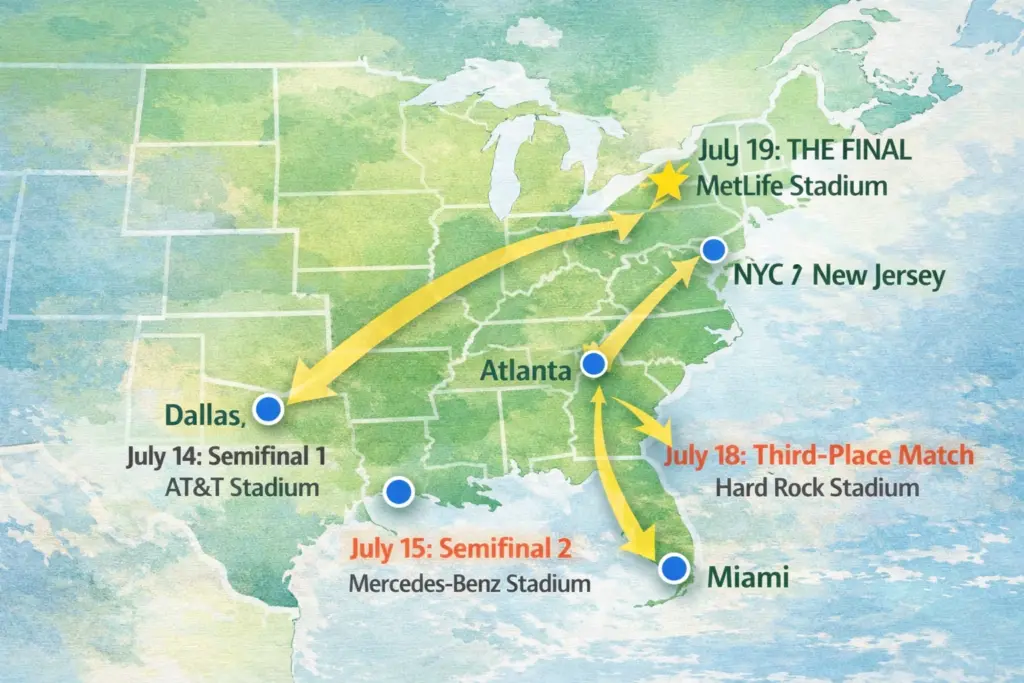
The Final Weekend: Three Cities, Three Matches
The World Cup’s closing stretch is concentrated in the United States.
July 14 — Semifinal 1: Dallas Stadium / AT&T Stadium
Dallas hosts the first semifinal and nine matches overall, the most of any host city.
July 15 — Semifinal 2: Atlanta Stadium / Mercedes-Benz Stadium
Atlanta hosts the second semifinal one day later.
July 18 — Third-Place Match: Miami Stadium / Hard Rock Stadium
The two semifinal losers meet in Miami for the bronze medal match.
July 19 — THE FINAL: New York New Jersey Stadium / MetLife Stadium
The tournament ends in East Rutherford, New Jersey, with the final on Sunday, July 19.
2026 World Cup Host Cities: Practical Travel Information for Fans
Time Zones
The host cities are spread mainly across three tournament time zones: Pacific, Central and Eastern. Vancouver, Seattle, the San Francisco Bay Area and Los Angeles are in the west; Mexico City, Guadalajara, Monterrey, Houston, Dallas and Kansas City form the Central cluster; and Atlanta, Miami, Toronto, Boston, Philadelphia and New York/New Jersey make up the Eastern cluster.
Visa Requirements
For the United States, foreign visitors generally need either a visitor visa or to qualify under the Visa Waiver Program. The US Department of State says foreign nationals traveling for tourism need a visitor visa unless they qualify for visa-free entry under the program.
For Canada, travelers need the correct entry document based on nationality and how they are arriving, which may be a passport, visitor visa, or Electronic Travel Authorization (eTA). Canada’s official eligibility tool specifically includes tourists attending FIFA World Cup 26 matches.
For Mexico, entry requirements depend on your nationality, travel document and immigration status. Travelers should check official Mexican visa guidance before booking, because some nationalities can enter for short tourist visits without a visa while others need one. Mexico’s consular guidance also notes that all foreign visitors must present a valid passport, and that a visa, where required, does not by itself guarantee entry.
Travel Between Cities
Because the tournament spans a continent, flying will be the practical default for many fans moving between regions. Within the northeastern corridor, however, rail travel between Boston, New York/New Jersey and Philadelphia can be a realistic alternative to domestic flights. For the group stage, the most travel-efficient approach is usually to pick one region and stay within it. That is exactly how FIFA’s city grouping is designed to function.
Climate in June–July
Weather conditions will vary sharply by region. The West Coast venues are generally milder, Texas and Florida can be hot and humid, and Mexico City is moderated by altitude compared with other Mexican hosts. Because local conditions can shift meaningfully from city to city, fans should check city-specific forecasts and stadium advisories closer to the tournament rather than rely on one static average.
Which Cities Are Hosting Your Team’s Matches?
The full match schedule is set, but fans should still check the official fixture list rather than rely on static summaries, especially for knockout scenarios. FIFA’s schedule pages allow readers to track matches by date, stadium and stage of the tournament.
As a broad guide, Western-region teams and fixtures are concentrated in Vancouver, Seattle, the San Francisco Bay Area and Los Angeles; Central-region fixtures are clustered around Mexico City, Guadalajara, Monterrey, Houston, Dallas and Kansas City; and Eastern-region fixtures are concentrated in Atlanta, Miami, Toronto, Boston, Philadelphia and New York/New Jersey. For exact match numbers, dates and venues, the official FIFA fixture list remains the source of truth.
Stadium Records and Highlights
Largest host by match count: Dallas Stadium with nine matches.
Most historic venue: Mexico City Stadium / Estadio Azteca — the only stadium to host matches at three men’s World Cups.
Newest marquee venue: Los Angeles Stadium / SoFi Stadium, opened in 2020.
Smallest venue: Toronto Stadium / BMO Field, expanded to 45,736 for the tournament.
Only group-stage-only city: Guadalajara.
Loudest venue reputation: Kansas City Stadium / Arrowhead, widely associated with the world-record crowd-noise claim and highlighted by FIFA as such in host-city coverage.
Roofed or partially covered venues of note: AT&T Stadium, Mercedes-Benz Stadium, NRG Stadium and BC Place all offer major roof coverage or retractable-roof functionality; Hard Rock has a permanent canopy over much of the seating bowl rather than a full retractable roof.
Frequently Asked Questions
How many host cities does the 2026 World Cup have?
The tournament is being played across 16 host cities in Canada, Mexico and the United States.
Where is the 2026 World Cup final?
The final is at New York New Jersey Stadium / MetLife Stadium in East Rutherford, New Jersey, on July 19, 2026.
Where is the 2026 World Cup opening match?
The opening match is at Mexico City Stadium / Estadio Azteca on June 11, 2026.
Which countries are hosting the 2026 World Cup?
Three countries: the United States, Mexico and Canada.
How many matches does the USA host?
The United States hosts 78 matches, while Canada and Mexico host 13 each.
Which city is hosting the most matches?
Dallas hosts the most, with nine.
Is Guadalajara hosting knockout matches?
No. Guadalajara is the only host city limited to group-stage matches.
Has Mexico hosted the World Cup before?
Yes. Mexico hosted in 1970 and 1986, and 2026 makes it the first country to host or co-host the men’s World Cup three times.
What is the smallest stadium at the 2026 World Cup?
BMO Field in Toronto, expanded to 45,736 seats for the tournament.
Key Takeaway
The 2026 World Cup is the most geographically ambitious tournament in men’s World Cup history: 16 cities, three countries, 48 teams and 104 matches. It begins in Mexico City on June 11 and ends in New York/New Jersey on July 19.
For fans travelling in person, the best strategy is usually simple: pick a region first, then build your itinerary around it, and sort out entry requirements well in advance for whichever of the three host countries you plan to visit. For fans watching from home, the reward is scale: on peak days, the 2026 World Cup will offer simultaneous action across a huge slice of North America in a way no previous tournament ever has.


