
UEFA 2026 World Cup Qualification has reached its most critical stage as the continent prepares for the high-stakes playoffs in March 2026. With 12 heavyweights having already secured their direct tickets to the first-ever 48-team tournament in North America, attention now turns to the 16 nations fighting for the final four spots. This cycle represents the largest expansion in European football history, providing more paths, more drama, and more qualification stories than any previous campaign.
England did it without conceding a single goal. Norway did it with Erling Haaland scoring 16 in one qualifying campaign. Scotland did it with an injury-time winner against Denmark on the final night. Croatia did it quietly, efficiently, and for the eighth time in their history.
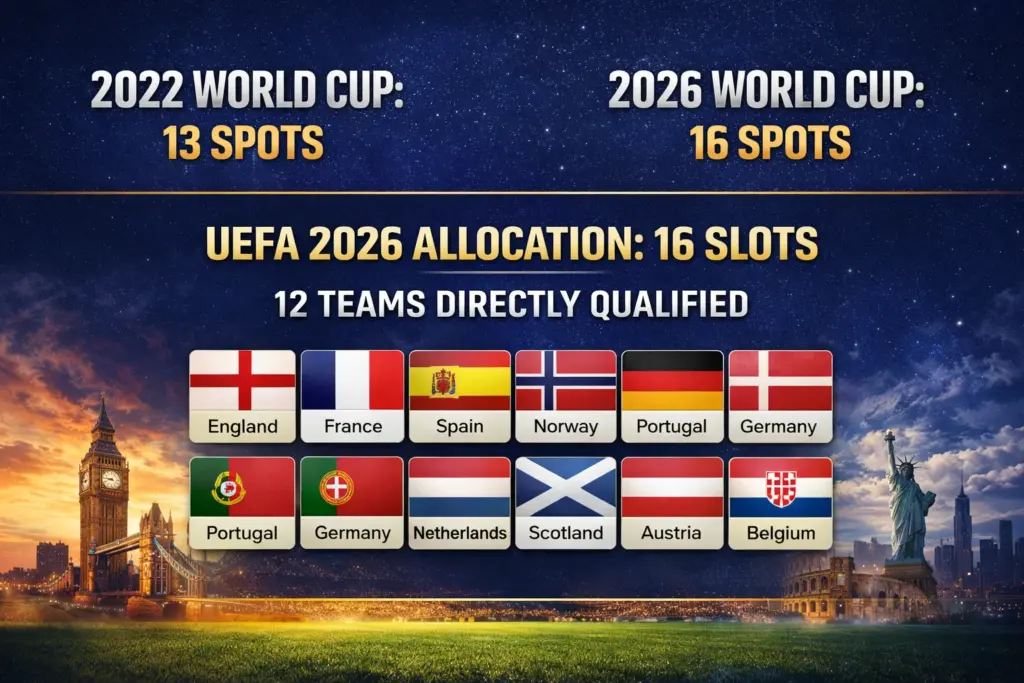
There are a total of 16 UEFA berths available at the 48-team 2026 FIFA World Cup, with the 12 qualifying group winners assured of a final tournament place along with the four eventual play-off winners. Sixteen spots is the largest allocation Europe has ever received at a World Cup — up from 13 at Qatar 2022. The tournament’s expansion from 32 to 48 teams transformed European representation, creating more paths and storylines across the continent.
Austria, Belgium, Croatia, England, France, Germany, Netherlands, Norway, Portugal, Scotland, Spain and Switzerland have confirmed their places at the finals. Four more European nations will join them after the playoffs on March 26 and March 31, 2026. The playoff paths — Italy, Wales, Kosovo, Ukraine, Poland, Türkiye, Slovakia, Denmark, Czechia, Republic of Ireland, Romania, Bosnia and Herzegovina, Sweden, Albania, North Macedonia and Northern Ireland — contain some of European football’s most historically significant nations. Four of them will make it to North America. The rest go home.
This is the complete guide to Europe’s road to 2026 — every group, every qualifier, every playoff path, and what happens next.
TL;DR
- In total, 16 UEFA nations will qualify for the 2026 World Cup. The 12 group winners qualify directly; the four remaining berths are determined by play-offs.
- 12 direct qualifiers (group winners): England, France, Spain, Norway, Portugal, Germany, Netherlands, Switzerland, Scotland, Austria, Belgium, Croatia.
- 4 playoff spots decided March 26 (semifinals) and March 31 (finals), 2026 — four paths, four winners.
- Playoff paths: Path A (Italy/Northern Ireland vs Wales/Bosnia and Herzegovina), Path B (Ukraine/Sweden vs Poland/Albania), Path C (Türkiye/Romania vs Slovakia/Kosovo), Path D (Denmark/North Macedonia vs Czechia/Republic of Ireland).
- Biggest storylines: England qualified with a perfect 8W-0L-0 conceded record. Haaland scored 16 goals. Italy finished second — again. Scotland’s Kenny McLean scored in injury time to beat Denmark.
- Campaign timeline: March 2025 to November 2025 (group stage); March 26–31, 2026 (playoffs).
SNIPPET BLOCK
UEFA received 16 World Cup spots for 2026 — the most Europe has ever had. Twelve group winners qualified directly: England, France, Spain, Norway, Portugal, Germany, Netherlands, Switzerland, Scotland, Austria, Belgium and Croatia. Four more places are decided by playoffs on March 26 and 31, 2026, featuring 16 teams including Italy, Wales, Kosovo, Ukraine, Poland and Türkiye. Russia remain suspended from all FIFA and UEFA competitions.
UEFA 2026 World Cup Qualification: How Many European Teams Qualify?
A total of 16 slots in the final tournament are available for UEFA teams. A revised qualification format was confirmed by the UEFA Executive Committee during their meeting in Nyon, Switzerland. As the number of final tournament slots for UEFA has increased from 13 to 16, the qualification format was modified from the previous cycle.
Thirteen spots at the 2022 World Cup. Sixteen in 2026. Three additional European nations making the trip to North America as a direct result of the expanded tournament. For context: those three extra spots — the difference between the old format and the new — would likely have included Italy, Ukraine and one of Türkiye, Poland or Denmark in the current cycle.
Europe remains the most represented confederation at the World Cup by a significant margin. With 16 direct spots, UEFA sends one team to North America for approximately every three member associations. No other confederation comes close to that ratio.
UEFA 2026 World Cup Qualification Format: Two Rounds Explained
Round 1 — Twelve Groups, Staggered Start (March–November 2025)
The qualifying group stage featured six groups of four and six groups of five teams. The winner of each group qualified for the World Cup, while the second-placed teams advanced to the play-offs, along with the four best-ranked group winners from the 2024–25 UEFA Nations League that finished outside the top two of their qualifying group.
The staggered start dates were determined by Nations League commitments. Groups of five teams (Groups G–L) began in March 2025, while groups of four teams (Groups A–F) began in September 2025. The four Nations League quarter-final winners — who competed in the Nations League Finals in June 2025 — could not start World Cup qualifying until September and were therefore placed in four-team groups.
This created two distinct qualifying timelines running simultaneously. Groups G through L completed matches across the full March–November 2025 window. Groups A through F ran September–November 2025 in a compressed schedule. The structure rewarded efficiency. Six matches in Groups A–F meant every point mattered from the first matchday.
Round 2 — The Playoffs: Four Paths, Four Spots (March 26–31, 2026)
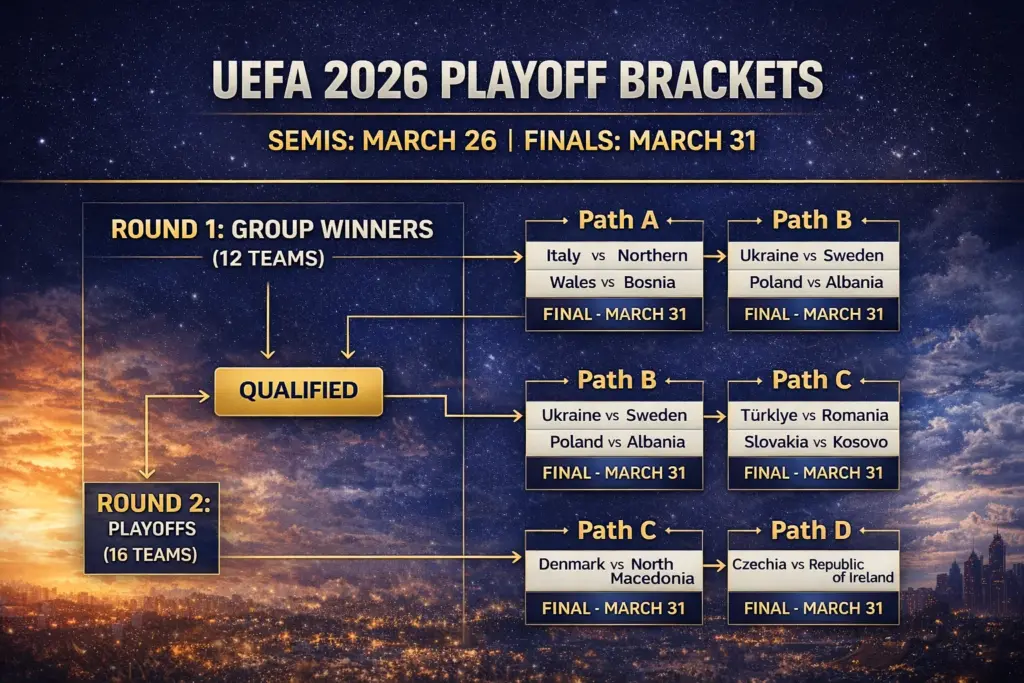
The twelve runners-up from the first round were joined by four Nations League group winners that finished outside the top two of their qualifying group. The sixteen teams were split into four play-off paths, each containing four teams. Each play-off path will feature two single-leg semi-finals on 26 March, and one single-leg final on 31 March 2026.
The Nations League pathway — unique to UEFA among all confederations — gives an additional four teams a second chance to qualify even if they finished outside the top two of their qualifying group. It rewards Nations League performance with World Cup opportunity, creating a direct connection between the two competitions.
The seeding system for the playoff draw:
- Pot 1: Four World Cup qualifying group runners-up with the best FIFA World Ranking.
- Pot 2: Teams fifth to eighth in the FIFA World Ranking list order.
- Pot 3: Teams ninth to 12th in the FIFA World Ranking list order.
- Pot 4: UEFA Nations League teams.
In the semi-finals, the Pot 1 team hosts the Pot 4 team, and the Pot 2 team hosts the Pot 3 team. The host of each path final is decided by a draw between the two semi-final pairings.
The 12 Direct Qualifiers — Group by Group
🏴 England — Group K Winners
England dominated Group K, earning eight wins from eight games without conceding a goal and sealed their spot in North America with two fixtures to spare. It is one of the most statistically dominant qualifying campaigns any European nation has produced in modern times. Thomas Tuchel’s fingerprints are all over those numbers — the defensive structure, the pressing system and the game management that produced clean sheet after clean sheet in a group that also contained Serbia and Albania. England face Croatia, Ghana and Panama in Group L at the 2026 tournament.
🇫🇷 France — Group D Winners
France have qualified as group winners from Group D, which also contained Ukraine, Iceland and Azerbaijan. France won 16 points from six matches. Ukraine finished second and advance to the playoffs. Didier Deschamps takes France to the 2026 tournament as one of the two or three favourites. Kylian Mbappé leads a squad that contains some of the world’s most individually brilliant players. France are in Group I alongside Senegal, Norway and the FIFA Play-Off Tournament winner 2.
🇪🇸 Spain — Group E Winners
Spain topped Group E with 16 points from six matches. Türkiye finished second and advance to the playoffs. Euro 2024 champions and unbeaten in qualifying, Spain arrive at 2026 as the tournament’s defending continental champions. Their squad, built around Barcelona’s midfield generation of Pedri and Gavi alongside Nico Williams and Lamine Yamal, is the most technically coherent side in European football.
🇳🇴 Norway — Group I Winners
Norway will be appearing at a World Cup finals for the first time in 28 years after impressively beating Italy to secure top spot in Group I. The relentless Erling Haaland scored an extraordinary 16 goals, while fellow Premier League star Martin Ødegaard tallied seven assists. Italy, who finished second in Group I, advance to the playoffs — Path A.
🇵🇹 Portugal — Group F Winners
Through to their seventh edition in a row, Portugal sealed their place after breezing past Armenia on Matchday 10. Vitinha, João Neves and Bruno Fernandes make things tick in midfield, while Cristiano Ronaldo is still pouring in the goals up front. Portugal are in Group K alongside Colombia, Uzbekistan and the FIFA Play-Off Tournament winner 1. Their opening match against Uzbekistan sets up the group’s central drama.
🇩🇪 Germany — Group A Winners
Germany qualified as group winners from Group A. The host nation of Euro 2024 arrives at the 2026 World Cup with renewed ambition under Julian Nagelsmann. Their squad, rebuilt after the 2022 World Cup group stage elimination, performed with the consistency that German football requires. Germany are in Group E alongside Ivory Coast, Ecuador and Curaçao.
🇳🇱 Netherlands — Group G Winners
The Netherlands qualified as group winners, with Ronald Koeman’s side demonstrating the quality across their squad that their Euro 2024 semifinal run confirmed. The Dutch — runners-up at the 2010 World Cup, with a squad now built around Virgil van Dijk and Frenkie de Jong — are consistently among Europe’s top eight sides.
🇨🇭 Switzerland — Group B Winners
Switzerland comfortably navigated a tricky-looking Group B to qualify for a sixth successive World Cup. Although they are no longer able to call on the services of Xherdan Shaqiri, in the likes of Manuel Akanji, Granit Xhaka, Dan Ndoye and Breel Embolo, the Swiss still have enough quality to trouble any opponent on their day. Six consecutive World Cups is one of European football’s most under-celebrated consistency records.
🏴 Scotland — Group C Winners
Scotland left it until injury time of their final group game with Denmark to finally seal victory in dramatic fashion. Kenny McLean’s goal — in the final moments of the final qualifying match — sent Scotland to the World Cup for the first time since France 1998. The 26-year wait finally ending has sparked national celebration for Steve Clarke’s side.
🇦🇹 Austria — Group H Winners
Austria qualified as group winners in a group that presented genuine competition. Their qualification represents a significant milestone for Austrian football — their first World Cup appearance since 1998, and confirmation that the generation of players that emerged through the Austrian league and German Bundesliga has produced a side capable of competing at the highest level. Austria are in Group J alongside Argentina, Algeria and Jordan.
🇧🇪 Belgium — Group J Winners (Qualifying Groups)
Belgium won Group J with 18 points. Their “Golden Generation” has aged but not expired: Kevin De Bruyne, Romelu Lukaku and Axel Witsel are at the final stages of careers that produced so much club and continental success. Wales finished second and advance to Path A playoffs alongside Italy.
🇭🇷 Croatia — Group L Winners
Croatia topped Group L with 22 points — seven wins and one draw from eight matches. Their qualification is notable: they are the team England face in the opening match of Group L on June 17 in Dallas. Luka Modrić will be 40 years old during the tournament. The golden generation’s final farewell begins in Texas.
UEFA 2026 World Cup Qualification: The Playoff Paths in Detail
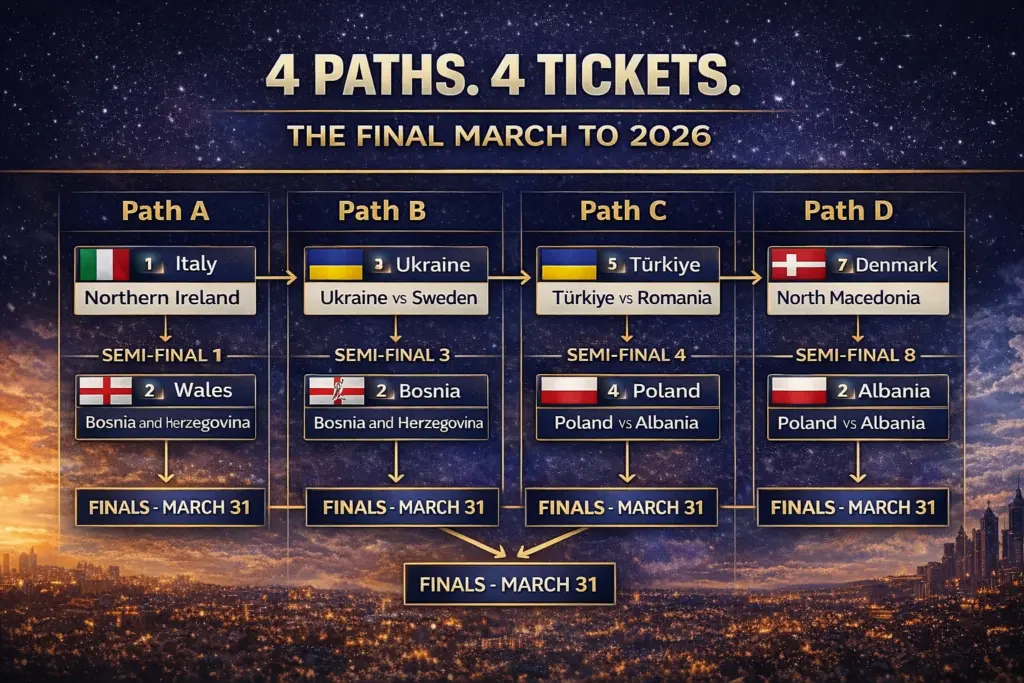
UEFA playoffs feature semi-finals on March 26 and finals on March 31, 2026. Four paths. Four winners. Here is the full picture:
Path A:
- Semi-final 1: Italy vs Northern Ireland (Italy hosting)
- Semi-final 2: Wales vs Bosnia and Herzegovina (Wales hosting)
- Final: Winner SF1 vs Winner SF2
Italy — Euro 2020 champions — finished second behind Norway in Group I and must navigate the playoffs. Wales face Bosnia and Herzegovina in their semi-final. If Italy and Wales both win their semifinals, the Path A final is a dramatic Home Nations vs Azzurri clash.
Path B:
- Semi-final 3: Ukraine vs Sweden (Ukraine hosting)
- Semi-final 4: Poland vs Albania (Poland hosting)
- Final: Winner SF3 vs Winner SF4
Ukraine carry the weight of a nation at war into a playoff semi-final. Playing home matches at neutral venues due to the ongoing conflict, Ukraine’s qualification story is one of national resilience. Poland features Robert Lewandowski, potentially at his final World Cup. At 37 during the tournament, he hopes to add a deep World Cup run to his club career.
Path C:
- Semi-final 5: Türkiye vs Romania (Türkiye hosting)
- Semi-final 6: Slovakia vs Kosovo (Slovakia hosting)
- Final: Winner SF5 vs Winner SF6
Kosovo face Slovakia in their semi-final as they seek their first World Cup appearance. Türkiye finished second behind Spain in Group E and remain a perpetual playoff contender who previously reached the World Cup semifinal in 2002.
Path D:
- Semi-final 7: Denmark vs North Macedonia (Denmark hosting)
- Semi-final 8: Czechia vs Republic of Ireland (Czechia hosting)
- Final: Winner SF7 vs Winner SF8
Denmark face North Macedonia after a dramatic final-day goal by Scotland denied them top spot. North Macedonia, whose Nations League performance earned them the wildcard route, face Denmark on the road as they look for another giant-killing performance.
The Biggest Absentee: Russia
Russia remain suspended from all FIFA and UEFA competitions following the country’s invasion of Ukraine. Russia were suspended indefinitely on 28 February 2022 from participating in international football. Russia will miss their third consecutive major tournament — having also been absent from Euro 2024 and the 2022 World Cup. For a nation that hosted the 2018 World Cup, the extended exclusion represents one of the most significant political interventions in the sport’s modern history.
The Controversy: Ukraine Map Incident and Israel-Related Protests
During the draw on 13 December 2024, when Ukraine was drawn, the map of the country did not include Crimea, which led to outrage from the Ukrainian Association of Football. FIFA later apologised for the incident. The omission of Crimea highlighted the political tensions that surround European qualifying in 2025–26.
In Group I, the Norwegian Football Federation stated that they “cannot remain indifferent to Israel’s disproportionate attacks on the civilian population in Gaza” during the Gaza war. The Norway-Israel relationship within Group I generated public statements from the Norwegian federation, reflecting the broader political tensions surrounding international football during the conflict.
UEFA 2026 World Cup Qualification: European Teams Group Placement
| Team | Group | Key Opponents | Qualification Route |
|---|---|---|---|
| England | L | Croatia, Ghana, Panama | Group K winner — 8W, 0 conceded |
| France | I | Senegal, Norway, FIFA Play-Off Tournament winner 2 | Group D winner |
| Spain | H | Uruguay, Saudi Arabia, Cabo Verde | Group E winner — 16 points |
| Norway | I | France, Senegal, FIFA Play-Off Tournament winner 2 | Group I winner — Haaland 16 goals |
| Portugal | K | Colombia, Uzbekistan, FIFA Play-Off Tournament winner 1 | Group F winner — 7th consecutive WC |
| Germany | E | Ivory Coast, Ecuador, Curaçao | Group A winner |
| Netherlands | F | Japan, Tunisia, UEFA Playoff B winner | Group G winner |
| Switzerland | B | Canada, Qatar, UEFA Playoff A winner | Group B winner — 6th successive WC |
| Scotland | C | Brazil, Morocco, Haiti | Group C winner — McLean injury-time |
| Austria | J | Argentina, Algeria, Jordan | Group H winner |
| Belgium | G | IR Iran, Egypt, New Zealand | Group J winner — 18 points |
| Croatia | L | England, Ghana, Panama | Group L winner — 8th WC |
Frequently Asked Questions
How many European teams qualify for the 2026 World Cup?
In total, 16 UEFA nations will qualify for the 2026 World Cup. The 12 group winners qualify directly; the four remaining berths are determined by play-offs involving the 12 group runners-up and four UEFA Nations League teams.
Which European teams are in the playoffs?
Path A: Italy vs Northern Ireland + Wales vs Bosnia and Herzegovina. Path B: Ukraine vs Sweden + Poland vs Albania. Path C: Türkiye vs Romania + Slovakia vs Kosovo. Path D: Denmark vs North Macedonia + Czechia vs Republic of Ireland.
Why is Russia not participating?
Russia were suspended indefinitely on 28 February 2022 from participating in UEFA and FIFA competitions for the country’s invasion of Ukraine. This is their third consecutive major tournament absence.
Did any European team qualify with a perfect record?
England qualified with eight wins from eight matches without conceding a single goal across the entire campaign — one of the most dominant qualifying records in modern football history.
When will the final four European qualifiers be confirmed?
March 31, 2026 — when all four playoff finals are played. By the morning of April 1, 2026, Europe’s full 16-nation lineup will be confirmed.
Key Takeaway
Europe’s road to 2026 is reaching its peak. With 12 spots confirmed and a 16-team playoff system set to decide the final four, the drama continues. From Tuchel’s England to Haaland’s record-breaking Norway, the European storylines are set to dominate the global stage when North America hosts the tournament starting June 11, 2026.