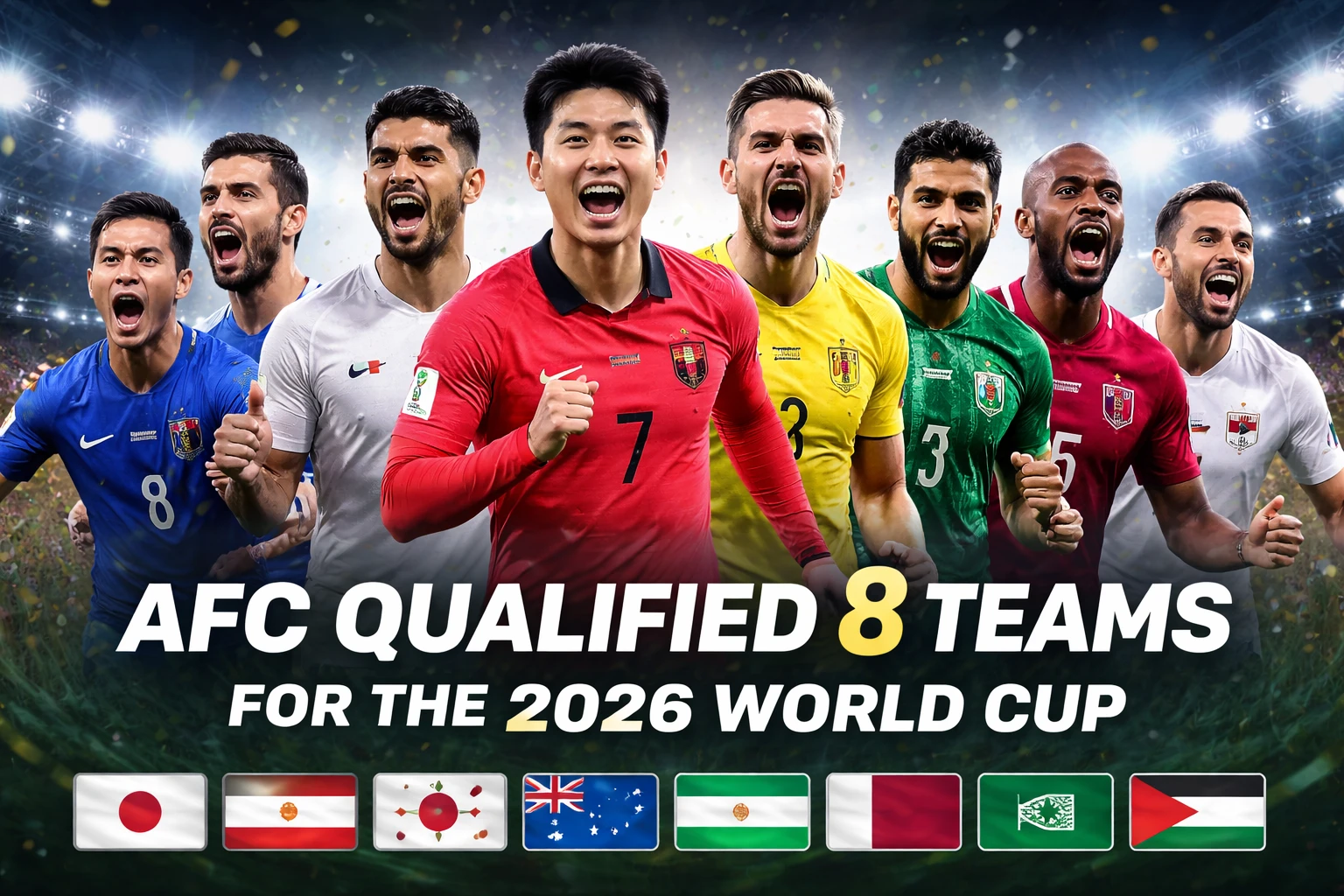

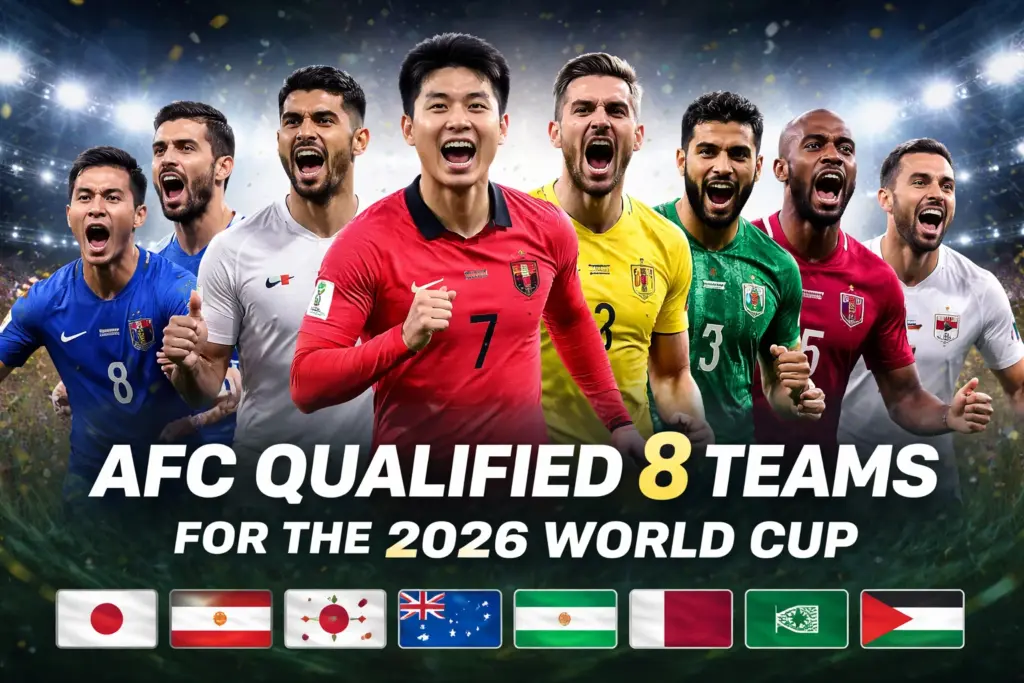
AFC Qualified 8 Teams for the 2026 World Cup through a five-round, 25-month campaign that ended with Japan, Iran, South Korea, Australia, Uzbekistan, Jordan, Qatar and Saudi Arabia taking the confederation’s eight direct places, while Iraq advanced to the FIFA World Cup 2026 Play-Off Tournament. On March 20, 2025, Japan beat Bahrain 2-0 in Saitama and became the first non-host nation — and the first team to qualify through confederation qualifying — to book their place at the 2026 World Cup.
It was a statement of where Asian football stands in 2026.
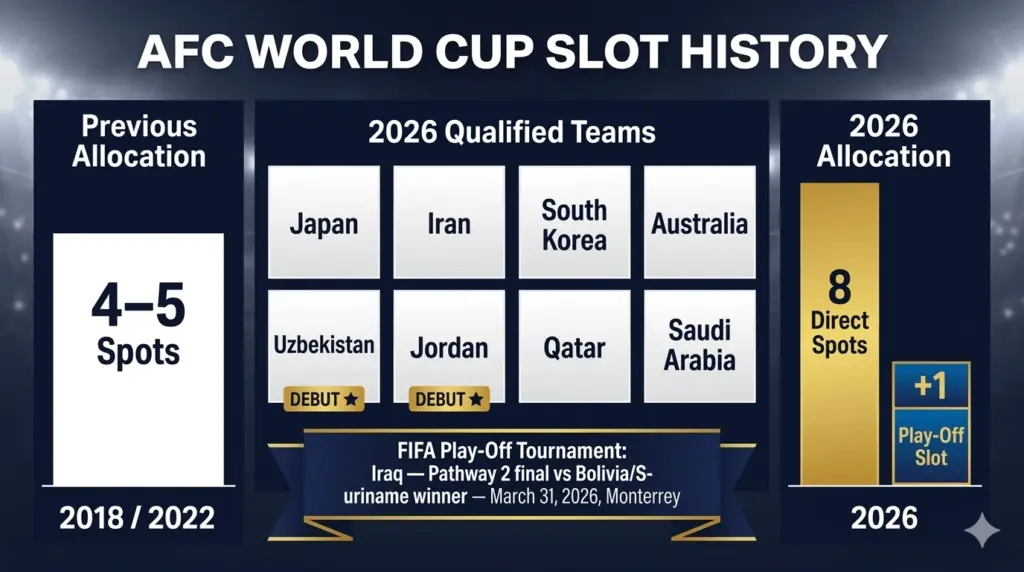
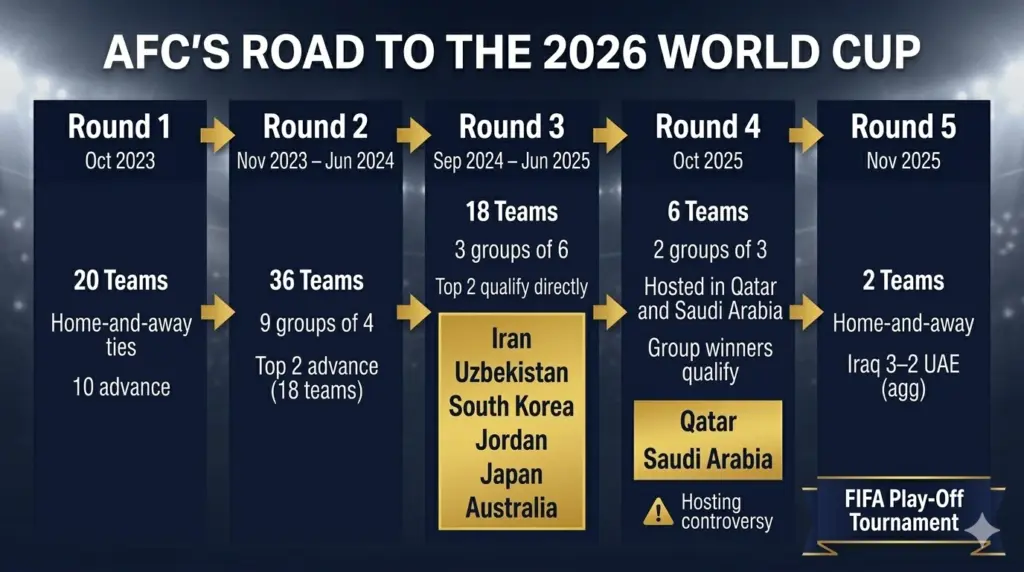
AFC teams were allocated eight direct qualifying slots and one inter-confederation play-off slot. The campaign to fill those eight spots ran from October 2023 to November 2025 — a 25-month process involving five rounds and every FIFA-affiliated Asian nation. From Myanmar playing Macau in the opening round to Iraq’s 3-2 aggregate victory over the UAE that clinched Asia’s place in the FIFA World Cup 2026 Play-Off Tournament in November 2025, Asian qualifying delivered five rounds of drama, controversy and football history.
Two nations — Jordan and Uzbekistan — reached a World Cup for the first time. One nation — Indonesia — came within a round of qualifying for only the second time in their history. One nation — North Korea — played their “home” matches in Laos and Saudi Arabia because security concerns made playing in Pyongyang impossible. And the fourth round was held in Qatar and Saudi Arabia — a decision that produced furious protests from the nations that felt they were being made to play on their opponents’ home turf.
This is the full story of Asia’s road to 2026.
TL;DR
- AFC teams were allocated eight direct qualifying slots and one inter-confederation play-off slot.
- The 8 qualified teams: Japan, Iran, South Korea, Australia, Uzbekistan, Jordan, Qatar, Saudi Arabia.
- FIFA World Cup 2026 Play-Off Tournament representative: Iraq — beat UAE 3-2 on aggregate; face the Bolivia vs Suriname winner in Monterrey on March 31, 2026.
- Five-round format: Round 1 (20 lowest-ranked teams) → Round 2 (9 groups of 4) → Round 3 (3 groups of 6 — 6 qualify) → Round 4 (2 groups of 3 in Qatar and Saudi Arabia — 2 more qualify) → Round 5 (FIFA World Cup 2026 Play-Off Tournament spot).
- Japan qualified first — the first non-host nation and the first team through confederation qualifying, on March 20, 2025.
- Two first-time qualifiers: Jordan and Uzbekistan — full stories in our dedicated articles.
- Biggest absentees: China, Indonesia (fell in Round 4), UAE (lost the FIFA World Cup 2026 Play-Off Tournament qualifier to Iraq).
- Campaign ran: October 2023 to November 2025.
Snippet Block
Asia received eight direct World Cup spots for 2026 through a five-round qualifying campaign. The eight qualified teams are Japan, Iran, South Korea, Australia, Uzbekistan, Jordan, Qatar and Saudi Arabia. Japan qualified first — the first non-host nation and the first team through confederation qualifying to book their 2026 place — with a 2-0 win over Bahrain on March 20, 2025. Iraq represent Asia in the FIFA World Cup 2026 Play-Off Tournament in March 2026 after beating UAE 3-2 on aggregate. Jordan and Uzbekistan qualified for the first time in their histories.
AFC Qualified 8 Teams for the 2026 World Cup: How Many AFC Teams Qualify?
AFC teams were allocated eight direct qualifying slots and one inter-confederation play-off slot.
Eight direct spots is a dramatic expansion from previous World Cups — Asia had only four or five automatic places at the 2022 and 2018 tournaments. The growth of the tournament from 32 to 48 teams transformed Asian football’s representation, making 2026 the most significant World Cup for the AFC in the tournament’s history.
Only Africa and Europe will place more teams in the 2026 World Cup than Asia. With nine potential representatives, eight direct plus a possible play-off winner, Asia arrives in North America with a presence that reflects the continent’s football growth over the past two decades.
The maximum possible is nine — if Iraq win in Monterrey on March 31. That would make Asia one of the most heavily represented confederations at the tournament.
AFC Qualified 8 Teams for the 2026 World Cup: The Five-Round Format
The qualification process involved five rounds, with the first two also serving as qualification for the 2027 AFC Asian Cup.
No other confederation used as many rounds. The five-round structure reflects the AFC’s size — 46 member associations, an enormous range of footballing quality from Japan to Macau and Bangladesh — and the need to give every nation a competitive pathway.
Round 1 — The Lowest-Ranked Nations (October 2023)
Twenty teams, ranked 27–46, played home-and-away over two legs. The ten winners advanced to the second round.
The opening round featured the AFC’s 20 lowest-ranked nations playing two-legged knockout ties. Nations including Mongolia, Maldives, Bangladesh, Singapore, Myanmar, Cambodia, Chinese Taipei, Indonesia, Hong Kong and Nepal entered here — competing for ten spots in Round 2 alongside the 26 higher-seeded nations who received byes.
The standout Round 1 result: Indonesia — ranked outside the top 150 at the time — beat Brunei Darussalam comfortably and progressed to Round 2. It was the first step in a qualifying journey that would eventually take Indonesia further than any previous campaign in their history.
Round 2 — Nine Groups of Four (November 2023–June 2024)
Thirty-six teams, ranked 1–26 plus the ten first-round winners, were divided into nine groups of four teams. The teams played against each other on a home-and-away basis. The nine group winners and group runners-up advanced to the third round.
Round 2 served the dual purpose of World Cup qualifying and AFC Asian Cup qualification — meaning every team had two incentives to perform. Eighteen teams advanced to Round 3: all nine group winners and all nine runners-up.
The Round 2 groups produced few surprises at the top — Japan, South Korea, Iran, Australia, Saudi Arabia and the other established AFC nations dominated their groups. But further down, the stories were more interesting: Indonesia’s Shin Tae-yong era was beginning to show results; Jordan was building the consistent defensive structure that would eventually take them to the World Cup; and Uzbekistan was demonstrating the squad depth that their youth tournament victories had always suggested was coming.
Round 3 — Three Groups of Six: The Main Event (September 2024–June 2025)
The third round of AFC matches for the 2026 FIFA World Cup qualification was played from September 5, 2024 to June 10, 2025. The 18 teams that advanced from the second round were divided into three groups of six teams. The teams played against each other on a home-and-away basis. The top two teams of each group qualified directly for the 2026 FIFA World Cup, while the third and fourth-placed teams advanced to the fourth round.
This was where the majority of Asia’s World Cup spots were decided. Three groups of six teams, each playing ten matches — five home, five away — over nine months. The top two from each group qualified automatically. That meant six of Asia’s eight spots were settled here.
Group A: Iran topped the group. Uzbekistan finished second, securing their historic first-ever qualification — the full story is in our Uzbekistan World Cup 2026 article.
Group B: South Korea topped the group. Jordan finished second — the full story of their historic first-ever qualification is in our Jordan World Cup 2026 article.
Group C: Japan dominated — they became the first non-host nation and the first team through confederation qualifying to secure a place on March 20, 2025 with a 2-0 win over Bahrain. Australia finished second, qualifying alongside Japan.
Notable third-round sub-story — North Korea’s bizarre home arrangements: North Korea chose Vientiane, Laos, as their home site for their matches against Qatar, Iran and Uzbekistan due to security concerns. North Korea also chose Riyadh, Saudi Arabia, as their home site for their matches against the United Arab Emirates and Kyrgyzstan.
North Korea — which does not allow foreign nationals to attend matches in Pyongyang and has an internationally isolated regime — played their “home” matches on two different neutral sites. Vientiane, the capital of Laos, hosted North Korean “home” matches in Southeast Asia. Riyadh, Saudi Arabia, hosted others in the Middle East. The logistical and political peculiarity of a nation playing home matches thousands of kilometres from home is unique in World Cup qualifying history.
AFC Qualified 8 Teams for the 2026 World Cup: Round 4 and the Controversy That Overshadowed Two More Qualifications
The fourth round of AFC matches for the 2026 FIFA World Cup qualification were played in October 2025. The third-place and fourth-place teams from the third round were divided into two groups of three teams. Each group played a round-robin tournament at a centralized venue. The winners of each group qualified directly for the 2026 FIFA World Cup, while the runners-up advanced to the fifth round.
The six teams that reached the fourth round were Indonesia, Iraq, Oman, Qatar, Saudi Arabia and UAE. These were the nations that had finished third or fourth in the three Round 3 groups — good enough to continue but not quite good enough to qualify automatically.
On June 13, 2025, the AFC confirmed Qatar and Saudi Arabia as the host countries. The decision to hold the centralised playoff format in Qatar and Saudi Arabia was met with criticism from Indonesia, Iraq, Oman and the United Arab Emirates over concerns of competitive advantage.
The controversy was legitimate. Qatar hosted Group A — in which they faced UAE and Oman. Saudi Arabia hosted Group B — in which they faced Iraq and Indonesia. Both hosts won their groups and qualified for the World Cup. Their opponents played in stadiums that functioned as de facto home grounds for Qatar and Saudi Arabia respectively — with home crowds, familiar conditions and infrastructure support that neutral venues would not provide.
The decision to hold the centralised playoff format in Qatar and Saudi Arabia was met with criticism from Indonesia, Iraq, Oman and the United Arab Emirates over concerns of competitive advantage. FIFA and the AFC received formal objections. The matches went ahead regardless.
Qatar qualified from Group A — returning to the World Cup having made their debut as hosts in 2022. For Qatar, the 2026 tournament is their first qualification-earned World Cup appearance, giving their programme a legitimacy that the host berth in 2022 could not fully provide.
Saudi Arabia qualified from Group B — ending a period of anxiety after their famous 2022 win over Argentina. Saudi Arabia were not guaranteed to qualify through the standard third-round process; the fourth round gave them a second chance, and they took it.
Indonesia’s journey ended here — losing in Group B under Saudi Arabia’s home-stadium conditions, after a qualifying campaign that had taken them further than any previous Indonesian team. Shin Tae-yong’s era produced results that changed Indonesian football’s relationship with the World Cup, even without the ultimate prize. Their fourth-round exit was met with enormous disappointment in the country of 280 million people — and even more enormous hunger for the next qualifying campaign.
Round 5: Iraq’s Dramatic FIFA World Cup 2026 Play-Off Tournament Qualification
November 13, 2025: United Arab Emirates 1-1 Iraq in the first leg. November 18, 2025: Iraq 2-1 United Arab Emirates in the second leg — Iraq won 3-2 on aggregate and reached the FIFA World Cup 2026 Play-Off Tournament.
The two fourth-round runners-up — Iraq and UAE — played a two-legged playoff for the right to represent Asia in the FIFA World Cup 2026 Play-Off Tournament in March 2026. The UAE held Iraq to a 1-1 draw in the first leg. Iraq won the second leg 2-1, taking the tie 3-2 on aggregate.
Iraq — who had faced Saudi Arabia in the fourth round under Saudi home conditions and still taken the runners-up spot — showed the competitive quality and resilience that defines their football programme at its best. Their 3-2 aggregate win secured Asia’s place in the FIFA World Cup 2026 Play-Off Tournament.
Iraq now face the winner of Bolivia vs Suriname in the Pathway 2 final on March 31, 2026 in Monterrey, Mexico. A win takes Iraq to the World Cup — their first since 1986. The result is pending.
AFC Qualified 8 Teams for the 2026 World Cup: The Eight Qualified Teams
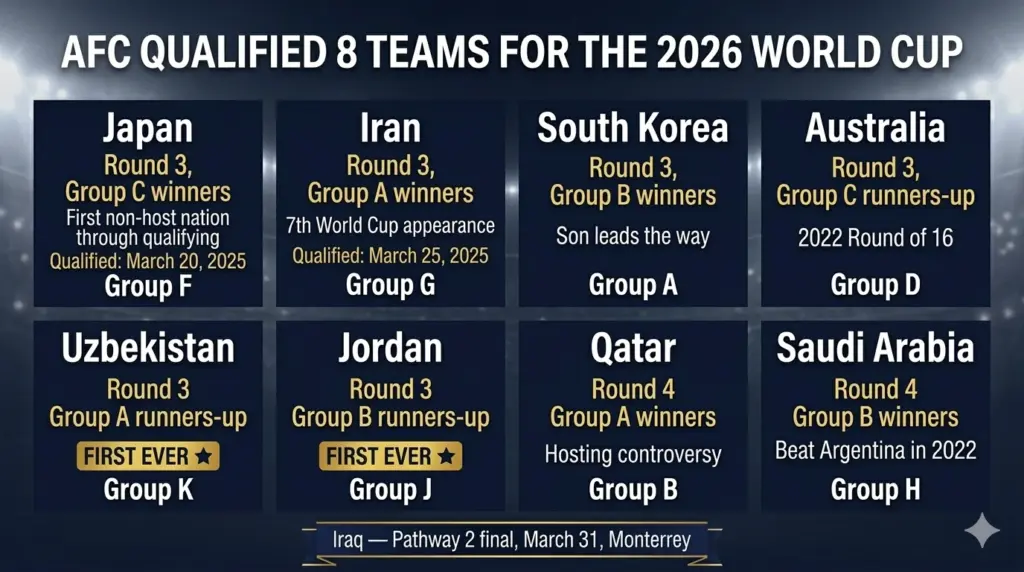
🇯🇵 Japan — Group C Winners, Round 3 (Qualified: March 20, 2025 — First Non-Host Nation Through Qualifying)
Japan was the first country to qualify through confederation qualifying on March 20. Their 2-0 win over Bahrain was the moment Asia announced its 2026 presence to the world — not just the first Asian qualifier, but the first non-host nation confirmed for the tournament.
Japan’s qualifying dominance under Hajime Moriyasu reflects a programme that has been steadily improving for three decades. Japan were awarded a 3-0 victory by forfeit after North Korea refused to host the match citing concerns about an infectious disease spreading in Japan, but Japan barely needed it. They topped Group C comfortably, losing only once across the campaign.
Japan are among Asia’s genuine tournament contenders. Their squad — featuring players at clubs across the Bundesliga, Premier League, Serie A and La Liga — reflects the depth and quality that has developed through decades of youth development. Their World Cup group and tournament path make them one of Asia’s most interesting teams to follow in North America.
🇮🇷 Iran — Group A Winners, Round 3 (Qualified: March 25, 2025)
Iran’s Group A dominance in Round 3 was expected — and under Amir Ghalenoei they qualified for a seventh World Cup appearance. Their programme treats qualification as a baseline expectation rather than an achievement.
Iran’s World Cup history includes the iconic 1998 win over the United States — one of the most politically charged results in football history. In 2022, they beat Wales 2-0 with two stoppage-time goals but were later eliminated in the group stage.
Iran are one of Asia’s physically imposing sides — tall, direct and capable of causing problems at set pieces. Their group for 2026 will determine how far their tournament run extends.
🇰🇷 South Korea — Group B Winners, Round 3 (Qualified: 2025)
South Korea qualified as Group B winners, with Heung-min Son — still their leading star in attack — continuing to define South Korean football at the highest level. Son’s decade of Premier League brilliance at Tottenham Hotspur has given South Korean football a global profile that no previous generation of Korean players achieved.
South Korea’s best World Cup result remains their astonishing 2002 run — as co-hosts, they reached the semi-finals, beating Spain and Italy along the way in results that remain among the tournament’s most debated. For the current generation, matching even a quarter-final run would represent significant achievement.
Their squad blends Son’s Premier League experience with a generation of players developing across European leagues — Lee Kang-in and Hwang Hee-chan among the most prominent. South Korea are consistently Asia’s second or third-ranked team and will be expected to advance from the group stage in North America.
🇦🇺 Australia — Group C Runners-Up, Round 3 (Qualified: 2025)
Australia finished second in Group C behind Japan, confirming their qualification with the pragmatic efficiency that their squads have consistently shown. Australia qualified as a member of the OFC in 1974 and 2006, and qualified as an AFC member for 2010, 2014, 2018, 2022 and 2026.
Australia’s 2022 World Cup campaign was the most significant in their recent history — beating Tunisia and Denmark to advance from the group stage, then taking Argentina to the wire in the Round of 16 before losing narrowly. Mathew Ryan and Mat Leckie are veterans of that campaign; the 2026 squad will contain both experienced players and the next generation of Australian talent.
The Socceroos play in a confederation that suits their physical, direct style — and they travel to North America as a credible dark horse capable of repeating or improving on their 2022 performance.
🇺🇿 Uzbekistan — Group A Runners-Up, Round 3 (Qualified: June 5, 2025 — First Ever)
Uzbekistan’s historic first World Cup qualification — the first Central Asian nation ever to reach the tournament — is covered in full in our Uzbekistan World Cup 2026 article. Their 0-0 draw in Abu Dhabi, goalkeeper Yusupov’s saves, and the celebrations in Tashkent are detailed there.
The qualifying context: Uzbekistan finished second behind Iran in Group A. Their consistency across the ten-match third round demonstrated that their qualification was earned across the campaign, not gifted by a single result.
🇯🇴 Jordan — Group B Runners-Up, Round 3 (Qualified: June 5, 2025 — First Ever)
Jordan’s first-ever World Cup qualification — secured on the same night as Uzbekistan, with Ali Olwan’s hat-trick in Muscat — is covered in full in our Jordan World Cup 2026 article. Their place in Group J alongside Argentina, Algeria and Austria, and their opening match against Argentina, are detailed there.
The qualifying context: Jordan finished second in Group B behind South Korea, confirming qualification on June 5, 2025. Their run to the 2024 AFC Asian Cup final — where they beat South Korea 2-0 in the semi-finals — was the platform their World Cup qualification was built on.
🇶🇦 Qatar — Group A Winners, Round 4 (Qualified: October 2025)
Qatar qualified from the fourth round as Group A winners — playing in Doha, at their own stadiums, against UAE and Oman. The hosting controversy does not erase the qualification: Qatar still had to win the matches. But the circumstances will be debated.
Qatar’s World Cup narrative is complex. They debuted as hosts in 2022 — losing all three group games, becoming the first host nation to be eliminated without winning a match. The 2026 tournament represents their first qualification-earned World Cup appearance, giving their programme a test that the automatic host berth could not provide.
Qatar are in Group B alongside Canada, Switzerland and the UEFA Playoff A winner — a group that will test them against North American and European quality.
🇸🇦 Saudi Arabia — Group B Winners, Round 4 (Qualified: October 2025)
Saudi Arabia rode host spots to berths from the fourth round of qualifying. Playing in Riyadh against Iraq and Indonesia, Saudi Arabia won Group B and confirmed their place in North America. The home advantage criticism was immediate — and the circumstances gave the complaints legitimacy.
Saudi Arabia’s 2022 win over Argentina — one of the tournament’s greatest upsets — remains the defining result of their recent football history. They arrive at 2026 with a squad bolstered by the domestic league’s investment in high-profile signings, though the national team benefits less directly from that than the clubs themselves.
Saudi Arabia are in Group H alongside Spain, Ukraine and Belgium — arguably one of the toughest groups for any Asian team in the tournament. Their opening match against Belgium will be one of the group stage’s most anticipated.
The Asian Teams at the 2026 World Cup: Where They Are
| Team | Group | Key Opponents | How They Qualified |
|---|---|---|---|
| Japan | F | Netherlands, Tunisia | Round 3, Group C — 1st (first non-host nation through qualifying) |
| Iran | G | Belgium, Egypt, New Zealand | Round 3, Group A — 1st |
| South Korea | A | Mexico, South Africa, UEFA Playoff D winner | Round 3, Group B — 1st |
| Australia | D | USA, Paraguay, UEFA Playoff C winner | Round 3, Group C — runner-up |
| Uzbekistan | K | Portugal, Colombia, FIFA World Cup 2026 Play-Off Tournament Pathway 1 winner | Round 3, Group A — runner-up — debut |
| Jordan | J | Argentina, Algeria, Austria | Round 3, Group B — runner-up — debut |
| Qatar | B | Canada, Switzerland, UEFA Playoff A winner | Round 4, Group A — hosting controversy |
| Saudi Arabia | H | Belgium, Spain, Ukraine | Round 4, Group B — home conditions |
| Iraq* | I | Norway, France, Senegal | Round 5 — beat UAE 3-2 aggregate |
*Iraq only if they win the Pathway 2 final in Monterrey on March 31.
The Biggest Absentees: China, UAE and Indonesia
China — the world’s most populous nation with a vast football market and sustained investment in development — did not make it past the third round. Chinese football’s underperformance relative to the country’s size and resources remains the great unfulfilled story of Asian football. A nation of more than a billion people continues to watch the World Cup from home.
UAE — who fell in the fifth round to Iraq by a 3-2 aggregate scoreline — came within two goals of making a World Cup for the first time since 1990. The dramatic two-legged elimination will be replayed by UAE football fans for years. Their programme — increasingly well-resourced and professionally run — will be among the frontrunners to qualify in 2030.
Indonesia — whose Round 4 exit was the most heartbreaking of any Asian team — achieved the most dramatic improvement of any nation in the entire AFC qualifying cycle. Ranked 166th before Shin Tae-yong began his work, Indonesia reached the fourth round with a squad that included naturalised players from the Netherlands, bringing Dutch football DNA to an Indonesian programme that had never previously approached this level. Indonesia’s 280 million people — the fourth-largest population on earth — will be watching the 2026 World Cup without their team, but knowing how close they came.
Decision Framework: Which Asian Team Should You Follow?
If you want the genuine contenders: Japan — technically sophisticated, European-league based, and the team that qualified first among non-host nations. They travel to North America as Asia’s most complete side.
If you want the star power: South Korea — Heung-min Son at what could be his final World Cup. One of the Premier League’s greatest players on the world stage.
If you want the debut story: Jordan, in Group J against Argentina, Algeria and Austria, and Uzbekistan, in Group K against Portugal and Colombia — two first-time qualifiers with extraordinary stories. Full profiles in our dedicated articles.
If you want the upset potential: Saudi Arabia beat Argentina in 2022. They face Belgium, Spain and Ukraine in Group H. If they can do it again, chaos will have a new passport stamp.
If you want the controversy: Qatar — returning to the World Cup after a gifted 2022 host berth, now earning it through the fourth round. But the hosting controversy of that round means questions remain.
If you want the March drama: Iraq face the Bolivia vs Suriname winner in the Pathway 2 final on March 31 in Monterrey. A win takes them back to the World Cup for the first time since 1986. Everything is still alive.
AFC Qualified 8 Teams for the 2026 World Cup: Frequently Asked Questions
How many teams does Asia send to the 2026 World Cup?
AFC teams were allocated eight direct qualifying slots and one inter-confederation play-off slot. Eight direct qualifiers are confirmed. Iraq compete in the Pathway 2 final on March 31 for a potential ninth spot.
How did the AFC qualifying format work?
The qualification process involved five rounds. Round 1 eliminated the lowest-ranked 20 teams in home-and-away ties. Round 2 placed 36 teams in nine groups of four. Round 3 placed 18 teams in three groups of six — top two from each group, six teams, qualified directly. Round 4 placed the remaining six in two groups of three in Qatar and Saudi Arabia — group winners, two teams, qualified. Round 5 was a two-legged playoff between the two Round 4 runners-up — Iraq beat UAE 3-2 on aggregate to reach the FIFA World Cup 2026 Play-Off Tournament.
Which Asian teams qualified for the first time?
Jordan and Uzbekistan both qualified for the World Cup for the first time in their histories. Both secured qualification on June 5, 2025. Full stories appear in our dedicated Jordan World Cup 2026 and Uzbekistan World Cup 2026 articles.
Why was the Round 4 controversial?
The decision to hold the centralised playoff format in Qatar and Saudi Arabia was met with criticism from Indonesia, Iraq, Oman and the United Arab Emirates over concerns of competitive advantage. Both Qatar and Saudi Arabia won their groups while hosting — giving rise to accusations of home advantage in a process that was meant to be a neutral qualifying round.
When did Japan qualify — and why does it matter?
Japan qualified on March 20, 2025. Not just the first Asian nation — the first non-host nation, and the first team through confederation qualifying. Japan’s 2-0 win over Bahrain made them the first side outside the three co-hosts to book a place at the tournament.
Why did North Korea play home matches in Laos and Saudi Arabia?
North Korea chose Vientiane, Laos, as their home site for their matches against Qatar, Iran and Uzbekistan due to security concerns. North Korea also chose Riyadh, Saudi Arabia, as their home site for their matches against the United Arab Emirates and Kyrgyzstan. North Korea does not allow foreign nationals to attend matches in Pyongyang, and their isolated political situation made hosting in the DPRK impossible.
What happened to Indonesia?
Indonesia — ranked outside the top 150 before their campaign began — reached the fourth round under manager Shin Tae-yong before being eliminated in Saudi Arabia. They came closer to World Cup qualification than at any point since their lone appearance in 1938 as the Dutch East Indies.
How did Iraq qualify for the FIFA World Cup 2026 Play-Off Tournament?
Iraq finished as runners-up in Round 4 Group B behind Saudi Arabia, then beat UAE 3-2 on aggregate in the two-legged Round 5 playoff — winning the second leg 2-1 to clinch the tie.
Where is Iraq’s Pathway 2 final?
Iraq face the winner of Bolivia vs Suriname on March 31, 2026 in Monterrey, Mexico. A win qualifies Iraq for the World Cup — their first since 1986.
Which was the biggest Asian qualifier surprise?
Jordan and Uzbekistan qualifying for the first time — combined with Indonesia’s run to the fourth round — were the three biggest positive surprises. The failure of China to advance past Round 3 was the biggest underperformance relative to expectations.
Key Takeaway
Asia’s road to 2026 was 25 months, five rounds and every extreme that international football can produce — from North Korea playing home matches in two foreign countries to the first non-host nation qualifying, to two debut qualifications on the same night, to a hosting controversy that overshadowed two of the eight qualification moments.
Eight Asian nations are confirmed for North America. A ninth — Iraq — will be decided on March 31 in Monterrey. Japan lead Asian football into its biggest World Cup with the distinction of having been the first non-host nation, and the first team through confederation qualifying, to secure their place.
Whether it is Jordan facing defending champions Argentina, Uzbekistan facing Portugal, or Japan facing whichever European power awaits them — Asia’s 2026 World Cup will be the most significant in the confederation’s history.
Sources
- FIFA — Japan qualify for the FIFA World Cup 26
- FIFA — Japan book first ticket to game-changing FIFA World Cup 26
- FIFA — Qualified teams for the FIFA World Cup 2026
- FIFA — Play-Off Tournament draw results
- FIFA — Match schedule for FIFA World Cup 2026 Play-Off Tournament
- FIFA — Tickets now on sale for FIFA World Cup 2026 Play-Off Tournament
- FIFA — Final Draw results
- FIFA — IR Iran World Cup history, records and 2026 fixtures
- FIFA — Wales 0-2 IR Iran match review
- FIFA — AFC qualifying standings