



High press football explained starts with a simple idea: the best teams do not always wait to defend near their own box. Instead, they try to win the ball back high up the pitch, close to the opponent’s goal, where one mistake can turn into a shot within seconds. From Jürgen Klopp’s Liverpool to Japan’s comeback wins over Germany and Spain at the 2022 World Cup, pressing from the front has changed how modern football is played and watched.
At the 2026 World Cup, it is one of the central tactical battlegrounds. Some teams will try to dominate matches by pressing high and forcing turnovers. Others will try to survive that pressure, play through it, or go over it. That clash of ideas is one of the clearest ways to understand how top-level football now works.
This guide explains exactly what the high press is, why it works, how teams trigger it, and which nations at the 2026 World Cup are most associated with pressing football. It also explains how teams defend against the press and why Japan remain one of the most interesting pressing case studies going into the tournament.
TL;DR
- The high press means defending by trying to win the ball back high up the pitch, near the opposition’s goal, rather than retreating and defending deep.
- It works because teams are often most vulnerable in the moment immediately after they lose or regain possession.
- Pressing requires triggers — specific moments that tell players when to press together.
- Several major 2026 World Cup teams, including Japan, Spain, England, Germany, Argentina and Uruguay, are associated with aggressive or selective pressing structures.
- The main weakness is clear: if the press is beaten, large spaces can open up behind it.
- The main counters are to build through the press, play over it, or draw it to one side and switch quickly.
Snippet: The high press in football means actively trying to win the ball back in the opponent’s half by pressing defenders and the goalkeeper immediately after losing possession. Rather than retreating into a deeper shape, pressing teams apply coordinated pressure high up the pitch. The key is using “press triggers” — specific moments such as a bad touch, back pass or short goal-kick routine — that signal multiple players to press together. Japan, Spain, England, Germany, Argentina and Uruguay are among the teams commonly associated with pressing structures in the modern international game.
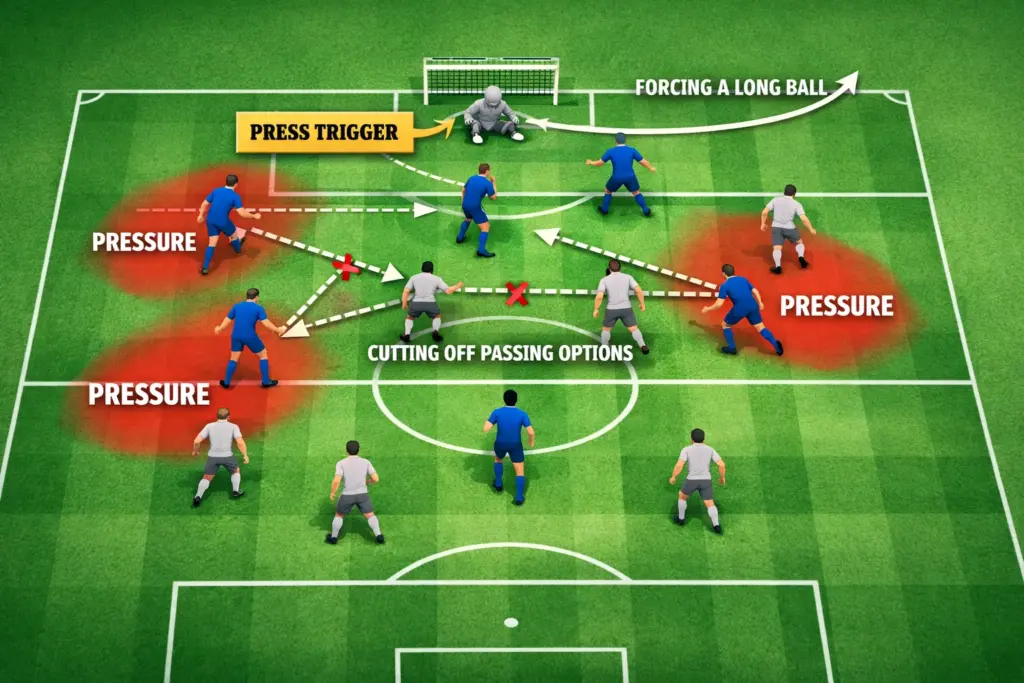
High press football explained: What Is the High Press?
Most defensive systems in football are reactive: wait for the opposition to come forward, organise your shape, and then try to stop them. The high press is different. It is proactive. Instead of waiting, a pressing team immediately hunts the ball when it loses possession, trying to win it back before the opposition can settle.
The word “high” describes where the defending happens. A high press aims to recover the ball high up the pitch, often near the opposition’s penalty area or in the middle third close to it. That matters for three reasons.
- If you win the ball near the opponent’s goal, you need fewer passes to create a chance.
- The opposition is often disorganised just after winning the ball.
- Defenders and goalkeepers are usually under the most stress when they are forced to play quickly under pressure.
The opposite idea is a low block. In a low block, a team sits deeper, stays compact, and waits for the opponent to move into dangerous areas before engaging. Both approaches can work. The high press simply accepts more risk in exchange for the chance to regain the ball in better attacking positions.
The History: From Cruyff to Klopp to Moriyasu
The idea of pressing is older than many people think. Johan Cruyff’s Ajax and the wider Dutch school of positional football emphasised winning the ball back quickly after losing it. Later, Ralf Rangnick helped shape the modern German pressing tradition. Then Jürgen Klopp turned counter-pressing, or gegenpressing, into one of the defining tactical ideas of the 2010s.
Klopp’s famous principle was simple: the best moment to win the ball is often immediately after you lose it, because the opposition has not yet organised its next action. That transition moment — often called the negative transition when a team loses possession — is where pressing teams try to strike.
At international level, Japan under Hajime Moriyasu has become one of the most closely watched examples of organised, situational pressing. FIFA’s World Cup coverage still highlights Japan’s comeback wins over Germany and Spain in Qatar as major tournament upsets, and those results remain central to how people discuss Japan’s modern tactical identity. The key point is not that Japan press every second. It is that they press at the right moments, with collective timing, and often with great discipline. Source: FIFA World Cup Qatar 2022
High press football explained: How the High Press Works
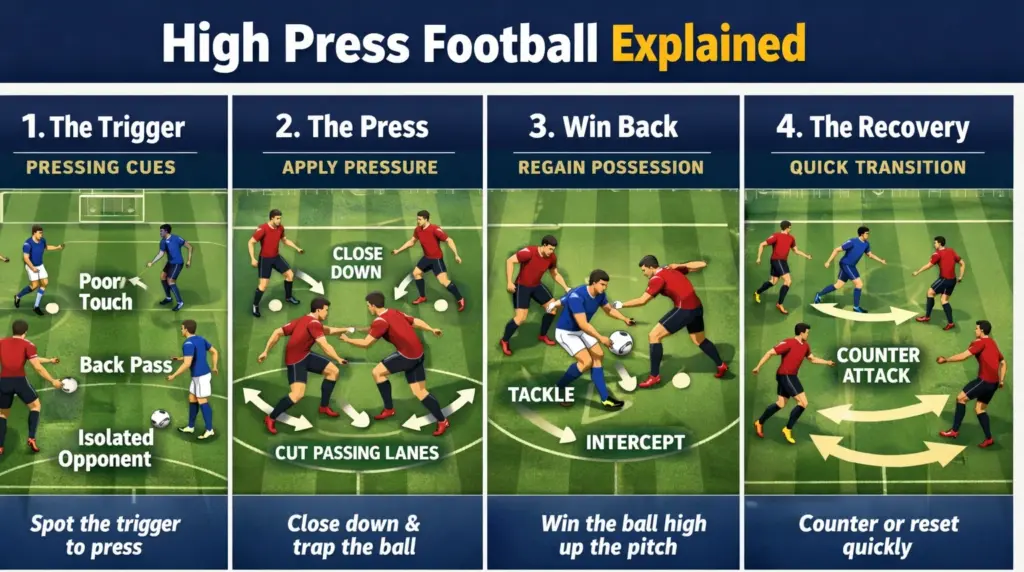
Phase 1: The Trigger
The press does not begin randomly. If players sprint at the ball without coordination, the result is usually chaos, not control. Good pressing teams work with press triggers: specific moments that tell several players at once that the press is on.
Common press triggers include:
- Back pass to the goalkeeper: the goalkeeper may have fewer forward options and less time.
- Poor first touch: the receiver has lost a little control, so the pressure can arrive before recovery.
- Side pass to a weaker passer: certain defenders are targeted more than others.
- Ball moved into the corner or touchline zone: the space narrows and passing options shrink.
- Short goal kick: the opponent is inviting build-up in a risky zone.
The real art lies in collective reading. When the front line sees the trigger and the midfield line steps up with it, the press can suffocate the next pass. When only one player goes, the press usually breaks before it begins.
Phase 2: The Press
Once the trigger appears, the nearest players close down the ball carrier quickly, often trying to force a decision within a few seconds. At the same time:
- The nearest player applies direct pressure.
- Supporting pressers block the obvious passing lanes.
- The midfield line squeezes up behind them.
- The back line holds a position that keeps the team compact without overcommitting.
The goal is not just to run hard. The goal is to create a press trap. A press trap is a situation in which the opponent feels they have an option, but the next pass has already been anticipated and closed.
Phase 3: The Win-Back
If the press works, the ball is won back in the opposition’s half. That is where the system becomes so dangerous.
- The opponent is often facing its own goal or moving backward.
- The pressing team is already advanced and compact.
- The distance to create a shot is short.
This is why many “brilliant attacks” actually begin as organised defensive actions. The press wins the ball, and the attack starts before the opponent can repair its shape.
Japan’s 2022 goals against Germany and Spain are still useful examples here. Those matches were not a constant 90-minute swarm, but they did show how quickly a team can punish opponents after pressing moments and transitional chaos. Source: FIFA World Cup Qatar 2022
Phase 4: Recovery if the Press Is Beaten
This is the danger. If the ball carrier escapes pressure and finds a teammate in space behind the first line, the pressing team can suddenly be in trouble. A clipped pass, a switch of play, or a clean vertical ball through midfield can turn a promising press into a defensive emergency.
That is why pressing is not just tactical; it is physical. Players must be able to sprint into the press and then sprint back into recovery positions if the first wave is broken. Without that recovery speed, the high press becomes a self-inflicted mess.
high press football explained: Pressing Metrics
Two common ways to discuss pressing are PPDA and high turnovers.
PPDA (Passes Allowed Per Defensive Action) measures how many opposition passes a team allows before making a defensive action such as a tackle, interception or foul. In simple terms, a lower PPDA usually suggests a more aggressive pressing approach. Source: The Analyst
High turnovers count how often a team wins the ball in advanced areas, especially in the final third. If those numbers are high, the press is probably creating useful attacking situations rather than just making the game look busy.
However, metrics need context. A team can post strong pressing numbers in short bursts, against certain opponents, or only in certain game states. Pressing is never just a number. It is a relationship between structure, opponent quality, fatigue and timing.
high press football explained: Which 2026 World Cup Teams Press High?
Japan: Japan remain one of the clearest examples of a disciplined, well-timed pressing side in international football. Their 2022 World Cup wins over Germany and Spain still define how their pressing is discussed, and the official 2026 draw placed them in Group F with the Netherlands, Tunisia and the UEFA play-off Path B winner. That group setup makes Japan a particularly interesting tactical watch, because they are likely to face both controlled build-up and more direct escape routes from opponents. Source: FIFA Final Draw Results
Spain: Spain are closely associated with counter-pressing because of how they structure possession. When they lose the ball, their shape often places several players close enough to smother the next action quickly. At the 2026 World Cup, Spain are in Group H with Cabo Verde, Saudi Arabia and Uruguay, which gives them at least one especially fascinating tactical group-stage test against Bielsa’s Uruguay. Source: FIFA Final Draw Results
England: England under Thomas Tuchel are strongly associated with proactive, front-foot football. UEFA’s qualification coverage shows that England reached the 2026 World Cup with a 100% record in Group K, scoring 22 goals and conceding none, and Tuchel spoke early in his reign about intensity, identity and clear tactical behaviour out of possession. That does not mean England will press wildly all game. It does mean they have the coaching profile and player pool to press high in organised moments. Source: UEFA European Qualifiers
Germany: Germany have long been linked to pressing structures, and Julian Nagelsmann’s teams are no exception. Germany qualified as Group A winners in UEFA qualifying, and their tactical identity still leans toward active defending, coordinated movement and aggressive ball-winning phases rather than passive retreat. Source: UEFA European Qualifiers
Argentina: Argentina do not always press at maximum intensity, but they are one of the best examples of a side that can counter-press selectively and then become ruthless after the regain. Their pressing is often less about endless running and more about choosing the right moment to squeeze.
Uruguay: Uruguay under Marcelo Bielsa are associated with one of the most aggressive pressing reputations in world football. That makes their confirmed 2026 group-stage meeting with Spain especially compelling. If Spain try to build cleanly and Uruguay try to make the game frantic, the match could become a classic contest between composure and pressure. Source: FIFA Final Draw Results
High press football explained: How Teams Defend Against the High Press
If your team is being pressed, there are three main answers.
Option 1: Build through the press (press-resistant play)
This means short, accurate passing under pressure. It requires a goalkeeper who can act like an extra outfield player, defenders who stay calm, and midfielders who can receive on the half-turn. Spain are the obvious reference point here. Their answer to pressure is often technical security.
Option 2: Play over the press (direct)
This means bypassing the first wave immediately. A long ball to a striker, a clipped pass into the channel, or a switch to an isolated wide player can break the press before it settles. This is a common solution for teams that do not want to spend all day passing in dangerous areas.
Option 3: Draw the press and switch (hybrid)
This is usually the most sophisticated solution. The idea is to invite pressure on one side and then move the ball quickly to the opposite side where space has opened up. Many top teams use this approach because it turns the opponent’s aggression into a structural weakness.
The best anti-pressing teams do not rely on only one method. They mix all three. That unpredictability matters because the high press feeds on repeated patterns. Once the pressing side knows exactly where you want to go, the trap becomes much easier to spring.
The Physical Cost of Pressing
High pressing is exhausting. It demands repeated accelerations, decelerations, short sprints, recovery runs and constant concentration. A team can be tactically brilliant for 20 minutes and still lose control if the physical level drops.
This is one reason tournament football makes pressing so interesting. A World Cup is not one match. It is a sequence of matches, often against very different opponents and under different emotional and physical conditions. A team that presses brilliantly in one round must still have the legs to do it again later.
That is why squad depth matters. It is also why some teams press in waves rather than at maximum intensity from the opening minute to the last. Smart pressing is not only about aggression. It is also about energy management.
High press football explained: Pressing vs Low Block in 2026
The most interesting tactical story of the 2026 World Cup may not be one formation against another. It may be the wider contest between teams that want to force chaos high up the pitch and teams that want to stay compact, survive pressure and punish the space behind it.
A few examples show why this matters:
- Spain vs Uruguay offers a confirmed group-stage clash between a possession-heavy side that can counter-press and a Bielsa team associated with relentless intensity.
- Japan vs Netherlands offers another compelling contrast in Group F, with Japan’s organised pressure tested against a nation strongly linked to controlled build-up and positional play.
- Potential knockout ties involving teams such as England, France, Germany, Argentina or Portugal could easily turn into contests between pressing bursts and press resistance rather than simple possession totals.
The team that solves the pressing problem best — whether by executing the press brilliantly or surviving it calmly — will give itself a major edge deep into the tournament. Source: FIFA Final Draw Results
FAQs
What is the high press in football?
The high press means trying to win the ball back in the opponent’s half by pressing defenders and the goalkeeper quickly after losing possession, rather than dropping into a deeper defensive shape.
What is gegenpressing?
Gegenpressing is German for “counter-pressing.” It describes pressing immediately after losing the ball, especially in the few seconds after possession changes hands.
Which teams press high at the 2026 World Cup?
Japan, Spain, England, Germany, Argentina and Uruguay are all commonly associated with pressing structures, although they do not all press in the same way or at the same intensity.
How do you defend against a high press?
The main solutions are to build through it with calm short passing, play over it with direct balls, or draw it to one side and switch play quickly into the space it leaves.
What is PPDA in football?
PPDA stands for Passes Allowed Per Defensive Action. It is a common metric used to describe how aggressively a team presses.
Why does the high press sometimes fail?
It usually fails when the first line presses without support, when the team leaves too much space behind the press, or when the opponent has enough technical quality to play through it cleanly.
Conclusion: Why the High Press Is the Defining Tactic of the 2026 World Cup
For two decades, the high press has been one of football’s most transformative tactical ideas. It turned ball-winning into an attacking weapon. It changed the role of the goalkeeper. It raised the defensive demands placed on forwards and made collective timing every bit as important as individual talent.
At the 2026 World Cup, the teams that press well will be able to control territory, force mistakes and create chances without needing long, patient attacking sequences. Just as importantly, the teams that can survive the press will be able to punish that aggression and open huge spaces in transition.
That is why the high press matters so much. It is not just a defensive method. It is a way of controlling time, space and panic. And by the time the tournament ends with the final in New York New Jersey on July 19, 2026, the battle between pressure and composure may have told us almost everything about why the champions lifted the trophy. Source: FIFA Final Announcement


