
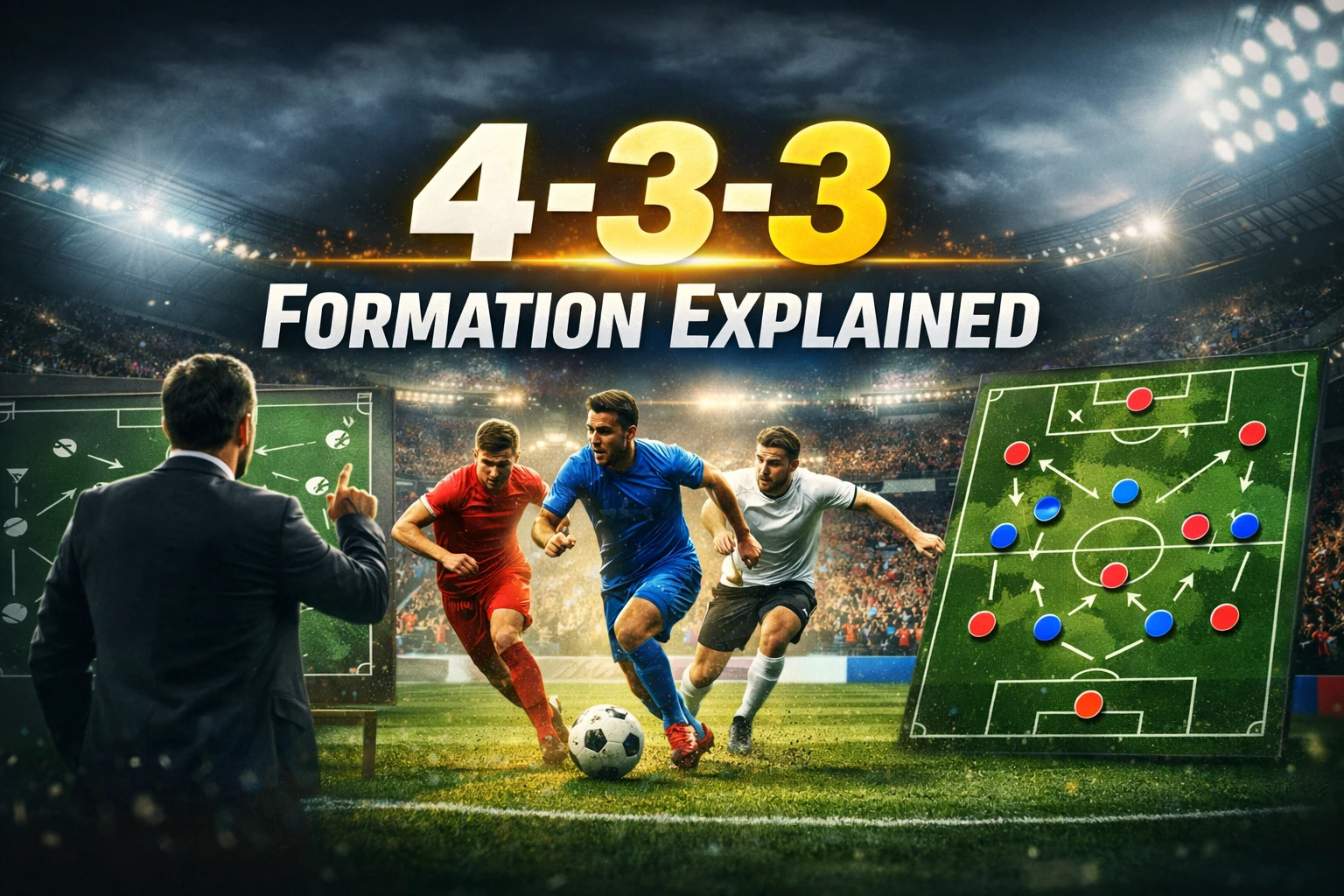

4-3-3 formation explained starts with a simple idea: four defenders, three midfielders and three forwards. It is one of the most influential systems in modern football, from Barcelona’s golden era and Dutch Total Football to many of the strongest teams heading into the 2026 World Cup, where pure 4-3-3 shapes and close variations are likely to be among the tournament’s most common systems. References: FIFA World Cup 2026 teams, ESPN 2026 World Cup confirmed teams analysis.
Understanding the 4-3-3 will make every match you watch richer. This guide explains exactly how it works in and out of possession, the specific roles of each position, where the system is strong, where it is vulnerable, and how the best teams in 2026 are using it.
TL;DR
- The 4-3-3 means 4 defenders, 3 midfielders, 3 forwards.
- In possession, wide forwards stretch the pitch and create overloads while midfield controls the ball.
- Out of possession, wide forwards press from the front and midfield blocks central passing lanes.
- Strengths: width, high pressing, quick transitions, flexibility.
- Weaknesses: exposed fullbacks, demanding on wide forwards, needs a high-quality central midfielder.
- 2026 World Cup teams using it: Argentina, Spain and Colombia; Morocco, Netherlands and Portugal use close variations.
Snippet: The 4-3-3 formation means four defenders, three midfielders and three forwards. It is one of the most popular systems in world football, used by Argentina, Spain, Colombia and others at the 2026 World Cup, with Morocco, Netherlands and Portugal using close variations. Its core strength is width — the two wide forwards stretch defences and create space for the central striker and attacking midfielder. Its main weakness is the space left behind the fullbacks when they push forward.
4-3-3 Formation Explained: What Does It Mean?
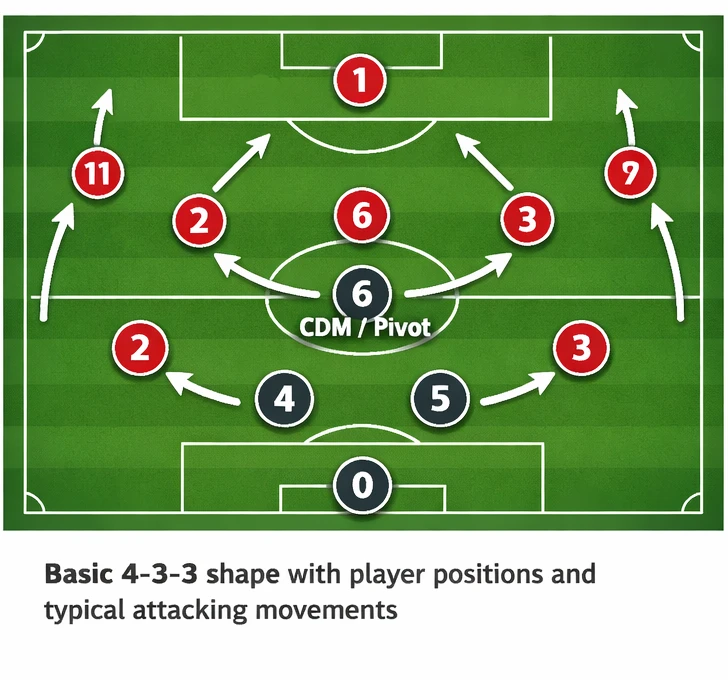
The numbers in any football formation describe how players are arranged from defence to attack, not counting the goalkeeper.
- 4 = four defenders (two centre-backs and two fullbacks)
- 3 = three midfielders (usually one defensive and two more attacking, or three balanced central midfielders)
- 3 = three forwards (one central striker and two wide forwards or wingers)
That is 10 outfield players in total, plus the goalkeeper, making 11.
The formation looks like a triangle or a rectangle depending on how the midfield three are arranged. Most modern 4-3-3 systems use a midfield triangle — one midfielder sitting deeper, the pivot or holding midfielder, with two others higher and wider on either side.
4-3-3 Formation Explained: The Roles and Responsibilities
The Goalkeeper (GK)
In a 4-3-3, the goalkeeper is often expected to be more than a shot-stopper. Modern 4-3-3 teams, especially those who play out from the back, want a goalkeeper who can pass accurately under pressure. Ederson, Alisson and Manuel Neuer are archetypes: excellent with the ball at their feet and able to act as an extra outfield player during build-up.
The Right Back and Left Back (Fullbacks)
The fullbacks in a 4-3-3 are among the most important — and most physically demanding — positions on the pitch. Their job has two completely different phases.
In possession: Push forward into the wide areas, overlap the wide forwards or tuck inside to create midfield overloads. Modern fullbacks like Trent Alexander-Arnold and Achraf Hakimi are essentially wide midfielders when their team has the ball.
Out of possession: Sprint back into a defensive line of four, mark the opposition’s wide players and protect the space behind them. This is exhausting work over 90 minutes, which is why fullbacks in top 4-3-3 systems run more distance per match than almost any other position.
The Centre-Backs (CBs)
Two centre-backs form the defensive spine. In a 4-3-3, the centre-backs must be comfortable on the ball because the team builds through them. One centre-back typically plays wider, sweeping up balls in behind, while the other can step forward with the ball once the pressing forward has been committed. Composure under pressure is essential.
The Holding Midfielder / Pivot (CDM or No. 6)
This is arguably the most important position in the 4-3-3. The holding midfielder sits between the defensive line and the two higher midfielders, protects the space in front of the centre-backs and recycles possession.
The best holding midfielders in 2026 include Rodri for Spain, Casemiro for Brazil, Sofyan Amrabat for Morocco and Enzo Fernández for Argentina.
Their job in possession is to receive the ball from defenders under pressure, find a safe pass and reset the build-up. Out of possession, they intercept passes, win second balls and can drop between the centre-backs to help form a back three when fullbacks push forward.
The Two Central Midfielders (CMs / No. 8s)
The two players either side of the holding midfielder are usually the most dynamic in the team. They cover huge amounts of ground — forward to support attacks and back to cover — and connect defence to attack.
In possession, they receive the ball in half-spaces, the zones between wide and central areas, drive forward, switch play and support the forwards. Out of possession, they press the opposition’s midfielders, block passing lanes and support the holding midfielder.
Examples include Pedri and Gavi for Spain, Jude Bellingham in an advanced version of the role for England, and Alexis Mac Allister and Rodrigo De Paul for Argentina.
The Wide Forwards / Wingers (RW and LW)
The two wide forwards are the most visible players in a 4-3-3 — and the most talked about. They generally operate in one of two ways.
Traditional winger: stays wide, takes on fullbacks with pace and dribbling, and delivers crosses for the striker. Gareth Bale in his prime is a classic example.
Inverted winger: starts wide but cuts onto the stronger foot to shoot or create. That usually means a left-footed player on the right side and a right-footed player on the left. This is the dominant modern version. Examples include Lamine Yamal on Spain’s right wing, Vinícius Júnior on Brazil’s left wing and Leroy Sané for Germany. References: FC Barcelona: Lamine Yamal player page.
In the 2026 World Cup context, Morocco often defend in a 4-1-4-1 shape, with the wingers dropping alongside the midfield line while Sofyan Amrabat protects the centre. That makes their version of the 4-3-3 one of the most tactically sophisticated systems in the tournament. References: ESPN Morocco match formation page, CAF Morocco qualification report.
The Centre-Forward (ST / No. 9)
The striker in a 4-3-3 is often a different type from the traditional target man. Because the wide forwards cut inside and take up central positions, the striker must find space differently — dropping deep to link play, making runs in behind or operating as a second creator.
The false nine — a striker who drops deep and lets others run beyond — is a 4-3-3 variation. Lionel Messi played this role at Barcelona famously. Brazil’s problem in 2026 is precisely this: they have Vinícius, Rodrygo and Estêvão all wanting central space, with no natural target striker to hold the line. That is a classic 4-3-3 structural problem.
Classic 4-3-3 strikers in 2026 include Robert Lewandowski for Poland, Darwin Núñez for Uruguay and Memphis Depay for the Netherlands when fit.
4-3-3 Formation Explained: How It Works In Possession
When a team using the 4-3-3 has the ball, the pitch should look like this.
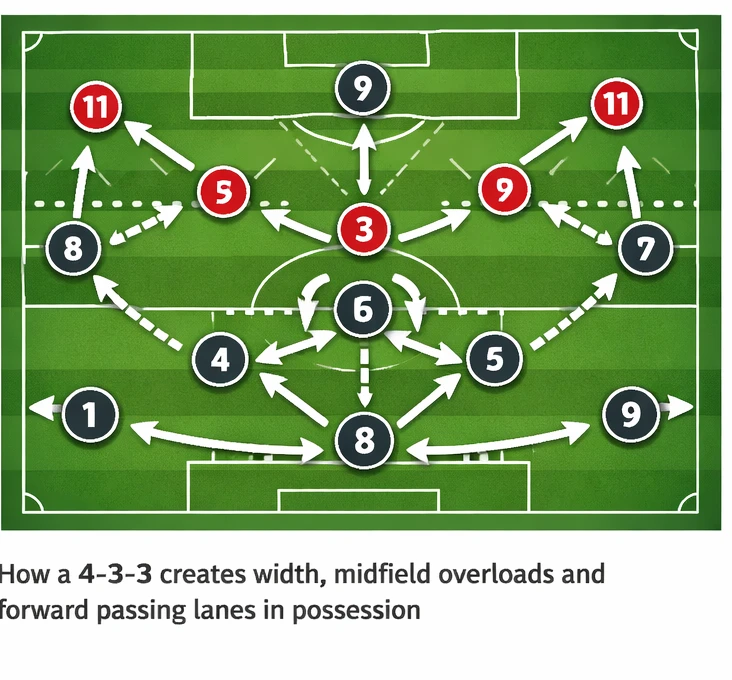
Phase 1 — Build-up from the back: The goalkeeper passes to one of the centre-backs. The holding midfielder drops between the centre-backs, creating a temporary back three. This gives the two fullbacks freedom to push wide and high, creating a 3-2 structure in the first third.
Phase 2 — Through midfield: The two central midfielders position themselves in the half-spaces, the gaps between the opposition’s wide players and central midfielders. The team builds through short passes, looking to find the central midfielders between the lines. This is where players like Pedri, De Paul and Bellingham thrive.
Phase 3 — Into attack: Once the midfielders receive between the lines, the wide forwards make runs either in behind the fullbacks or inside to create shooting opportunities. The striker moves to occupy the centre-backs, and the fullbacks continue forward as late overlapping runners.
The result, when it works, is that the opposition is stretched wide and deep at the same time, creating gaps everywhere.
4-3-3 Formation Explained: How It Works Out of Possession
The 4-3-3 pressing system is one of the most demanding and most effective defensive structures in football when applied correctly.
Front three press: The two wide forwards and the striker press the opposition’s defensive line together, cutting off passing angles and forcing the ball wide or into a mistake. Spain, Argentina and Morocco all use coordinated front-three pressing triggers.
Midfield blocks: When the front three press, the three central midfielders push up to close the gaps behind, cutting off passes into the opposition’s midfield. The holding midfielder is the last line before the defence.
Defensive shape: When the press fails and the opposition breaks through, the team reverts to a 4-3-3 defensive block — compact, narrow and hard to play through centrally.
4-3-3 Formation Explained: Strengths
Width and overloads: Two wide forwards plus two overlapping fullbacks creates four wide threats at once. No defensive shape can comfortably cover all of them.
High pressing from the front: Three forwards pressing as a coordinated unit can win the ball high up the pitch and create short scoring opportunities.
Flexibility in midfield: The midfield three can shift into a 3-1 structure or a 1-2 structure depending on the situation.
Quick transition: When the team wins the ball high, the forwards are already in advanced positions, reducing the distance to goal for counter-attacks.
4-3-3 Formation Explained: Weaknesses
Exposed fullbacks: When fullbacks push forward, the space behind them is large. If the opposition has fast wide forwards, they can exploit this channel mercilessly. This is one reason Argentina vs France in the 2022 World Cup final produced so many dangerous wide moments.
Physically demanding on wide forwards: In a modern 4-3-3, wide forwards must press, track back, defend and attack continuously. Over 90 minutes at a World Cup, this is gruelling, particularly in summer heat.
Reliance on the holding midfielder: If the holding midfielder is overrun or injured, the entire structure breaks down. That is why Rodri’s return from injury became such a major talking point around Spain before 2026. References: ESPN on Spain before the World Cup, Sporting News Spain injury/team news report.
Central striker isolation: If the two wide forwards cut inside, the striker can become isolated against two centre-backs with no support. That requires a very mobile, creative striker, which is not every team’s strength.
4-3-3 Formation Explained: 4-3-3 vs 4-2-3-1
Many people confuse the 4-3-3 and the 4-2-3-1. They look similar but work differently.
| Feature | 4-3-3 | 4-2-3-1 |
|---|---|---|
| Midfield structure | One pivot + two box-to-box | Two defensive midfielders + one attacking midfielder |
| Defensive security | Slightly less secure centrally | More secure with a double pivot |
| Attacking freedom | Higher, because midfielders get forward | Lower, because defensive midfielders stay back |
| Width | Two wide forwards | Wide midfielders in the attacking three |
| Best when | Dominating possession | Controlling without the ball |
| Teams that use it | Argentina, Spain, Morocco | England, France |
The 4-2-3-1 sacrifices some attacking freedom for defensive structure. The 4-3-3 trusts the front three to both press and create, which requires higher-quality players and more coordinated movement.
4-3-3 Formation Explained: Which 2026 World Cup Teams Use It?
Argentina — Lionel Scaloni’s 4-3-3 is one of the most studied systems at the tournament. Argentina’s midfield triangle usually rotates responsibilities between Enzo Fernández, Alexis Mac Allister and Rodrigo De Paul rather than assigning one fixed holder in every phase. Lautaro Martínez and Julián Álvarez can rotate at striker, and Argentina controlled possession in qualifying more often than almost any South American side. References: FIFA qualified teams for World Cup 2026, ESPN Argentina World Cup roster and shape preview.
Spain — Spain are one of the purest 4-3-3 teams in the tournament when Rodri plays. Pedri and Gavi operate as advanced midfielders, while Lamine Yamal and Nico Williams provide width and directness from the wings. Spain’s shape can look simple on paper, but the timing and interchange in their midfield and wide areas is highly sophisticated. References: ESPN on Spain’s World Cup build-up, ESPN Spain World Cup roster and shape preview.
Morocco — Morocco often look like a 4-3-3 in possession and a 4-1-4-1 out of possession. Achraf Hakimi is the attacking fullback, while the wingers drop back to support the midfield line when defending. Morocco qualified with a perfect record and remained one of CAF qualifying’s toughest defensive sides. References: CAF Morocco qualification report, FIFA qualified teams for World Cup 2026.
Colombia — Colombia use one of the most dynamic attacking 4-3-3 variations in the tournament. James Rodríguez can operate in the advanced midfield role, while Luis Díaz and Jhon Arias give width and forward thrust. FIFA and ESPN both highlighted Colombia’s assertive attacking profile during qualification. References: FIFA on Colombia’s qualification, ESPN Colombia World Cup analysis.
Netherlands — The Dutch 4-3-3 tradition continues under Ronald Koeman, although the shape can also tilt toward 4-2-3-1 depending on the opponent. Memphis Depay can play centrally when fit, with Cody Gakpo and Xavi Simons providing movement and threat from the sides. References: ESPN Netherlands World Cup analysis, FIFA qualified teams for World Cup 2026.
Portugal — Portugal can resemble a 4-3-3, but they often shift into a 4-2-3-1 or hybrid shape depending on personnel and match state. Bruno Fernandes remains the key advanced midfielder, and that tactical flexibility is one of the reasons Portugal are so difficult to prepare for. References: ESPN Portugal World Cup analysis, FIFA qualified teams for World Cup 2026.
Decision Framework: Is the 4-3-3 Right for a Team?
A team suits the 4-3-3 when they have:
- Two genuine wide threats with pace, dribbling or creativity on the flanks.
- A reliable holding midfielder who can protect and recycle possession.
- Fullbacks fit enough to cover both attacking and defensive duties in the same match.
- A striker who can operate without constant service and hold the line alone.
A team should consider a different formation when they have:
- A world-class number 10 who needs a central creative role.
- Weak fullbacks who cannot defend wide areas alone.
- No natural holding midfielder.
- A traditional target striker who needs crosses rather than cutbacks.
FAQs
What does 4-3-3 mean in football?
It means four defenders, three midfielders and three forwards. The goalkeeper is not counted in formation numbers.
Which teams use the 4-3-3 at the 2026 World Cup?
Argentina, Spain and Colombia are among the clearest 4-3-3 teams. Morocco, Netherlands and Portugal use close variations of it.
What is the difference between a 4-3-3 and a 4-2-3-1?
The main difference is the midfield structure. A 4-3-3 has one holding midfielder and two box-to-box players. A 4-2-3-1 has two defensive midfielders and one attacking midfielder, making it more defensively secure but less attacking through the middle.
What is the weakness of the 4-3-3?
The main weakness is the space left behind the fullbacks when they push forward. Fast opposition wingers can exploit this. It also requires a technically superior holding midfielder, and without one the system can break down.
Who invented the 4-3-3?
The 4-3-3 evolved from the WM formation in the 1950s. Brazil’s 1970 World Cup-winning team is often cited as one of the first great sides associated with it. Ajax and Johan Cruyff developed Total Football using it in the 1970s, and Barcelona under Johan Cruyff and later Pep Guardiola popularised the modern version.
Is the 4-3-3 good for beginners to understand?
Yes. Once you understand the three units — defence, midfield and attack — and the key rules of the system, you can follow most of what any 4-3-3 team is trying to do.
Conclusion: Why the 4-3-3 Dominates the 2026 World Cup
The 4-3-3 remains one of the world’s dominant formations because it balances width, pressing and possession control better than almost any alternative. At the 2026 World Cup, it is likely to feature in every round, from Argentina’s title defence to Morocco’s tactical discipline, from Spain’s technical control to Colombia’s attacking adventure.
Watch for the front three coordinating their press, the holding midfielder scanning before every pass and the fullbacks timing their overlapping runs. Once you know what to look for, the 4-3-3 transforms from eleven players chasing a ball into a coordinated tactical system that is genuinely beautiful to watch.


