

2026 World Cup runs a format that is new, bigger, and more complex than any previous edition. If you want to understand exactly how it works — from the first group stage kick-off to the Final — this guide covers everything: how teams advance, how ties are broken, what happens in extra time, how VAR works, and what rule changes are actually in effect.
TL;DR
- 48 teams in 12 groups of four. Top 2 from each group + 8 best third-placed teams = 32 advance
- Four knockout rounds: Round of 32 → Round of 16 → Quarterfinals → Semifinals → Final
- The champion must win 8 matches — a first in World Cup history
- Tiebreakers (in order): head-to-head → goal difference → goals scored → fair play → FIFA ranking → older FIFA rankings (official FIFA rules here)
- Third-placed teams: only the 8 BEST of the 12 advance; ranked by points, then goal difference, then goals scored
- Extra time (30 min) then penalty shootout if level in the knockout rounds
- VAR and Semi-Automated Offside Technology (SAOT) are in use
- The “Wenger offside law” was proposed but NOT adopted for 2026
SNIPPET BLOCK
The 2026 FIFA World Cup uses a 48-team format with 12 groups of four nations. Each team plays three group matches. The top two teams in each group and the eight best third-placed teams advance to a Round of 32 — a new knockout stage. From there, single elimination runs through the Round of 16, Quarterfinals, Semifinals, and Final on July 19. If a knockout match is level after 90 minutes, 30 minutes of extra time is played, then a penalty shootout if still tied.
Part 1: The Group Stage — How It Works
48 Teams, 12 Groups, 72 Matches
The tournament begins with a group stage. All 48 qualified nations are divided into 12 groups of four teams each, labeled Group A through Group L.
Every team plays three matches in the group stage — one against each of the other three teams in their group. Matches within the same group are played in the same geographic region of the tournament, which keeps travel manageable for teams and fans.
Scoring is simple:
- Win: 3 points
- Draw: 1 point
- Loss: 0 points
At the end of the group stage, each team’s record is totalled and teams are ranked within their group by points.
Who Advances From the Group Stage?
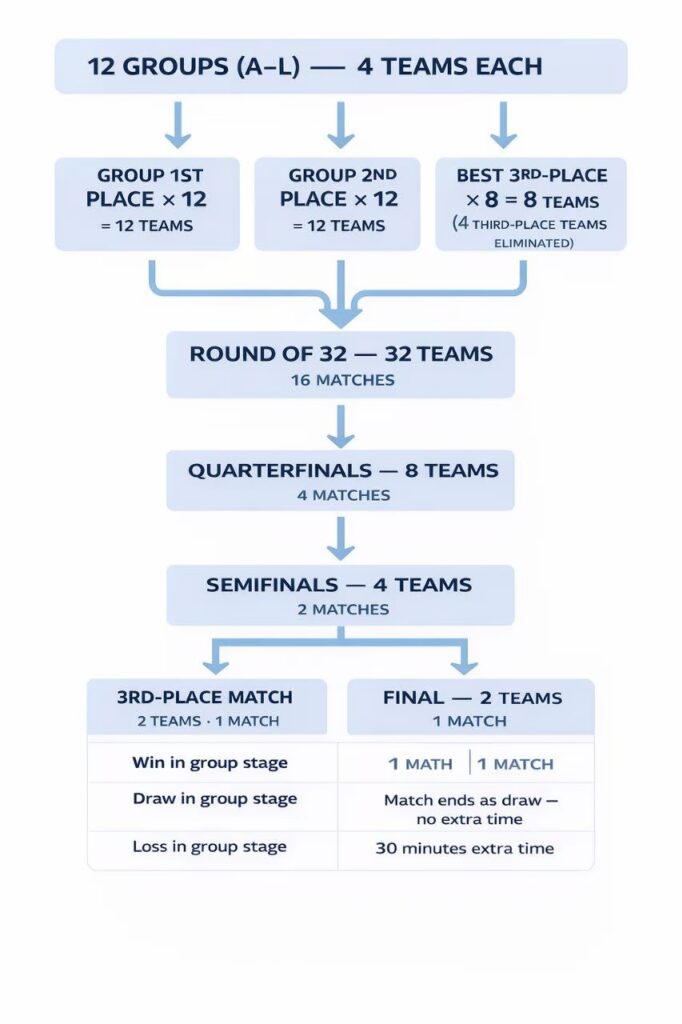
Thirty-two teams advance from the group stage to the Round of 32. Here is exactly who:
- 24 guaranteed qualifiers: The top two teams (1st and 2nd place) from each of the 12 groups
- 8 wildcard qualifiers: The eight best third-placed teams across all 12 groups
This means four third-placed teams — those with the weakest records of the 12 third-place finishers — are eliminated at the group stage.
Part 2: Tiebreakers — What Happens When Teams Are Level on Points?
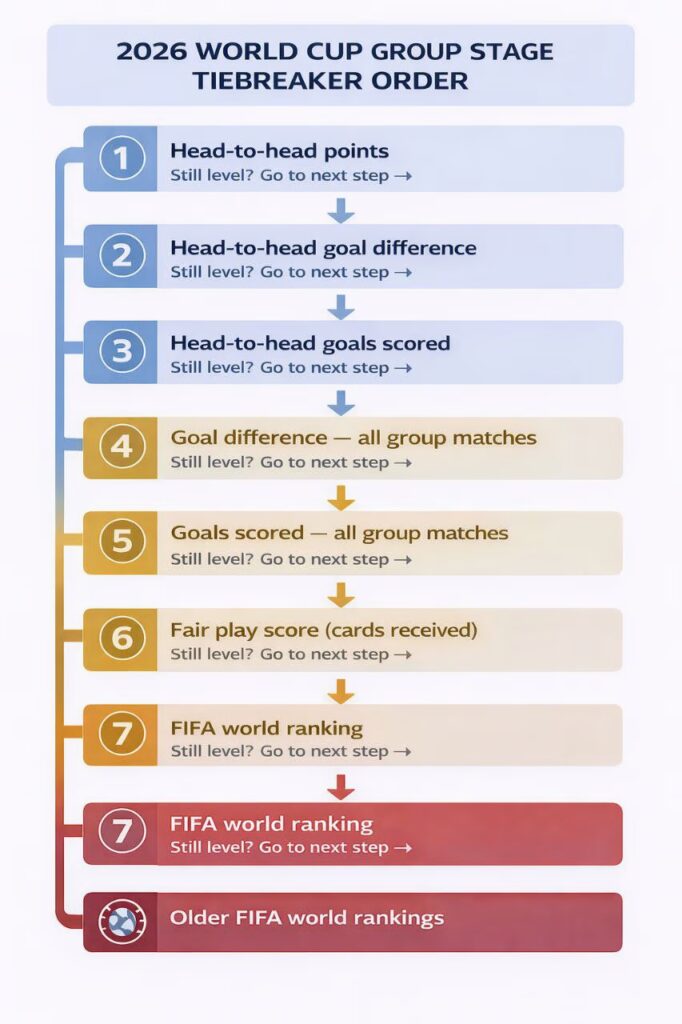
This is where most fans get confused. Here is the full, correct tiebreaker sequence, in order. The first criterion that separates the teams is used — you stop as soon as you have a winner.
Tiebreaker Sequence: Two or More Teams Equal on Points
Step 1 — Head-to-head points
Look only at the match results between the tied teams. The team with more points in those head-to-head games ranks higher.
Step 2 — Head-to-head goal difference
If still level, compare goal difference only in the head-to-head match(es) between the tied teams.
Step 3 — Head-to-head goals scored
If still level, compare total goals scored only in the head-to-head match(es).
Step 4 — Goal difference (all group matches)
Subtract goals conceded from goals scored across all three group matches. The team with the better (higher) goal difference ranks higher.
Step 5 — Goals scored (all group matches)
The team that has scored the most total goals in the group stage ranks higher.
Step 6 — Fair play / team conduct score
This is calculated using cards received across all group matches:
- Yellow card: −1 point
- Two yellow cards (indirect red): −3 points
- Direct red card: −4 points
- Yellow card + direct red: −5 points
The team with the least negative fair play score ranks higher.
Step 7 — FIFA world ranking
If still level, the team with the higher FIFA Men’s World Ranking (using the most recent published ranking) ranks higher.
Step 8 — Older FIFA world rankings
If still level after Step 7, older FIFA Men’s World Rankings are used until the tie is broken.
Part 3: The Third-Place Teams — How the 8 Best Are Chosen
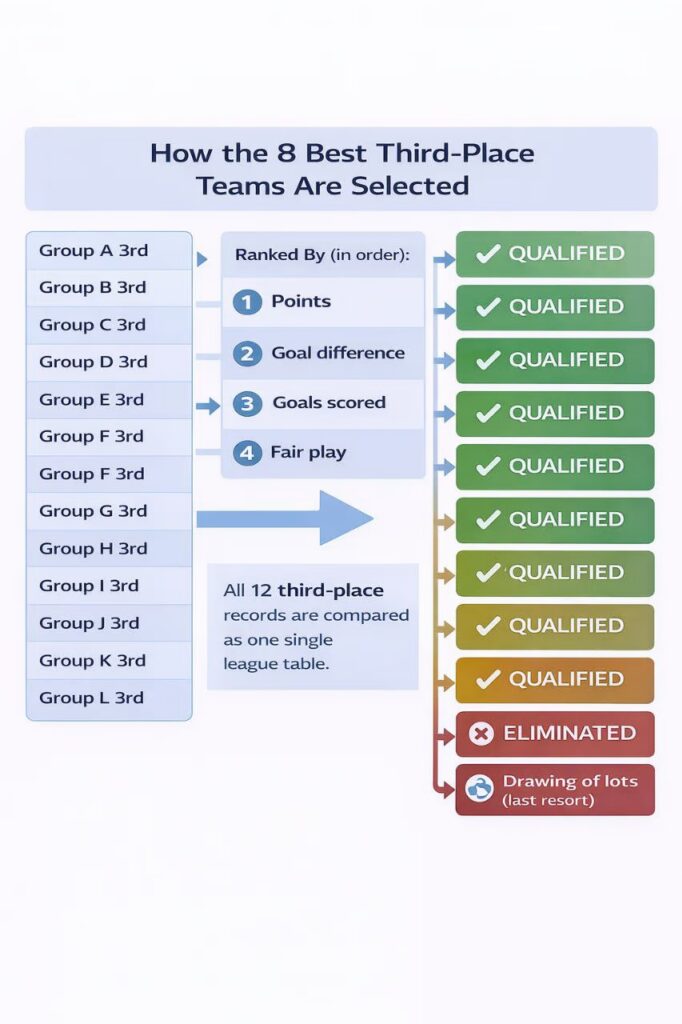
After the group stage, 12 teams will have finished in third place — one per group. Only 8 of those 12 advance. FIFA takes all 12 third-place records and ranks them against each other as if they were in one single league table.
Third-Place Ranking Criteria (in order)
- Points
- Goal difference
- Goals scored
- Team conduct score
- FIFA world ranking
Part 4: The Knockout Rounds — How They Work
From the Round of 32 onward, the tournament is pure single elimination. Win and advance. Lose and go home.
Round of 32 — New and Important
The Round of 32 is a brand-new stage that has never existed at a World Cup before. It is 16 matches, played over six days in late June 2026, between all 32 teams that advanced from the group stage.
The bracket for the Round of 32 is pre-set — it was determined at the time of the draw in December 2025, based on group positions and which third-placed teams advance. There is no re-draw at this stage.
Part 5: Extra Time and Penalty Shootouts
Extra time only applies in knockout rounds (Round of 32 and beyond). It does not apply in the group stage — group stage matches that are level after 90 minutes end as draws.
If a knockout match is level after 90 minutes of normal time:
- Extra time: Two periods of 15 minutes each (30 minutes total)
- Substitutions: teams are allowed an additional substitution in extra time (on top of the standard 5 in normal time, up to a maximum of 6 total)
If still level after extra time → penalty shootout.
Part 6: VAR — How It Works at the 2026 World Cup
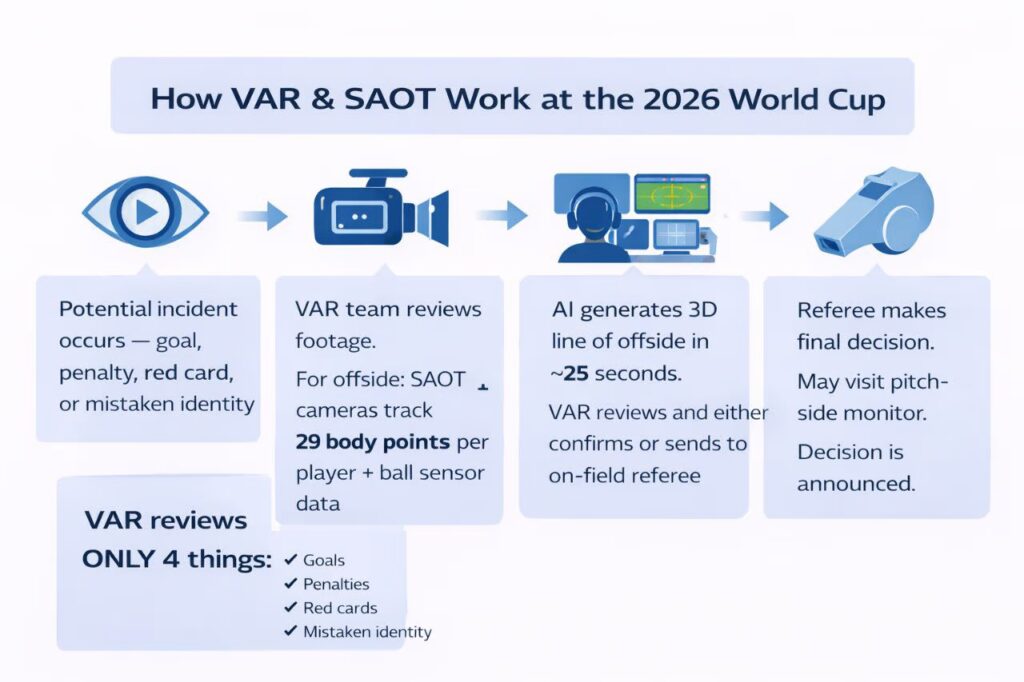
VAR stands for Video Assistant Referee. A team of officials in a video operations room review footage of match incidents and communicate with the on-field referee via earpiece. The referee can also choose to visit the pitch-side monitor to review a decision themselves.
Critical point: The on-field referee retains final authority. VAR advises; the referee decides.
Part 7: The Offside Rule — Plainly Explained
A player is offside if, at the exact moment the ball is played to them: Any part of their body that can legally score a goal is nearer to the opponent’s goal line than both the ball and the second-last defender.
The proposed “Wenger Law” was rejected for 2026. It continues to be tested in lower-level competitions.
Part 8: New Rules in Effect for 2026
The Goalkeeper 8-Second Rule
Goalkeepers must now release the ball within 8 seconds of taking it into their hands. If they do not, the opponents are awarded a corner kick.
Captain-Only Rule
Only the team captain may approach the referee respectfully to question decisions.
Part 9: Quick-Reference Rules Card
| Scenario | What Happens |
|---|---|
| Win in group stage | 3 points |
| Draw in group stage | 1 point |
| Loss in group stage | 0 points |
| Group stage draw after 90 min | Match ends as draw — no extra time |
| Knockout match level after 90 min | 30 minutes extra time |
| Still level after extra time | Penalty shootout (5 kicks each, then sudden death) |
| Third-placed team ranking | Points → GD → Goals → Fair play → FIFA rank |
| Team advances as 3rd place | Only if they are one of the 8 best of 12 third-placed teams |
| Goal disallowed for offside | VAR reviews using SAOT cameras (fast check) |
| Goalkeeper holds ball too long | Referee awards corner to opponents (8-second rule in effect) |
| Yellow card (fair play score) | −1 point |
| Red card (fair play score) | −4 points |
| Two yellows = red (fair play) | −3 points |
| Yellow + direct red (fair play) | −5 points |
| Total matches to win tournament | 8 (a first in World Cup history) |
| Final venue | MetLife Stadium, New Jersey — July 19, 2026 |
Common Myths — Corrected
“The Wenger Law will apply at the 2026 World Cup, making offside calls more lenient.” False. IFAB rejected implementation before 2026. The current offside rule remains unchanged for this tournament. The Wenger proposal is being trialled in lower-level competitions only.
“If two teams are equal on points and goal difference, it goes to a penalty shootout.” False. There are multiple tiebreaker steps, including head-to-head criteria and FIFA rankings. Penalties are only used in the knockout stage to decide a match result, never to resolve group stage standings.
“All four third-placed teams from the worst groups go out.” Not exactly. The 12 third-placed teams are ranked against each other on a common table — the group they came from does not matter. What matters is their record (points, goal difference, goals scored).
“VAR reviews every goal automatically.” VAR does check all goals for potential offside, handball, or foul in the build-up — but this is increasingly a rapid background check rather than a long delay, especially with SAOT handling the offside element.
“Goalkeepers can hold the ball for as long as they want.” No — the 8-second rule is in force and can be punished with a corner kick.
Decision Framework: “What Does My Team Need?”
If your team has 6 points (two wins) before the final match: You are mathematically qualified. The only question is whether you finish first or second — which affects your knockout bracket path.
If your team has 4 points (one win, one draw) before the final match: You are very likely qualified as top two.
If your team has 3 points (one win, two losses) before the final match: You need a win to realistically hope for a third-place wildcard spot.
If your team has 1 point (three draws) before the final match: A win gives you 4 points — potentially enough for a third-place wildcard.
If your team has 0 points (three losses): Eliminated from third-place contention in all practical scenarios.
FAQs: Your Remaining Rules Questions, Answered
How many teams advance from the group stage at the 2026 World Cup?
32 teams advance — 24 automatic qualifiers (top two from each of 12 groups) plus the 8 best third-placed teams.
What happens if teams are equal on goal difference in the group stage?
If teams are tied on points, head-to-head criteria are checked first.
Can a team advance to the Round of 32 with zero wins?
Technically yes — a team with three draws (3 points) could finish third and still advance if they are one of the 8 best third-placed teams.
Is there extra time in the group stage?
No. Group stage matches that end level after 90 minutes are recorded as draws.
How many substitutions are allowed in a match?
Teams are permitted up to 5 substitutions during normal time. An additional (6th) substitution is permitted if the match goes to extra time.
How does a penalty shootout work if both teams score the same number of kicks?
After five kicks each, if still level, the shootout enters sudden death.
Will VAR be used at the 2026 World Cup?
Yes. VAR will continue, with SAOT assisting offside decisions.
Did the offside rule change for the 2026 World Cup?
No. The proposed “Wenger Law” was rejected for implementation before the 2026 World Cup.
What is the goalkeeper 8-second rule?
Goalkeepers now have a maximum of 8 seconds to release the ball once they hold it in their hands, or a corner can be awarded.
How many matches does the World Cup champion need to win?
Eight. This is one more than in all previous editions.


