

You are watching the 2026 World Cup. A goal is scored. The players celebrate. Then the referee holds up a hand — VAR is checking. Forty seconds later, the goal is disallowed. Or confirmed. And you are left wondering: what just happened, and why?
TL;DR
- What it is: A team of certified referees in a video booth who automatically check key match incidents — and can recommend or initiate a review
- Four reviewable situations only: Goals, penalties, direct red cards, mistaken identity
- The threshold: “Clear and obvious error” or “serious missed incident” — not “could the decision have been different?”
- Final decision: Always the on-field referee — never the VAR team alone
- 2026 new additions: Corner kick VAR review (pending final approval), second yellow card reviews, semi-automated offside technology
- Decision accuracy: Rose from 82% before VAR to 96% with it
—
SNIPPET BLOCK
VAR (Video Assistant Referee) at the 2026 World Cup is a team of certified referees in a video booth who automatically check every incident in four reviewable situations: goals, penalty decisions, direct red cards, and mistaken identity. VAR intervenes only for “clear and obvious errors” or “serious missed incidents” — not close calls. The on-field referee always makes the final decision, either based on VAR communication or after reviewing footage at a pitch side monitor. Players and coaches cannot request a review. New in 2026: semi-automated offside technology delivering sub-one-second calls, expanded VAR powers for second yellow card errors, and a potential corner kick review system pending final IFAB approval.
What Is VAR? The Simple Explanation
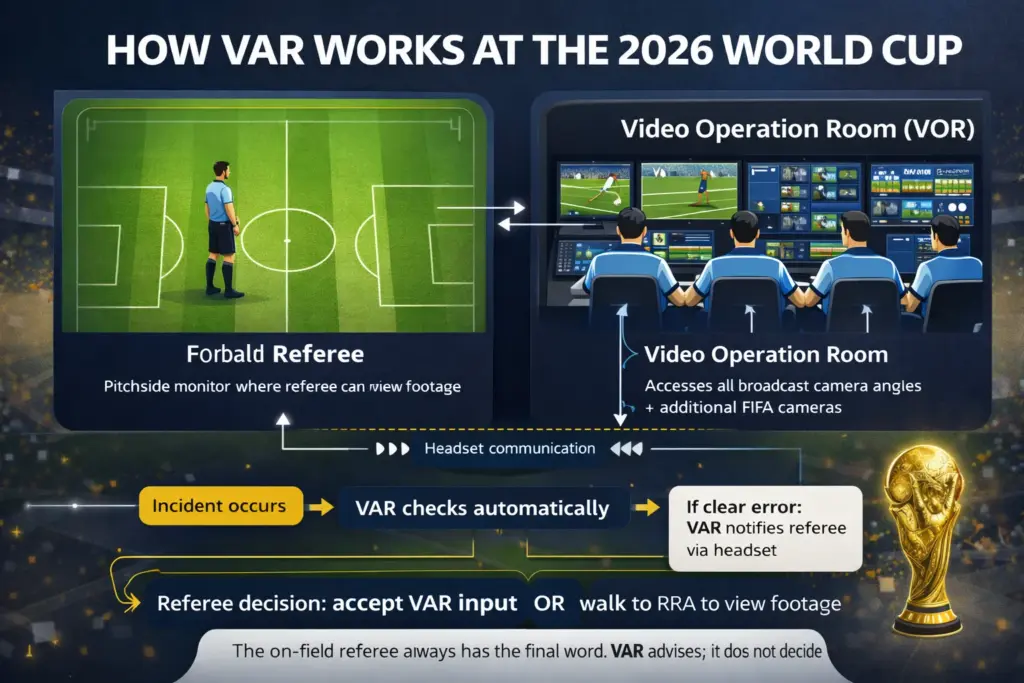
VAR World Cup 2026 stands for Video Assistant Referee. It is not a machine or an algorithm — it is a team of certified, qualified referees positioned in a Video Operation Room (VOR), with access to every available broadcast camera angle and additional FIFA-installed cameras. For the definitive rules, consult the IFAB’s official VAR protocol.
The core team at a World Cup consists of five video officials:
- VAR — the lead video official who communicates directly with the on-field referee
- AVAR (Assistant VAR) — supports the VAR and monitors live play while the VAR is conducting a review
- Offside VAR — specifically monitors potential offside situations in match-changing incidents
- Support VAR — coordinates communication and monitors broadcast feeds
- Replay Operator — manages the footage and provides the specific camera angles the VAR needs
The 2022 World Cup in Qatar used five officials per match in the booth — significantly more than the two or three used by most domestic leagues. This is partly why VAR accuracy at World Cups tends to be higher than in club football: more officials, more angles, more processing power.
The guiding philosophy — formally written into IFAB’s operating principles — is “minimal interference, maximum benefit.” VAR is not designed to review every decision. It is designed to correct the errors that would otherwise change the outcome of a match unfairly.
The Four Reviewable Situations — and What They Cover
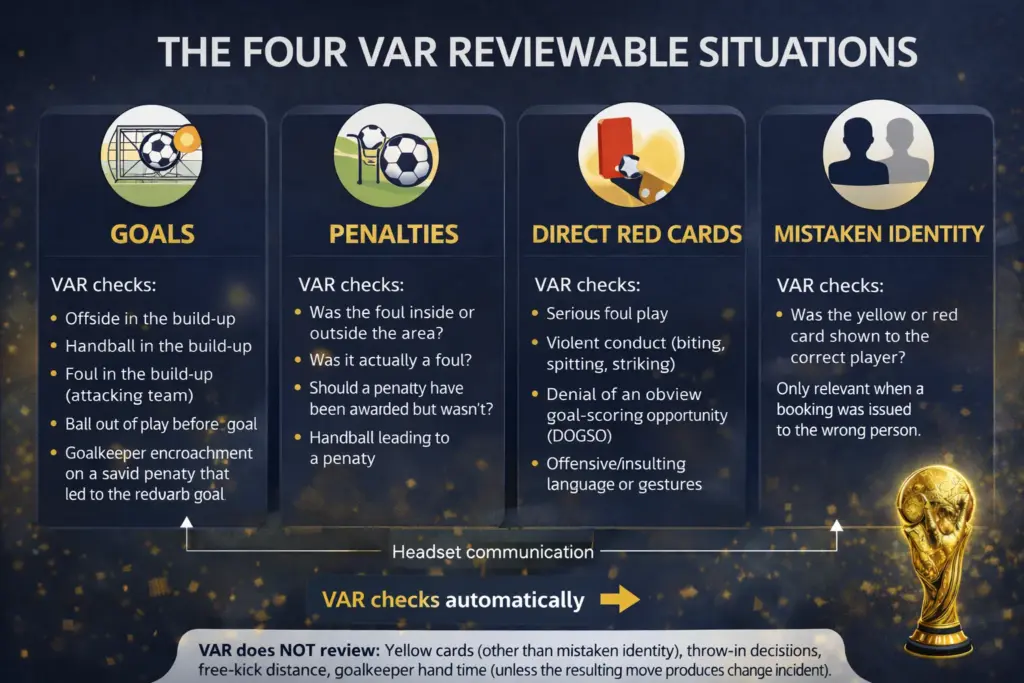
This is the most important thing to understand about VAR. It does not review everything. It reviews exactly four categories of match-changing decisions — nothing more.
Situation 1 — Goals
Every goal is automatically checked by VAR. The check happens immediately and, in many cases, the match continues before the check is complete — the referee waits to see if there is a clear error before interrupting.
What VAR looks for when reviewing a goal:
- Offside anywhere in the build-up phase that led directly to the goal
- Handball by an attacking player in the build-up
- A foul by an attacking player in the build-up (including on the goalkeeper)
- Ball out of play at any point in the attacking phase
- Goalkeeper encroachment (leaving the line early) during a penalty kick that was saved and rebounded in
The “build-up phase” (called the Attacking Phase of Play, or APP) is the window of the attacking move — from when the attacking team first gained possession in the relevant sequence, through to the moment of the goal. Incidents outside that window are not reviewed.
Situation 2 — Penalties
VAR checks both awarded and non-awarded penalties:
- Was the foul inside the penalty area or outside? (Location determines whether it’s a penalty or a free kick)
- Was it actually a foul, or did the player simulate a fall?
- Should a penalty have been awarded but wasn’t? (A serious missed incident)
- Was there a handball inside the area that wasn’t spotted?
In the instance where VAR determines a penalty was awarded for a simulation, the penalty is overturned and the player who dived is shown a yellow card for unsporting behavior.
Situation 3 — Direct Red Cards
VAR can review direct red card decisions and non-decisions:
- Serious foul play (a tackle that endangers an opponent’s safety)
- Violent conduct — biting, spitting, striking, using offensive gestures
- Denial of an obvious goal-scoring opportunity (DOGSO) — bringing down a player through on goal
- Offensive, insulting, or abusive language or gestures
What VAR cannot review (currently): Second yellow cards leading to a red. If a player is incorrectly shown a second yellow — for example, if the referee misidentified a foul as a second bookable offence when it should have been a straight red — that decision has traditionally not been reviewable unless mistaken identity is involved.
This changes in 2026 — see the “What’s New” section below.
Situation 4 — Mistaken Identity
If a referee books or sends off the wrong player — for example, issuing a yellow card to a player who was not involved in the incident — VAR can correct this.
This is the rarest of the four reviewable situations but is included because issuing a card to the wrong player is an entirely correctable factual error.
The Threshold: “Clear and Obvious Error” — What This Means
Understanding what VAR intervenes on requires understanding its threshold. VAR does not ask “was the correct decision made?” It asks: “was there a clear and obvious error?”
These are different questions. A “correct decision” might mean the referee chose the most technically accurate interpretation of a rule. A “clear and obvious error” means the decision was demonstrably wrong — visible across multiple camera angles, with no reasonable interpretation supporting the original call.
This distinction matters because it explains why VAR sometimes appears not to intervene on decisions fans consider wrong. If a potential handball is marginal — some camera angles suggest contact, others are ambiguous — VAR will not overturn the on-field decision. The original call stands. Only if the error is unambiguous does VAR recommend a change.
The threshold rule also explains why VAR does not review incidents it cannot definitively resolve. If the footage is inconclusive, the original decision stands.
How the Review Process Works — Step by Step
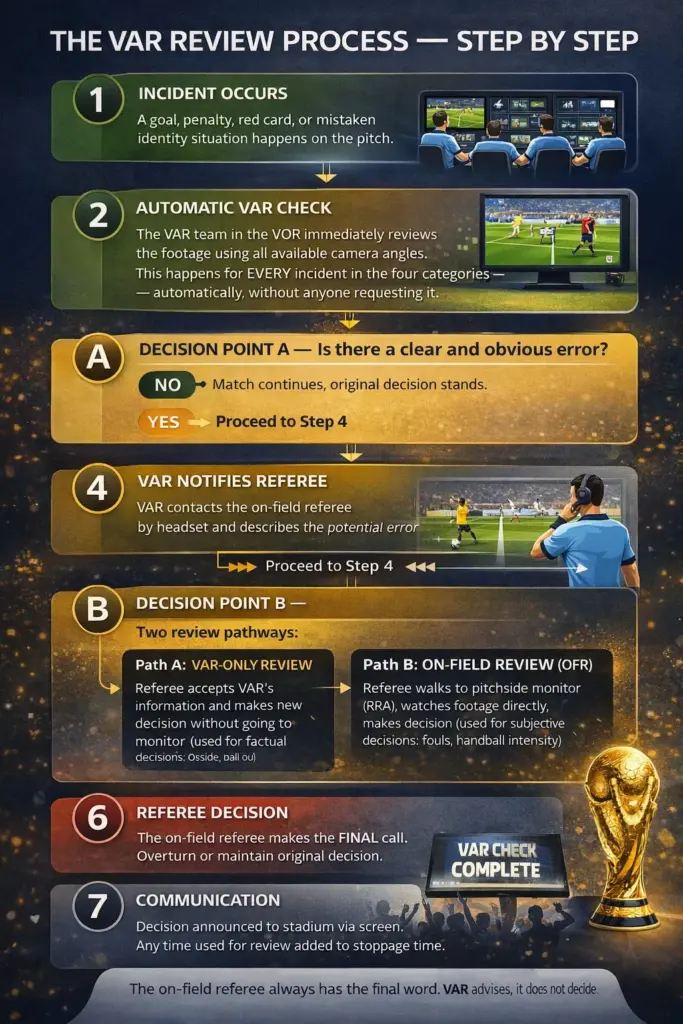
Step 1 — The Incident Occurs
A goal is scored. A penalty is awarded. A player is sent off. The incident falls into one of the four reviewable categories.
Step 2 — Automatic Check by VAR
The VAR team in the VOR immediately reviews the footage. This is automatic — it happens for every incident in the four categories, regardless of whether anyone requests it. It happens even if the referee appears confident in the original decision.
Players cannot request a check. Coaches cannot request a check. Team officials cannot request a check. If any player mimics the “TV signal” gesture to suggest a review, they are cautioned (yellow card).
Step 3 — Is There a Clear Error?
The VAR checks the footage across all available camera angles. If there is no clear error — or if the footage is inconclusive — the match continues with the original decision. Most checks end here, with no interruption visible to fans.
If there is a clear and obvious error, the VAR contacts the referee by headset.
Step 4 — Two Review Pathways
After the VAR recommends a review, the referee has two options:
Path A — VAR-Only Review:
The referee receives information from the VAR via headset and makes a new decision without walking to the pitch side monitor. This is used for factual decisions — offside (which is either on-side or off-side based on position), ball out of play, and similar. The referee draws the “TV box” signal, receives the update, and announces the decision.
Path B — On-Field Review (OFR):
The referee walks to the Referee Review Area (RRA) — the pitch side monitor — and watches the footage directly. This is used for subjective decisions — the intensity of a foul, a potential handball, whether a tackle was serious foul play. The referee needs to see it personally before making a judgement.
Step 5 — The Final Decision
The on-field referee always makes the final decision. VAR advises — the referee decides. This is non-negotiable in the protocol: the video officials cannot change a decision themselves. They can only provide information and footage.
Step 6 — Communication and Stoppage Time
The decision is announced on the stadium screens. Any time used for the review process is added to stoppage time at the referee’s discretion — reviews do not simply disappear from the match clock.
An average VAR review takes approximately 80 seconds.
What Is New at the 2026 World Cup
This is what separates 2026 from previous World Cups. Several significant VAR developments are either confirmed or pending final approval. FIFA has detailed its technology plans for 2026 on their official website.
1 — Semi-Automated Offside Technology
Semi-automated offside technology — already deployed in the Premier League — uses multiple cameras and player tracking data to produce offside decisions in under one second.
At the 2022 World Cup, the automated offside system significantly reduced the time spent on offside checks. The 2026 upgrade is expected to refine this further — delivering definitive offside calls faster and with greater accuracy than any previous World Cup system.
What this means for fans: The long waits while offside lines are drawn on screen should be materially shorter in 2026 than in 2022. Offside is a factual, positional call — the technology resolves it without subjective judgment.
2 — Second Yellow Card Reviews (Confirmed for 2026)
One of the most common sources of fan frustration with VAR has been that second yellow cards were traditionally not reviewable. If a referee incorrectly issued a second yellow — for a challenge that did not warrant a caution, or that should have been a straight red — VAR could not correct it (unless mistaken identity applied).
IFAB’s October 2025 meeting reached agreement that VAR should be allowed to intervene when a player receives an incorrect second yellow card. This was described by beIN Sports (December 2025) as the expansion of VAR to cover “incorrectly given second yellow cards — one of the most controversial situations in modern football.”
What this means for fans: A second yellow card that sends a player off incorrectly — for example, where the contact was minimal or the incident was outside the area — can now be reviewed and corrected. This closes a gap in the existing system that had produced several high-profile injustices at major tournaments.
3 — Corner Kick VAR Review (Pending Final Approval)
This is the most consequential and most contested potential change for 2026. FIFA, led by referees chief Pierluigi Collina, has been pushing for VAR to review whether corner kicks were correctly awarded — specifically to prevent goals scored from corners that should have been goal kicks from standing.
The case for the change: once a corner is awarded, there is time before the kick is taken for VAR to quickly verify who touched the ball last. Goals scored from incorrectly awarded corners — of which there are several high-profile examples in recent football — would be preventable. Collina cited a specific incident from the Euro 2016 Final, where Portugal was awarded a free kick incorrectly in extra time, as an example of the type of error the change would prevent.
The challenge: unlike the four existing reviewable categories (where review is triggered by a clear error in a specific incident), every corner in the match would technically need to be checked — approximately 10 per match on average.
The approval timeline: IFAB’s October 2025 meeting rejected corner kick VAR as a universal change for domestic leagues. However, FIFA announced it would push ahead with a World Cup-specific version regardless. IFAB’s annual meeting was scheduled for late January/February 2026, with any new rules set to take effect from July 1, 2026 — which could allow implementation at the World Cup.
Status as of February 2026: The corner kick VAR change is not yet confirmed for the 2026 World Cup. The final decision was pending the IFAB general meeting. This article will be updated once the outcome is confirmed.
What this means for fans if approved: Goals scored from incorrectly awarded corners — a goal kick misidentified as a corner — would be reviewable. This is a meaningful correction to a genuine gap in the existing system. The practical implication: after a corner is awarded, there will be a brief VAR check before the kick is taken to verify the decision was correct.
4 — Referee Public Announcements After Reviews
IFAB’s 2025/26 law changes included an option for referees to make a public announcement — via stadium PA or microphone — after a VAR review or a lengthy check, explaining the decision.
FIFA has confirmed this option is available at the 2026 World Cup. Whether individual referees use it consistently is at their discretion, but the infrastructure exists. This directly addresses one of the most persistent fan complaints: “We can see VAR is happening but nobody tells us what is being reviewed or why.”
5 — Referee Body Cameras
Body cameras worn by referees were officially tested at the 2025 FIFA Club World Cup in the United States. IFAB expressed support for allowing referee body cameras as an optional feature within the Laws of the Game.
The footage is not used to make VAR decisions — it is used for broadcast and educational purposes. But its presence at the 2025 Club World Cup test makes its inclusion at the 2026 World Cup likely.
Common Fan Frustrations About VAR — Addressed
“VAR takes too long. The game is ruined.”
The average VAR review takes approximately 80 seconds. Most checks — where no clear error is found — are invisible to fans.
Prolonged reviews (those that visibly interrupt the game for several minutes) are less common and typically involve complex subjective decisions — multiple camera angles needed for a handball call, or an incident with multiple potential infringements. IFAB has issued specific instructions to referees for 2026 to priorities speed: “make review decisions immediately and without delaying restarts.”
The eight-second goalkeeper hold rule, now confirmed for 2026, is also part of a broader IFAB package explicitly designed to reduce dead time and improve game flow.
“VAR keeps disallowing perfectly good goals for tiny offsides.”
This is a legitimate frustration that FIFA has acknowledged. Millimetre-margin offside calls — where a shoulder or armpit is fractionally beyond the line in a freeze-frame — created significant controversy, particularly in the Premier League.
At the 2026 World Cup, the semi-automated offside system is designed to produce faster calls. FIFA has also indicated it is “proactively identifying competitions to conduct additional offside trials with a view to fostering attacking football and encouraging goalscoring.” The precise implementation parameters for 2026 offside tolerance are not yet publicly confirmed.
“Why didn’t VAR check that? It was a clear foul.”
Two reasons. First: if the incident is not in one of the four reviewable categories, VAR cannot look at it — regardless of how clear the error appears. Yellow card fouls (other than mistaken identity), free-kick distance, and other incidents outside the four situations are simply not reviewable under the current protocol.
Second: if the incident is in a reviewable category but the footage is inconclusive — some angles suggest a foul, others are ambiguous — VAR will not overturn the original decision. The “clear and obvious error” threshold is the gate. Ambiguity favors the original call.
“Managers should be able to challenge decisions like in tennis or American football.”
Under the current IFAB protocol, this is not permitted — and deliberately so. Because VAR automatically checks every incident in the four categories, there is no need for a challenge system. Every relevant incident is already being reviewed. A challenge system would add a strategic element — teams saving challenges for key moments — that IFAB considers inconsistent with football’s decision-making culture.
This remains unchanged for 2026.
“VAR is still getting it wrong even after a review.”
Decision accuracy rose from 82% before VAR to 96% with it — a material improvement. But 96% means 4% of reviewed decisions may still be wrong.
Additionally, IFAB’s rules confirm that a match is not invalidated because of a wrong decision made using VAR — the VAR is a match official, and as with all match officials, their decisions (even incorrect ones) stand as part of the game.
What VAR Cannot Do
Understanding VAR’s limits is as important as understanding what it does. These are confirmed limits under the current IFAB protocol:
- Cannot review single yellow card decisions — except to upgrade to a straight red (if the offence warrants it) or to correct mistaken identity. Note: In 2026, VAR can now review incorrect second yellow cards that would result in a sending-off. Standard single yellow card decisions are not reviewable.
- Cannot review incidents once play has restarted — with one narrow exception: mistaken identity and violent conduct (biting/spitting/striking) can be reviewed even after play restarts, but the window is short.
- Cannot change a restart decision once play has restarted — IFAB’s Laws state clearly that once a corner has been taken and play is live, the decision cannot be changed regardless of whether the corner was correctly awarded. This is precisely why the corner kick VAR proposal, if approved, must act before the kick is taken.
- Cannot be requested by players or coaches — any player making the “TV box” gesture will be cautioned.
- Cannot override a referee who refuses to go to the monitor — the VAR can recommend a review and provide information, but the final decision rests with the referee. If the referee disagrees with the VAR’s assessment after receiving the information, they can maintain their original decision.
- Cannot invalidate a match due to malfunction — if the VAR system fails during a match, the game continues without video review. Contingencies are built in for partial failures.
VAR at Previous World Cups: A Brief History
VAR was formally written into IFAB’s Laws of the Game on March 3, 2018 — and debuted at the same year’s World Cup in Russia.
At the 2018 World Cup, VAR’s presence was credited with producing the cleanest tournament since 1986 in terms of discipline. It also produced a significant increase in penalties — 29 awarded in total (22 converted as goals), beating the previous record of 17 from 1998.
At the 2022 World Cup in Qatar, the system was further refined — with a larger video official team per match and additional cameras providing more angles for review. Semi-automated offside lines were introduced, reducing the time for offside decisions.
The 2026 World Cup builds on both tournaments with the additional developments described above — particularly the second yellow card review, the potential corner check, and the continued refinement of offside technology.
FAQs: VAR at the 2026 World Cup
What does VAR stand for?
Video Assistant Referee — a team of qualified referees in a video booth who monitor matches and can recommend or conduct reviews of key match incidents.
What are the four situations VAR can review?
Goals (and potential offences in the build-up), penalty decisions, direct red cards, and mistaken identity in bookings. These are the only reviewable situations — everything else is outside VAR’s remit.
Does VAR check every goal automatically?
Yes — VAR automatically checks every goal. The check may happen while the match continues. If no clear error is found, the goal stands without visible interruption.
Can players or coaches ask for a VAR review?
No. VAR automatically checks every relevant incident. Players, coaches, and team officials cannot request a review. Any player who makes the “TV box” request gesture will be cautioned.
Who makes the final VAR decision — the video team or the referee?
Always the on-field referee. VAR advises; the referee decides. The video officials cannot change a decision themselves.
What is an On-Field Review (OFR)?
When the referee walks to a pitch side monitor (the Referee Review Area) to watch the footage personally before making a decision. Used for subjective calls — foul intensity, handball — where the referee needs to see it directly rather than accept a verbal description. [
How long does a VAR review take?
On average, approximately 80 seconds. Most checks — where no clear error is found — are invisible to fans.
What is new about VAR at the 2026 World Cup?
Three confirmed or pending developments: (1) Semi-automated offside delivering faster, sub-one-second calls. (2) VAR can now review incorrectly awarded second yellow cards. (3) A potential corner kick review system — pending final IFAB approval as of February 2026. Plus, referee public announcements explaining VAR decisions, and potential referee body cameras.
Why doesn’t VAR review yellow cards?
Standard yellow card decisions are outside VAR’s four reviewable categories. VAR can review a yellow card only if it should have been a straight red (upgraded via the direct red card category) or if it was issued to the wrong player (mistaken identity). Regular single bookings are not reviewable — though VAR review of second yellow cards is new in 2026.
What happens if the VAR system breaks down mid-match?
The match continues without VAR. Contingencies exist for partial failures. A match is never suspended or abandoned due to a VAR malfunction.


