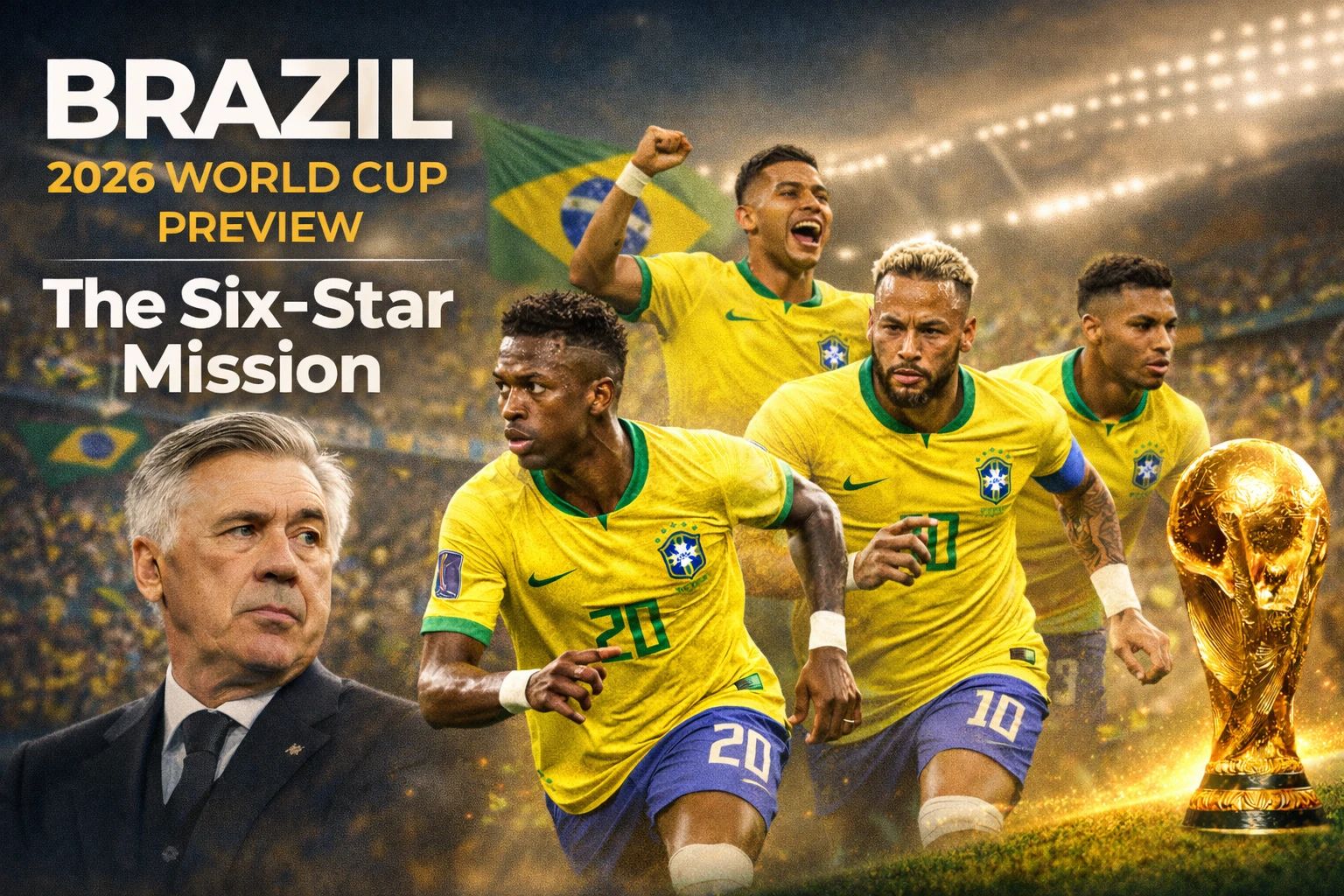

Brazil 2026 World Cup campaign begins with the same weight every tournament carries — five titles, the most in history, and an expectation that the sixth is always just one victory away.
2024 was not kind to Brazil. Before Carlo Ancelotti arrived in May 2025, Brazil were sitting fourth in CONMEBOL qualifying, tactically incoherent, and politically turbulent inside the CBF. The most successful nation in World Cup history had become a team without a clear identity.
Then Ancelotti — known affectionately in Brazil as Carleto — walked through the door. Within months, the picture changed. A hard-fought win over Paraguay sealed qualification. A 2-0 defeat of Senegal in October 2025, described by multiple analysts as Brazil’s most complete performance in years, showed what the rebuild could produce.
The question for 2026 is whether Ancelotti’s structure, his deep familiarity with the squad’s Real Madrid core, and a generation of extraordinary attacking talent can finally deliver Brazil’s sixth star — against the best teams in the world, across eight matches, in North America’s summer heat.
TL;DR
- Manager: Carlo Ancelotti — appointed May 2025, most decorated manager in Real Madrid history, first international coaching role
- Group C: Brazil, Morocco, Haiti, Scotland — Brazil clear favourites, Morocco the credible test
- The identity shift: From jogo bonito chaos to disciplined, flexible 4-3-3 — “finally functioned as a team”
- The headline question: Does Neymar make the squad? Ancelotti decides in May 2026
- The key player: Vinicius Jr — unquestioned No. 1 attacker, but the club/country gap is the challenge to resolve
- The history: 5 titles (1958, 1962, 1970, 1994, 2002) — no World Cup since 2002, a 24-year wait
SNIPPET BLOCK
Brazil are in Group C of the 2026 World Cup alongside Morocco, Haiti and Scotland, managed by Carlo Ancelotti — appointed in May 2025 after years of managerial instability. Ancelotti uses a flexible 4-3-3 built around Vinicius Jr as the central attacking reference, with Rodrygo and Raphinha providing width and creativity. Key unknowns entering the tournament include Neymar’s fitness — Ancelotti’s decision deferred to May 2026 — and whether Vinicius can translate his extraordinary Real Madrid form into World Cup goals. Brazil are five-time World Cup champions (1958, 1962, 1970, 1994, 2002) — the most of any nation — and have qualified for every World Cup in history.
→ 2026 World Cup Players to Watch | → 2026 World Cup Groups Guide | → Golden Boot Predictions | → Full 2026 World Cup Guide
Carlo Ancelotti: The Man Tasked With Ending 24 Years of Hurt
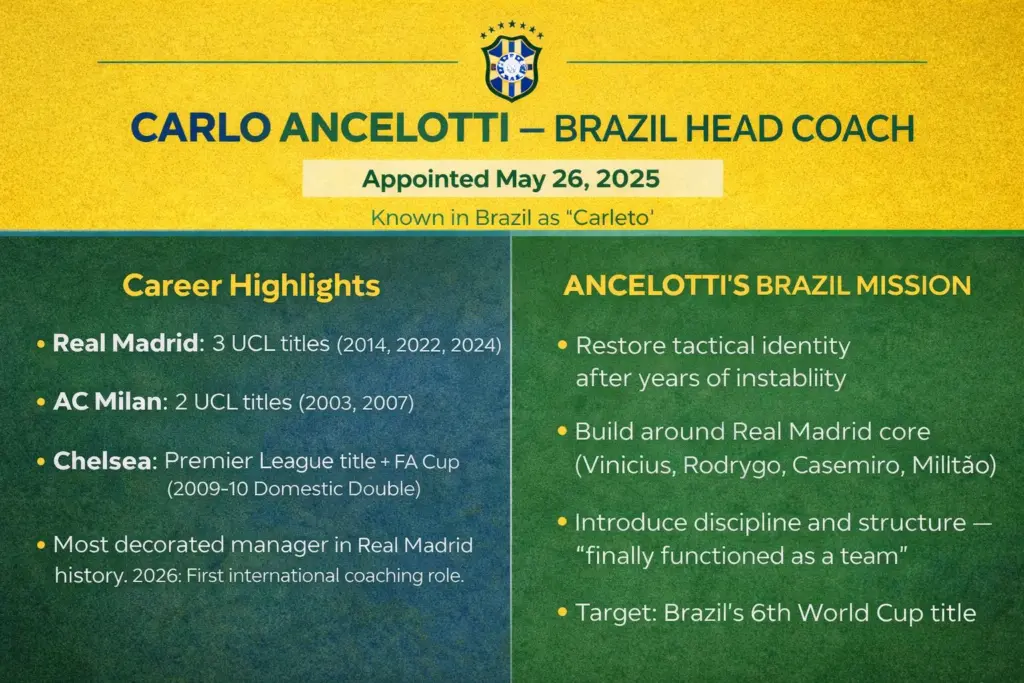
Carlo Ancelotti left Real Madrid on May 25, 2025, said goodbye to the Bernabéu, flew to Rio de Janeiro, and two days later held his first press conference as Brazil head coach. The speed of the transition was symbolic — here was a man who wanted this job.
“I have a big job ahead of me,” he said at his unveiling. “I’m delighted; the challenge is great. I’ve always had a special connection with this team.”
The connection he referenced is real. Ancelotti had managed Vinicius Jr and Rodrygo at Real Madrid — he knows their personalities, their strengths, their tendencies under pressure. He also knows Casemiro, Militão, and other Brazilian internationals who formed the spine of his Madrid sides. Stepping into the national team was not a blind introduction; it was a reunion with players he had already shaped at club level.
What Ancelotti inherited was a mess. Before his arrival, Brazil had cycled through multiple managers in rapid succession, suffered an embarrassing 4-2 defeat to Senegal, and were sitting fourth in CONMEBOL qualifying — an unacceptable position for the five-time champions. The squad had extraordinary individual talent but no coherent tactical identity.
Ancelotti’s first game — a CONMEBOL qualifier in Guayaquil against Ecuador — produced a 0-0 draw. Not a classic debut, but the tactical analyst credited in Urban Pitch’s review noted what mattered: “Brazil played much more like a team.” His second game, a home fixture against Paraguay, was a 1-0 win — Vinicius scoring the only goal — that sealed qualification. More importantly, Brazil “outshooting Paraguay 11-5 and controlling 75% of possession” while playing in a far more fluid, organized way than in previous months.
By the end of 2025, the progress was clearer. Brazil defeated Senegal 2-0 in October 2025 — the same Senegal that had beaten them 4-2 less than two years earlier. “Against an opponent unbeaten in 26 matches,” SofaScore’s season review noted, “the Seleção dominated physically, technically and tactically, with relentless intensity on and off the ball.”
Brazil then prepared for March 2026 European tests against France and Croatia — Ancelotti’s own words on the plan: “I think it’s a good test. We need to face top European opponents.”
The Ancelotti effect is not yet complete. It is a work in progress. But the direction is clear.
How Ancelotti’s Brazil Play: Tactics and Formation
Ancelotti at Real Madrid was always a pragmatist. He favored a 4-3-3 as his base but adapted constantly — tucking wingers inside to create overloads, using a double pivot when defensive solidity was needed, or allowing his front three to roam freely when the game was won.
With Brazil, the approach is similar — and structurally very familiar to the same players.
The base formation: 4-3-3
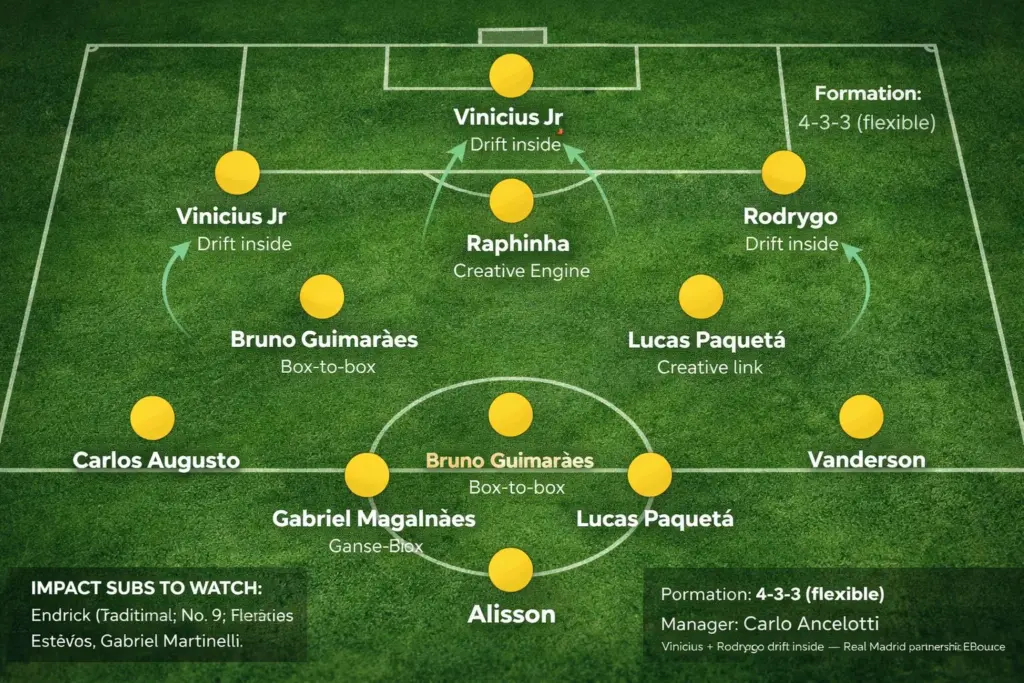
Ancelotti’s first game against Ecuador used a 4-3-3 setup. The core of the midfield three features a defensive anchor — Casemiro, whose physicality and reading of the game provide the protective layer — alongside Bruno Guimarães (Newcastle) as a box-to-box operator and Lucas Paquetá as the creative link.
The front three is the tactical puzzle Ancelotti is still solving. In the cleanest version: Vinicius Jr on the left drifting inside, Rodrygo on the right doing the same, with Raphinha operating as a false nine or fluid central presence. This is a striker-less front three — a system the Vinicius-Rodrygo partnership has already mastered at Real Madrid.
Squawka’s pre-Ancelotti tactical analysis noted this potential: “The pair are used to doing this under Ancelotti at Real Madrid, while he could add Barcelona’s Raphinha as a false nine… creating chances in wide overloads on both sides.”
The identity shift
What changed under Ancelotti is captured in one observation from tactical analyst Filippo Silva (cited in Urban Pitch): “Brazil played much more like a team. It wasn’t pretty, both were tough opponents. Brazil finally functioned as a team.”
Previous Brazil squads under recent managers were described as “tactically disjointed” despite being loaded with talent. Ancelotti’s instinct is the opposite of spectacle-first football: he simplifies roles, makes teams harder to beat, and builds trust through clarity. For a Brazil squad that had talented players confused about their responsibilities, this was exactly the medicine required.
The freedom philosophy
Ancelotti’s preference for “freedom of movement” — a philosophy that “will prevail over predecessors Dorival Junior’s and especially Tite’s more rigid and positional styles” — also suits the Brazilian temperament. Brazil’s best players, historically and currently, perform best when given expressive freedom within a structure. Ancelotti’s system provides the structure; he trusts his players to fill it creatively.
The remaining tactical challenge
The principal concern going into the tournament is central goalscoring. With a striker-less or false-nine front three, Brazil depends on goals arriving from wide positions or midfield runners. This has historically limited individual Golden Boot accumulation — and can create barren spells when wide players are well tracked. Whether Endrick (Real Madrid, age 19 at the tournament) earns a starting or impact role as a more traditional striker is the selection decision that will define Brazil’s attacking profile in knockout matches.
Key Players: Who Makes Brazil’s 2026 Threat
Vinicius Jr — The Undisputed No. 1
Vinicius Jr arrives at the 2026 World Cup as Brazil’s undisputed leading attacking threat. His club record at Real Madrid — Champions League goals, consistent Liga top-scorer contention, near-Ballon d’Or level — makes him one of the world’s two or three best players.
The challenge is the numbers at international level. FourFourTwo (December 2025) noted plainly: “He will need to up his output for the national team, having only found the net seven times in 41 appearances for his country.” For a player of his quality, seven goals in 41 caps are a jarring statistic. The tactical context matters — in wide, rigid systems under previous managers, his shooting opportunities were reduced. Under Ancelotti, given license to drift inside as he does at Real Madrid, that number is expected to improve significantly.
He scored the winner against Paraguay in qualification. He is Brazil’s designated leader — not just tactically, but as a symbol of the team’s ambitions.
As SportsOrca (December 2025) framed it: “Brazil 2026 will be the first World Cup where Vinicius Junior walks in as the unquestioned reference point.”
Rodrygo — The Trusted Partner
Rodrygo has been through the injury and suspension cycles that disrupted early Ancelotti squads, but his centrality to the project is unquestioned. Ancelotti himself said: “He’s very motivated and an important player for the national team. He can play in every attacking position.”
At Real Madrid, Rodrygo has repeatedly delivered in the biggest moments — Champions League knockout goals, crucial Liga contributions. His chemistry with Vinicius is established and deep. In Brazil’s flexible front three, he provides the right-side balance to Vinicius’s left, and his ability to operate as a second striker or wide forward gives Ancelotti genuine tactical options across match states.
Raphinha — The Creative Engine
Raphinha’s 2024-25 season at Barcelona — when he moved from right wing to a more central, fluid role under Hansi Flick — demonstrated he can operate effectively as the front three’s deepest-lying attacker. Under Ancelotti, he is the likeliest occupant of the false nine position — linking Vinicius and Rodrygo while contributing goals himself.
His fitness record has been a concern — multiple injury absences in Ancelotti’s early squads — but when available, he is Brazil’s most complete attacking option outside of Vinicius.
Casemiro and Bruno Guimarães — The Midfield Foundation
Casemiro (now playing regularly under Ancelotti) provides the defensive anchor the Brazil midfield has lacked in recent years — physicality, positioning, and the experience of winning trophies at the highest level. Alongside him, Bruno Guimarães has established himself as one of the Premier League’s best box-to-box midfielders at Newcastle — his engine and range of passing are central to how Brazil transition between defensive solidity and attacking expression.
Together they form the engine room that allows Vinicius and Rodrygo to operate freely in the final third.
Marquinhos — Defensive Leader
Marquinhos remains Brazil’s first-choice center-back and has captained the side regularly — experienced, composed, and among the world’s best at reading the game. Gabriel Magalhães (Arsenal) partners him in the most settled central defensive pairing Brazil have had in years.
The Young Wave — Endrick and Estêvão
Endrick (Real Madrid, age 19): Described as “the teenager most likely to play real minutes” by SportsOrca (December 2025). His Champions League minutes at Real Madrid, Brazil qualifying goals under previous managers, and his instinctive center-forward profile make him the closest thing Brazil have to a traditional No. 9. Whether he starts or impacts from the bench, he is the most exciting young striker in this tournament.
Estêvão (Chelsea): Another teenage forward building in Europe. Came off the bench against Tunisia in October 2025 and helped Brazil come from behind to draw — demonstrating composure for a player his age. A potential surprise contributor in the knockout rounds.
The Neymar Question
No Brazil World Cup preview in 2026 can be written without addressing the most complicated subplot in Brazilian football.
Neymar — Brazil’s all-time top scorer, the defining player of a generation — ruptured his ACL and tore his meniscus in October 2023. The recovery process consumed all of 2024. He returned to Santos in 2025, where his performances were inconsistent but occasionally brilliant: a hat-trick against Juventude to help Santos escape relegation reignited discussion about his World Cup inclusion.
Ancelotti’s position is clear and consistent. Asked about Neymar at the post-draw press conference in December 2025, he said: “I want to make it clear that we are in December, the World Cup is in June, and I will choose the team that goes to the World Cup in May.” And, when pressed further: “If Neymar deserves to be there, if he’s doing well, if he’s better than someone else, he will play in the World Cup, period. I don’t owe anything to anyone.”
That is the honest position of a meritocratic coach who will not make a sentimental selection — but equally will not close the door. Neymar’s phone call with Ancelotti was described as constructive: “Brazil count on him. He returned home to prepare himself for the World Cup. I talked to him this morning and explained the situation, and he fully understood.”
Ancelotti’s comment that “He can’t play on the wings” signals a tactical reality: if Neymar plays, it is in a central creative role — not competing directly with Vinicius or Rodrygo for a wide position, but as a deeper orchestrator or second striker.
The scenario-based assessment: If Neymar arrives at the May squad announcement in consistent Santos form — full fitness, regular 90-minute contributions, genuine competitive sharpness — his technical quality and dead-ball threat remain world-class enough to justify inclusion in a support role. If his fitness remains stop-start and his Santos performances are inconsistent, Ancelotti has clearly signalled he will not make a sentiment-driven selection.
The decision, by Ancelotti’s own framing, is deferred entirely to May 2026. That is where this story resolves.
Group C: Brazil’s Path from the Group Stage
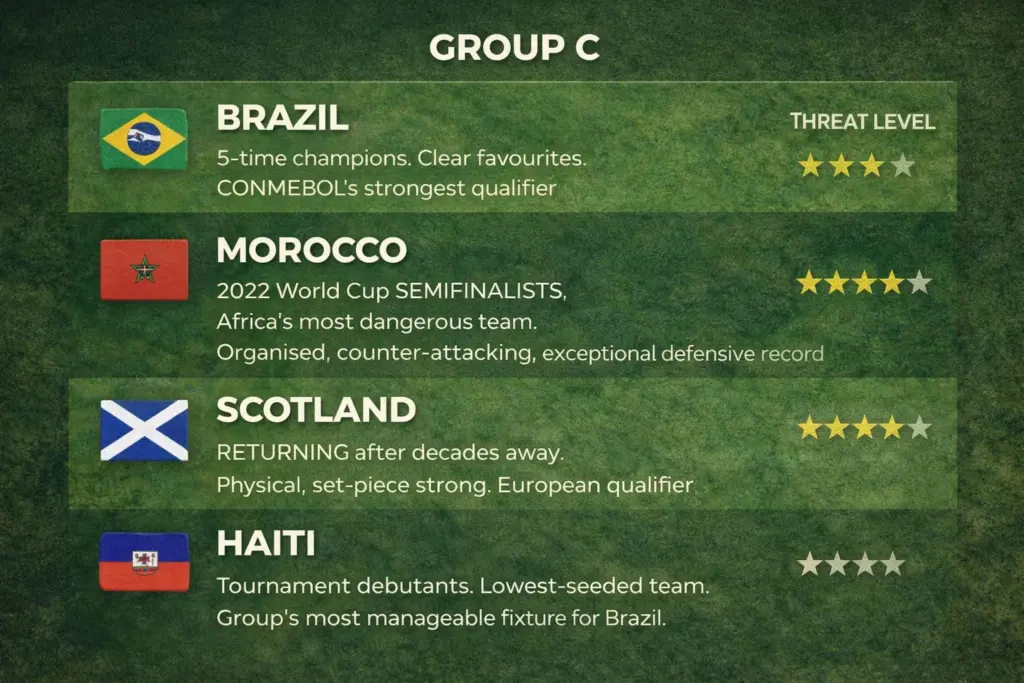
Brazil are in Group C alongside Morocco, Haiti, and Scotland.
Brazil vs Morocco — the group’s key match
Morocco were the 2022 World Cup’s greatest story — becoming the first African nation in history to reach the semifinal, defeating Spain and Portugal on the way. They arrive at 2026 as the most organised, defensively structured team Brazil will face in the group stage.
Morocco’s defensive record and tactical discipline — built around a disciplined mid-block and rapid transitions — represent exactly the kind of opponent that exposes a team still building cohesion under a new manager. This is not a free-scoring opportunity; this is the group stage match that will define Brazil’s tactical credibility at the tournament.
Brazil vs Scotland — emotional return
Scotland return to the World Cup after a long absence — the emotional weight of qualification makes them a difficult opponent in terms of motivation and physical intensity. They press high, rely on set pieces, and will use the occasion to maximum effect. For Brazil, it is a match that demands proper respect but should ultimately be within their means.
Brazil vs Haiti — the group stage’s most manageable fixture
Haiti, as the group’s lowest-seeded qualifier, represent Brazil’s clearest opportunity for a clean sheet and controlled goal accumulation in the group stage. Managing the match professionally — protecting key players from unnecessary bookings, keeping the core squad fresh — is the primary objective.
Group C verdict: Brazil are heavy favourites to win the group. The Morocco match is the genuine test. Advance from Group C, and Brazil likely face a runner-up from a weaker group in the Round of 32 — giving them a manageable route into the quarterfinals. A deep run to the Final is structurally plausible.
Brazil’s World Cup History — Five Stars and the Wait for a Sixth
Brazil are the most successful nation in World Cup history, the only country to have qualified for every World Cup since 1930, and the only nation to have won on five different continents.
The five titles:
- 1958 — Sweden: The original triumph. A 17-year-old Pelé announced himself to the world. Brazil beat the host nation Sweden 5-2 in the Final. The beginning of the legend.
- 1962 — Chile: Back-to-back. Pelé injured early in the tournament; Garrincha stepped up as the dominant figure. Another final victory.
- 1970 — Mexico: Widely considered the greatest team in World Cup history. Pelé, Jairzinho, Rivelino, Carlos Alberto. The 4-1 victory over Italy in the Final is one of football’s defining moments.
- 1994 — USA: A different Brazil — defensively organised, pragmatic. Romário and Bebeto up front, the penalty shootout win over Italy in the Final (0-0 after extra time). The tournament was held in the United States — 32 years later, Brazil return to North America hunting their sixth.
- 2002 — South Korea/Japan: Ronaldo’s redemption after 1998. Eight goals in the tournament. A 2-0 win over Germany in the Final. The last time Brazil held the trophy — 24 years ago.
Since 2002: Four World Cups without a title. Quarterfinal exits in 2006 and 2010. A catastrophic 7-1 loss to Germany on home soil in the 2014 semifinal — “the Mineirazo,” still the defining wound of modern Brazilian football. A quarterfinal exit in 2018. A quarterfinal exit in 2022. The hurt accumulates.
2026, in North America, is the opportunity. The six-star dream is alive.
Strengths and Weaknesses: The Honest Assessment
Strengths:
- Attacking depth unlike any other squad. Vinicius Jr, Rodrygo, Raphinha, Endrick, Estêvão, Gabriel Martinelli, Matheus Cunha — Brazil has more elite attacking options than any other team in the tournament. Even with injuries, the quality available is extraordinary.
- Ancelotti’s direct player relationships. The manager has coached the core of this squad at club level. Trust, communication, and tactical familiarity are already established — something most international managers must build from scratch during a tournament.
- The October 2025 Senegal result as proof. Beating a team that had not lost in 26 matches, after losing to the same team 4-2 two years earlier, is tangible evidence of progress.
Weaknesses:
- The Vinicius club/country gap. Seven international goals in 41 caps versus consistent 20+ goal seasons at Real Madrid. If Ancelotti cannot translate the club form — specifically, the central-zone freedom of movement — into a World Cup context, Brazil’s greatest weapon is underperforming.
- Midfield was “overmatched” against Argentina. The 2025 data analysis from Total Football Analysis noted that “the midfield was completely overmatched in their last game against Argentina.” Against the elite opposition Brazil will face from the quarterfinals onward, midfield control is the decisive battle. Casemiro and Guimarães are quality; whether they can dominate against France or Spain at their best is unresolved.
- Multiple injury concerns at key moments. Ancelotti’s early squads were repeatedly disrupted by absences — Alisson, Neymar, Raphinha, Marquinhos, Gabriel Magalhães, Militão, Rodrygo, Endrick — all missed at least one preparation window due to fitness. A tournament run across eight matches demands this squad stays healthy.
- No confirmed solution at central striker. The striker-less false-nine system is tactically elegant but relies on Vinicius and Rodrygo converting from wide positions. Against compact defensive blocks — the kind Morocco, and potential opponents like England or Germany in the knockouts, will deploy — a clinical No. 9 can be decisive. Whether Endrick earns that role, or Ancelotti persists with the false-nine, is the biggest tactical question remaining.
Scenario-Based Assessment: How Far Can Brazil Go?
Scenario A — Optimal (reach the Final):
Vinicius Jr translates club form into tournament goals. Rodrygo and Raphinha contribute consistently. Ancelotti’s tactical flexibility adapts to different knockout opponents. Brazil win Group C comfortably, reach the quarterfinal against a European or South American side, and the tactical clarity installed in 2025 holds under maximum pressure. In this scenario: Brazil are the tournament’s most dangerous team and genuine favourites to lift the trophy.
Scenario B — Good (quarterfinal or semifinal):
Brazil advance through Group C, navigate the Round of 32, and win a challenging Round of 16 match — but face a Spain, France, or Argentina in the quarterfinal or semifinal that exposes the midfield control gap. The depth and attacking quality keep them competitive, but tactical superiority wins the tie. Honourable exit at a stage that reflects genuine progress under Ancelotti.
Scenario C — Disappointing (Round of 32 or Round of 16 exit):
A combination of key injuries, the Morocco match producing an unexpected loss, and the individual brilliance that defines Brazil unable to function coherently as a collective results in an early exit. This is Brazil’s track record since 2006 — consistent underperformance relative to individual quality. Ancelotti’s work in 2025 has reduced this risk materially but not eliminated it.
Realistic range: Quarterfinal minimum, Final as the ambition. The Ancelotti appointment was the right call at the right time. Whether eight months of work is enough to end a 24-year wait is the question that will be answered in July 2026.
Common Myths — Corrected
“Brazil are always the favourites — they should win every World Cup.”
Five titles in 22 World Cups means Brazil have won roughly 23% of the time, which is the highest rate of any nation — but also means they have not won 77% of the time. They are consistently among the two or three most likely winners, not certainties. Since 2002, they have not advanced past the quarterfinal at any World Cup.
“Neymar’s absence means Brazil are weaker than ever.”
Not necessarily. Neymar at full fitness is still one of the world’s most impactful attacking players. However, the team Ancelotti is building — organized, coherent, structured around Vinicius as the primary threat — is significantly more functional than the Neymar-dependent squads of 2014 and 2018, both of which failed despite his presence. Brazil’s strength is now collective, not dependent on one individual.
“Vinicius Jr will win the Golden Boot.”
Possible, but not the straightforward case his Real Madrid numbers might suggest. Brazil has multiple elite scorers sharing the attacking burden — Rodrygo, Raphinha, Endrick — which historically reduces individual accumulation. His international goal rate (7 in 41 caps) is the empirical concern, even accounting for tactical context.
“Brazil’s 7-1 loss to Germany in 2014 means they can’t handle pressure at home.”
The 2026 World Cup is not a home tournament for Brazil — it is played across the United States, Mexico, and Canada on neutral ground. The psychological weight of the Mineirazo was specific to hosting; it does not transfer to North America.
FAQs: Brazil 2026 World Cup
Which group are Brazil in at the 2026 World Cup? Group C — alongside Morocco, Haiti, and Scotland. Brazil are the clear group favorites.
Who is Brazil’s manager at the 2026 World Cup? Carlo Ancelotti, appointed May 26, 2025. The Italian is the most decorated manager in Real Madrid history, having won three Champions League titles there. The 2026 World Cup is his first international coaching role.
What formation does Ancelotti use with Brazil? A base 4-3-3, with Vinicius Jr and Rodrygo operating as wide forwards who drift inside, and Raphinha playing in the false-nine or flexible central role. The system mirrors what Ancelotti used at Real Madrid with the same players.
Will Neymar be in Brazil’s 2026 World Cup squad? Unknown as of February 2026. Ancelotti has publicly stated his decision will be made in May 2026: “I will choose the team that goes to the World Cup in May.” He has not closed the door: “If Neymar deserves to be there, if he’s doing well, if he’s better than someone else, he will play in the World Cup, period.”
How many World Cups has Brazil won? Five — 1958 (Sweden), 1962 (Chile), 1970 (Mexico), 1994 (USA), 2002 (South Korea/Japan). The most of any nation.
When did Brazil last win the World Cup? 2002 — in South Korea and Japan. Ronaldo scored twice in the Final against Germany. The 24-year wait for a sixth title continues.
Who is Brazil’s key player at the 2026 World Cup? Vinicius Jr is Brazil’s primary attacking threat — described by multiple analysts as the “unquestioned reference point” for the squad under Ancelotti. His ability to translate Real Madrid form into a World Cup context is the defining question.
Is Endrick playing for Brazil at the 2026 World Cup? Endrick (Real Madrid, age 19 at the tournament) is expected to make the squad and has been described as “the teenager most likely to play real minutes.” Whether he starts or contributes as an impact substitute depends on his Real Madrid form through the 2025-26 season.
What was Brazil’s best and worst recent World Cup performance? Best recent: 2002 champions. Worst recent: 7-1 loss to Germany on home soil in the 2014 semifinal — the “Mineirazo.” Since 2006, Brazil have not advanced past the quarterfinal at any tournament.
How did Brazil qualify for the 2026 World Cup? Through CONMEBOL qualifying — the South American confederation. Brazil secured qualification under Ancelotti with a 1-0 home win over Paraguay, with Vinicius Jr scoring the winner.
Related Reading
- → 2026 World Cup Players to Watch: “Vinicius Jr, Endrick and every Brazil player to watch at the 2026 World Cup →”
- → 2026 World Cup Golden Boot: “Is Vinicius Jr a realistic Golden Boot contender? The full analysis →”
- → 2026 World Cup Groups: “Full Group C breakdown — Morocco, Haiti and Scotland assessed →”
- → Argentina 2026 World Cup: “Argentina 2026 preview — Brazil’s greatest rivals and the defending champions →”
- → Spain 2026 World Cup: “Spain 2026 preview — potential quarterfinal opponent →”