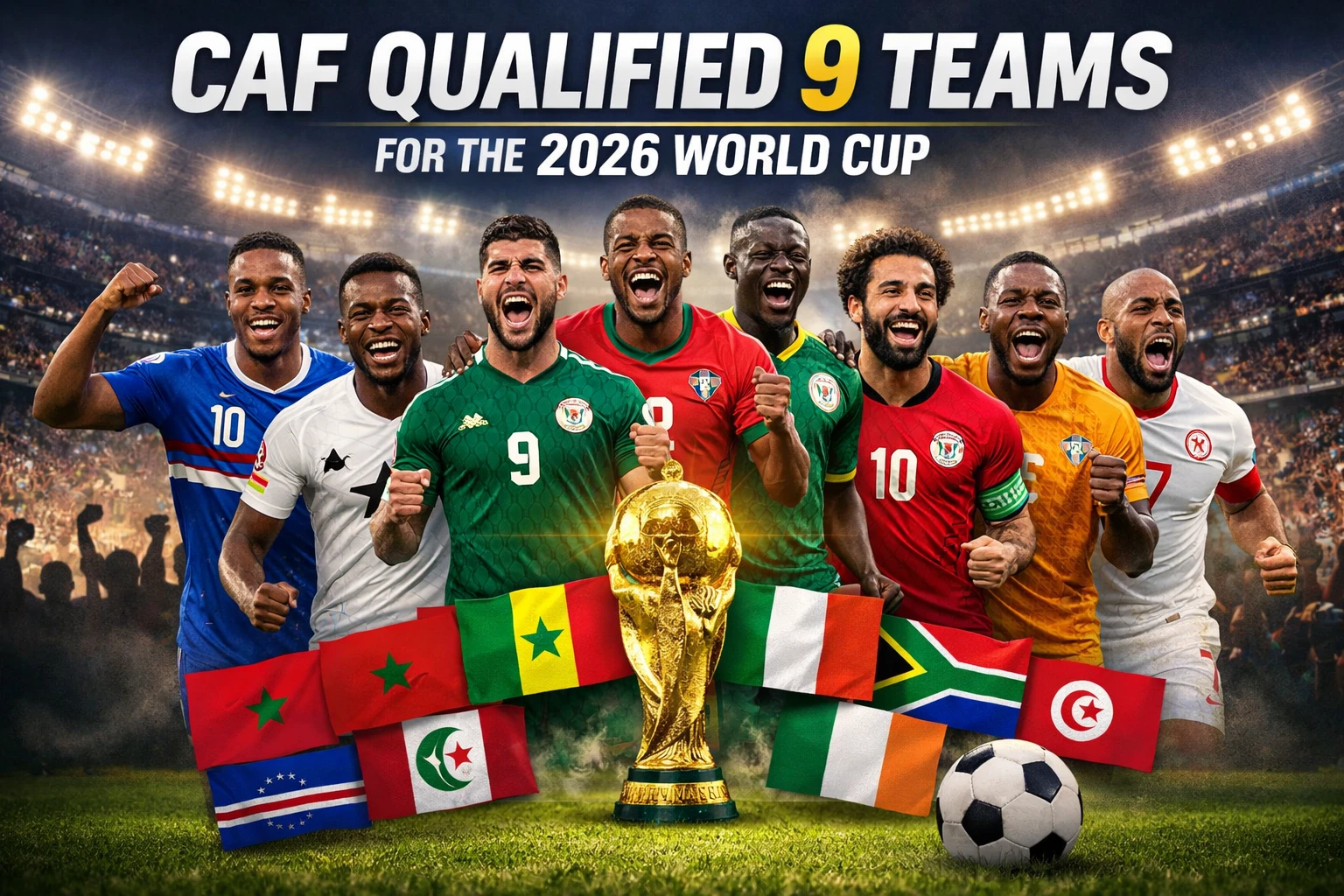

CAF qualified 9 teams for the 2026 World Cup through a two-year campaign that ended with DR Congo beating Nigeria on penalties in Morocco to claim Africa’s FIFA Play-Off Tournament place, while Nigeria and Cameroon — Africa’s two most successful World Cup nations by appearances — both failed to qualify for the finals.
Africa’s road to 2026 was full of drama, controversy, shock eliminations and historic firsts. Nine spots — the most Africa has ever received at a single World Cup — were distributed across a campaign involving 53 nations across nine qualifying groups. Morocco qualified first, with a game to spare, hammering Niger 5-0. Cape Verde qualified last, on October 13, 2025, with a statement 3-0 win over Eswatini that completed one of football’s most extraordinary debut qualification stories.
In between, South Africa survived a forfeited-result controversy involving an ineligible player. Ivory Coast topped a group containing Gabon despite barely winning it. Senegal, Egypt, Algeria, Ghana and Tunisia qualified with the assurance of continental heavyweights who expected to be there.
And Cameroon — eight-time World Cup participants, Africa’s most experienced nation at the tournament — lost in the semi-finals of the CAF play-offs to DR Congo in the single biggest shock of African qualifying.
This is the full story of how Africa got its nine teams to North America.
TL;DR
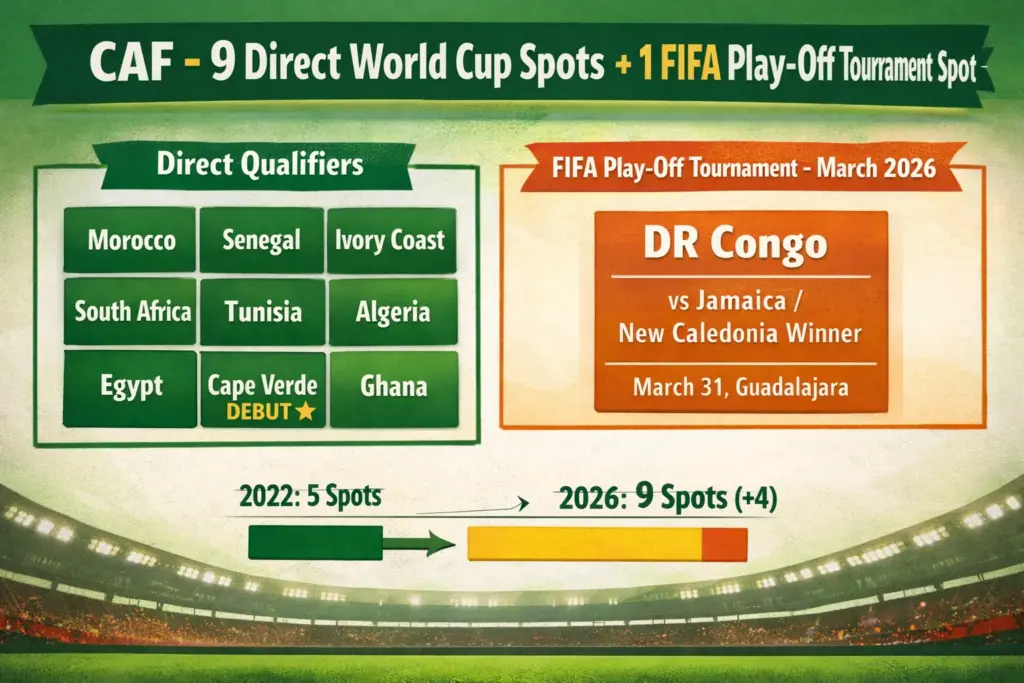
- CAF received 9 direct World Cup spots for 2026 — the most ever allocated to Africa.
- Format: 54 teams entered, reduced to 53 after Eritrea’s withdrawal, in 9 groups, with one group effectively reduced to five teams. Group winners qualified directly.
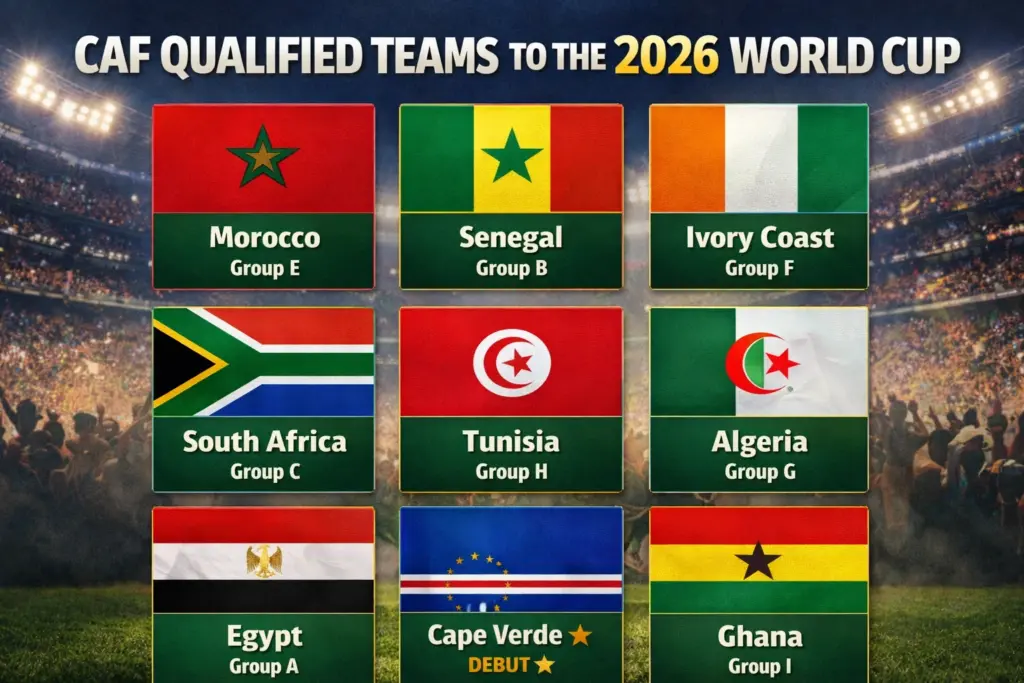
- The 9 qualified teams: Morocco, Senegal, Ivory Coast, South Africa, Tunisia, Algeria, Egypt, Cape Verde, Ghana.
- 4 runners-up — Nigeria, Cameroon, DR Congo and Gabon — competed in CAF play-offs in Morocco. DR Congo won and advanced to the FIFA Play-Off Tournament.
- Biggest absentees: Nigeria and Cameroon — both eliminated in the CAF play-off round.
- First-time qualifier: Cape Verde — full story in our dedicated Cape Verde World Cup 2026 article.
- DR Congo are Africa’s FIFA Play-Off Tournament representative — facing the winner of Jamaica vs New Caledonia in Guadalajara on March 31, 2026.
Snippet Block
CAF received nine direct World Cup spots for 2026 — the most Africa has ever had. The nine qualified teams are Morocco, Senegal, Ivory Coast, South Africa, Tunisia, Algeria, Egypt, Cape Verde and Ghana. The qualifying format used nine groups, with group winners qualifying automatically. Nigeria and Cameroon — Africa’s two most historically prominent World Cup nations — both failed to qualify, losing in the CAF play-off round. DR Congo represent Africa in the FIFA Play-Off Tournament in March 2026.
CAF Qualified 9 Teams for the 2026 World Cup: How Many African Teams Qualify?
A total of nine slots in the final tournament and one FIFA Play-Off Tournament slot were reserved for Confederation of African Football teams.
Nine direct spots is the largest allocation Africa has ever received at a World Cup. At Qatar 2022, Africa had five direct spots. At Russia 2018, Africa also had five. The expansion of the tournament from 32 to 48 teams transformed Africa’s representation.
Due to nine CAF teams now directly qualifying instead of five, the CAF Executive Committee approved a new qualification format in May 2023.
The total possible African presence at the 2026 tournament is ten — nine direct qualifiers plus the FIFA Play-Off Tournament winner, if DR Congo beat their March 2026 opponents. Ten African nations at a single World Cup would be unprecedented.
CAF Qualified 9 Teams for the 2026 World Cup: The CAF Qualifying Format
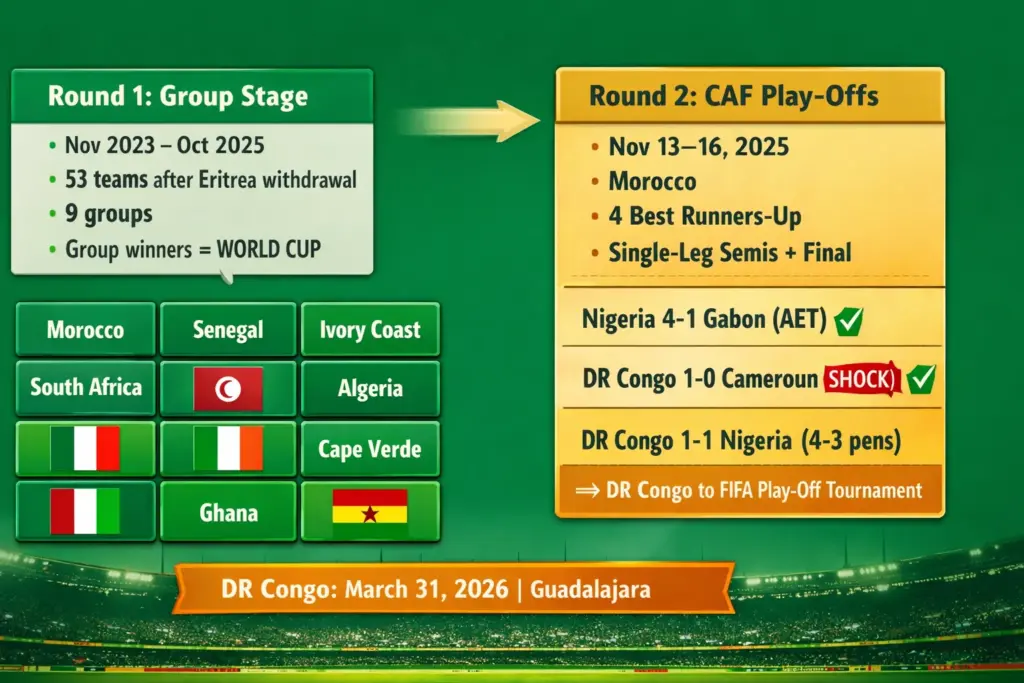
Round 1 — Nine Groups (November 2023–October 2025)
All 54 FIFA-affiliated football associations from CAF entered qualification. However, Eritrea withdrew after the draw, leaving one group of five rather than six, with results against the sixth-placed team discounted for runners-up comparison purposes.
Teams were drawn into nine groups. The winner of each group directly qualified to the World Cup, while the four best group runners-up participated in play-offs to determine which team would advance to the FIFA Play-Off Tournament.
The campaign ran from November 2023 to October 2025 — nearly two full years of qualifying football across the African continent. Most teams played ten matches — five home and five away — in a double round-robin format within their group.
The nine group winners needed only to finish first in their group. No additional hurdle, no play-off, no final round. Finish top and you are going to North America. That simplicity — combined with the prestige of automatic qualification — made every group game meaningful from the first matchday.
Round 2 — The CAF Play-offs (November 2025, Morocco)
The best four runners-up from the first round advanced to the second round. Results against sixth-place teams were discounted due to the differing group sizes as a result of Eritrea’s withdrawal. The second round featured two single-leg semi-finals and one single-leg final, with all matches played in Morocco from November 13 to November 16, 2025.
The four teams that reached this stage — Nigeria, Cameroon, DR Congo and Gabon — were the best runners-up from across the nine groups. Each had spent two years finishing second in their group, then been given one final opportunity: three matches in Morocco over four days to earn Africa’s FIFA Play-Off Tournament spot.
The play-offs saw Nigeria beat Gabon 4-1 after extra time, while Cameroon lost in shock fashion to DR Congo to crash out. The sole CAF spot in the FIFA Play-Off Tournament went to DR Congo after they beat Nigeria on penalty kicks.
Cameroon — eight World Cup appearances, the most of any African nation — lost to DR Congo in the semi-final. It was, without question, the single biggest upset of the entire African qualifying campaign. Then Nigeria — six World Cup appearances — beat Gabon in their semi-final but lost to DR Congo in the final on penalties. Nigeria drew 1-1 with DR Congo, with the Congolese side winning 4-3 on penalties to reach FIFA’s inter-confederation route.
Neither Cameroon nor Nigeria will be at the 2026 World Cup.
CAF Qualified 9 Teams for the 2026 World Cup: The Nine Qualified Teams
🇲🇦 Morocco — Group E Winners (Qualified: September 2025)
Morocco were the first African nation to qualify for the 2026 World Cup. A five-goal statement against Niger, with a game to spare, confirmed it in Rabat. Morocco’s group also contained Zambia, Tanzania and Congo, but the Atlas Lions were dominant from the opening matchday.
Morocco are Africa’s strongest side entering 2026 — semi-finalists at Qatar 2022, where they became the first African nation to reach the last four of a World Cup. Their squad — built around players from Europe’s elite clubs, with Achraf Hakimi as the most prominent name — is the African team most neutrals expect to go deepest into the tournament.
Morocco are in Group C alongside Brazil, Scotland and Haiti. They are arguably the group’s second-most dangerous team and Scotland’s most challenging opponent.
🇸🇳 Senegal — Group B Winners (Qualified: October 2025)
Senegal qualified from a group that included DR Congo — one of the teams that would later reach the CAF play-off final. Their 3-2 win in Kinshasa demonstrated Senegal’s quality against the very team that would cause the biggest upsets of the play-off round.
Senegal’s side — led by a squad containing Sadio Mané, Idrissa Gana Gueye, Pape Matar Sarr and Ismaïla Sarr — are among Africa’s most technically and tactically sophisticated national teams. AFCON 2021 champions and regular World Cup qualifiers, they enter 2026 as one of Africa’s most experienced tournament sides.
Senegal are in Group I alongside France, Norway and the winner of FIFA Play-Off Pathway 2.
🇨🇮 Ivory Coast — Group F Winners (Qualified: October 2025)
Ivory Coast — AFCON 2023 champions — topped a group that included Gabon, one of the four teams to reach the CAF play-off round. The Elephants qualified with the understated efficiency of a team that knows its quality and manages matches accordingly.
Their squad retains genuine depth — players from Ligue 1, the Premier League and Serie A complement a domestic base that was strengthened by AFCON success. Sébastien Haller, Franck Kessié and Nicolas Pépé represent the generation that delivered continental glory in 2023.
Ivory Coast are in Group E alongside Germany, Ecuador and Curaçao — the same group as Q15’s subject, the smallest nation in World Cup history. The contrast in resources between Ivory Coast and Curaçao — competing in the same group — is one of the tournament’s most striking structural asymmetries.
🇿🇦 South Africa — Group C Winners (Qualified: October 2025)
South Africa’s qualification came with a controversy that ran for months and nearly derailed their campaign.
The South Africa v Lesotho match, which originally finished as a 2-0 win for South Africa, was later declared forfeited 3-0 after South Africa fielded an ineligible player, Teboho Mokoena.
The group contained Nigeria, South Africa, Benin, Zimbabwe, Rwanda and Lesotho. The group winners, South Africa, directly qualified for the World Cup, and the runners-up, Nigeria, qualified for the second round.
South Africa fielded Teboho Mokoena — a player who was serving a suspension — against Lesotho. The original result was overturned and recorded as a 3-0 forfeiture. But Bafana Bafana ultimately accumulated enough points across the rest of their campaign to top Group C regardless of the controversial result. It was a self-inflicted wound that made the final stages of their qualifying campaign more tense than it needed to be.
South Africa — known as Bafana Bafana (“The Boys, The Boys”) — last appeared at the World Cup in 2010, when they hosted the tournament. Their return to the World Cup after a 16-year absence is a significant moment for South African football, which has struggled to consistently produce the results their football infrastructure should enable.
South Africa are in Group A alongside Mexico, South Korea and the winner of UEFA Play-off D.
🇹🇳 Tunisia — Group H Winners (Qualified: September 2025)
Tunisia topped their group ahead of Equatorial Guinea, qualifying with the composure of a side that has been a consistent African World Cup presence — this is their seventh World Cup appearance overall.
The Carthage Eagles’ most memorable World Cup moment came at the 2022 tournament in Qatar — where they beat defending champions France 1-0 in the group stage, becoming only the second African team to beat France at a World Cup. The victory came too late to advance from the group, but it demonstrated Tunisia’s capacity to produce a shock result against elite opposition.
Tunisia’s squad combines experienced European-based players with a disciplined defensive structure that makes them difficult opponents at tournament level.
Tunisia are in Group F alongside the Netherlands, Japan and the winner of UEFA Play-off B.
🇩🇿 Algeria — Group G Winners (Qualified: September 2025)
Algeria — two-time AFCON champions and one of Africa’s most historically consistent World Cup nations — qualified from a group containing Mozambique, Guinea and Botswana. The Desert Foxes topped their group without the drama that surrounded some of their continental rivals.
Algeria’s most famous World Cup moment remains the 1982 tournament in Spain — where they beat West Germany 2-1 in one of the competition’s most celebrated upsets, only to be eliminated when West Germany and Austria played a scandalous result-fixing match in their final group game. The “Disgrace of Gijón” led to the simultaneous final group game rule that now governs all World Cups.
More recently, Algeria reached the Round of 16 at the 2014 World Cup in Brazil — losing narrowly to eventual champions Germany in extra time. Their squad entering 2026 is among Africa’s most technically proficient.
Algeria are in Group J alongside Argentina, Austria and Jordan — full details in our Jordan World Cup 2026 article.
🇪🇬 Egypt — Group A Winners (Qualified: September 2025)
Egypt — Africa’s most successful AFCON nation with seven continental titles — topped their qualifying group. The Pharaohs are one of Africa’s most historically prominent football nations, though their World Cup record is modest: four appearances overall, including 1934, 1990, 2018 and now 2026.
Mohamed Salah remains Egypt’s defining player and their most globally recognised talent. At 33-34 during the tournament, the 2026 World Cup represents Salah’s best opportunity at the world stage after Egypt’s last appearance ended in the 2018 group stage.
Egypt’s return to the World Cup — their first since Russia 2018 — is driven by the quality of a squad that punches above its infrastructure weight, with Salah’s individual quality the most significant advantage any African team possesses.
Egypt are in Group G alongside Belgium, Iran and New Zealand.
🇨🇻 Cape Verde — Group D Winners (Qualified: October 2025)
Cape Verde topped their group ahead of Cameroon — Africa’s most experienced World Cup nation — in the qualifying campaign’s most extraordinary group finish. Their 3-0 win over Eswatini on October 13, 2025 confirmed a World Cup debut for one of the smallest nations in world football.
The full Cape Verde story — including Roberto “Pico” Lopes, captain Ryan Mendes, manager Bubista’s tournament run, and Group H opponents Spain, Uruguay and Saudi Arabia — is covered in full in our dedicated Cape Verde World Cup 2026 article.
The key qualifying detail: Cape Verde beat Cameroon 1-0 during the group stage — one of the results that pushed the Indomitable Lions into the runners-up position and ultimately contributed to their play-off campaign.
Cape Verde are in Group H alongside Spain, Uruguay and Saudi Arabia.
🇬🇭 Ghana — Group I Winners (Qualified: October 2025)
The group contained Mali, Ghana, Madagascar, Central African Republic, Comoros and Chad. The group winners, Ghana, directly qualified for the World Cup.
Ghana topped a group that included Mali — a side that gave them problems throughout — and Comoros, who overperformed consistently. The Black Stars’ qualification was not the comfortable march expected of a nation with major World Cup experience; it required results on the final matchdays to confirm their position.
Ghana’s World Cup history includes one of the tournament’s most heartbreaking moments: their quarter-final defeat to Uruguay at the 2010 World Cup in South Africa, when Luis Suárez deliberately handled the ball on the goal line and Asamoah Gyan missed the subsequent penalty. The moment still resonates deeply in Ghanaian football culture.
Ghana are in Group L alongside England, Croatia and Panama — England’s full story, including the Group L fixtures, is covered in our England World Cup 2026 article.
CAF Qualified 9 Teams for the 2026 World Cup: The Biggest Story
This is African football’s most discussed qualifying outcome, and it deserves its own section.
Neither Cameroon nor Nigeria will be at the 2026 World Cup.
Cameroon have appeared at eight World Cups — the most of any African nation. Their 1990 campaign in Italy remains the high point of African World Cup football: Roger Milla’s dancing celebrations, the quarter-final run, the narrow 3-2 extra-time defeat to England. The Indomitable Lions have been at virtually every World Cup since 1982.
Not in 2026. Cameroon losing in shock fashion to DR Congo in the CAF play-off semi-final — a single-leg match on neutral ground in Morocco — ended their campaign. A side that had finished second in their group behind Cape Verde, then reached the CAF play-off semi-finals, lost to a DR Congo team that had themselves spent the group stage trailing Senegal. The upset of the play-off round.
Nigeria have appeared at six World Cups, including a Round of 16 at the 1994 tournament in the USA and a Round of 16 in 2014 in Brazil. The Super Eagles — with Victor Osimhen among the most lethal strikers in world football — were expected to at minimum compete through the FIFA Play-Off Tournament.
Africa’s FIFA Play-Off Tournament place was decided by a winner-take-all mini-tournament, with DR Congo emerging victorious over Nigeria, Gabon and Cameroon. Nigeria beat Gabon after extra time in the semi-final — then lost to DR Congo in the final on penalties. Osimhen will not be at the 2026 World Cup.
The elimination of both nations opens enormous space in the African football conversation — Morocco, Senegal and Egypt now lead the continent into North America, with no Nigerian or Cameroonian claim to challenge their prominence.
DR Congo: Africa’s IC Playoff Hope
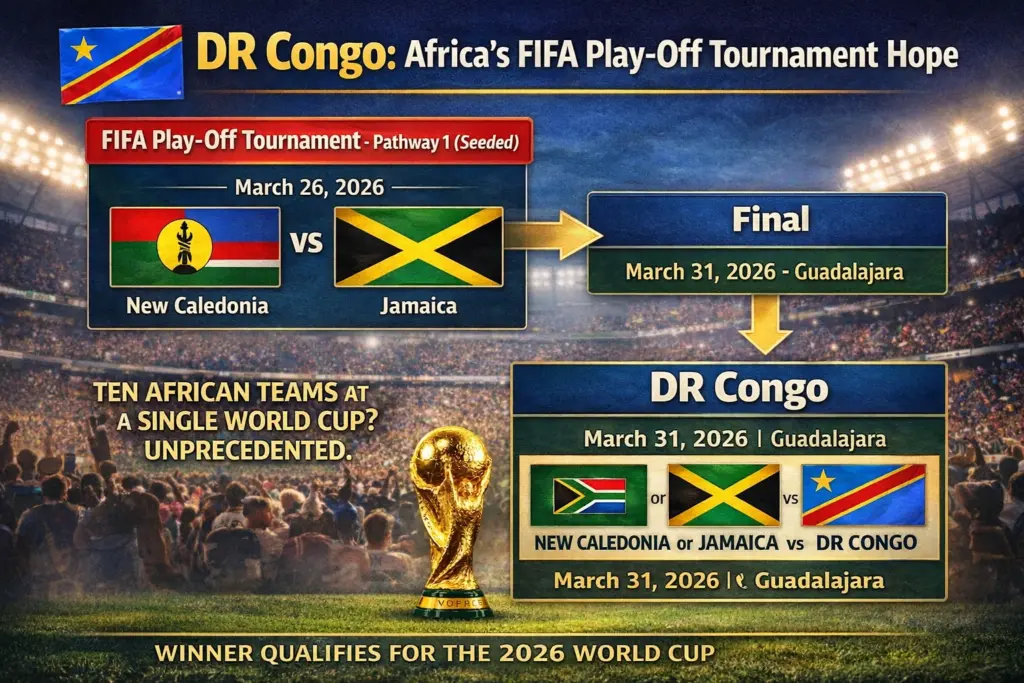
The winner of the second round, DR Congo, joined Bolivia, Iraq, Jamaica, Suriname and New Caledonia in the FIFA Play-Off Tournament.
DR Congo — the African nation that beat both Nigeria and Cameroon in the space of four days in Morocco — face the following path to qualification:
The bracket: DR Congo are one of the seeded teams in Pathway 1 and go directly to the final. Their opponent will be the winner of New Caledonia vs Jamaica on March 26, 2026. DR Congo play that final on March 31, 2026 in Guadalajara, Mexico.
If DR Congo qualify, they would be the 10th African team at the 2026 World Cup — unprecedented. Their place would be in Group K alongside Portugal, Colombia and Uzbekistan.
The Leopards’ journey from group-stage runner-up, through the play-off upsets, to a potential World Cup appearance is itself one of African football’s most remarkable stories of the qualifying cycle.
The African Teams at the 2026 World Cup: Where They Are
| Team | Group | Key Opponents | World Cup History |
|---|---|---|---|
| Morocco | C | Brazil, Scotland, Haiti | 2022 semi-finalists — best African World Cup run ever |
| Senegal | I | France, Norway | 2002 quarter-finalists; regular World Cup qualifiers |
| Ivory Coast | E | Germany, Ecuador, Curaçao | AFCON 2023 champions |
| South Africa | A | Mexico, South Korea | Hosted 2010; last appeared 2010 |
| Tunisia | F | Netherlands, Japan | 7th World Cup appearance; beat France in 2022 |
| Algeria | J | Argentina, Austria, Jordan | 1982 heroes; 2014 Round of 16 |
| Egypt | G | Belgium, Iran, New Zealand | Salah’s tournament; 7x AFCON champions |
| Cape Verde | H | Spain, Uruguay, Saudi Arabia | DEBUT — first ever World Cup |
| Ghana | L | England, Croatia, Panama | 5th World Cup appearance; 2010 quarter-final heartbreak |
| DR Congo* | K* | Portugal, Colombia, Uzbekistan | *Pending FIFA Play-Off Tournament result |
*DR Congo only if they win the FIFA Play-Off Tournament final on March 31 in Guadalajara.
Decision Framework: Which African Team Should You Follow?
If you want the favourites: Morocco (Group C) are Africa’s highest-ranked and best-performing side. Semi-finalists in 2022, they have proven they can beat European and South American elite.
If you want the debut story: Cape Verde (Group H) — see our full Cape Verde World Cup 2026 article. This is their first World Cup.
If you want the superstar: Egypt (Group G) — Mohamed Salah’s World Cup. The Liverpool forward is one of the world’s elite attackers and this is his last realistic chance at the tournament.
If you want the comeback story: South Africa (Group A) — returning after hosting in 2010, surviving an ineligible player controversy, Bafana Bafana are back.
If you want the historical angle: Algeria (Group J) — facing Argentina in the group stage. The 1982 World Cup injustice against West Germany still echoes through football history.
If you want the March play-off drama: DR Congo face Jamaica or New Caledonia on March 31 in Guadalajara. A win takes them to the World Cup for the first time since 1974.
Frequently Asked Questions
How many teams does Africa send to the 2026 World Cup?
Nine directly, plus potentially one more through the FIFA Play-Off Tournament via DR Congo. This compares to five direct spots at the 2022 World Cup — a significant expansion driven by the tournament’s growth from 32 to 48 teams.
How did the CAF qualifying format work?
The equation is simple enough: the nine group winners qualified automatically for 2026 in Canada, Mexico and the USA. The four best runners-up went to CAF play-offs for a route to the FIFA Play-Off Tournament. The CAF play-offs were three single-leg matches — two semi-finals and one final — held in Morocco in November 2025.
Why are Nigeria and Cameroon not at the 2026 World Cup?
Both finished as runners-up in their qualifying groups and advanced to the CAF play-off round, but were eliminated there. Cameroon lost to DR Congo in the semi-final. Nigeria beat Gabon in their semi-final but lost to DR Congo in the final on penalties. Neither will be in North America.
Who is Africa’s first-time qualifier at the 2026 World Cup?
Cape Verde — a nation of roughly half a million people who topped CAF Group D ahead of Cameroon, qualifying for the first time in their history.
What is DR Congo’s path to the World Cup?
DR Congo — who beat both Nigeria and Cameroon in the CAF play-offs — represent Africa in the FIFA Play-Off Tournament in March 2026. They face the winner of New Caledonia vs Jamaica in a final on March 31 in Guadalajara.
Which African team did the best at the 2022 World Cup?
Morocco — they reached the semi-finals at Qatar 2022, beating Spain and Portugal along the way to become the first African team ever to reach the World Cup’s last four.
When did CAF qualifying begin and end?
Round 1 began in November 2023 and concluded in October 2025. The CAF play-offs were held from November 13 to 16, 2025 in Morocco.
Why did Eritrea withdraw from qualifying?
Eritrea withdrew after the draw, reducing one CAF qualifying group from six teams to five.
Is this the most African teams ever at a World Cup?
Nine direct qualifiers is already the most Africa has ever had at a World Cup. With DR Congo potentially adding a tenth via the FIFA Play-Off Tournament, ten African nations at a single World Cup would be unprecedented.
Who is Africa’s strongest team at the 2026 World Cup?
Morocco — ranked highest and with the best recent tournament record among African teams — are widely regarded as Africa’s strongest representative. Senegal, with their tournament experience and proven quality, are also considered among Africa’s top contenders.
Key Takeaway
Africa’s 2026 qualifying campaign produced nine deserving group winners across two years of competition — and then delivered its most dramatic twist in the four-team play-off round in Morocco, where DR Congo eliminated both Nigeria and Cameroon to claim the continent’s FIFA Play-Off Tournament spot. The absence of Africa’s two most historically prominent World Cup nations opens the North American tournament to a more diverse African presence than any previous edition.
Morocco lead Africa into 2026 as genuine contenders. Senegal, Algeria and Egypt bring quality, experience and star power. Ghana, Ivory Coast, Tunisia and South Africa bring competitive depth. And Cape Verde — an island nation of around half a million people, playing in the World Cup for the first time — bring a debut story as extraordinary as any in the tournament’s history.
Nine African flags. Nine national anthems. Nine stories. All in North America, from June 2026.
Sources
- FIFA — qualified teams, final draw results, play-off tournament draw, and CAF qualifying coverage.
- Inside FIFA — disciplinary ruling on South Africa’s forfeited result against Lesotho.
- CAF Online — CAF qualifying and play-off coverage.