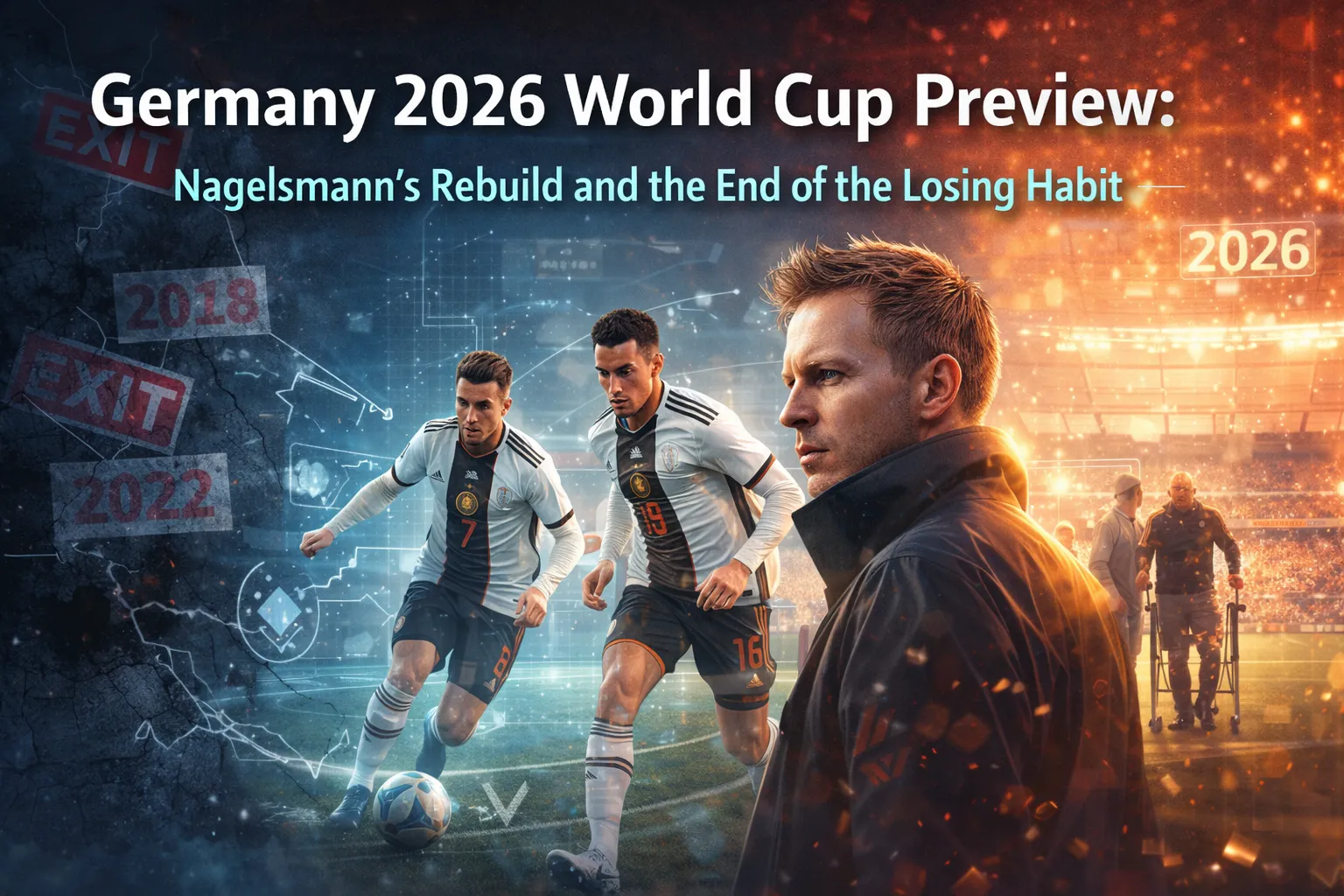

Germany have won the World Cup four times. They have never missed a tournament since 1950. They arrived at 2022 as one of the seeded favourites and went home in the group stage — for the second consecutive tournament.
The question that defines Germany’s 2026 World Cup is simple and uncomfortable: is this generation ready to stop being the team that should win and start being the team that does?
The evidence is mixed but genuinely encouraging. Julian Nagelsmann has built something with real identity — aggressive pressing, fluid attacking movement, and two of the most talented young midfielders in world football. The group draw handed them one of the most manageable paths in the tournament. And the ghost of consecutive group-stage exits is exactly the kind of pressure that historically either breaks German teams or forges them.
The biggest question mark is wearing number 42 at Bayern Munich and is only just returning from a broken fibula. Whether Jamal Musiala is fully fit and in form by June is the single most important variable for Germany’s 2026 World Cup.
TL;DR
- Group E: Curaçao (June 14, Houston), Ivory Coast (June 20, Toronto), Ecuador (June 25, New Jersey) — one of the more favourable group draws for a Pot 1 nation
- Manager: Julian Nagelsmann — appointed Sept 22, 2023; record 17W-6L-6D; led Germany to Euro 2024 quarterfinals
- The key players: Wirtz (#1 attacking midfielder in the world — FourFourTwo), Kimmich (106 caps, UCL winner), Musiala (returning from fractured fibula — World Cup the target)
- The injury crisis: Musiala (fractured fibula July 2025, returned to Bayern training December 2025, targeting January 2026 comeback); Kai Havertz has also had injury issues
- The new striker: Nick Woltemade (Newcastle United) competing with Havertz for the No.9 — one of 2025’s most-talked-about emerging forwards
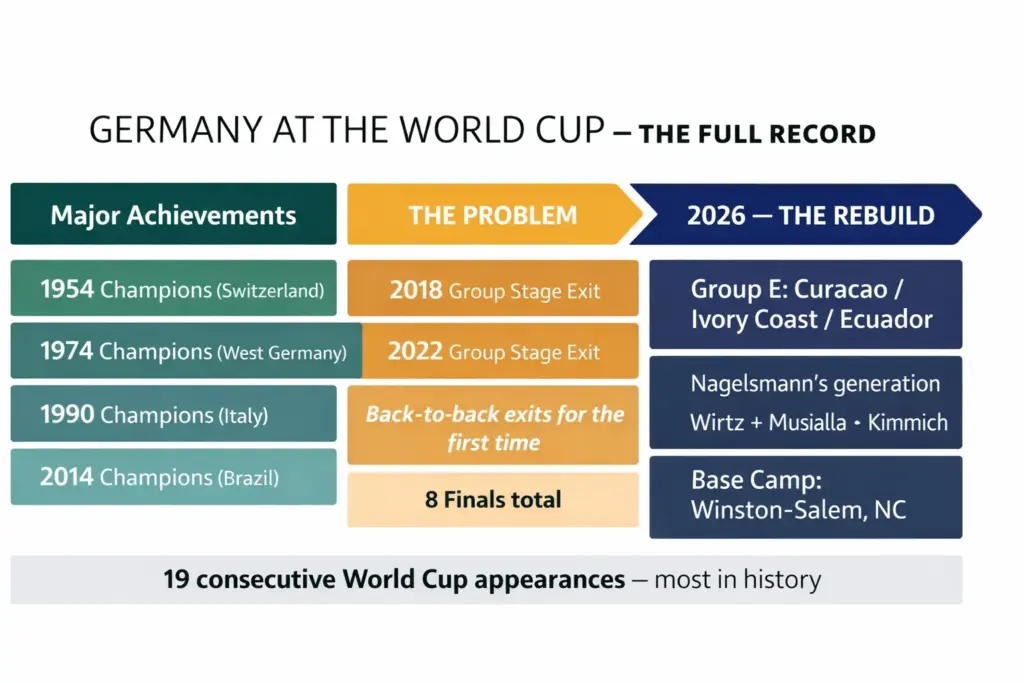
- History: 4 World Cup titles (1954, 1974, 1990, 2014); 19th consecutive tournament; two consecutive group-stage exits (2018, 2022) to overcome
- Base camp: Winston-Salem, North Carolina (Wake Forest University)
SNIPPET BLOCK
Germany enters the 2026 World Cup as one of the tournament’s most dangerous teams — and one of its most scrutinized. A four-time World Cup winner with back-to-back group-stage exits in 2018 and 2022, Julian Nagelsmann’s rebuilt squad carries the weight of history and the potential of a genuinely world-class midfield generation. Florian Wirtz (Liverpool, ranked the world’s best attacking midfielder by FourFourTwo), Joshua Kimmich (106 caps), and a returning Jamal Musiala anchor a Germany side drawn into Group E alongside Curaçao, Ivory Coast, and Ecuador — giving them one of the most navigable group draws of any Pot 1 nation. If Musiala is fit and firing, Germany are a genuine title contender.
The Context: Why 2026 Matters More Than Usual
Germany are the most consistently successful nation in World Cup history by appearances — 19 consecutive tournaments, more than any other nation. They have won it four times and reached the final eight times.
But since lifting the trophy in Brazil in 2014, Germany have:
- 2018 Russia: Eliminated in the group stage — losing to Mexico and South Korea, failing to beat Sweden convincingly
- 2022 Qatar: Eliminated in the group stage again — drawing with Spain and losing to Japan, finishing third in their group despite being unbeaten
No nation with Germany’s pedigree has exited in back-to-back group stages in the modern era. The pressure to reverse this pattern defines everything Nagelsmann has done since his appointment.
The 2024 European Championship offered genuine grounds for optimism. Germany were the tournament hosts and reached the quarterfinals — eliminating Denmark and Scotland, and taking eventual champions Spain to extra time before a 119th-minute goal knocked them out. It was not a tournament win, but it was evidence that Nagelsmann’s system can compete with elite opposition.
2026 is where the rebuild faces its defining test.
Julian Nagelsmann: The Youngest National Coach With the Biggest Brief
Julian Nagelsmann was appointed Germany head coach on September 22, 2023, replacing Hansi Flick after a poor run of results. At the time of appointment he was 36 years old — Germany’s second-youngest coach ever. His record through to February 2026: 17 wins, 6 losses, 6 draws.
His club career before Germany established him as one of Europe’s most tactically sophisticated managers. He became the youngest manager in Bundesliga history when he took charge of Hoffenheim at 28 — guiding them to Europa League football on limited resources. He then took RB Leipzig to a UEFA Champions League semifinal — the furthest the club had gone in their short history. At Bayern Munich, he won the Bundesliga and two German Super Cups before his unexpected dismissal in 2023.
The tactical signature Nagelsmann brings to Germany is recognisable: gegenpressing (aggressive high press when possession is lost) combined with high-tempo, possession-dominant attacking football. His teams move the ball quickly, press aggressively in transition, and rely on technically gifted attacking midfielders to unlock defences in tight spaces.
The challenge at international level is always the same: international football provides far fewer training days than club football. Patterns drilled into club teams over months must be condensed into days. Nagelsmann’s response has been to build a system that emphasises individual quality within a recognisable shape — trusting Wirtz, Musiala, and Kimmich to improvise within a clear framework, rather than demanding mechanical execution of complex drills.
Germany will play Ivory Coast in Stuttgart (March 30, 2026) and Finland in Mainz (May 31) before meeting co-hosts USA in Chicago (June 6) as their final tune-up before the tournament.
Base camp confirmed: Winston-Salem, North Carolina — Wake Forest University (training) and The Graylyn Estate (accommodation). Nagelsmann: “We have three fields in excellent condition that meet all of our sporting requirements, and they can be reached on foot or by bike in less than ten minutes.”
Germany 2026 World Cup – The Players & Squad Guide
Florian Wirtz — The Engine
Liverpool. Born May 3, 2003 (age 22 at tournament). Position: Attacking midfielder.
Wirtz is the player Nagelsmann’s system is built around. FourFourTwo ranked him the number one attacking midfielder in the world in December 2025 — ahead of Bellingham, Pedri, and De Bruyne.
His backstory is one of football’s great resilience narratives. He tore his ACL at 18 in 2022, returned, and then produced what became one of the Bundesliga’s all-time great individual seasons — 18 goals and multiple assists in Leverkusen’s historic unbeaten domestic double of 2023-24. His goal in a 5-0 title-clinching win over Werder Bremen was a hat-trick performance that announced him globally.
At Euro 2024 he scored the tournament’s opening goal against Scotland (becoming the youngest German scorer in European Championship history at 21 years and 42 days) and then produced one of the tournament’s most dramatic moments — coming off the bench in the quarterfinal against Spain and equalising in the 89th minute to take the match to extra time. Germany ultimately lost to a 119th-minute goal, but Wirtz’s impact was undeniable.
In June 2025, Liverpool signed him for a British-record guaranteed £100 million (plus bonuses) — confirmation of where the market places his value.
The Liverpool question: Wirtz has found the Premier League’s tempo more demanding than expected. Through January 2026 he has 4 goals and 2 assists in the PL — a decent return after a slow start, with Liverpool.com noting he is “starting to score and assist regularly” and “much more used to the speed of the Premier League” since December. His Leverkusen director placed the settling-in process in direct context: “It’s a completely normal settling-in process, entirely independent of any transfer fee.”
The key reassurance: With Germany, Wirtz consistently produces his best football. He has 31 caps and 7 goals for the national team — his international form has always been a level above his early club-level adjustment periods.
Jamal Musiala — The Returner
Bayern Munich. Born February 26, 2003 (age 23 at tournament). Position: Attacking midfielder / winger.
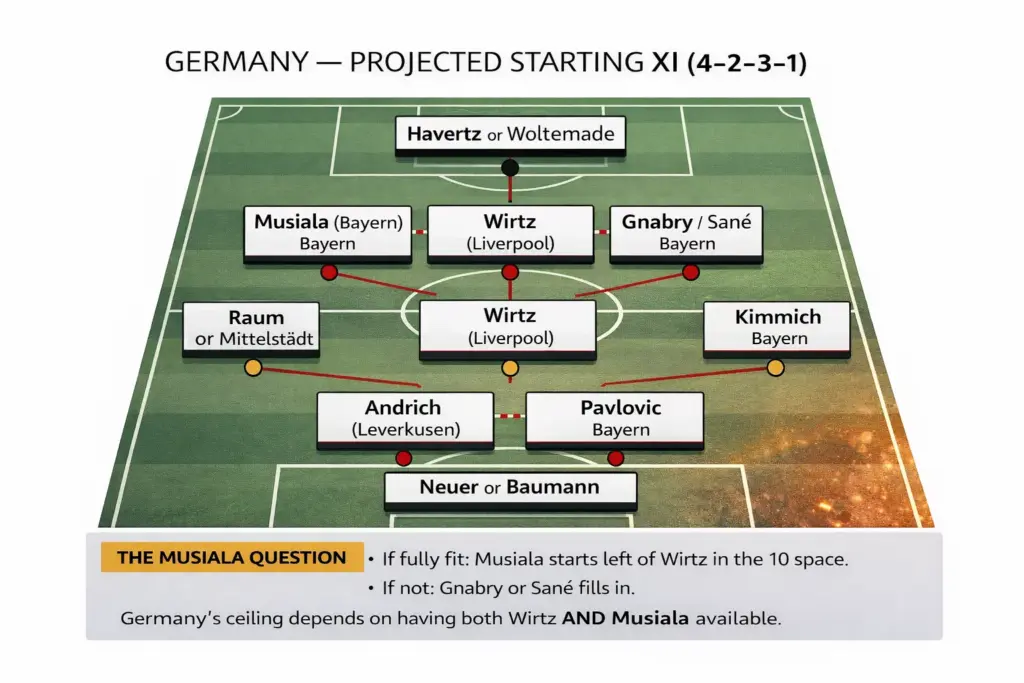
If Wirtz is Germany’s engine, Musiala is their spark — the dribbler, the improviser, the player who finds angles that should not exist. He was named in the Euro 2024 Team of the Tournament. In 40 caps for Germany he has established himself as, arguably, the most naturally gifted German player since a prime Michael Ballack.
Then came July 5, 2025. In the Club World Cup quarterfinal against PSG, Musiala was caught in a collision with goalkeeper Donnarumma near the byline. Bayern confirmed immediately: fractured fibula, dislocated ankle. Surgery successful but “several months” on the sidelines.
The recovery timeline:
- July 2025: Surgery — “fractured fibula as a result of a broken and dislocated ankle”
- October 23, 2025: First individual outdoor training session — “My first jump a few weeks ago, then my first run on the Alter-G treadmill, now on the pitch. That was a very big step.”
- December 16–17, 2025: Rejoined main Bayern squad in team training
- January 2026: Targeting first competitive minutes — Kompany: “His first minutes on the pitch should follow in January. That would be an ideal plan for us.”
- February 2026 (current status): Returning to competitive action after six-month absence; form and fitness build-up underway. As of February 20, he is building match rhythm but has not yet completed a full 90-minute high-intensity fixture since the injury.
The honest assessment: fitness by June is achievable and likely. Full match sharpness — the rhythm of 90 minutes in elite competition — depends on whether he can stay injury-free through the rest of the Bundesliga season. Musiala himself: “When I come back, I want to be at 100 percent, at a good level. That’s why we’re taking our time.”
Joshua Kimmich — The Anchor
Bayern Munich. 106 Germany caps. Position: Defensive midfielder / right back.
Kimmich is Germany’s most experienced outfield player and the organising intelligence of the squad. He has won the Champions League, multiple Bundesliga titles, and been named in UEFA’s Team of the Year.
His role at the 2026 World Cup is as the defensive pivot that allows Wirtz and Musiala to operate with freedom further forward. Kimmich reads the game as well as any midfielder in world football — his ability to intercept, recycle possession, and dictate tempo is what allows the attacking players around him to take risks.
Nick Woltemade — The New Striker
Newcastle United. Position: Centre forward.
Nick Woltemade was among the top five most expensive transfers globally in 2025, moving from VfB Stuttgart to Newcastle United. He is competing directly with Kai Havertz for Germany’s No.9 jersey — and by all accounts, the competition is genuine.
Eddie Howe (Newcastle manager) praised his integration: “Confidence is absolutely essential for a centre forward.” Kimmich publicly spoke about him after the Slovakia qualifier: “Everyone knew what was at stake.” Woltemade scored in the 6-0 destruction of Slovakia — his composure in that match, with World Cup qualification confirmed on the night, was exactly the kind of evidence Nagelsmann needed.
The Havertz-vs-Woltemade competition for the No.9 jersey is one of the most interesting internal battles at the 2026 World Cup for any nation — not because one is clearly superior, but because they represent genuinely different profiles. Havertz is technically polished and links play better; Woltemade is physically imposing, direct, and increasingly clinical.
The Supporting Cast
Leroy Sané (Bayern Munich, returning from long-term injury issues but Kimmich called him “physically stronger than any other player I know” after his Nations League return).
Kai Havertz (Arsenal — had a “minor relapse” per Nagelsmann’s late 2025 update, but expected fit for the tournament).
Jonathan Tah (Bayer Leverkusen) and Nico Schlotterbeck (Borussia Dortmund) — the centre-back pairing who combined experience and youth at Euro 2024. Schlotterbeck after the Slovakia qualifier: “We can beat any opponent.”
Aleksandar Pavlovic (Bayern Munich, U21 talent forcing his way into the senior squad) and Robert Andrich (Leverkusen) provide midfield cover and aggression.
Oliver Baumann (Hoffenheim) has been the backup goalkeeper option with Manuel Neuer’s fitness a recurring concern — though reports emerged in late 2025 that Bayern manager Vincent Kompany backed a Neuer return for the World Cup.
Group E: Germany’s Path
Germany were drawn into Group E — described by analysts as “a path that on paper favours Germany but carries risk if injuries persist.” They face:
June 14 — Germany vs Curaçao, NRG Stadium, Houston (12:00 local / 19:00 CEST)
Curaçao are the smallest nation ever to qualify for a World Cup. No previous meeting with Germany. This is the match where Nagelsmann will demand a fast, professional win — ideally with Musiala and Wirtz both starting, building combination play and confidence. A heavy win here shifts all group stage momentum in Germany’s favour.
June 20 — Germany vs Ivory Coast, BMO Field, Toronto (16:00 local / 22:00 CEST)
The real group stage test. Ivory Coast are the reigning Africa Cup of Nations champions (2024) — physical, organised, with genuine individual quality including Sébastien Haller (when fit) and a midfield that consistently disrupts European opponents. Germany will face Ivory Coast twice in preparation — a friendly in Stuttgart on March 30, 2026, which Nagelsmann has explicitly structured to learn about this specific opponent.
June 25 — Ecuador vs Germany, MetLife Stadium, New Jersey (16:00 local / 22:00 CEST)
Ecuador finished second in CONMEBOL qualifying with 25 points — a genuine test, not a formality. Post #19 (Dark Horses) identified Moisés Caicedo (Chelsea) as one of the tournament’s most dangerous defensive midfielders. This is the match that decides whether Germany top the group or advance as runners-up. Nagelsmann will want the group sealed before this point.
The Ecuador connection: Post #19 established Ecuador as dark horse contenders. For Germany, the fact that their hardest group game is against one of the most organised CONMEBOL survivors — rather than a European giant — is the central advantage of their draw. The bracket is genuinely favourable.
Qualifying: How Germany Got Here
Germany won UEFA Qualifying Group A — their path included Northern Ireland, Luxembourg, and Slovakia.
Their record was not flawless: they lost 2-0 away in Slovakia on September 4, 2025 — their very first qualifier. That result generated immediate concerns.
What followed was exactly what Nagelsmann needed: a recovery that proved character. Germany won their next five matches including a 6-0 destruction of Slovakia in Leipzig on November 17, 2025 — sealing qualification as group winners and claiming the first-pot seeding that gave them the favourable draw.
The 6-0 was notable beyond just the scoreline. Woltemade scored and performed with the confidence of a player who belongs at this level. Kimmich was authoritative throughout. The only shadow was the continued absence of Musiala — already one month into his recovery by that point.
Germany’s qualifying also featured a 3-3 draw with Italy and a 2-1 win over Italy — the see-saw form that explains why this squad is simultaneously viewed as a title contender and an unpredictable quantity.
This is Germany’s 19th consecutive World Cup appearance — they have not missed a tournament since 1950.
Strengths, Weaknesses and the Honest Verdict
Strengths:
- Wirtz and Musiala (if fit) form one of the most dangerous attacking midfield partnerships in the tournament — comparable to Ødegaard/Haaland in creative-destructive potential but with more technical diversity
- Kimmich’s 106-cap experience provides a tournament-hardened backbone that younger squads lack
- Group E is the most manageable draw Germany could have hoped for from Pot 1 — a realistic path to the Round of 32 as group winners
- Nagelsmann’s system has a clear identity — not experimental. Euro 2024 showed they can take Spain to the brink
- Woltemade as a new striker option gives Nagelsmann genuine tactical flexibility at No.9
- Base camp proximity and logistics are well-planned — Winston-Salem is central to their three group venues (Houston, Toronto, New Jersey)
Weaknesses:
- Musiala’s injury is the most significant individual fitness risk in the tournament after Ødegaard for Norway — his return timeline is achievable but not guaranteed at full sharpness
- Wirtz’s Premier League adaptation has been slower than expected — his international form has always exceeded club form, but the question remains whether the adjustment affects his World Cup peak
- Back-to-back group stage exits create a psychological weight that is real, not just media-generated — Germany’s players know the history
- The Havertz/Woltemade striker situation remains unresolved — both are good options, but neither is the dominant, obvious choice
- Nations League form has been inconsistent — a Nations League semifinal defeat (before the World Cup draw) and results against France and Portugal in 2025 suggested this squad is still capable of off nights against elite opposition
The verdict: Germany are a genuine top-four contender if Musiala is fully fit. Their ceiling — a Wirtz-Musiala-Kimmich midfield in a flowing Nagelsmann system against a manageable bracket — is as high as any team in the field outside France, Argentina, and Spain.
The floor — Musiala still ring-rusty, Wirtz struggling to assert himself at international level after a difficult Premier League transition, a striker situation unresolved — is a quarterfinal exit.
The most likely reality is somewhere between those two points. Germany will advance from Group E. They will win a knockout match. Whether they go deeper depends almost entirely on one player returning from injury at his absolute best.
Watch the Germany vs Ivory Coast friendly on March 30, 2026. If Wirtz and Musiala are both starting and creating, the ceiling is very high.
FAQs: Germany at the 2026 World Cup
What group are Germany in at the 2026 World Cup?
Group E — alongside Curaçao (June 14, Houston), Ivory Coast (June 20, Toronto), and Ecuador (June 25, New Jersey). Germany were a Pot 1 seed.
Who is Germany’s manager for the 2026 World Cup?
Julian Nagelsmann, appointed September 22, 2023. His record as Germany coach: 17 wins, 6 losses, 6 draws. He previously managed Hoffenheim, RB Leipzig, and Bayern Munich. At 36 when appointed, he was Germany’s second-youngest coach.
Is Jamal Musiala fit for the 2026 World Cup?
As of February 2026, Musiala is working his way back to fitness after fracturing his fibula and dislocating his ankle in the Club World Cup (July 5, 2025) during Bayern’s quarterfinal against PSG. He returned to Bayern team training in December 2025 and targeted competitive minutes in January 2026. If his recovery continues as planned, he should be available for the World Cup — but arriving at full match sharpness after a near-12-month layoff remains the key question.
Where does Florian Wirtz play?
Wirtz plays attacking midfield — in the number 10 position or drifting from the left. He joined Liverpool for a British-record £100 million in June 2025 after his key role in Leverkusen’s unbeaten Bundesliga title season. He has 31 Germany caps and 7 goals.
How many times has Germany won the World Cup?
Four times: 1954 (Switzerland), 1974 (West Germany), 1990 (Italy), 2014 (Brazil). They have also won the European Championship three times (1972, 1980, 1996).
Why have Germany struggled recently at World Cups?
They were eliminated in the group stage in both 2018 (Russia) and 2022 (Qatar) — the first time in their history they have had consecutive group-stage exits in the modern era. The common factors were tactical inflexibility, an aging squad, and an inability to adapt quickly to opponents who pressed their build-up. Nagelsmann’s rebuild since 2023 specifically addresses these issues with a younger, more dynamic squad.
Who is Nick Woltemade and why does he matter?
Nick Woltemade is a German striker who moved from VfB Stuttgart to Newcastle United in 2025 — one of the five most expensive transfers globally that year. He is competing with Kai Havertz for Germany’s No.9 position and has impressed Nagelsmann with his composure in big matches, including scoring in the decisive 6-0 qualifier win over Slovakia.
How can I watch the 2026 World Cup matches in Germany?
In Germany, the matches will traditionally be broadcast by public service broadcasters ARD and ZDF, who share rights for the tournament. Select matches may also be available via Deutsche Telekom (MagentaTV).
Where is Germany’s World Cup base camp?
Winston-Salem, North Carolina — they will train at Wake Forest University’s facilities and stay at The Graylyn Estate. Nagelsmann confirmed the choice personally, citing the quality of three training pitches that can be reached on foot in under ten minutes.
Will Germany win the 2026 World Cup?
Based on squad quality, draw, and tactical identity, Germany are a genuine top-four contender — not the outright favourite but firmly in the bracket of teams capable of winning it. The key condition is Musiala being fully fit and in form. If both Wirtz and Musiala are operating at their ceiling simultaneously, and the bracket falls kindly in the knockout rounds, Germany have the firepower to beat anyone.