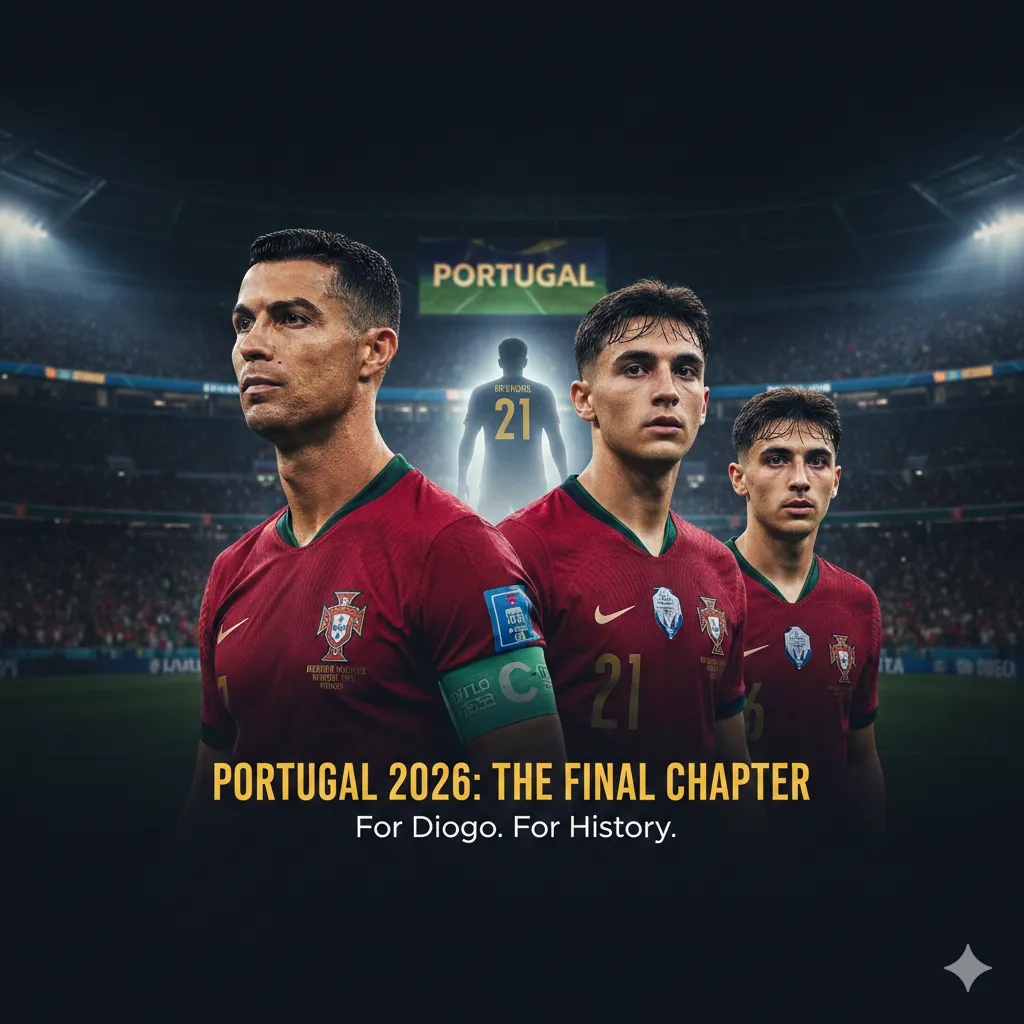
The last time Portugal won the World Cup was never. That is the single fact that haunts one of football’s most gifted nations — and drives everything about their 2026 campaign.
They have the players. They have the manager, fresh off beating Spain in a Nations League final four months before the tournament. They have depth in midfield that would make most squads envious. And, for one last time, they have Cristiano Ronaldo — confirmed, definitive, his own words — playing in his sixth and final World Cup at the age of 41.
The 2026 World Cup is the tournament Portugal have been building toward since Roberto Martínez took over in January 2023. It is also, for a generation of Portugal supporters, the tournament they have to win before Ronaldo leaves and the era ends.
There is something else running underneath all of it. On July 3, 2025 — 25 days after helping Portugal lift the Nations League trophy — Diogo Jota died in a car crash in northwestern Spain alongside his younger brother André. He was 28 years old. He was married eleven days. The squad who cried for him in July travels to the World Cup carrying a promise that cannot be put into words easily.
Martínez said it simply: “He wanted to win the World Cup. We have a responsibility to fight for Diogo, and that’s very special.”
TL;DR
- Group K: Playoff winner (June 17), Uzbekistan (June 23), Colombia (June 28) — drawn from Pot 1; venues Houston and Mexico City
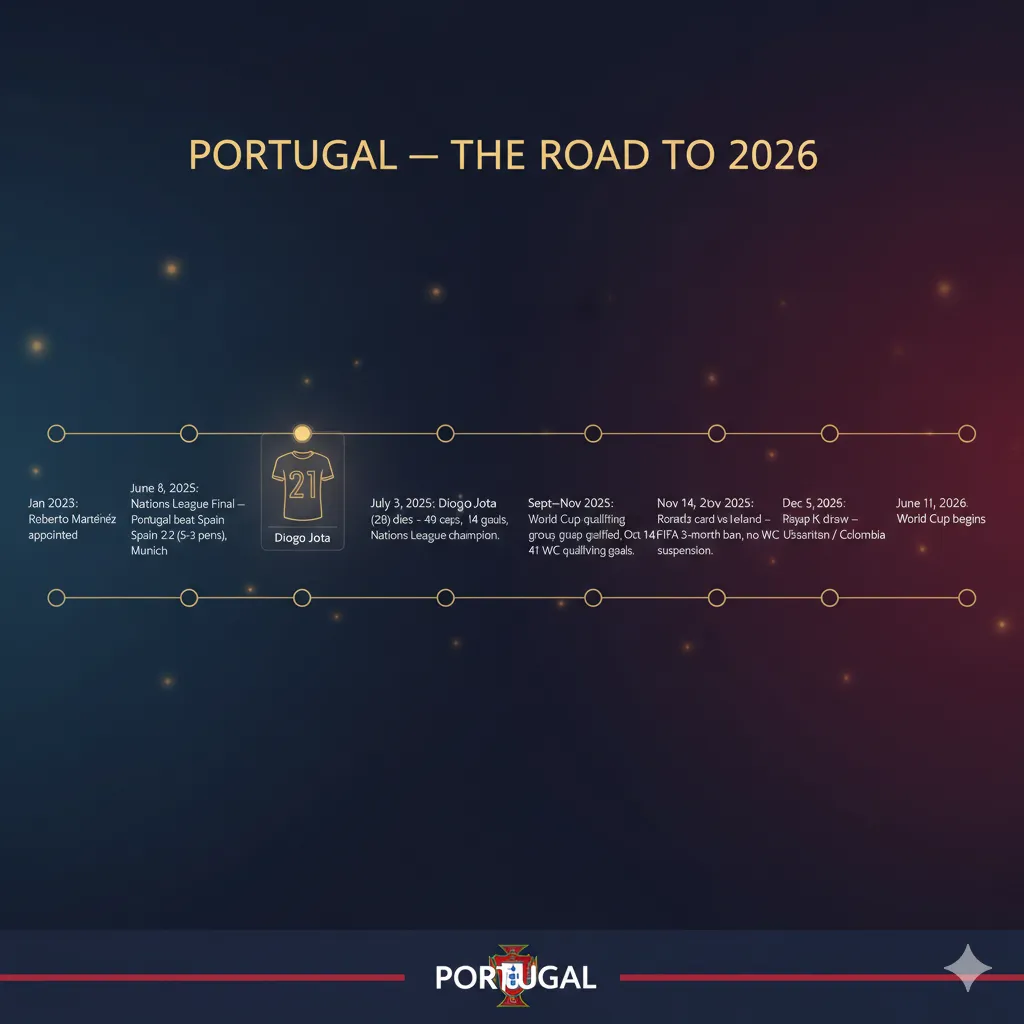
- Manager: Roberto Martínez — appointed January 2023; Nations League winner June 8, 2025 (Portugal 2-2 Spain, 5-3 pens)
- Ronaldo: Born February 5, 1985 — 41 at the tournament; confirmed this is his last; 200+ caps (most-capped male player in history); 41 WC qualifying goals (all-time record)
- The midfield: João Neves, Vitinha, Bruno Fernandes (all PSG Champions League winners May 2025) + Bernardo Silva (Man City) + Rúben Neves (Al Hilal) — generational depth
- The shadow: Diogo Jota (July 3, 2025; 49 caps, 14 goals; Nations League winner; died in car crash); his number 21 given to close friend Rúben Neves
- The verdict: A genuine title contender — top-four realistic, final possible; the draw and squad depth point toward a deep run
SNIPPET BLOCK
Portugal arrives at the 2026 World Cup as reigning UEFA Nations League champions, having beaten Spain 5-3 on penalties in June 2025. Manager Roberto Martínez leads a squad of rare depth — a generational midfield built around PSG’s João Neves and Vitinha, Bruno Fernandes, Bernardo Silva, and the final World Cup campaign of all-time record holder Cristiano Ronaldo, who confirmed this tournament will be his last. Placed in Group K (Playoff winner, Uzbekistan, Colombia), Portugal have the profile of a team capable of reaching the semifinal or beyond.
For Diogo: The Shadow Over Everything
Before tactics, formations, and group draws, there is this.
Diogo Jota played his last match for Portugal on June 8, 2025 — coming on as a substitute in extra time of the Nations League final against Spain, the same match in which Ronaldo scored Portugal’s second equaliser and the squad lifted the trophy together in Munich.
Twenty-five days later, Jota and his younger brother André Silva were killed when their car suffered a tyre blowout on the A-52 highway in Zamora, northwestern Spain. He was 28 years old. He had married Rute Cardoso eleven days earlier. He had three children.
He had 49 caps for Portugal and 14 goals. He was a two-time Nations League winner. He was, according to his manager, his teammates, and every person who watched him play, someone whose work rate and spirit were impossible to separate from what Portugal actually were.
Ronaldo’s tribute: “It doesn’t make sense. We were only just together in the national team. You had only just got married.”
Portugal subsequently gave Jota’s number 21 to close friend Rúben Neves, who unveiled a tattoo of Jota on his left leg in tribute. Martínez carried the grief directly into the World Cup context, making it clear it would tournament with the squad to North America: “We won the Nations League and Diogo Jota was part of that success. He’s a strength for us, a source of motivation because he wanted to win the World Cup.”
This is the emotional architecture of Portugal’s 2026 campaign. Everything else sits on top of it.
Roberto Martínez: The Quiet Architect
Roberto Martínez was appointed Portugal head coach in January 2023, arriving after spells at Wigan, Everton, and then an eight-year run with the Belgium national team. He had guided Belgium to the top of the FIFA world rankings and to three consecutive quarterfinals at major tournaments — but never won a trophy.
In two and a half years with Portugal, he has already done the thing Belgium could not deliver.
The Nations League triumph was not a fluke. Portugal beat Germany in the semifinal and Spain in the final — defeating the two nations that dominate European football in back-to-back matches. The manner of the final was instructive: Portugal twice came from behind, organized defensively against one of the world’s best attacks, and then held their nerve in a penalty shootout.
Martínez’s post-final reflection explained his philosophy in one clear passage: “When we work for over 30 games, we start to see confidence, resilience, trust, and quality. Quality plus the other values helps you win trophies. We don’t just have a team; we have 16-17 players on the same level, and, as a coach, I have many options and can change concepts.”
That breadth — 16 to 17 players who can meaningfully contribute — is the defining feature of the squad he has assembled. In midfield alone, Portugal can field Vitinha, João Neves, Bernardo Silva, Bruno Fernandes, and Rúben Neves, all of them playing at elite European club level. No other nation at the 2026 World Cup has that quality of midfield rotation.
Martínez’s system: A 4-2-3-1 or 4-3-3 depending on the opponent. In the Nations League final, the base shape was 4-2-3-1 with a compact defensive block that channeled Spain wide, disrupting their central combinations. The two-pivot midfield (Vitinha + João Neves in the final’s first half) provided balance, though Martínez corrected first-half issues at the break by bringing on Rúben Neves for a more orthodox defensive anchor. His willingness to adjust within a game was one of the final’s tactical stories.
The forward structure places Ronaldo as the reference point in attack — a focal striker with technical quality rather than a pure runner — supported by quick, direct wide players. Rafael Leão (AC Milan) and Pedro Neto (Chelsea) provide width and directness; when both are operating at their best, Portugal’s attacking play can be devastating in transition.
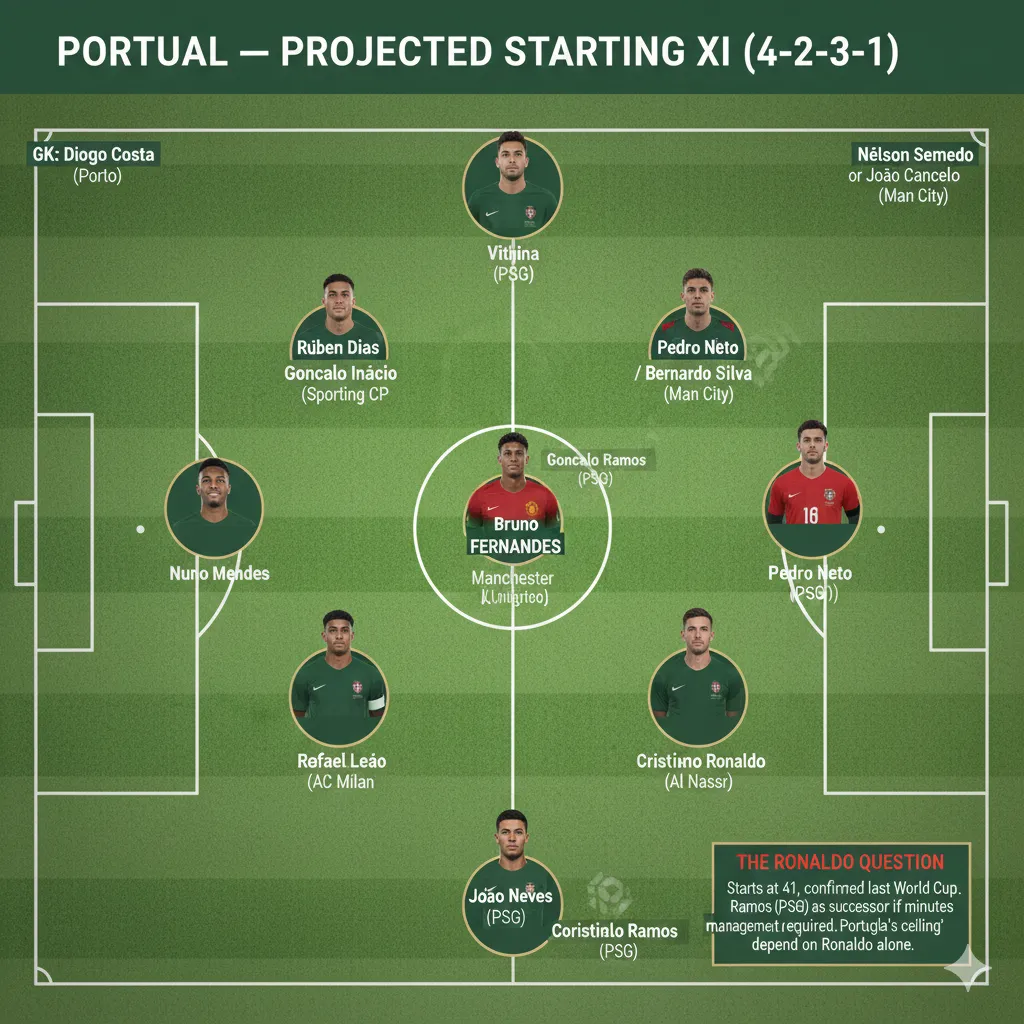
Portugal 2026 World Cup – The Players & Squad Guide
Cristiano Ronaldo — The Final Chapter
Al Nassr. Born February 5, 1985. Age at tournament: 41. Position: Striker/forward.
The numbers surrounding Ronaldo’s final World Cup are, by any measure, extraordinary:
- 200+ international caps — the most of any male player in history
- 41 goals in World Cup qualifying — a record he set on October 14, 2025, breaking the previous mark during a 2-2 draw with Hungary with a first-half brace
- 8 goals at World Cup finals across five tournaments — including a hat-trick against Spain at Russia 2018
- 138th international goal scored in the Nations League final vs Spain on June 8, 2025 — the 61st-minute volley that levelled at 2-2 and sent the game toward extra time
- First male player ever to score in five different World Cups
- First player ever to feature in six European Championships
He confirmed in November 2025 that 2026 will be his last World Cup. He did not hesitate: “Definitely, yes, because I will be 41. I gave everything for football. I’ve been in the game for the last 25 years.”
The context around his confirmation matters. In October 2025, he broke the world record for goals in World Cup qualifying. In the Nations League, he started all matches and scored eight goals in nine games across the whole tournament cycle — the leading scorer. When pressed about his fitness at 40 going on 41, his answer was straightforward: “I feel very good at this moment. I score goals; I still feel quick and sharp.”
The red card and FIFA ban: In Portugal’s 2-0 loss to Ireland in Dublin on November 14, 2025, Ronaldo was sent off for elbowing defender Dara O’Shea. FIFA issued a three-month ban and one year of probation. Crucially, the ban did not affect tournament participation — Ronaldo will be available from Portugal’s opening group match.
The honest Ronaldo assessment: His brilliance at club level and with the national team has always operated in parallel with an underwhelming World Cup knockout-round record. He has never scored a goal past the group stage at a World Cup. That context makes 2026 — his last chance, the World Cup he has circled for a decade — the defining match of his extraordinary career legacy. Whether it produces a fairy tale or one final cruel exit is the most watched individual story of the 2026 tournament.
João Neves — The Future, Now
PSG. Born September 27, 2004 (age 21 at tournament). Position: Central midfielder.
João Neves is 21 years old. In the 2024-25 season he won the UEFA Champions League with PSG. He was Portugal’s key midfield presence in the Nations League final, starting in an adapted right-back role before Martínez shifted him centrally. He is the player Martínez trusts most when the game requires composure and precision in tight spaces.
His technical profile — short passes in confined areas, pressing triggers, ball-winning without recklessness — makes him the ideal partner for Vitinha in the double pivot. Portugal’s post-Ronaldo era will be built around him. For now, at 21, he is already part of the team that makes them so difficult to break down.
Vitinha — The Connector
PSG. Position: Central midfielder.
Vitinha won the Champions League with PSG in May 2025 — and then, two months later, made a public vow in tribute to Diogo Jota: “a World Cup aim clear,” as reported in January 2026 coverage noting that the PSG midfielder had spoken about winning the World Cup as a direct tribute to his late teammate.
In Portugal’s system, Vitinha operates as the deeper, more defensive of the two midfield pivots — protecting the backline while João Neves moves higher. His passing range and ability to progress the ball from defensive positions are what allow Portugal to build from the back efficiently.
Bruno Fernandes — The Captain in Waiting
Manchester United. Position: Attacking midfielder.
Bruno Fernandes wears the captain’s armband when Ronaldo is absent and is, by any measure, one of the most technically gifted attacking midfielders in the squad. He delivered the trophy to Ronaldo personally after the Nations League final — a symbolic moment.
He is Portugal’s central creative outlet in the attacking third. His crossing, set-piece delivery, and ability to shoot from range make him a consistent threat. In the Nations League, he was clinical in the penalty shootout — one of five flawless Portuguese spot-kicks in the final.
The Supporting Cast
Bernardo Silva (Man City) — extraordinary technical quality, versatile across multiple positions; started the Nations League final but was moved wide in the second half for better balance.
Rafael Leão (AC Milan) — electric in transition and one-on-one situations; came on as a second-half substitute in the final and transformed Portugal’s left flank. His partnership with Nuno Mendes on the left is one of the most dangerous corridor combinations in the tournament.
Pedro Neto (Chelsea) — started the Nations League final, direct wide runner, contributed to the build-up throughout.
Nuno Mendes (PSG, Champions League winner) — played as an advanced left back in the Nations League and was named Player of the Tournament. His two contributions in the final — scoring the first equalizer and providing the cross for Ronaldo’s — were decisive.
Gonçalo Ramos (PSG, Champions League winner) — Ronaldo’s direct successor as center forward; converted his penalty in the Nations League final shootout and will be the main striker once Ronaldo’s involvement is managed in a long tournament.
Rúben Neves (Al Hilal) — converted the decisive final penalty, wears Jota’s number 21, one of the most composed defensive midfielders in the squad.
Rúben Dias (Man City) — captain contender, one of the best center-backs in world football alongside Gonçalo Inácio (Sporting CP), who offers composure and aerial strength.
Diogo Costa (Porto) — penalty shootout hero in the Nations League final, saving Morata’s effort at the crucial moment.
Group K: The Path Out of the Group Stage
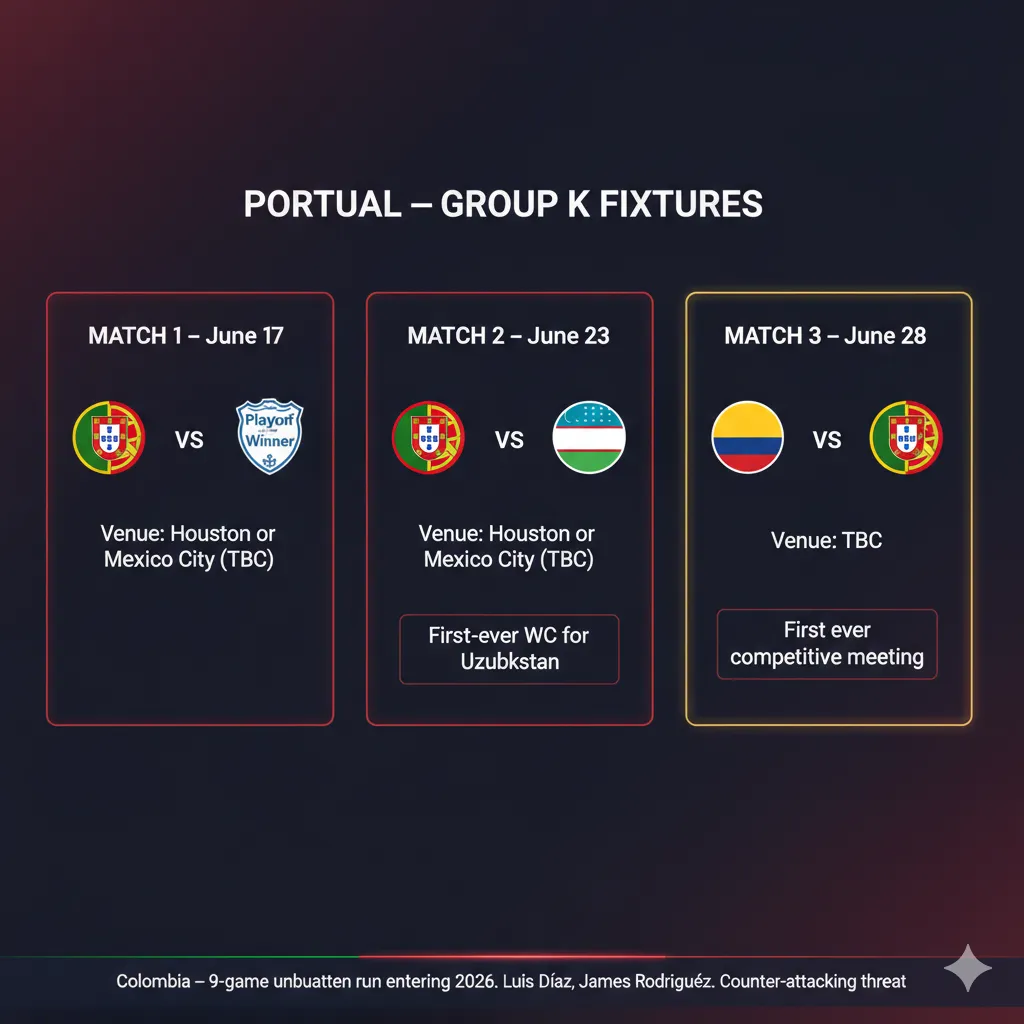
Portugal were drawn into Group K alongside the playoff winner (from the UEFA/CONMEBOL pathway — to be confirmed), Uzbekistan, and Colombia.
The group fixtures were announced for Houston and Mexico City:
June 17 — Portugal vs Playoff Winner, NRG Stadium Houston (to be confirmed) or Estadio Azteca Mexico City
The most unpredictable fixture on paper — until the playoff winner is confirmed in June 2026, Portugal cannot know exactly who they face. The smart assumption is a UEFA side (ranked between 20th and 40th globally). Portugal should win this comfortably.
June 23 — Portugal vs Uzbekistan, NRG Stadium Houston or Estadio Azteca Mexico City
Uzbekistan are making their first-ever World Cup appearance. Their key player is Manchester City defender Abdukodir Khusanov, who has improved dramatically in the Premier League. Former Roma striker Eldor Shomurodov leads their attack. Uzbekistan is the weakest opponent in Group K — Portugal should be comfortable — but first World Cup nerves and a lack of tournament experience make them genuinely unpredictable opponents.
June 28 — Colombia vs Portugal (venue TBC)
The real group stage test. Colombia arrives unbeaten in nine consecutive matches at the end of 2025 and represent a genuine counter-attacking threat. Their manager Néstor Lorenzo has built a coherent tactical identity: high-tempo pressing, devastating on the break, with Luis Díaz (Bayern Munich) as the central danger and James Rodríguez (Minnesota United) still capable of controlling tempo and creating from deep.
This will be the first ever competitive meeting between Portugal and Colombia
Group K assessment: Portugal’s draw is favorable but not simple. Advancing as group winners — critical for bracket positioning toward the final — requires beating Colombia convincingly. The reward for topping Group K is a likely more manageable bracket path in the Round of 32 and beyond.
Qualifying: How Portugal Got There
Portugal qualified from UEFA Group I alongside England — England as group winners after six wins from six, Portugal as runners-up.
The qualifying record had several notable moments:
The record: On October 14, 2025, Ronaldo scored twice in a 2-2 draw with Hungary to reach 41 goals in World Cup qualifying — the all-time record, breaking Guatemala’s Carlos Ruiz at 40. Both goals came in the first half. Portugal was held to a draw and could not clinch qualification that night.
The red card: On November 14, 2025, in Lisbon’s Estádio José Alvalade, Portugal lost 2-0 to Ireland. Ronaldo was sent off for elbowing Dara O’Shea. FIFA issued a three-month ban. It did not affect his World Cup availability.
Qualification confirmed: Portugal secured their place before Ronaldo’s ban became relevant, finishing as Group I runners-up with enough points. Their final tally: five qualifying goals from Ronaldo leading the group’s top scorers.
The first qualifier after Jota’s death: Portugal’s first match after July 3, 2025, was against Armenia. Rúben Neves wore Jota’s number 21. Fans planned a minute’s applause in the 21st minute. Rúben Dias when talked about the gesture: “Now I even got goosebumps. On behalf of Portugal, I thank you very much.”
Strengths, Weaknesses and the Honest Verdict
Strengths:
- The deepest midfield of any team at the tournament — Vitinha, João Neves, Bruno Fernandes, Bernardo Silva, Rúben Neves: all Champions League or major trophy winners in 2024-25
- Nations League title confirmation that Martínez’s system works under maximum pressure — beating Germany and Spain back-to-back in knockout stages
- Penalty shootout composure — Diogo Costa’s save + five clinical Portugal penalties in the final: evidence this squad does not collapse in the decisive moment
- Group K is achievable — the playoff wildcard + Uzbekistan first timers mean Portugal should advance with points to spare if they handle Colombia on June 28
- Genuine depth in every position allows Martínez to rotate without quality drop: Gonçalo Ramos as Ronaldo backup, Rafael Leão/Pedro Neto/Conceição rotating wide, multiple midfield options
Weaknesses:
- Ronaldo at 41 will require minutes management across a long tournament. The question of when and how Gonçalo Ramos takes over the starting role is unresolved — and getting the transition wrong at a crucial knockout moment could cost Portugal dearly
- The emotional weight of Jota’s death is real. Portugal’s squad are human beings carrying genuine grief into a high-pressure tournament. Martínez has channeled it as motivation — but motivation and grief are complex, unpredictable forces
- Portugal have never won the World Cup and have a history of dramatic quarterfinal exits (2006 SF remains their best, standard exits at QF stage in 2010 onwards)
- Colombia represents the most complete tactical challenge in the group — a well-organized, counter-attacking side who have beaten bigger squads at recent tournaments
The verdict: Portugal are a top-three contender at the 2026 World Cup. Their squad depth, recent form (Nations League title), tactical clarity, penalty composure, and manageable group draw all point toward a deep run.
The ceiling is a final — a rematch with Spain, or a France vs Portugal semifinal, would be the most anticipated match of the tournament. Portugal beat Spain in June 2025. They can do it again.
The floor is a quarterfinal exit, the familiar Portuguese story — reaching the knockout rounds, competing with anyone, then finding one match too difficult to convert quality into victory.
The thing that might change that pattern? This squad knows something about loss that most football squads never have to know. That knowledge travels with them to every match. Whether it becomes fuel or weight is the most human question in the tournament.
The Jota promise is the most important thing Portugal carry into 2026. No tactical analysis fully captures it.
FAQs: Portugal at the 2026 World Cup
What group are Portugal in at the 2026 World Cup?
Group K — alongside the playoff winner (to be confirmed June 2026), Uzbekistan, and Colombia. Fixtures are scheduled for June 17, June 23, and June 28, with venues in Houston and Mexico City.
Will Cristiano Ronaldo play at the 2026 World Cup?
Yes. Ronaldo has confirmed the 2026 World Cup will be his last international tournament. He told CNN in November 2025: “Definitely, yes, because I will be 41.” He will be available from Portugal’s opening match — a FIFA three-month ban for a red card against Ireland (November 14, 2025) does not affect tournament participation.
How old will Ronaldo be at the 2026 World Cup?
Ronaldo was born on February 5, 1985. He will turn 41 in February 2026 — meaning he arrives at the June tournament already 41. He would be the second-oldest outfield player to appear at a World Cup.
Who is Roberto Martínez?
Roberto Martínez is Portugal’s head coach, appointed in January 2023. He previously managed Wigan Athletic, Everton, and the Belgian national team for eight years. He won his first major trophy with Portugal when they beat Spain 5-3 on penalties in the 2025 UEFA Nations League final in Munich.
Who is Diogo Jota and why is he mentioned in relation to Portugal’s World Cup?
Diogo Jota was a Portuguese forward who played for Liverpool. He won 49 caps and scored 14 goals for Portugal, including playing a key role in the 2025 Nations League triumph. He died on July 3, 2025, in a car accident in Spain — just 25 days after the Nations League final — alongside his younger brother André. The Portugal squad have dedicated their World Cup campaign to his memory.
What is Portugal’s best World Cup result?
Their best finish was third place at the 1966 World Cup, when Eusébio was the tournament’s top scorer. In the modern era, their best result is a semifinal in 2006, when they were eliminated by France 1-0 (Zidane penalty). They have typically been quarterfinal-level performers since 2006. [established record]
What formation does Portugal use?
Under Martínez, Portugal predominantly uses a 4-2-3-1 — a double midfield pivot (typically Vitinha and João Neves at the Nations League final) with Bruno Fernandes as the number 10, wide attackers (Rafael Leão and Pedro Neto or Bernardo Silva), and Ronaldo as the focal striker. Martínez adjusts the system in-game — he shifted Bernardo Silva wide and brought on Rúben Neves in the second half of the Nations League final to add defensive balance.
Can Ronaldo win the World Cup?
Portugal is genuine title contenders based on squad quality and recent form. If they progress to the final — a likely matchup with Spain or France — they would be competitive. For Ronaldo personally, winning the one major international trophy missing from his career at age 41, in his final World Cup, would be one of sport’s most remarkable storylines.