
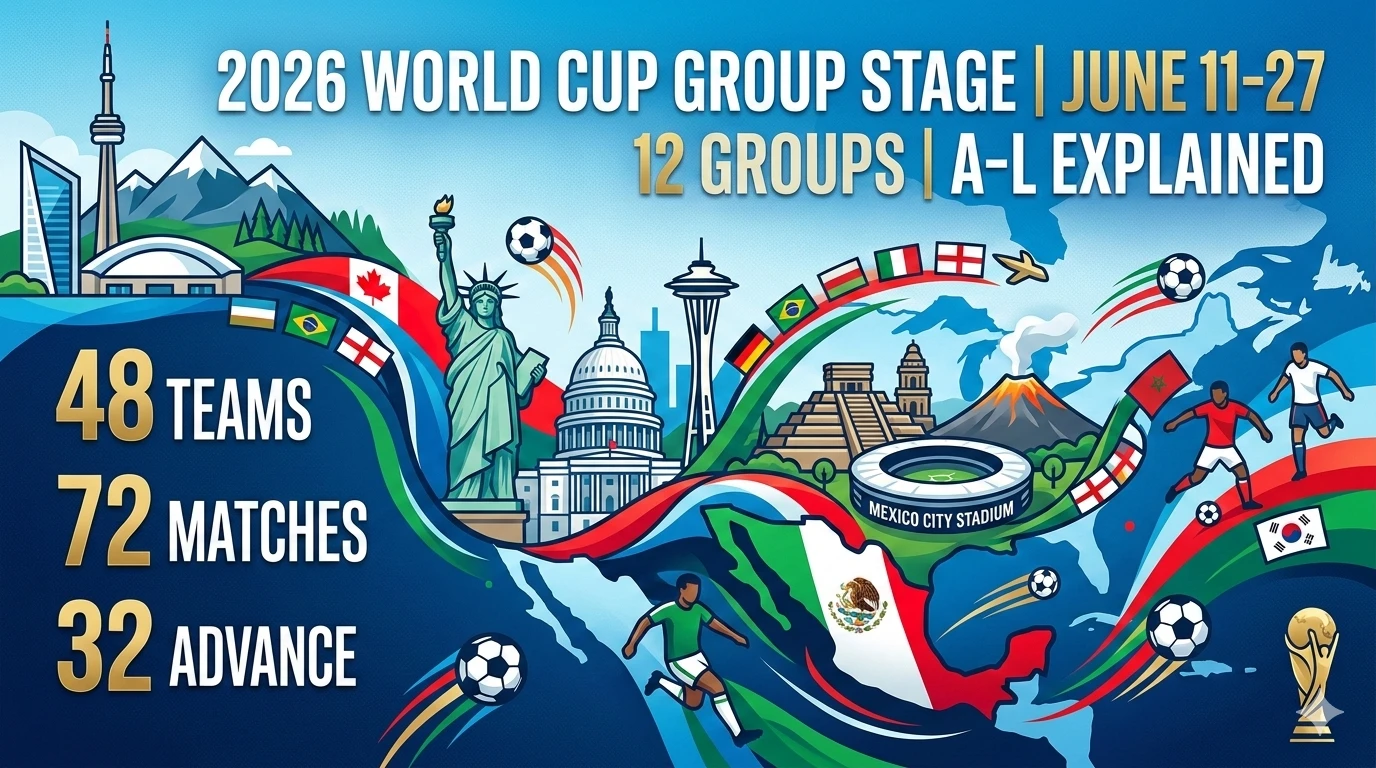

The 2026 FIFA World Cup has twelve groups. That is four more than the eight groups fans are used to from every World Cup since 1998. The format is new, the group letters run from A to L, and 48 teams are competing across three host countries. This guide covers every group, every team, when the group stage is played, and how the expanded format works — including which teams advance and which go home.
TL;DR
- The 2026 World Cup has 12 groups of 4 teams — labelled Group A through Group L.
- 48 teams compete in total — 16 more than at any previous World Cup.
- Top 2 from each group advance automatically — that is 24 teams.
- 8 best third‑placed teams also advance — making 32 teams in the Round of 32.
- This results in 72 group‑stage matches, an increase from the 48 played in previous tournaments.
- The group stage runs from June 11 to June 27, 2026.
- Games are played across 16 venues in the USA, Canada and Mexico.
- The full list: Group A through Group L, with 4 teams in each group.
Snippet Block
The 2026 FIFA World Cup has 12 groups — labelled Group A through Group L — each containing four teams. The top two teams from each group qualify automatically for the Round of 32. The eight best third‑placed teams also advance. This expanded format results in 72 group‑stage matches. The group stage runs from June 11 to June 27, 2026, across venues in the United States, Canada and Mexico. This is the first World Cup with 48 teams and 12 groups — expanded from the 32‑team, 8‑group format used since 1998.
Why 12 Groups? The Expanded Format Explained
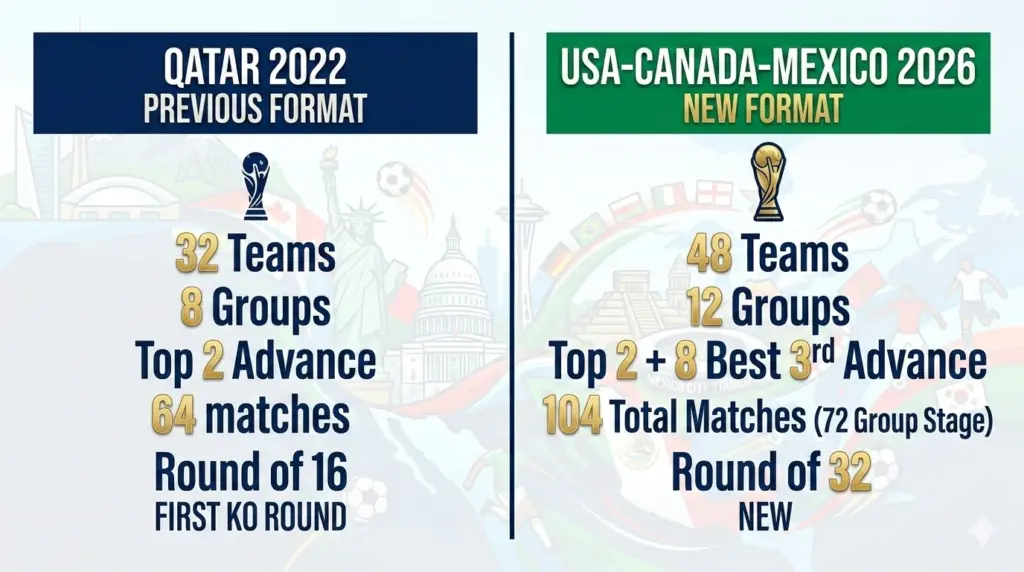
Every World Cup from 1998 to 2022 used eight groups of four teams — 32 teams in total. The 2026 edition changes that fundamentally.
The FIFA Council approved the expansion to 48 teams in January 2017, with the format confirmed as twelve groups of four in March 2023. The 48‑team format was originally proposed with sixteen groups of three, but that was scrapped in favour of twelve groups of four — a decision widely welcomed by football analysts who argued that groups of three produce too many dead‑rubber final games and incentivise defensive play.
Twelve groups of four means:
- 72 matches in the group stage (each group of four plays six matches)
- 32 teams advancing to the knockout stage
- A new Round of 32 before the Round of 16
- 104 total matches — up from 64 at Qatar 2022
The group stage runs from June 11 to June 27, 2026. The final is on July 19 at New York New Jersey Stadium.
All 12 Groups A–L
Below is every group and every confirmed team, based on the official FIFA draw held in December 2025. Groups marked with ⚠️ contain teams whose qualification was pending the March 2026 playoffs, as per the draw results. These slots will be filled by the winners of the respective playoff paths.
Group A
Teams: Mexico, South Korea, South Africa, ⚠️ UEFA Play‑off D winner
Mexico are a co‑host nation with one of the most passionate fanbases in world football. El Tri always travel in numbers — at a home tournament, their support will be extraordinary. They open the tournament against South Africa on June 11 at the iconic Mexico City Stadium.
South Korea are Asia’s other major contender — Son Heung‑min leads a squad that combines Premier League and Bundesliga experience with the tactical discipline that took them to the 2022 Round of 16.
South Africa return to the World Cup for the first time since hosting the tournament in 2010. Their squad, known as Bafana Bafana, is youthful and athletic, capable of causing problems on the counter‑attack.
⚠️ UEFA Play‑off D winner: The final team will be one of Denmark, Czechia, North Macedonia, or the Republic of Ireland.
Group B
Teams: Canada, Switzerland, Qatar, ⚠️ UEFA Play‑off A winner
Canada are playing at home — a co‑host nation in front of passionate home support. Alphonso Davies (Bayern Munich), Jonathan David (Lille) and Tajon Buchanan lead a Golden Generation that has never been closer to a deep World Cup run.
Switzerland are one of Europe’s most consistent qualifiers — disciplined, organised and reliable. At the 2022 World Cup, they finished top of their group but were eliminated by Portugal in the Round of 16.
Qatar return to the World Cup as a previous host nation. Their home tournament in 2022 was historic — they became the first host nation ever eliminated in the group stage. At a neutral venue, they face a genuine test.
⚠️ UEFA Play‑off A winner: The final team will be one of Italy, Northern Ireland, Wales, or Bosnia and Herzegovina.
Group C
Teams: Brazil, Morocco, Scotland, Haiti
Brazil are the world’s most successful World Cup nation — five titles, the most of any country. After a quarterfinal exit at Qatar 2022 (losing to Croatia on penalties), they arrive with renewed purpose. Vinicius Jr, Rodrygo, Endrick and a squad of global stars make them one of the tournament favourites.
Morocco became the first African nation to reach a World Cup semifinal, eliminating Belgium, Spain and Portugal in Qatar 2022 before losing to France. They are physically powerful, tactically disciplined and have the belief of teams who know they can beat anyone.
Scotland qualified directly by winning UEFA Group C — their first World Cup since France 1998. Steve Clarke’s side face the toughest possible group draw — but they have earned their place.
Haiti return to the World Cup for the first time since 1974 — a 52‑year gap. Their qualification is an extraordinary story in itself, representing the resilience of Haitian football through decades of profound challenges.
Group D
Teams: USA, Paraguay, Australia, ⚠️ UEFA Play‑off C winner
USA are a co‑host nation and one of the tournament’s most anticipated teams on home soil. Christian Pulisic, Weston McKennie, Tyler Adams and a squad built around Premier League and Bundesliga experience carry enormous expectations.
Paraguay are a South American side with genuine World Cup credentials — they reached the quarterfinals in 2010. A new generation is building toward a strong tournament showing.
Australia — the Socceroos qualified through the AFC/OFC playoff. Led by players in European club football, Australia are a competitive, organised side that has made the Round of 16 at multiple World Cups.
⚠️ UEFA Play‑off C winner: The final team will be one of Türkiye, Slovakia, Romania, or Kosovo.
Group E
Teams: Germany, Ecuador, Ivory Coast, Curaçao
Germany are one of the pre‑tournament favourites. A new generation under Julian Nagelsmann — Jamal Musiala, Florian Wirtz, Leroy Sané — is widely considered one of the most gifted German squads in a generation.
Ecuador impressed at Qatar 2022 with their high‑energy pressing and technical ability. They qualified comfortably from CONMEBOL and will look to progress from the group stage for the first time since 2006.
Ivory Coast are a powerful African side, rich in talent. As a two‑time Africa Cup of Nations winner, they possess the physicality and skill to challenge any team in the group.
Curaçao is the smallest nation ever to qualify for a men’s World Cup. Their debut is a landmark moment for Caribbean football, and they will aim to make their presence felt.
Group F
Teams: Netherlands, Japan, Tunisia, ⚠️ UEFA Play‑off B winner
Netherlands are one of Europe’s most competitive nations entering 2026, with a squad featuring Virgil van Dijk, Cody Gakpo, and Memphis Depay. They reached the Euro 2024 semifinals and have genuine World Cup ambitions.
Japan have become one of Asia’s most competitive nations — they beat Germany and Spain in Qatar 2022’s group stage. Their pressing intensity makes them dangerous.
Tunisia are a defensively solid and well‑organised North African side, consistently qualifying for World Cups. They will be difficult to break down.
⚠️ UEFA Play‑off B winner: The final team will be one of Ukraine, Sweden, Poland, or Albania.
Group G
Teams: Belgium, Egypt, Iran, New Zealand
Belgium arrive with a “Golden Generation” that is aging but still boasts world‑class talent like Kevin De Bruyne and Romelu Lukaku. They finished third in 2018 and will want to make one last deep run.
Egypt are the African giants led by the iconic Mohamed Salah. With a passionate fanbase and a squad of talented players, they are always a threat in major tournaments.
Iran are Asia’s top‑ranked team, known for their tactical discipline, physicality, and organised defence. They consistently qualify and are difficult opponents.
New Zealand qualified comfortably via the Oceania pathway. As the sole representative from OFC, they will look to build on their physical style and cause an upset.
Group H
Teams: Spain, Uruguay, Saudi Arabia, Cape Verde
Spain are among the tournament’s top favourites. La Roja won Euro 2024 in dominant fashion — Lamine Yamal, Pedri, and Rodri make them arguably the most complete side in the world.
Uruguay are one of South America’s most competitive nations — compact, hard to beat, and always capable of causing problems with their tactical discipline and set‑piece quality.
Saudi Arabia shocked the world at Qatar 2022 by beating eventual champions Argentina. They are a technically gifted side with growing confidence on the world stage.
Cape Verde is making its World Cup debut. The small island nation has risen rapidly through the African ranks and will be a popular underdog story.
Group I
Teams: France, Senegal, Norway, ⚠️ FIFA Play‑off 2 winner
France are the reigning finalists — they lost the 2022 final to Argentina on penalties. Kylian Mbappé leads a squad of world‑class players, making them one of the two or three most likely winners. This group features a rematch of the 2002 World Cup opener (France vs. Senegal).
Senegal are Africa’s most complete team — the reigning AFCON champions, with Sadio Mané and a squad of Premier League and La Liga quality. They reached the Round of 16 at Qatar 2022, where they lost 3–0 to England.
Norway qualified with a perfect 8/8 record, scoring 37 goals. Erling Haaland (16 goals in qualifying) and Martin Ødegaard (7 assists) are the most dangerous partnership in the group.
⚠️ FIFA Play‑off 2 winner: The final team will be one of Iraq, Bolivia, or Suriname.
Group J
Teams: Argentina, Austria, Algeria, Jordan
Argentina are the reigning World Cup champions — they won Qatar 2022 in what many consider the greatest final ever played. Lionel Messi, at 38, leads a squad built around him. Defending champions enter with a target on their back.
Austria qualified impressively, playing a high‑intensity pressing style under their manager. They have a strong core of players from top German and international clubs.
Algeria are a talented North African side, known for their technical flair and passionate support. They will look to replicate the form that saw them win the 2019 Africa Cup of Nations.
Jordan is making its World Cup debut. Their qualification is a huge achievement for Jordanian football, and they will be eager to prove themselves on the biggest stage.
Group K
Teams: Portugal, Colombia, Uzbekistan, ⚠️ FIFA Play‑off 1 winner
Portugal arrive with arguably the deepest squad they have assembled in years. Bruno Fernandes, Bernardo Silva, and Rúben Dias form the spine of a team capable of deep runs.
Colombia are one of South America’s most entertaining sides — built around James Rodríguez, Luis Díaz, and a fluid attacking unit. They qualified comfortably from CONMEBOL.
Uzbekistan is making its World Cup debut. A rising force in Asian football, they will be a physical and organised opponent.
⚠️ FIFA Play‑off 1 winner: The final team will be one of DR Congo, Jamaica, or New Caledonia.
Group L
Teams: England, Croatia, Ghana, Panama
England arrive as one of the pre‑tournament favourites. Jude Bellingham, Phil Foden, and Harry Kane lead a golden generation that has been close but not yet over the line at major tournaments. This group features a rematch of the 2018 World Cup semi‑final between England and Croatia.
Croatia are the perennial tournament overachievers. Led by the evergreen Luka Modrić, their midfield control and mental fortitude make them a dangerous opponent in any knockout scenario.
Ghana are a dynamic and athletic African side, packed with talent playing in Europe’s top leagues. Their physicality and pace on the break will test any defence.
Panama return to the World Cup after their debut in 2018. They are a hard‑working, organised team that will rely on team spirit and defensive discipline.
When Does the Group Stage Take Place?
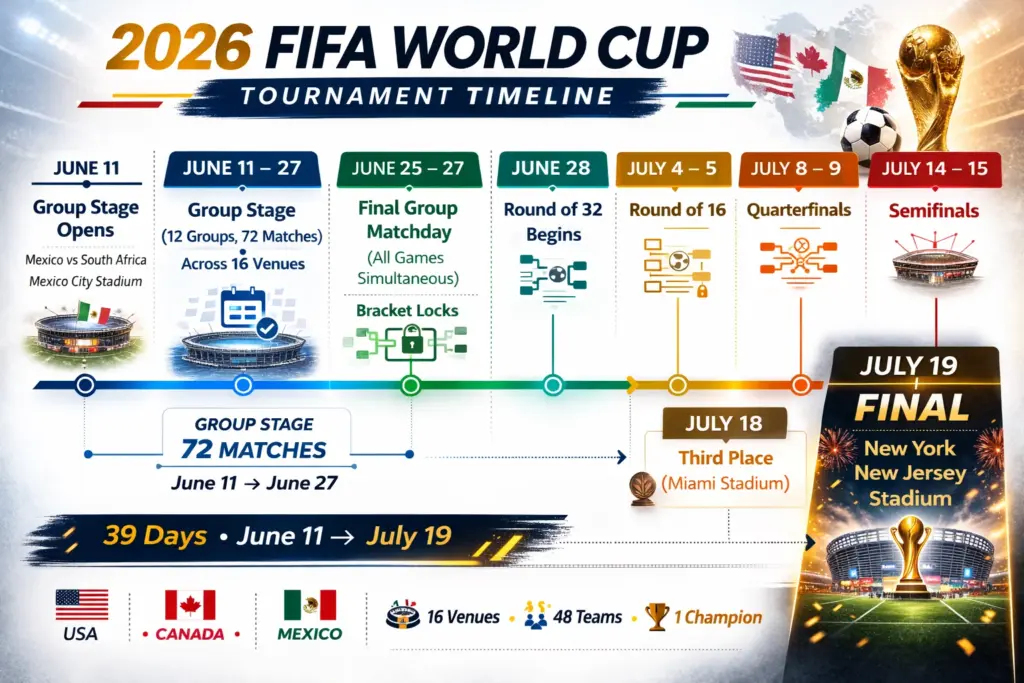
The 2026 World Cup group stage runs for 17 days, from the opening match to the final group games.
The group stage opens on June 11, 2026 with the tournament’s first match — Mexico vs South Africa at Mexico City Stadium.
The final group‑stage matchday runs from June 25 to June 27, 2026 — the three days when all remaining group games are completed simultaneously.
- Matchday 1 for all groups: June 11–15
- Matchday 2 for all groups: June 16–21
- Matchday 3 for all groups (simultaneous within each group): June 22–27
The Round of 32 begins June 28, 2026. The final is July 19, 2026 at New York New Jersey Stadium.
How the Group Stage Works – Rules and Format
Each group contains four teams. Every team plays every other team in its group exactly once — three games per team, resulting in six matches per group.
Points system:
- Win: 3 points
- Draw: 1 point each
- Loss: 0 points
Who advances:
- 1st and 2nd place in each group advance automatically to the Round of 32 (24 teams).
- 8 best third‑placed teams across all 12 groups also advance (ranked by points, goal difference, goals scored, fair play, FIFA ranking).
- The 4 worst third‑placed teams are eliminated.
Group tiebreakers (when teams are level on points within the same group):
If two or more teams finish level on points, the following criteria are applied in this order, as per the official FIFA 2026 regulations:
- Head‑to‑head points: Most points obtained in the matches played exclusively between the tied teams.
- Head‑to‑head goal difference: Superior goal difference in those matches.
- Head‑to‑head goals scored: Most goals scored in those matches.
If some, but not all, teams remain tied after applying these head‑to‑head criteria, the process reverts to the start and is applied exclusively to the subset of teams still tied.
If any tie still remains (or if the tie involves only two teams from the start), the following criteria are applied:
- Overall goal difference: Superior goal difference in all group matches.
- Overall goals scored: Most goals scored in all group matches.
- Fair play points: Highest team conduct score in all group matches (e.g., -1 point for a yellow card, -3 points for an indirect red card, -4 points for a direct red card).
- FIFA world ranking: Best position in the FIFA/Coca‑Cola Men’s World Ranking.
How the best third‑placed teams are determined:
- Points
- Goal difference
- Goals scored
- Fair play points
- FIFA world ranking
2026 World Cup Groups: Team Distribution by Confederation
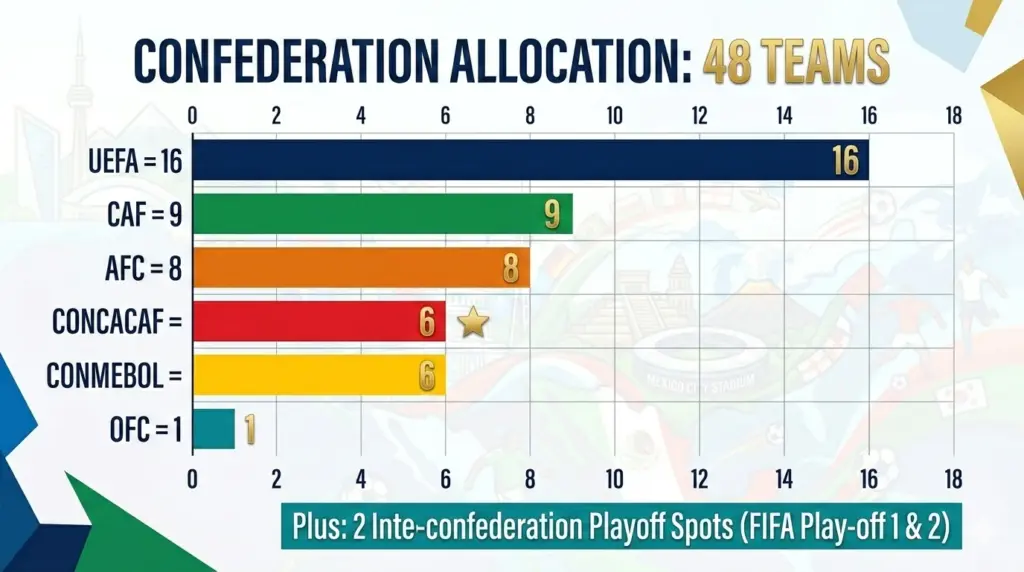
The 48‑team expansion required a significant reallocation of qualifying slots across all six confederations.
- UEFA (Europe): 16 teams
- CAF (Africa): 9 teams
- AFC (Asia): 8 teams
- CONCACAF (North/Central America & Caribbean): 6 teams (including hosts USA, Canada, Mexico)
- CONMEBOL (South America): 6 teams
- OFC (Oceania): 1 team (New Zealand)
- Inter‑confederation playoffs: 2 additional spots
2026 World Cup Groups: Venues Across North America
Games are spread across sixteen stadiums in the USA, Canada and Mexico. For the tournament, FIFA uses generic names for venues to avoid conflicts with commercial partners.
United States venues (11):
- Atlanta Stadium (Mercedes-Benz Stadium)
- Boston Stadium (Gillette Stadium)
- Dallas Stadium (AT&T Stadium)
- Houston Stadium (NRG Stadium)
- Kansas City Stadium (GEHA Field at Arrowhead Stadium)
- Los Angeles Stadium (SoFi Stadium)
- Miami Stadium (Hard Rock Stadium)
- New York New Jersey Stadium (MetLife Stadium)
- Philadelphia Stadium (Lincoln Financial Field)
- San Francisco Bay Area Stadium (Levi’s Stadium)
- Seattle Stadium (Lumen Field)
Canada venues (2):
- Toronto Stadium (BMO Field)
- Vancouver Stadium (BC Place)
Mexico venues (3):
- Mexico City Stadium (Estadio Azteca)
- Guadalajara Stadium (Estadio Akron)
- Monterrey Stadium (Estadio BBVA)
Must‑Watch Matches
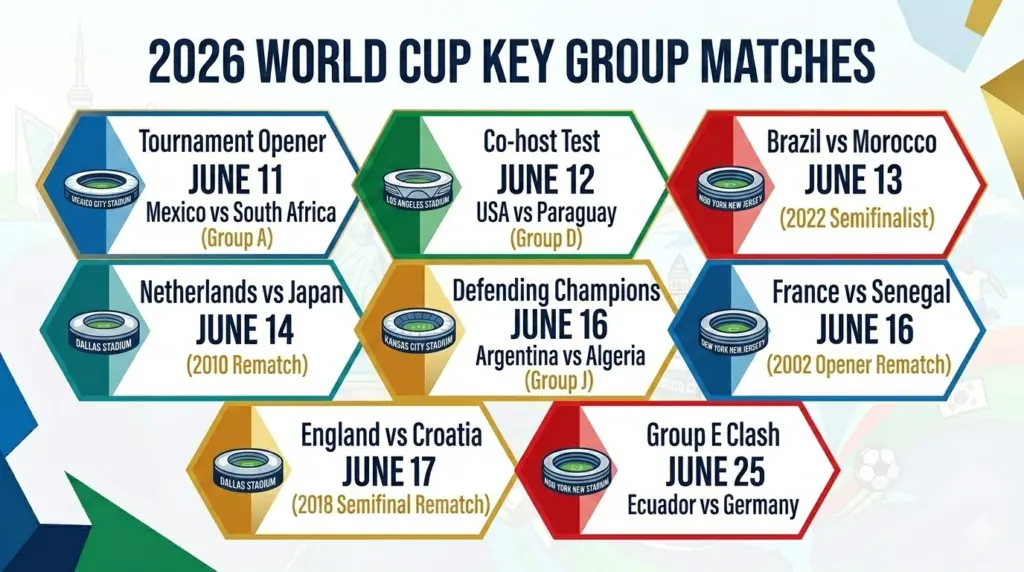
| Match | Group | Date | Venue | Why Watch? |
|---|---|---|---|---|
| Mexico vs South Africa | A | June 11 | Mexico City Stadium | Tournament Opener |
| USA vs Paraguay | D | June 12 | Los Angeles Stadium | Co‑host’s first test |
| Brazil vs Morocco | C | June 13 | New York New Jersey Stadium | 2022 semifinalist Morocco vs five‑time champion Brazil |
| Netherlands vs Japan | F | June 14 | Dallas Stadium | 2010 World Cup group‑stage rematch |
| Argentina vs Algeria | J | June 16 | Kansas City Stadium | Defending champions begin campaign |
| England vs Croatia | L | June 17 | Dallas Stadium | 2018 World Cup semi‑final rematch |
| France vs Senegal | I | June 16 | New York New Jersey Stadium | 2002 World Cup opener rematch |
| Ecuador vs Germany | E | June 25 | New York New Jersey Stadium | Decisive Group E clash |
Frequently Asked Questions
How many groups are there in the 2026 World Cup?
Twelve. The groups are labelled Group A through Group L.
How many teams are in each group?
Four teams per group, across all twelve groups.
How many group stage matches are there?
There are 72 matches in the group stage, as each of the 12 groups plays 6 matches.
How many teams qualify from each group?
The top two teams from each group qualify automatically. Additionally, the eight best third‑placed teams from across all twelve groups also advance — making 32 teams in the Round of 32.
When does the 2026 World Cup group stage start?
June 11, 2026, with the opening match at Mexico City Stadium.
When does the group stage end?
June 27, 2026.
Why does the World Cup have 12 groups now instead of 8?
Because the tournament expanded from 32 to 48 teams. Twelve groups of four was chosen over sixteen groups of three to avoid short group stages and dead‑rubber matches.
What happens to the third‑placed teams?
All 12 third‑placed teams are ranked together. The 8 best advance to the Round of 32. The 4 worst are eliminated.
When will all 48 teams be confirmed?
The final six teams will be determined by the UEFA and inter‑confederation playoffs. The FIFA Play‑Off Tournament finals are scheduled for March 31, 2026, meaning the full lineup will be confirmed on that date.
Has the World Cup had 12 groups before?
No. This is the first time.
Common Misconceptions
“Third place always means elimination.”
Not at this World Cup. Eight third‑placed teams advance.
“There are 16 groups.”
No. The confirmed format is 12 groups of 4.
“Every third‑placed team advances.”
No — only the 8 best.
“Groups go from A to P.”
No — groups go from A to L.
Key Takeaways
Twelve groups. Forty‑eight teams. Three host countries. The 2026 World Cup group stage is the biggest in the tournament’s history — and the most complex to follow, track and understand. With 72 group‑stage matches and a new third‑placed team rule, results in one group directly affect outcomes in others, tying all twelve groups together in a way that previous World Cups never did.
From June 11 to June 27, 2026, the group stage will produce 72 matches, eliminate 16 teams, advance 32, and almost certainly generate moments of drama — tiebreakers decided by a single yellow card, goals scored in injury time that change who goes home — that define the tournament’s narrative before the knockout stage even begins.


