

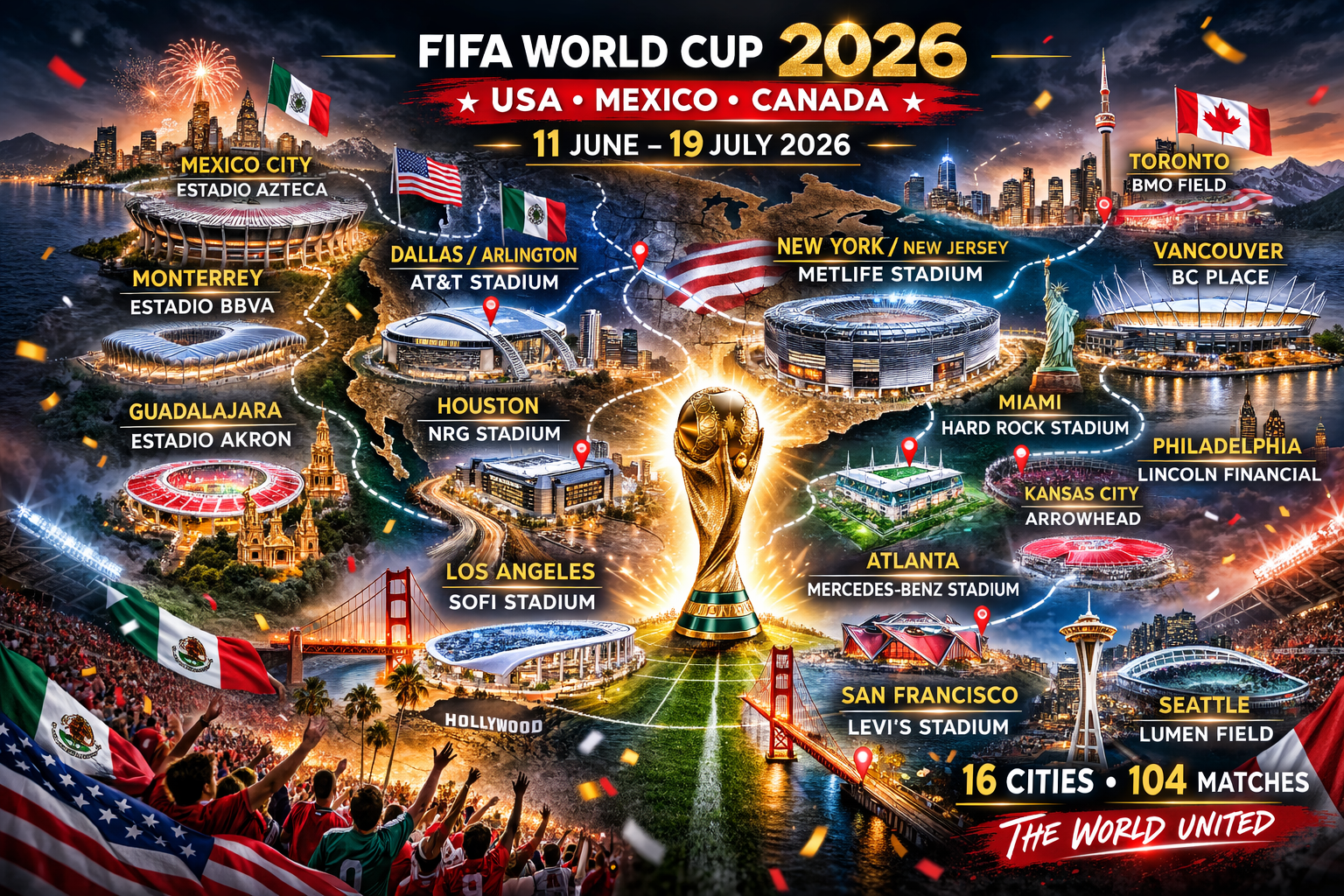
2026 World Cup Stadiums span three countries and 16 host cities — from Vancouver in Canada’s Pacific Northwest to Miami on Florida’s southern tip. That’s a geographic spread of roughly 3,500 miles, making 2026 the most wide-ranging World Cup ever in terms of distance covered.
This guide breaks down every stadium and host city, explains where matches are played, and highlights what makes each venue worth knowing — whether you’re planning to attend in person or following along from home.
TL;DR
- 16 host cities, 16 stadiums: 11 in the USA, 3 in Mexico, 2 in Canada
- Three geographic regions: Western, Central, Eastern
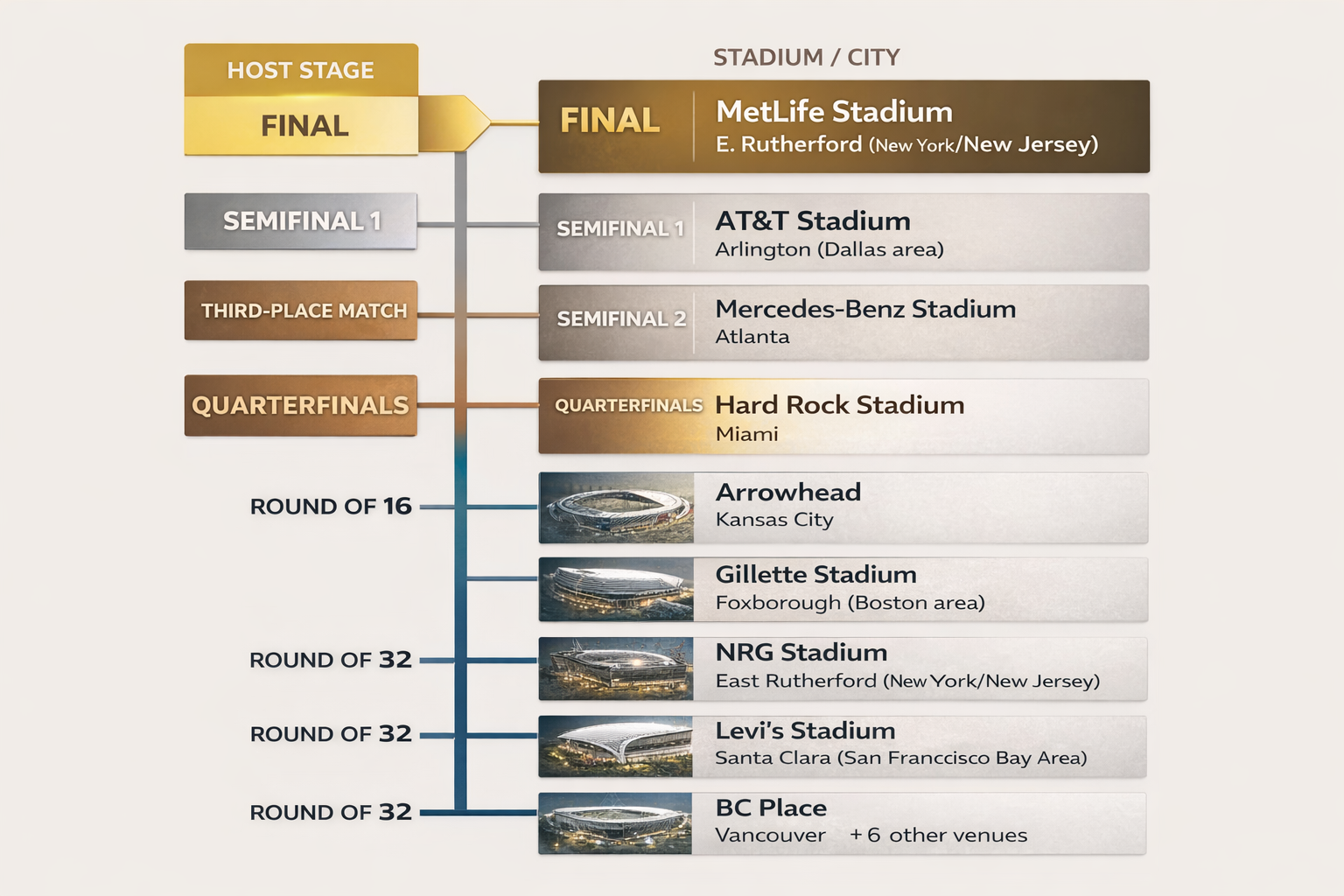
- Dallas Stadium hosts the most matches — 9 total, including a semifinal
- New York New Jersey Stadium hosts the Final on July 19, 2026
- Mexico City Stadium hosts the opening match and makes history as the first stadium at three separate World Cups
- Guadalajara Stadium is the only venue with no knockout matches
- USA hosts all matches from the quarterfinal stage onward
- FIFA requires 40,000+ capacity for group games; 80,000+ for the opening match and Final
SNIPPET BLOCK
The 2026 FIFA World Cup is played across 16 stadiums in 16 host cities: 11 in the United States, 3 in Mexico, and 2 in Canada. The Dallas venue hosts the most matches (9), including a semifinal. The New York New Jersey Stadium hosts the Final on July 19. The tournament’s opening match takes place at the historic Mexico City Stadium on June 11.
The Three Regions — How the Tournament Is Organised Geographically
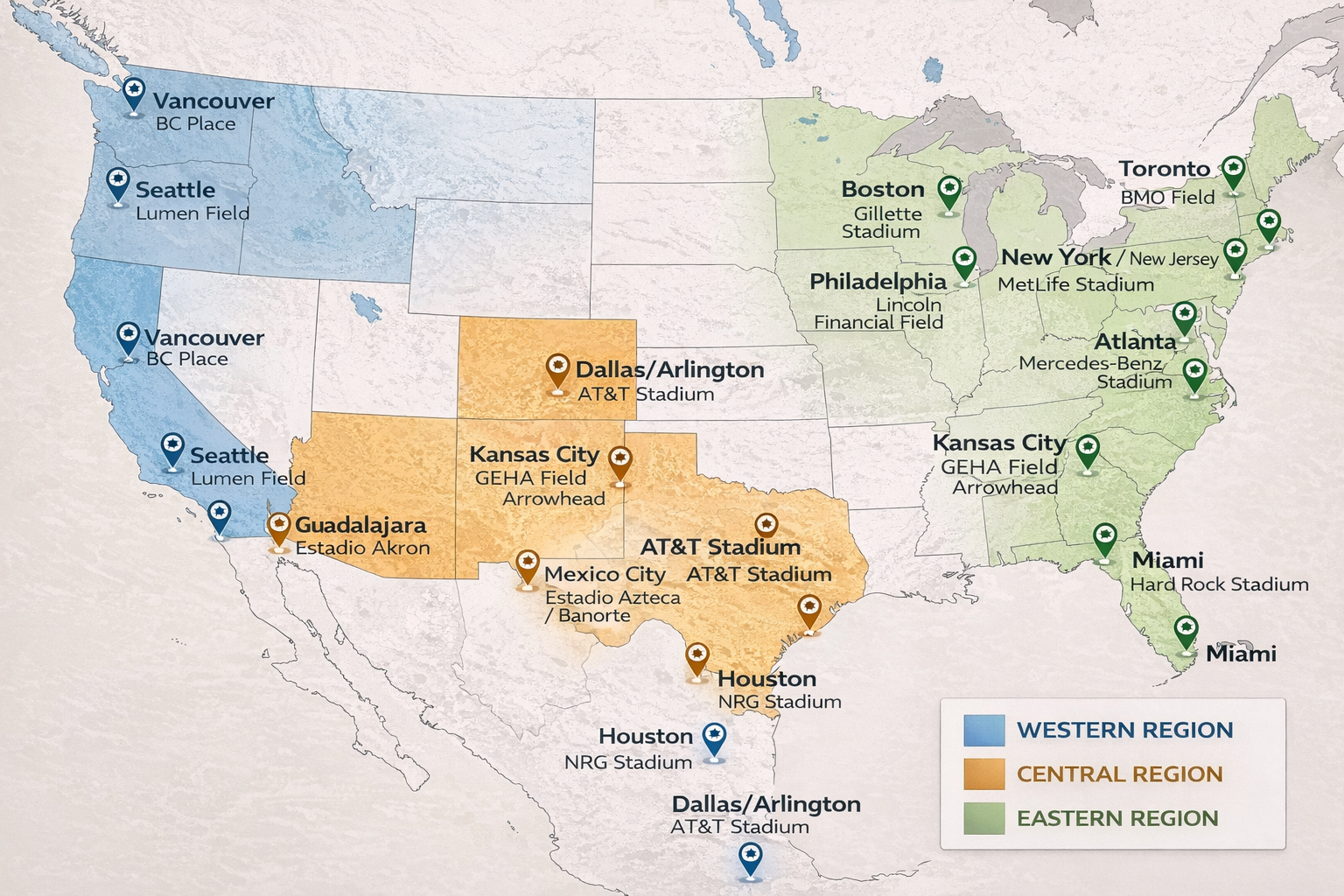
FIFA divided the 16 host cities into three geographic regions for scheduling purposes. This reduces travel distances for teams and fans during the group stage. To further minimize fatigue, FIFA has implemented “Regional Pods,” where teams stay within their specific cluster (West, Central, or East) for the duration of the group phase.
| Region | Cities | Matches Hosted |
| Western | Vancouver, Seattle, San Francisco Bay Area, Los Angeles | 26 |
| Central | Guadalajara, Mexico City, Monterrey, Houston, Dallas, Kansas City | 40 |
| Eastern | Toronto, Boston, Philadelphia, New York/NJ, Atlanta, Miami | 38 |
Each host nation plays all three of its group stage matches within its own country — USA games in US venues, Canada games in Canadian venues, Mexico games in Mexican venues.
FIFA Stadium Capacity Rules — Why Not Every City Hosts the Final
Before diving into each venue, it helps to understand why FIFA assigned certain stages to certain stadiums. The requirements are strict:
| Match Stage | Minimum Required Capacity |
| Group stage | 40,000 |
| Round of 32, Round of 16 | 40,000 |
| Quarterfinals | 60,000 |
| Opening match | 80,000 |
| Final | 80,000 |
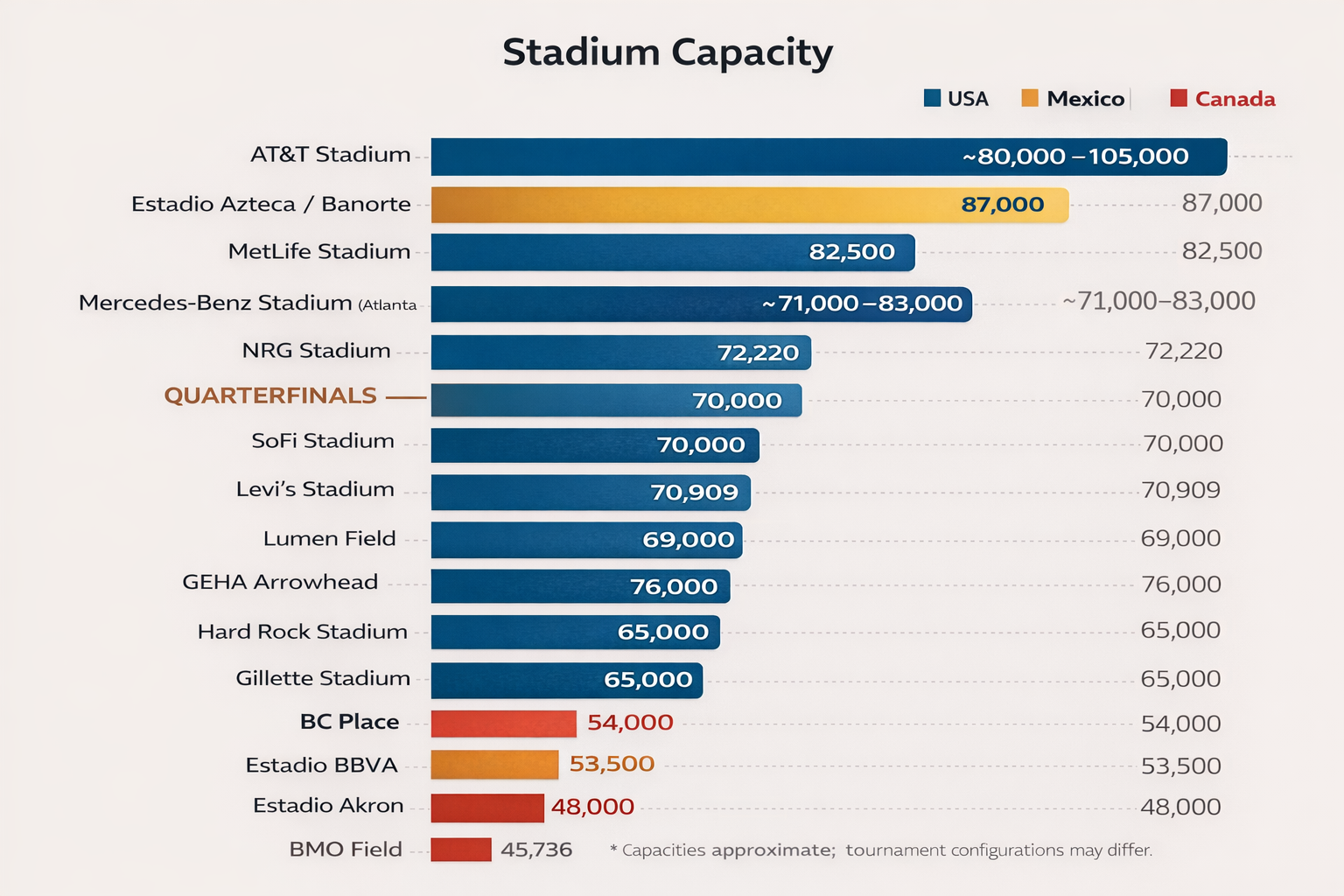
This is why smaller venues like Toronto Stadium (45,736) and Guadalajara Stadium (48,000) are limited to group stage fixtures. It is not a reflection of the city’s importance — it is simply a matter of physical capacity. Only venues meeting the 80,000-minimum were in consideration for the opening match and the Final.
All 16 Venues: The Complete Breakdown
MEXICO (3 Stadiums, 13 Matches)
Mexico City Stadium (Estadio Azteca)
- Capacity: ~83,000–87,000
- FIFA Official Name: Mexico City Stadium
- 2026 Matches: Opening match (June 11) + Mexico group matches + Round of 32 + Round of 16
- Biggest Match: Match 1: Mexico vs. South Africa, June 11, 2026
- History: The first stadium ever to host three separate World Cups. It was here that Pelé (1970) and Maradona (1986) lifted the trophy.
Monterrey Stadium (Estadio BBVA)
- Capacity: ~53,500
- FIFA Official Name: Estadio Monterrey
- Biggest Match: Match 75: Round of 32
- Note: Set against the Sierra Madre mountains, it offers the most scenic backdrop in Mexico. It will host the 1,000th match in World Cup history (Tunisia vs. Japan) on June 20.
Guadalajara Stadium (Estadio Akron)
- Capacity: ~48,000
- FIFA Official Name: Estadio Guadalajara
- Matches: Group stage only (no knockout fixtures)
- Note: Known as “El Volcán” for its volcanic crater design. It is the only 2026 venue without a knockout game.
CANADA (2 Stadiums, 13 Matches)
Vancouver Stadium (BC Place)
- Capacity: ~54,000
- FIFA Official Name: BC Place Vancouver
- Biggest Match: Match 96: Round of 16
- Note: Features a state-of-the-art retractable roof, making it immune to Vancouver’s rainy weather.
Toronto Stadium (BMO Field)
- Capacity: ~45,736 (Includes 17k temporary seats)
- FIFA Official Name: Toronto Stadium
- Biggest Match: Match 3: Canada vs. UEFA Playoff A Winner, June 12, 2026
- Note: The smallest venue in the tournament, though $146 million in renovations have added temporary grandstands to meet FIFA standards.
UNITED STATES (11 Stadiums, 78 Matches)
Dallas Stadium (AT&T Stadium)
- Capacity: ~80,000–90,000
- FIFA Official Name: Dallas Stadium
- 2026 Matches: 9 — the most of any venue
- Biggest Match: Match 101: Semifinal, July 14, 2026
- Note: Climate-controlled to manage the Texas summer. Hosts marquee group matches like England vs. Croatia (June 17) and Netherlands vs. Japan (June 14).
New York New Jersey Stadium (MetLife Stadium)
- Capacity: ~82,500
- FIFA Official Name: New York New Jersey Stadium
- Biggest Match: Match 104: THE FINAL, July 19, 2026
- Note: Located in East Rutherford, New Jersey. It is currently undergoing a “debranding” process to remove all commercial signage per FIFA regulations.
Atlanta Stadium (Mercedes-Benz Stadium)
- Capacity: ~71,000–83,000
- FIFA Official Name: Atlanta Stadium
- Biggest Match: Match 102: Semifinal, July 15, 2026
- Note: Features a retractable petal-roof. It will host Spain vs. Cabo Verde on June 15.
Miami Stadium (Hard Rock Stadium)
- Capacity: ~65,000
- FIFA Official Name: Miami Stadium
- Biggest Match: Match 103: Third-Place Match, July 18, 2026
- Note: Pack your hydration: Miami’s July humidity is a serious factor for players and fans alike. Brazil vs. Haiti (June 19) is a highlight here.
Kansas City Stadium (Arrowhead Stadium)
- Capacity: ~76,000
- FIFA Official Name: Kansas City Stadium
- Biggest Match: Match 100: Quarterfinal, July 11, 2026
- Highlight: Hosts Argentina vs. Algeria (June 16). Known as the loudest outdoor stadium on earth.
Los Angeles Stadium (SoFi Stadium)
- Capacity: ~70,000
- FIFA Official Name: Los Angeles Stadium
- Biggest Match: Match 98: Quarterfinal, July 10, 2026
- Note: The most expensive stadium ever built ($5.5 billion). It hosts the USA’s opening match against Paraguay on June 12.
Quick-Reference: All 16 Venues at a Glance
| FIFA Official Name | Host City | Country | Capacity | Biggest Stage |
| Dallas Stadium | Arlington | USA | ~80–90K | Semifinal |
| New York New Jersey Stadium | E. Rutherford | USA | ~82,500 | FINAL |
| Atlanta Stadium | Atlanta | USA | ~71–83K | Semifinal |
| Mexico City Stadium | Mexico City | Mexico | ~83–87K | Opening Match |
| Kansas City Stadium | Kansas City | USA | ~76K | Quarterfinal |
| Houston Stadium | Houston | USA | ~72,220 | Round of 16 |
| San Francisco Bay Area Stadium | Santa Clara | USA | ~70,909 | Round of 32 |
| Los Angeles Stadium | Inglewood | USA | ~70,000 | Quarterfinal |
| Philadelphia Stadium | Philadelphia | USA | ~69,796 | Round of 16 |
| Seattle Stadium | Seattle | USA | ~69,000 | Round of 32 |
| Miami Stadium | Miami | USA | ~65,000 | 3rd-Place Match |
| Boston Stadium | Foxborough | USA | ~65,000 | Quarterfinal |
| BC Place Vancouver | Vancouver | Canada | ~54,000 | Round of 16 |
| Estadio Monterrey | Monterrey | Mexico | ~53,500 | Round of 32 |
| Estadio Guadalajara | Guadalajara | Mexico | ~48,000 | Group Stage Only |
| Toronto Stadium | Toronto | Canada | ~45,736 | Round of 32 |
Common Myths — Corrected
- “The Final is in New York”: It is physically in New Jersey. Fans should book hotels in the Jersey City or Hoboken area to avoid cross-river traffic on match day.
- “Estadio Azteca is unchanged”: The stadium has been renamed Estadio Banorte commercially, but FIFA will refer to it simply as Mexico City Stadium.
- “All 16 host cities get knockout matches”: False. Guadalajara Stadium’s capacity is too low for FIFA’s knockout stage requirements.
- “The USA is building new stadiums”: Mostly false. All venues are existing, though many have widened their pitches and removed thousands of commercial signs.
FAQs: Everything You’re Wondering About the Venues
How many stadiums are there at the 2026 World Cup?
16 stadiums across 16 host cities — 11 in the USA, 3 in Mexico, and 2 in Canada.
Which stadium hosts the 2026 World Cup Final?
New York New Jersey Stadium (MetLife) in East Rutherford, New Jersey, on July 19, 2026.
Where is the 2026 World Cup opening match?
Mexico City Stadium (Estadio Azteca) in Mexico City on June 11, 2026.
Which 2026 World Cup venue has no knockout matches?
Estadio Guadalajara (Estadio Akron) in Mexico. It is limited to group stage matches only.
Is Toronto Stadium really that small?
Normally yes, but temporary seating has expanded it to 45,736 to meet the FIFA minimum.


