

The offside rule is one of football’s oldest laws. It is also one of its most argued about — in living rooms, in stadiums, on social media, and now in VAR review rooms equipped with cameras tracking 29 points on every player’s body 50 times per second.
If you have ever watched a goal celebration turn to silence and wondered what just happened, this guide is for you.
By the end you will understand exactly what offside is, when it applies and when it does not, how semi-automated technology has changed decisions forever, and what the rule might look like in the near future — including the proposal that could reshape attacking football entirely.
TL;DR
- Core rule: Any part of a player’s head, body, or feet nearer to the opponents’ goal line than both the ball and the second-last opponent at the moment the ball is played = offside position.
- Arms do not count: Hands and arms are excluded from all offside calculations for all players.
- Level = onside: Exactly level with the second-last defender is not offside — this has been the law since 1990.
- Three exceptions: Offside cannot be called from goal kicks, corner kicks, or throw-ins.
- Technology at 2026: Semi-Automated Offside Technology (SAOT) — 12 dedicated cameras, 29 body data points, tracked 50 times per second, producing a 3D ruling in approximately 25 seconds.
- The Wenger Proposal: A rule change that would only penalise an attacker if their entire body is ahead of the last defender — under active discussion but NOT adopted for 2026.
SNIPPET BLOCK
Under IFAB Law 11, a player is offside when any part of their head, body, or feet is closer to the opponents’ goal line than both the ball and the second-last opponent at the moment a teammate plays the ball — and they then become actively involved in play. Arms and hands are excluded entirely. Being exactly level with the last outfield defender is onside. Offside cannot be called from a goal kick, corner kick, or throw-in. At the 2026 World Cup, all offside decisions will be supported by Semi-Automated Offside Technology (SAOT), generating a 3D ruling in approximately 25 seconds.
Offside Rule, what it is? The Direct Answer
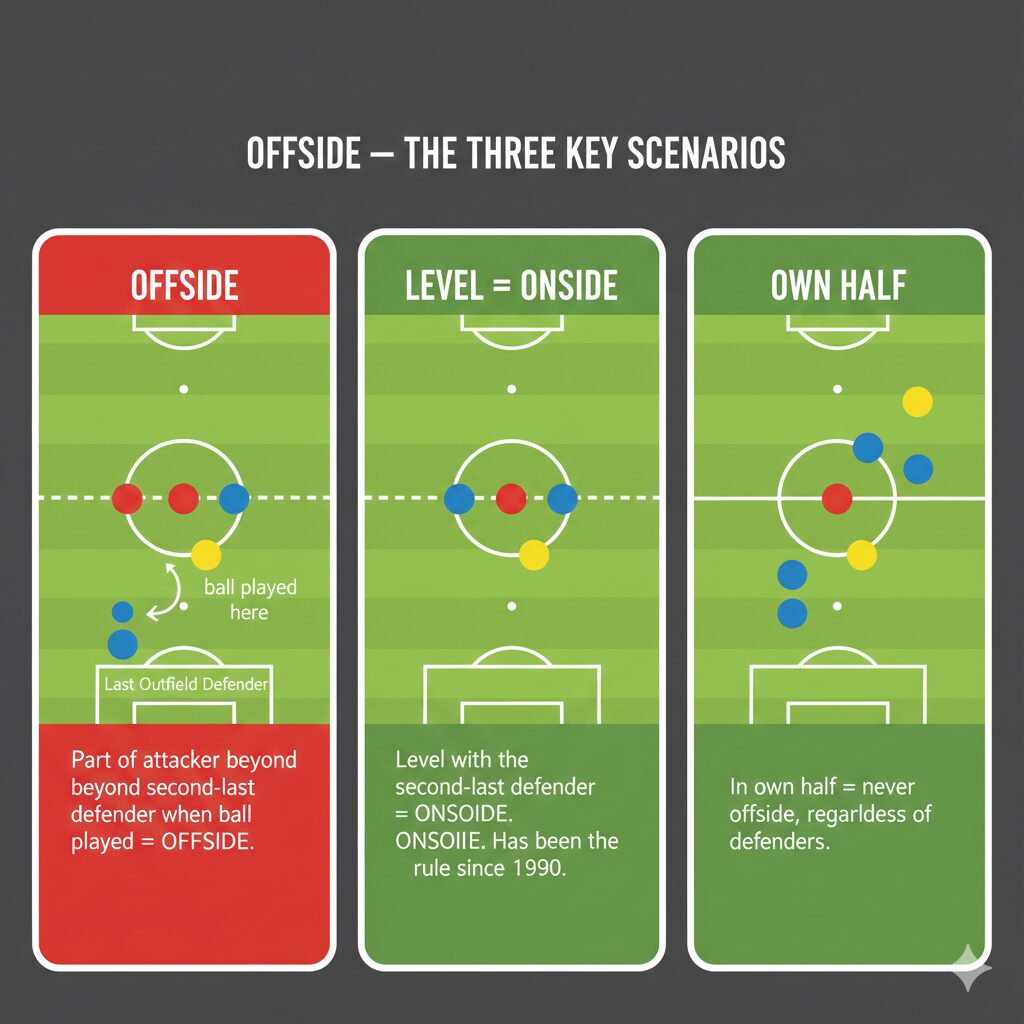
A player is in an offside position if any part of their head, body, or feet is nearer to the opponents’ goal line than both the ball AND the second-last opponent at the exact moment the ball is played by a teammate.
That is the rule in one sentence. Everything else is context, nuance, or exception.
Three conditions must all be true at once for an offside offence to be given:
1) Position: The player must be in the opponents’ half of the pitch. A player in their own half can never be offside, regardless of where the defenders are standing.
2) Depth: Some part of their head, body, or feet must be beyond the second-last opponent — meaning further toward the opponents’ goal than that defender’s position.
3) Involvement: They must become actively involved in play — by receiving the ball, interfering with an opponent, or gaining an advantage from their position.
If all three conditions are met, the referee awards an indirect free kick to the defending team, taken from the spot where the offside player was when the ball was played.
The one word that changes everything: “moment.”
The offside position is judged at the exact moment the ball leaves the foot (or head, or any body part) of the teammate making the pass — not when the attacker receives it. A striker can be perfectly onside when the ball is kicked, sprint past the last defender, and receive the pass entirely legally. The question is always: where were they the instant the ball was played?
The Five Most Common Offside Misunderstandings
Many people watch football for years and still get these wrong. Here is where the confusion comes from — and what the law actually says.
Misunderstanding 1: “The goalkeeper doesn’t count for offside.”
The goalkeeper absolutely counts — but the terminology is what confuses people. The rule refers to the “second-last opponent.” In almost every normal situation, the goalkeeper is the deepest player on the pitch (the last defender), so the second-last opponent is the deepest outfield defender. That is the player whose position the attacker must stay behind or level with. If the goalkeeper is off their line and no longer the deepest player, the calculation still works the same way — whoever the second-deepest opposition player is becomes the reference point.
Misunderstanding 2: “If a defender’s arm is further back, the attacker is onside.”
False — and the reverse is equally true. Arms and hands are completely excluded from offside calculations for every player, attackers and defenders alike. It does not matter where anyone’s arms are. Only head, body, and feet count. IFAB updated the Laws of the Game in 2017/18 to make this completely explicit: “The hands and arms of all players, including the goalkeepers, are not considered.”
This clarification was necessary because the previous wording left room for ambiguity. It is now unambiguous.
Misunderstanding 3: “If a defender plays the ball to the attacker, there’s no offside.”
Mostly correct — but with a critical exception introduced by IFAB in 2022.
If an attacker in an offside position receives the ball from an opponent who deliberately plays it — a controlled pass back, a goalkeeper’s throw, an intentional header — they are not offside. The deliberate play resets the situation.
However, a deflection does not count as a deliberate play. If a ball clips a defender at close range without them having the time or intention to control it, and an attacker in an offside position benefits, the offside stands. The distinction between “deliberate play” and “deflection” is a matter of referee judgement — and it remains one of the most argued-over calls in the game.
Misunderstanding 4: “You can’t be offside if you don’t touch the ball.”
You can be offside without touching the ball if you interfere with an opponent. Law 11 defines this as “clearly obstructing the opponent’s line of vision” or “making a gesture or movement which, in the opinion of the referee, deceives or distracts an opponent.”
In practice, referees only call this when the obstruction is unambiguous — a striker running into the goalkeeper’s line of sight as a shot arrives, for example. Unclear situations are not penalised.
Misunderstanding 5: “You can be offside from a corner kick.”
Completely false. You cannot be offside directly from a corner kick, goal kick, or throw-in. A striker can stand on the goal line during a corner — it makes no difference. Once play resumes and another touch occurs, normal offside rules apply from that moment onward.
Three Situations Where Offside Never Applies
These are absolute rules with no exceptions:
Goal kicks: No attacker can be penalised for an offside position while the ball is in play from a goal kick, regardless of how far they are up the pitch.
Corner kicks: An attacker can stand anywhere on the pitch when a corner is taken. No offside can be called directly from the corner.
Throw-ins: The same applies to throw-ins by either team.
Why do these exceptions exist? In all three cases, the defending team has full possession or a controlled restart. Requiring them to track offside positions at these moments would create an unfair additional burden and would complicate restarts unnecessarily. The exceptions have been part of the game for over a century.
How the Offside Decision Is Made: From Match to Monitor
Before technology, the process was simple: the assistant referee (linesman) tracked the line of the second-last defender, watched the moment the ball was played, and either raised the flag or kept it down. Simple in theory — extremely difficult in practice, especially when an attacker’s shoulder is the part of the body being judged.
At the 2026 World Cup, that human judgement is supported by Semi-Automated Offside Technology (SAOT), which has been used at every major FIFA and UEFA competition since Qatar 2022.
Here is the step-by-step process:
Step 1 — Dedicated tracking cameras activated. Twelve cameras positioned around the stadium track all players’ movements continuously. These are separate from the broadcast cameras.
Step 2 — 29 body data points per player, 50 times per second. The system tracks 29 specific skeletal points on each player’s body — including the tips of both feet, knees, hips, shoulders, elbows, and the top of the head — and records their exact position 50 times every second.
Step 3 — The ball tracking layer. The match ball contains an inertial measurement unit (IMU) — a small sensor that transmits the ball’s exact position 500 times per second. This allows the system to identify the precise moment the ball is kicked.
Step 4 — Position capture at the moment of the kick. The instant the IMU detects the kick, the system captures the exact position of every tracked player. This freeze-frame position is what determines offside — not the assistant referee’s eye.
Step 5 — Automatic flag and alert. If the system detects an attacker in an offside position, it sends an automatic alert to the VAR team. Crucially, the assistant referee is instructed to keep their flag down at this point — the flag only goes up after VAR review confirms the offside, preventing incorrect calls from stopping play unnecessarily.
Step 6 — 3D animation generated. The SAOT system generates a three-dimensional animation of the offside moment — showing the exact body positions of all relevant players at the precise millisecond the ball was played. This animation, which takes approximately 25 seconds to produce, is shown on stadium screens to explain the decision to fans inside the ground.
The impact on decision-making: Before SAOT, marginal offsides involving fingertips, armpits, or collar bones required frame-by-frame video review by the VAR team — a process that could take several minutes and still carry uncertainty because it relied on camera angles and approximations. SAOT removes that uncertainty by providing actual spatial data rather than image interpretation.

The Offside Rule Through History: How We Got Here
The rule has changed dramatically since football was first codified. Understanding the history explains why certain modern provisions exist.
1863 — The original FA rules. A player was offside if fewer than three opponents were between them and the goal when the ball was played. This made attacking football extremely difficult.
1925 — The two-defender rule. The threshold was reduced from three defenders to two. Immediately, goal scoring across the Football League increased dramatically — from an average of approximately 2.5 goals per game to more than 3.5 in the following seasons.
1990 — Level is onside. Before 1990, a player level with the last defender was offside. The rule was changed so that a player level with the second-last opponent is considered onside. This was a significant shift in favor of attackers.
2005 — The “daylight” guidance. FIFA guidance clarified that assistant referees should use “daylight” between players as a practical visual test — if there is no visible gap between attacker and defender, do not raise the flag. This was informal guidance, not a law change, but it influenced how marginal calls were made.
2017-18 — Arms and hands clarified. IFAB updated Law 11 to explicitly state that hands and arms are excluded from offside calculations.
2022 — Deflection exception introduced. IFAB clarified that a deflection off a defender does not count as a deliberate play and does not reset the offside position.
2022 — SAOT introduced at World Cup. Semi-Automated Offside Technology was first used at a World Cup at Qatar 2022, having been tested in the 2021-22 UEFA Champions League final stages.
The Wenger Proposal: The Rule Change Being Debated Right Now
Arsène Wenger, FIFA’s Chief of Global Football Development, has been publicly advocating for a fundamental change to the offside law since 2020. The proposal is now commonly called the Wenger Law or the Whole Body Rule.
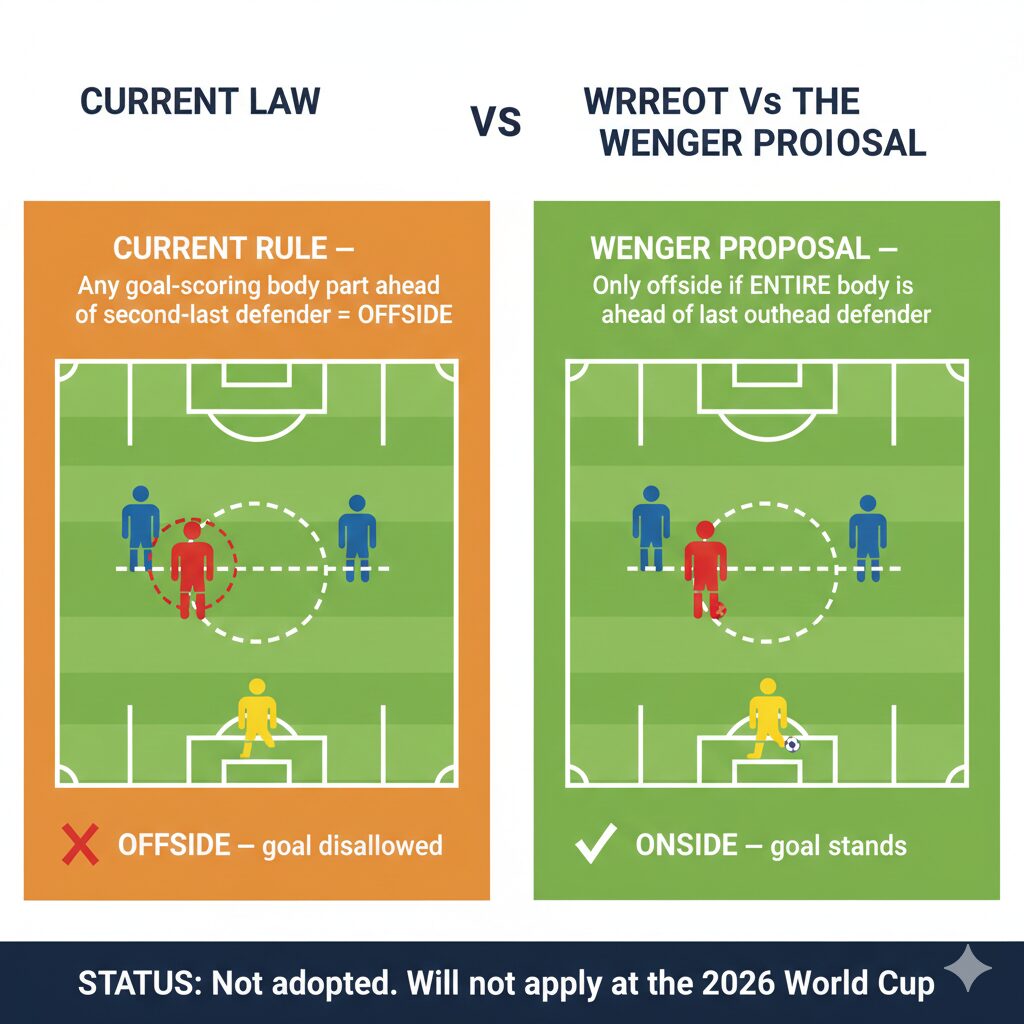
What it proposes: Under current law, an attacker is offside if any part of a goal-scoring body part is ahead of the second-last defender. Under the Wenger proposal, an attacker would only be offside if their entire body is ahead of the last outfield defender — meaning they would be onside if any part of them is behind or level with the defender.
In plain language: A shoulder, a toe, a knee ahead of the defender currently = offside. Under the new rule: that same shoulder, toe, or knee = onside.
The intended effect: Goals disallowed by marginal fractions of centimetres would instead stand. The attacking team would get the benefit of any doubt. Overall goal rates would increase. The 25-second wait for SAOT animations would become less common because fewer decisions would result in offside.
The arguments in favour:
- Marginal centimetre-level offsides undermine the spirit of the rule, which was designed to prevent goal-hanging, not to disallow legitimate attacking runs.
- Attackers who make good forward runs and time them correctly deserve the benefit of any marginal call.
- The technology that enabled greater precision in detection has also exposed how arbitrary centimeter-level decisions can feel.
The arguments against:
- Defenders would lose a clear spatial reference — they currently know they need to keep any part of the attacker behind them; the new rule makes that calculation harder to judge in real time
- It could encourage passive defending — if attackers are only penalised when completely clear, defenders might stop pushing their line up aggressively, reducing the tactical tension that makes the offside trap a legitimate strategy.
- The law change would require significant re-education of referees, coaches, and fans globally
Current status: IFAB has discussed the proposal at multiple annual general meetings. As of February 2026, the Wenger Law has not been adopted and will not be in place at the 2026 World Cup. Trials in lower-level competitions have been mentioned as a potential pathway but no formal trial has been officially confirmed for a major competition.
The 2026 World Cup offside law remains the existing Law 11 in its current form.
Offside at the 2026 World Cup: What to Watch For
Now that you understand the law and the technology, here are the specific scenarios most likely to generate controversy during the tournament.
1) The 48-team format means more matches and more offside moments. The 2026 World Cup features 104 matches — 40 more than Qatar 2022. More matches mean more offside decisions, more SAOT animations on stadium screens, and more controversy. Expect the 25-second wait to become a familiar part of the viewing experience. [Post #4 — Format & Rules]
2) The overlapping defender and the new deflection rule. Any time a pass intended for an attacker is deflected off a defender — rather than deliberately played — the SAOT system and VAR team must make the “deliberate vs deflection” call. In a tournament of 104 matches, this will happen repeatedly. Watch for disputes about whether a defender had time to control the ball or was simply reacting.
3) Goalkeeper position edge cases. If a goalkeeper commits to an attacking set piece and moves high up the pitch — common in desperate late-game situations — the second-last defender becomes an outfield player, potentially leaving a very high defensive line. An attacker behind even one outfield defender in these moments can be in a legally onside position that looks wrong visually. Knowing the rule prevents confusion.
4) The 25-second SAOT animation on stadium screens. FIFA confirmed that every offside decision reviewed by SAOT will be displayed as a 3D animation on the stadium screen during the review period. This is designed to explain decisions to fans inside the ground — but it also means every close call is immediately visible to hundreds of millions of television viewers globally. The transparency is new. Expect it to generate both appreciation and debate.
5) Trap goals against the host nations. When the USA, Canada, and Mexico play on home soil, any disallowed goal against them will generate enormous media response. Understanding the offside law means you can evaluate those decisions on their merit rather than reacting to the noise.
Decision Framework: How to Judge an Offside in Real Time
When a flag goes up or a VAR review is triggered, use this sequence to assess the decision yourself:
Step 1 — When was the ball played? Everything depends on the moment of the kick. Look at where the attacker was at that exact moment — not where they ended up when they received the ball.
Step 2 — Which body part? Arms and hands do not count. Is the part of the body that appears ahead of the defender a foot, knee, hip, shoulder, or head? If yes, it counts. If it is only an arm, it does not.
Step 3 — Who is the second-last opponent? Identify the goalkeeper (usually the last defender) and the deepest outfield defender. That outfield defender is the reference line.
Step 4 — Is the attacker level or ahead? Level = onside. Any goal-scoring body part ahead = offside position.
Step 5 — Were they involved in play? If they were in an offside position but another attacker received the ball and scored, the offside attacker’s position only matters if they interfered with an opponent or gained an advantage. Pure non-involvement = no offside offence even if the position was technically offside.
Common mistake to avoid: Watching where the ball lands, rather than where the attacker was when it was kicked. The ball travels — the attacker’s position at kick-time is what counts.
FAQs: The Offside Rule
What is the basic offside rule in football?
A player is offside if any part of their head, body, or feet is closer to the opponents’ goal line than both the ball and the second-last opponent at the exact moment a teammate plays the ball to them — and they then become actively involved in play. Arms and hands do not count.
Can you be offside in your own half?
No. A player in their own half of the pitch cannot be in an offside position under any circumstances, regardless of where the defenders are standing.
What does “second-last opponent” mean?
It means the second-deepest opposition player on the pitch. In normal play this is the last outfield defender, because the goalkeeper is typically the deepest (last) player. The attacker must stay behind or level with that second-last opponent.
Is a player offside if they are level with the defender?
No. Being exactly level with the second-last opponent is onside. The attacker must be ahead — not level — to be in an offside position. This rule has been in place since 1990.
Do arms count for offside?
No. Hands and arms are completely excluded from offside calculations for all players, including the goalkeeper. This was clarified explicitly in the Laws of the Game in 2017/18.
Can you be offside from a corner kick?
No. Offside cannot be called directly from a corner kick, goal kick, or throw-in. These are the three permanent exceptions to the offside law.
What happens when a defender accidentally deflects the ball to an offside attacker?
As of 2022, a deflection is not treated the same as a deliberate play. If the deflection is unintentional — the ball rebounds off a defender without them controlling it — an attacker who benefits from the deflection while in an offside position is still offside. The deliberate play reset only applies when the defender intentionally plays the ball.
How does SAOT (Semi-Automated Offside Technology) work?
SAOT uses 12 dedicated cameras and tracks 29 body data points on each player 50 times per second. A sensor in the match ball transmits its position 500 times per second. At the moment the ball is kicked, the system captures all player positions and automatically alerts VAR if an attacker is in an offside position. A 3D animation is generated in approximately 25 seconds and shown on stadium screens.
What is the Wenger Proposal for offside?
Proposed by Arsène Wenger (FIFA’s Chief of Global Football Development), the Wenger Proposal — also called the Whole Body Rule — would only penalize an attacker if their entire body is ahead of the last outfield defender. Under the current rule, any goal-scoring body part ahead of the defender is enough. The proposal is under discussion but has not been adopted and will not apply at the 2026 World Cup.
What is the result of an offside offence?
An indirect free kick is awarded to the defending team, taken from the position where the offside player was when the ball was played by their teammate.


